




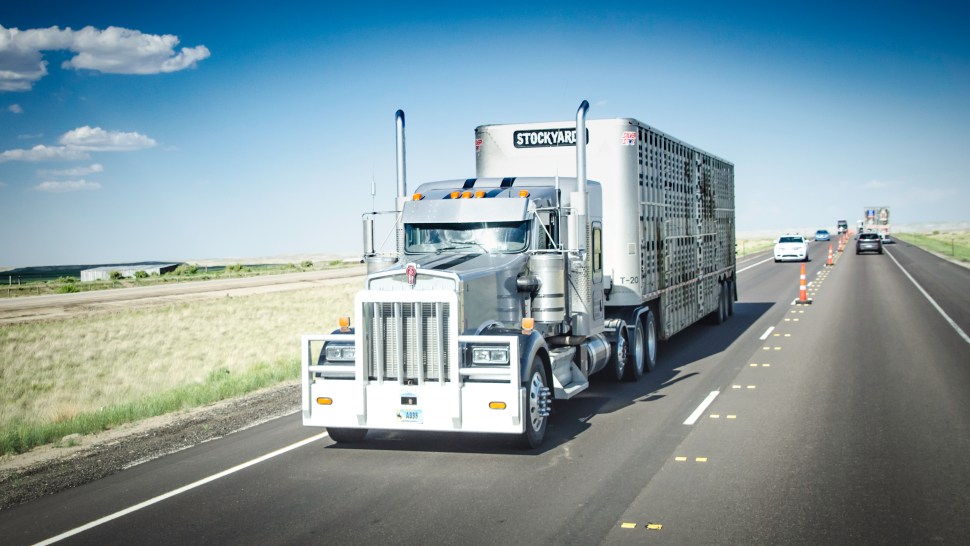
WASHINGTON — Legislation aimed at better protecting livestock trucked over long distances would give the U.S. Department of Transportation partial responsibility for making sure such protections are enforced.
The Humane Transport of Farmed Animals Act, introduced by U.S. Rep. Dina Titus, D-Nev., would require DOT, along with the U.S. Department of Agriculture, to monitor truck drivers’ compliance with the Twenty-Eight Hour Law, a USDA regulation that requires animals to be offloaded for food, water, and rest if they have travelled for 28 hours or more.
Titus introduced the same bill in the previous Congress but it died before receiving a vote.
“For far too long, federal regulations requiring humane treatment of transported farm animals have not been enforced,” Titus said in a press release. “The Humane Transport of Farmed Animals Act would stop this lax regulation that has resulted in many animals being injured or succumbing to disease during transport.”
The Twenty-Eight Hour Law was passed in 1873 to address inhumane conditions endured by farm animals during long journeys by rail. Transportation of livestock since then has been done almost exclusively by truck.
Titus’s bill would also prohibit the interstate transport of livestock deemed unfit for travel due to sickness or injury.
“The worst abuses in farmed animal transport occur when animals are hauled extremely long distances or when they are ill, disabled, or otherwise in such poor condition that they can’t withstand the journey,” said Adrienne Craig, a staff attorney for the Animal Welfare Institute, a supporter of the bill.
“The millions of animals carried on our roads every year should be entitled to protection under our nation’s oldest animal welfare law – the Twenty-Eight Hour Law – but that’s not possible without a clear mechanism for enforcement and cooperation among agencies.
Lawmakers have introduced at least two other bills this year affecting commercial drivers and trucks transporting animals across state lines, including a ban on horses hauled in double-deck trailers and relief from hours-of service requirements for livestock haulers.
Related articles:
Brokerage Compliance Symposium
The day before F3. Every compliance issue you face - fraud exposure, carrier liability, FMCSA rules, cargo theft, insurance gaps - navigated by attorneys and operators defining best practices in a changing industry.
F3 Awards Dinner
The night before F3. FreightTech100 companies honored. FreightTech 25 and Shipper of Choice winners revealed live. Cocktail reception into dinner and live music - 300 industry leaders in one purpose-built room.
F3: Future of Freight Festival
Industry-defining keynotes, rapid-fire technology demos, and industry leaders networking in experiences across Chattanooga - plus the inaugural F3 Awards Dinner featuring the FreightTech and Shipper of Choice reveals.
The day before F3. Every compliance issue you face - fraud exposure, carrier liability, FMCSA rules, cargo theft, insurance gaps - navigated by attorneys and operators defining best practices in a changing industry.
The Signal at Chattanooga Choo Choo • Chattanooga, TN Register NowThe night before F3. FreightTech100 companies honored. FreightTech 25 and Shipper of Choice winners revealed live. Cocktail reception into dinner and live music - 300 industry leaders in one purpose-built room.
The Signal at Chattanooga Choo Choo • Chattanooga, TN Register NowIndustry-defining keynotes, rapid-fire technology demos, and industry leaders networking in experiences across Chattanooga - plus the inaugural F3 Awards Dinner featuring the FreightTech and Shipper of Choice reveals.
The Signal at Chattanooga Choo Choo • Chattanooga, TN Register Now