




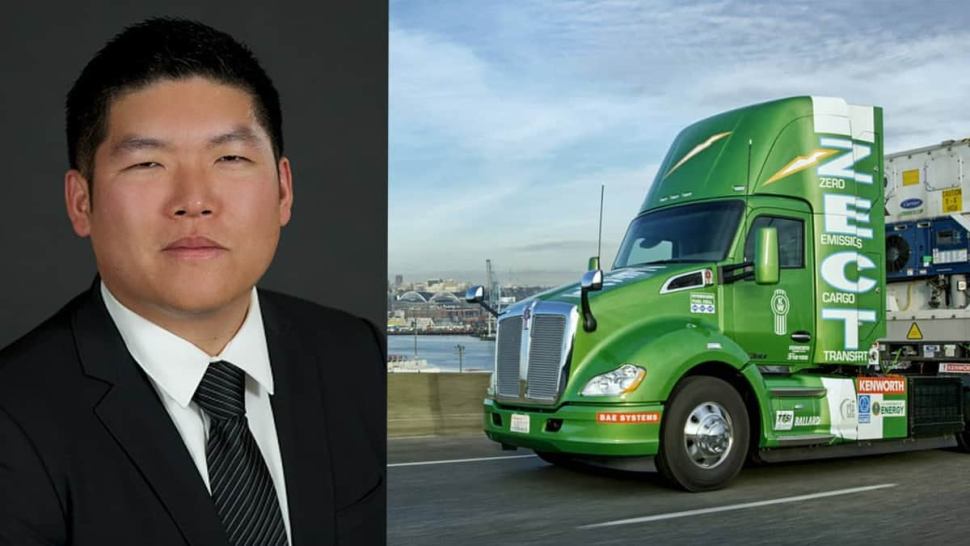
The vice president of government affairs for the California Trucking Association says the state’s Air Resources Board (CARB) should be realistic about the rollout of California’s proposed electric truck manufacturing standard. Officially unveiled two weeks ago, the rule is in the public comment phase.
The VP, Chris Shimoda, drew a comparison with California’s zero emissions passenger vehicle standard. That rule, adopted in 1990 and repeatedly revised, requires the sale of an increasing number of electric vehicles over time.
Almost three decades later, only 8% of new cars currently sold in California are electric, Shimoda pointed out.
“That is a space where all the major manufacturers have been for quite some time,” he said. “So when you look at the Class 4-8 vocational truck sector, being told to go 50% by 2030 — that is a very ambitious goal.”
A sales and reporting mandate
The Advanced Clean Truck rule, if adopted by the Air Resources Board next spring, would require truck manufacturers to sell zero-emission trucks as an increasing percentage of their annual California sales from 2024 to 2030.
In 2024, zero-emission truck/chassis sales would have to be 7% of Class 4-8 straight truck sales and 3% of all other truck sales. By 2030, zero-emission truck/chassis sales would have to be 50% of Class 4-8 straight trucks sales and 15% of all other truck sales.
In addition to the vehicle sales requirement, Shimoda expressed concern about the rule’s fleet reporting component, which he views as onerous.
That section requires all businesses that gross more than $50 million in revenue and do business in California to report contracting practices with motor carriers and for services that use the zero-emission shuttles or trucks.
Companies that own trucks and buses would have to report information about those fleets and how they are operated.
“We think that the fastest way to get deployment of these vehicles is to have good products that are serviced and supported by major manufacturers,” Shimoda said.
“Those are big enough efforts without thinking some reporting paper exercise is going to move this along more quickly than some of the powerful policy levers the state has already deployed.”
Zero emissions sales on the rise
While trucking groups like the CTA want the state to slow down, environmental and community organizations urge faster deployment. A coalition called Electric Trucks Now is calling on CARB to strengthen the rule by requiring at least 15% of the trucks on the road to be zero emission by 2030.
Under the current mandates, the group says, only 4% of the 2 million trucks on the road in California will be electric by 2030. They acknowledge truck sales are still a tiny fraction of the market but note the race to get more alternative fuel trucks on the road is heating up – fast.
Shimoda said he would defer to manufacturers on the readiness of current technology. But to illustrate his concerns about the state moving too fast, he drew a contrast with the Truck and Bus rule, California’s primary rule governing emissions in medium- and heavy-duty commercial vehicles.
Fleets required to retrofit their trucks to meet that standard, Shimoda said, had easy access to the technology and plenty of time to transition.
“Why I think this [the electric truck standard] is different, we are trying to build the market for electric vehicles from almost nothing. We are asking manufacturers to begin making them while technology is still improving.”
He added: “If the Truck and Bus rule was expensive and difficult to comply with, you can only imagine what will happen with electric vehicles. It would be the Truck and Bus rule on steroids to do a zero emissions fleet rule.”
The proposed electric truck manufacturing rule is a sales standard, not a fleet purchasing standard like the Truck and Bus regulation. That is, fleets will not be required to buy electric trucks, but manufacturers will be under a mandate to sell them.
Practicality vs. prestige
Drawing another comparison with passenger vehicles, Shimoda said unlike buyers of electric cars, fleets don’t buy heavy-duty electric trucks because of personal beliefs or the perception that such vehicles are status symbols.
Instead, they buy because of the business case for the vehicles, such as lower maintenance costs or cheaper electricity-vs.-gas costs.
“They are going to have to be able to make an economic case for moving into the technology,” Shimoda said. “That is what we should be focusing on.”
Ten other states have adopted California’s zero emissions passenger vehicle mandate. Should California adopt the electric truck mandate, other states are expected to follow suit.
Brokerage Compliance Symposium
The day before F3. Every compliance issue you face - fraud exposure, carrier liability, FMCSA rules, cargo theft, insurance gaps - navigated by attorneys and operators defining best practices in a changing industry.
F3 Awards Dinner
The night before F3. FreightTech100 companies honored. FreightTech 25 and Shipper of Choice winners revealed live. Cocktail reception into dinner and live music - 300 industry leaders in one purpose-built room.
F3: Future of Freight Festival
Industry-defining keynotes, rapid-fire technology demos, and industry leaders networking in experiences across Chattanooga - plus the inaugural F3 Awards Dinner featuring the FreightTech and Shipper of Choice reveals.
The day before F3. Every compliance issue you face - fraud exposure, carrier liability, FMCSA rules, cargo theft, insurance gaps - navigated by attorneys and operators defining best practices in a changing industry.
The Signal at Chattanooga Choo Choo • Chattanooga, TN Register NowThe night before F3. FreightTech100 companies honored. FreightTech 25 and Shipper of Choice winners revealed live. Cocktail reception into dinner and live music - 300 industry leaders in one purpose-built room.
The Signal at Chattanooga Choo Choo • Chattanooga, TN Register NowIndustry-defining keynotes, rapid-fire technology demos, and industry leaders networking in experiences across Chattanooga - plus the inaugural F3 Awards Dinner featuring the FreightTech and Shipper of Choice reveals.
The Signal at Chattanooga Choo Choo • Chattanooga, TN Register Now