




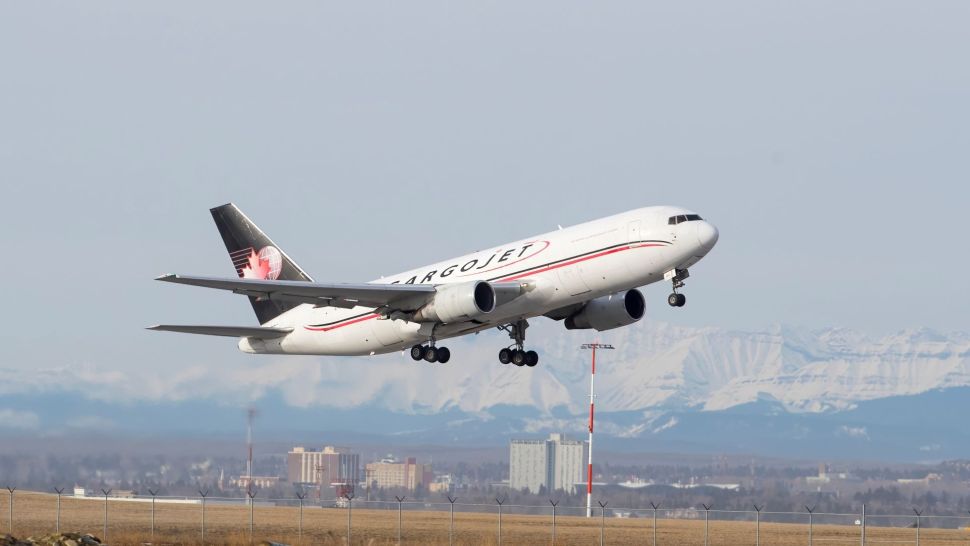
Cargojet’s core transportation revenue from a domestic Canada overnight network, dedicated contract carriage and charter flights increased 7% year over year in the second quarter amid a rise in U.S.-fueled trade barriers, but management said it is cautiously optimistic it can maintain volumes in the near-to-medium term despite global trade uncertainty.
Transport revenue came in at $148.7 million, with a 14% increase in domestic revenue and 22% growth in charter revenues outpacing a 9.6% decline from aircraft-as-a-service contracts, according to results published Wednesday night. The bundled lease business was down 15% in the first quarter. Cargojet (TSX: CJT) said revenue from its domestic network, which co-loads freight from multiple customers in 16 cities, benefitted from e-commerce and B2B growth, as well as rate escalators in customer contracts.
Reflecting the economic uncertainty from trade tensions with the United States, domestic revenues were down 2.4% from the first quarter. The decline in revenue from leased aircraft with crews was largely due to lower shipment volumes from Europe amid U.S. tariff threats of up to 50%, but trans-atlantic business constitutes a small portion of overall revenue, the airline said.
Adjusted earnings before interest, taxes, depreciation and amortization was $58.3 million, up 1.4% compared to the same quarter the previous year. Management said its adjusted profit margin of 34% was the result of strong operating efficiencies and cost management as flight hours declined 10%. Cargojet posted a smaller net loss of $2.3 million as it used cash to invest in more freighter aircraft.
Analysts called the results solid considering the turbulent macroeconomic environment.
“I’m not expecting that this is going to be a huge, huge bumper season. It’s a season of adjustments,” Executive Chairman Ajay Virmani told analysts.
The company separately announced a long-term extension of its flying contract with DHL Express. Virmani said it made sense to renew the strategic partnership two years early by lowering the share price DHL needs to pay to exercise a stock buy and that motivates DHL to give Cargojet more business so it can reach the revenue target for executing its warrants. The replacement warrants were on the growth side, indicating DHL intends to grow volume and put Cargojet first in line for new business, he explained.
“During tough economic times, consumers often substitute a product with a lower cost item, but we expect the volumes to remain resilient. Our Q2 results clearly demonstrate that such behavior is playing out and that e-commerce is still strong and has a long runway of growth ahead of it in Canada. That said, we did see some weakness in our European ACMI (aircraft, crew, maintenance, and insurance) routes after Liberation Day, but we remain optimistic that after the EU-U.S trade deal and our new DHL agreement, air cargo flows will reemerge in the coming quarters,” said co-CEO Jamie Porteous on Thursday’s earnings conference call.
Cargo airlines, including Cargojet, might see a spike in parcel volumes this month as shippers rush to beat the United States’ Aug. 29 date for ending the de minimis exemption for all nations, which allowed small-dollar shipments to enter the country with no need to pay duties and minimal paperwork, Virmani said.
Cargojet said it recently took advantage of market conditions to buy three converted Boeing 767-300s and one factory-built 767-300, the latter of which is scheduled to join the operational fleet this quarter.
Cargojet now operates 43 Boeing 767 and 757 freighter aircraft after adding two used 767-300 passenger aircraft this year that were modified to carry cargo containers. A third 767-300 aircraft remains under conversion and is expected to be delivered in the fourth quarter.
The company said it will sell two older 767-300 aircraft during the third quarter to improve cash flow and its debt leverage ratio. It will also return an older 767-200 to its lessor in the first quarter of 2026.
During the call, management announced that Gord Johnston, who has served as executive president, strategic partnerships, since early 2024, has been promoted to chief commercial officer. The new role will streamline sales processes and generate new revenues by improving capacity utilization in key lanes, including backhaul lanes, by leveraging spot market opportunities and interline relationships with other airlines, co-CEO Pauline Dhillon said.
In June, Cargojet hired Aaron McKay, who previously worked at Canadian passenger airline WestJet, as chief financial officer. He replaced Scott Calver, who departed in March.
Click here for more FreightWaves/American Shipper stories by Eric Kulisch.
Write to Eric Kulisch at ekulisch@freightwaves.com.
RELATED STORIES:
DHL moves early to renew Cargojet contract until 2033
New US de minimis policy could trim DHL profit by 3%
Rise in China e-commerce traffic lifts Cargojet to record revenue
Brokerage Compliance Symposium
The day before F3. Every compliance issue you face - fraud exposure, carrier liability, FMCSA rules, cargo theft, insurance gaps - navigated by attorneys and operators defining best practices in a changing industry.
F3 Awards Dinner
The night before F3. FreightTech100 companies honored. FreightTech 25 and Shipper of Choice winners revealed live. Cocktail reception into dinner and live music - 300 industry leaders in one purpose-built room.
F3: Future of Freight Festival
Industry-defining keynotes, rapid-fire technology demos, and industry leaders networking in experiences across Chattanooga - plus the inaugural F3 Awards Dinner featuring the FreightTech and Shipper of Choice reveals.
The day before F3. Every compliance issue you face - fraud exposure, carrier liability, FMCSA rules, cargo theft, insurance gaps - navigated by attorneys and operators defining best practices in a changing industry.
The Signal at Chattanooga Choo Choo • Chattanooga, TN Register NowThe night before F3. FreightTech100 companies honored. FreightTech 25 and Shipper of Choice winners revealed live. Cocktail reception into dinner and live music - 300 industry leaders in one purpose-built room.
The Signal at Chattanooga Choo Choo • Chattanooga, TN Register NowIndustry-defining keynotes, rapid-fire technology demos, and industry leaders networking in experiences across Chattanooga - plus the inaugural F3 Awards Dinner featuring the FreightTech and Shipper of Choice reveals.
The Signal at Chattanooga Choo Choo • Chattanooga, TN Register Now