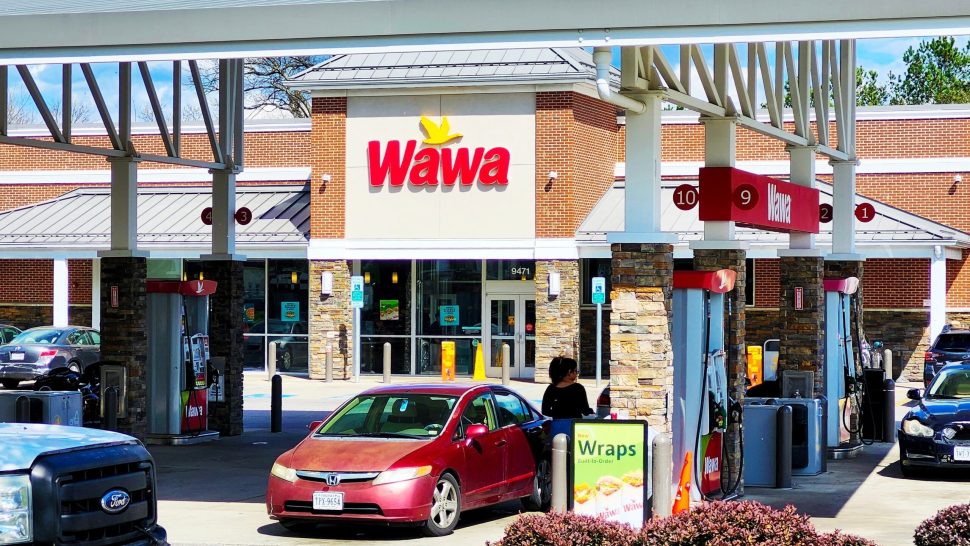
There’s a new company entrant into the truck stop/travel center business with deep pockets, which means there’s a new supplier of truck parking: Wawa.
The mostly mid-Atlantic convenience store chain, whose fans can be almost obsessive about the business, opened its first travel center Wednesday in Hope Mills, North Carolina. While North Carolina is not seen as the heart of Wawa country, which is more likely to be thought of as Pennsylvania, Maryland and New Jersey, Privately-owned Wawa said in a prepared statement announcing the Hope Mills travel center that it is the company’s 15th store in the Tar Heel State.
Despite that limited footprint relative to its larger areas, Wawa decided that is where it would establish its first travel center that will have features servicing truck drivers.
Wawa also has two travel centers under construction, one in Richmond, Indiana and the other in Lima, Ohio.
The “prototype” for existing Wawa stores is between 5,500 and 6,000 square feet, a Wawa spokeswoman said in an email to FreightWaves. But the travel centers are just over 8,000 square feet. She added in response to queries from FreightWaves that there are no plans to convert existing stores to travel centers.
There will be 18 parking spots at the North Carolina facility. However, serving as a long-term parking answer–overnight or for multiple hours of rest during the day–is not a priority on the Wawa agenda for drivers as of now.
As a point of contrast, Love’s Travel Stops said Thursday is had opened a new outlet in Tulia, Texas. It added 59 truck parking spaces and is more than 12,000 feet. It also has four showers.
“While designed primarily for the short-haul professional driver segment and mid-trip pit stops for the long-haul segment, professional drivers are welcome to park overnight,” the spokeswoman said.
A key feature of travel centers that do cater to long-haul drivers are showers. But Wawa is not planning to add showers to its travel centers at present, the spokeswoman said.
The parking will be free at the travel center, she added. There also is a truck scale onsite.
The Hope Mills facility will accept OTR payments. It has six “high speed” diesel fuel lanes. For passenger vehicles, it will have 20 fueling outlets and 24 EV charging stalls. Refilling air also will be free.
Although Wawa is not necessarily known as primarily servicing trucks, the spokeswoman said it does offer diesel at more than 970 of its other outlets.
More articles by John Kingston
Two state troopers who falsified CDL test results get short jail sentences in Massachusetts
BMO’s transportation numbers show slight improvement in trucking credit conditions
NFI driver misclassification case in New Jersey could reach individual payouts of $50k
Brokerage Compliance Symposium
The day before F3. Every compliance issue you face - fraud exposure, carrier liability, FMCSA rules, cargo theft, insurance gaps - navigated by attorneys and operators defining best practices in a changing industry.
F3 Awards Dinner
The night before F3. FreightTech100 companies honored. FreightTech 25 and Shipper of Choice winners revealed live. Cocktail reception into dinner and live music - 300 industry leaders in one purpose-built room.
F3: Future of Freight Festival
Industry-defining keynotes, rapid-fire technology demos, and industry leaders networking in experiences across Chattanooga - plus the inaugural F3 Awards Dinner featuring the FreightTech and Shipper of Choice reveals.
The day before F3. Every compliance issue you face - fraud exposure, carrier liability, FMCSA rules, cargo theft, insurance gaps - navigated by attorneys and operators defining best practices in a changing industry.
The Signal at Chattanooga Choo Choo • Chattanooga, TN Register NowThe night before F3. FreightTech100 companies honored. FreightTech 25 and Shipper of Choice winners revealed live. Cocktail reception into dinner and live music - 300 industry leaders in one purpose-built room.
The Signal at Chattanooga Choo Choo • Chattanooga, TN Register NowIndustry-defining keynotes, rapid-fire technology demos, and industry leaders networking in experiences across Chattanooga - plus the inaugural F3 Awards Dinner featuring the FreightTech and Shipper of Choice reveals.
The Signal at Chattanooga Choo Choo • Chattanooga, TN Register Now