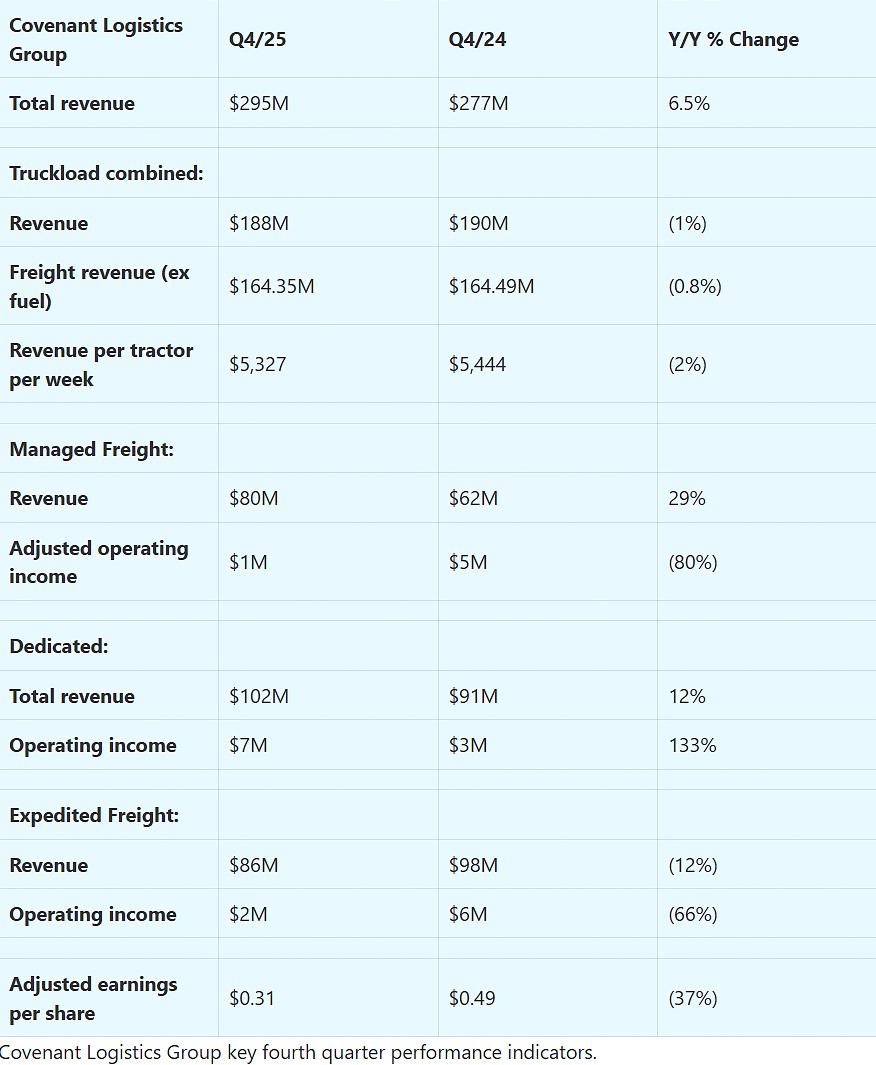
Covenant Logistics Group reported a fourth-quarter net loss, but told analysts it is increasingly confident that freight fundamentals are improving, positioning the carrier for stronger operating performance in the second half of 2026.
Executives said adjusted fourth-quarter results came in largely as expected despite disruptions from a prolonged U.S. government shutdown, elevated insurance claims and capacity costs, and startup expenses in warehousing.
Chattanooga-based Covenant Logistics Group (NYSE: CVLG) released its third-quarter earnings on Thursday and held an earnings call on Friday.
“We believe the freight market continues to evolve toward equilibrium between shippers and carriers. In fact, we might be at equilibrium now,” Chairman and CEO David Parker said.
Parker said spot rates rose meaningfully in the fourth quarter and revenue trends across all business units improved during the first three weeks of January.
The company has already secured low- to mid-single-digit contractual rate increases in its expedited fleet that take effect in the first quarter, with additional increases expected across expedited and dedicated operations early in the second quarter.
“We would not be surprised for industry-wide driver and truck capacity to continue to decline,” Parker said, citing regulatory pressures, cost inflation and insurance risk. He added that inventory restocking and stronger corporate earnings could further tighten capacity as 2026 progresses.
Related: First look: Covenant Logistics reports Q4 net loss
Fleet rationalization and capital discipline
Covenant officials said they are intentionally shrinking and reshaping its asset-based fleet to improve returns, following impairment charges tied to underutilized equipment.
The carrier expects to operate with a modestly smaller fleet by the end of 2026 and plans net capital expenditures of $40 million to $50 million, a sharp reduction from prior years.
Within truckload, Covenant Logistics Group President Paul Bunn said the company will continue growing higher-service, specialized dedicated operations while exiting more commoditized freight.
Dedicated posted an adjusted operating ratio of 92.2 in the fourth quarter — its best performance of the year — and management said it plans to further expand specialized niches, including agriculture.
“We were pleased by how the [Dedicated] segment improved its results each quarter throughout the year and are excited about the momentum we are taking with us into 2026,” Bunn said. “With Dedicated, we grew the fleet by 90 average tractors, or approximately 6.3%, as we have continued to win new business and specialize in high-service niches within that segment.”
By contrast, the expedited segment underperformed expectations in the quarter, posting a 97.2 adjusted operating ratio amid lower utilization and the government shutdown.
Covenant said it expects sequential improvement in expedited margins in the first quarter, though executives acknowledged typical seasonal softness and weather risk early in the year.
Brokerage acquisition adds upside
Covenant also used the call to highlight its recent acquisition of a truckload brokerage now operating as Star Logistics Solutions, which contributed to a nearly 29% increase in managed freight revenue during the quarter.
While margins were compressed due to elevated peak-season capacity costs, management said the asset-light business provides operating leverage and greater upside in a tightening freight market.
Over the longer term, Covenant is targeting mid-single-digit operating margins in managed freight and said the segment should become a more stable earnings contributor as contract pricing resets catch up with rising costs.
2026 outlook: execution-focused
Covenant officials said that first-quarter 2026 results could still reflect seasonal headwinds, but said the company expects freight conditions and margins to improve as the year progresses.
Parker described 2026 as a year focused on execution, capital allocation discipline, and balance-sheet deleveraging after several years of acquisitions and share repurchases.
“I’m more excited now than I was three months ago,” Parker said, adding that Covenant is already winning new business at higher rates and seeing clear signs of capacity leaving the market. “We believe we’re on the beginning stages of the trucking industry getting back to where it needs to be.”
Brokerage Compliance Symposium
The day before F3. Every compliance issue you face - fraud exposure, carrier liability, FMCSA rules, cargo theft, insurance gaps - navigated by attorneys and operators defining best practices in a changing industry.
F3 Awards Dinner
The night before F3. FreightTech100 companies honored. FreightTech 25 and Shipper of Choice winners revealed live. Cocktail reception into dinner and live music - 300 industry leaders in one purpose-built room.
F3: Future of Freight Festival
Industry-defining keynotes, rapid-fire technology demos, and industry leaders networking in experiences across Chattanooga - plus the inaugural F3 Awards Dinner featuring the FreightTech and Shipper of Choice reveals.
The day before F3. Every compliance issue you face - fraud exposure, carrier liability, FMCSA rules, cargo theft, insurance gaps - navigated by attorneys and operators defining best practices in a changing industry.
The Signal at Chattanooga Choo Choo • Chattanooga, TN Register NowThe night before F3. FreightTech100 companies honored. FreightTech 25 and Shipper of Choice winners revealed live. Cocktail reception into dinner and live music - 300 industry leaders in one purpose-built room.
The Signal at Chattanooga Choo Choo • Chattanooga, TN Register NowIndustry-defining keynotes, rapid-fire technology demos, and industry leaders networking in experiences across Chattanooga - plus the inaugural F3 Awards Dinner featuring the FreightTech and Shipper of Choice reveals.
The Signal at Chattanooga Choo Choo • Chattanooga, TN Register Now