




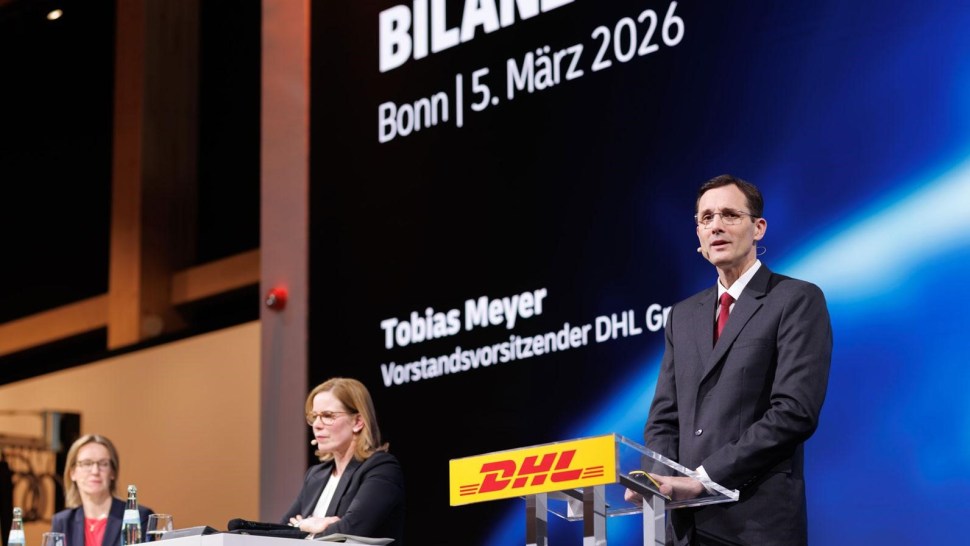
DHL Group revenues dipped during the first quarter, but operating profit improved 8.3% behind strong performance from the Express and Supply Chain divisions despite disruptions caused by the conflict in the Middle East and negative currency impacts.
DHL Express (XETRA: DHL) revenues slumped 1.9% to 6 billion euros, equivalent to $7 billion, but earnings before taxes and interest jumped 20.6% due to aggressive capacity management, cost discipline and yield management, according to financial results released on Thursday. Adjusted revenue was up 2%. Express has recorded seven consecutive quarters of operating profit as it ramps up its Fit for Growth campaign, which aims to take out more than $1.2 billion in structural costs over three years.
The revenue and profit increase was achieved even as average daily shipment volume for the time-definite international air product fell 6%, thanks to increased weight per shipment. Weight is a core metric for assessing asset utilization and network profitability because sales are substantially based on weight and yield. TDI weight per shipment is up 4.4% since 2019 and 2.9% year over year, excluding U.S. destinations — a big improvement from recent quarters.
“This higher profitability, despite lower shipments, is not a coincidence, but the result of how we steer sales, pricing, and network cost in close alignment,” said Chief Financial Officer Melanie Kreis during an earnings briefing with analysts.
DHL’s investment in more modern, fuel-efficient Boeing 777 freighter aircraft since 2019, including the addition of several new 777-300 converted freighters in recent months, also played a role in margin expansion, CEO Tobias Meyer added. And the company is using artificial intelligence to better judge which vehicles need ad hoc repairs, as well as regular maintenance and tire renewal, which reduces repair shop visits and costs.

The Iran war, which began on Feb. 28, had little impact on DHL’s overall earnings during the quarter, he said.
By rerouting freighter aircraft and making other network adjustments, the division was able to respond to Iran war impacts and maintain service for customers. DHL , for example, was forced to temporarily suspend operations at its regional hub in Bahrain, but shifted the dedicated fleet to airports in Riyadh, Saudi Arabia, and Muscat, Oman, several days after the conflict started. Some long-range aircraft were relocated to Europe so they could be better utilized. The parcel and logistics titan also heavily leaned on its road network to move shipments from those airports to the United Arab Emirates, Qatar, Bahrain and Kuwait.
DHL made a similar pivot for container shipments managed by the Global Forwarding division. As ocean carriers diverted to ports in Oman and on Saudi Arabia’s Red Sea coast to offload import traffic, DHL secured extra trucking capacity to distribute goods around the Gulf region.
Weak jet-fuel availability, especially in Asia, is a growing concern as the war cuts off tanker shipments to many parts of the world. DHL has to buy fuel in the commercial market at Asian airports, unlike in Europe where it has direct supply contracts with energy providers. DHL has the option to fuel up planes at origin destinations so there is enough fuel for the outbound leg, but that is only possible for regional and short-haul flights, Meyer explained. Tankering doesn’t work for intercontinental flights because it would reduce too much payload.
Established pricing and surcharge mechanisms will allow DHL to pass on conflict-related costs to customers as recovery charges kick in over time, the company said.
Global Forwarding revenue declined 5% due to lower freight rates. Capacity shortages, including at Middle East airlines, and higher oil prices resulting from the conflict in the Middle East caused freight rates to rise again significantly at the end of the quarter. Airfreight volumes increased 3.8% to 438,000 metric tons, driven primarily by the Asia-Europe trade lane and exports from Latin America. Air freight revenues decreased 2.2%.
Ocean freight demand moved up 2% year over year to 804,000 standard shipping units, with growth particularly strong from Asia to Europe. Ocean freight revenue and gross profit decreased by 16.5% and 17.5%, respectively, during the quarter, reflecting the normalization of market freight rates underway since 2025.
Supply Chain revenue grew 5.7% thanks to new customers, contract renewals and continued expansion of e-commerce activities, led by the Americas region, DHL said.
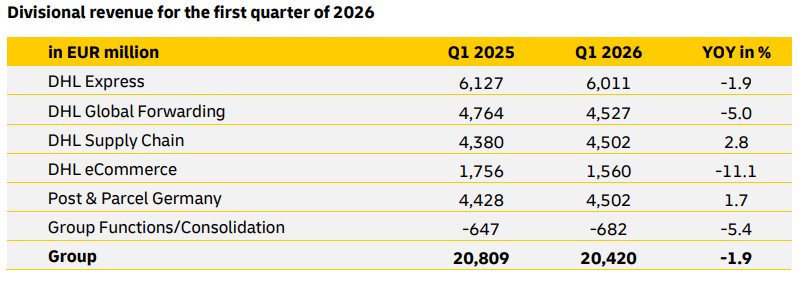
DHL eCommerce, which provides parcel delivery, returns and international shipping customized for online merchants, generated 11% less revenue than in the prior year period due to negative currency effects and not including UK contributions so the Evri merger in September doesn’t skew comparisons. Absent those factors, revenue increased by 4.9%.
Group adjusted revenue, excluding currency impacts, has gradually improved over the past year and was up 2% year over year during the first quarter. The company reaffirmed full-year guidance of $7.25 billion of operating profit.
Meyer said U.S group revenue could grow the remainder of the year as the effects of frontloaded shipments to avoid U.S. tariffs in 2025 subside.
DHL Group’s capital expenditure during the quarter totaled $605.75 million, up 12.4% y/y, with most of the investments directed to the Supply Chain and Post & Parcel Germany divisions. An ongoing modernization program in the mail and parcel operations in Germany helped Deutsche Post handle a spike in mail and parcel shipments during the Easter and spring season. The capex growth stands in contrast to rival integrators FedEx and UPS, which are reducing investment in assets to reduce costs and increase profitability. DHL continues to invest as part of its 2030 growth strategy in efficiency and fast-growth sectors and regions, such as life science & healthcare, data centers and the Middle East. By the end of 2025, for example, the share of electric vehicles used for pickup and delivery in Germany reached nearly 60%.
European trucking
Earlier this month, DHL Freight rolled out a more differentiated trucking product to give customers better choice. Road Freight Standard is the default option for less-than-truckload shipments and covers the majority of routine transport needs with DHL’s European freight network. Road Freight Priority is a premium product for time-critical international LTL shipments that combines prioritized handling, enhanced pick-up and delivery options and defined transit time commitments. Road Freight Direct provides customized partial truckload and full truckload point-to-point service for dedicated shipments.
Click here for more FreightWaves/American Shipper stories by Eric Kulisch.
Write to Eric Kulisch at ekulisch@freightwaves.com.
RELATED STORIES:
How DHL tackled mail and parcel boom during peak Easter season
DHL prioritizes own cargo jets for pharmaceuticals transport
Brokerage Compliance Symposium
The day before F3. Every compliance issue you face - fraud exposure, carrier liability, FMCSA rules, cargo theft, insurance gaps - navigated by attorneys and operators defining best practices in a changing industry.
F3 Awards Dinner
The night before F3. FreightTech100 companies honored. FreightTech 25 and Shipper of Choice winners revealed live. Cocktail reception into dinner and live music - 300 industry leaders in one purpose-built room.
F3: Future of Freight Festival
Industry-defining keynotes, rapid-fire technology demos, and industry leaders networking in experiences across Chattanooga - plus the inaugural F3 Awards Dinner featuring the FreightTech and Shipper of Choice reveals.
The day before F3. Every compliance issue you face - fraud exposure, carrier liability, FMCSA rules, cargo theft, insurance gaps - navigated by attorneys and operators defining best practices in a changing industry.
The Signal at Chattanooga Choo Choo • Chattanooga, TN Register NowThe night before F3. FreightTech100 companies honored. FreightTech 25 and Shipper of Choice winners revealed live. Cocktail reception into dinner and live music - 300 industry leaders in one purpose-built room.
The Signal at Chattanooga Choo Choo • Chattanooga, TN Register NowIndustry-defining keynotes, rapid-fire technology demos, and industry leaders networking in experiences across Chattanooga - plus the inaugural F3 Awards Dinner featuring the FreightTech and Shipper of Choice reveals.
The Signal at Chattanooga Choo Choo • Chattanooga, TN Register Now