The price used for most fuel surcharges rose one cent in a market that has featured stability for weeks
Stability in the retail price of diesel remains the prevailing condition in the market, with the benchmark price used for most fuel surcharges moving a mere one cent this week.
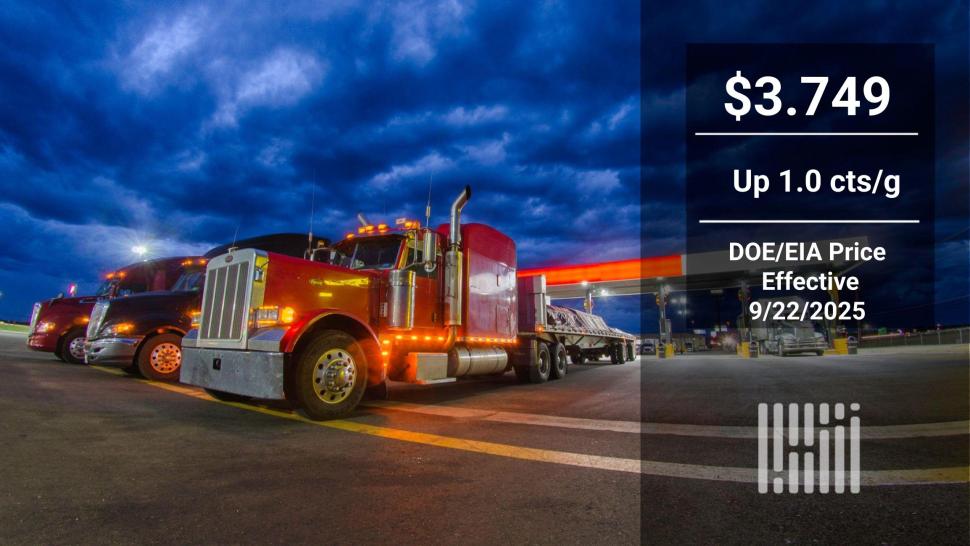
The Department of Energy/Energy Information Administration average retail diesel price, effective Monday but released Tuesday, rose one cent per gallon to $3.749/g. With the move, the price in 11 of the last 14 weeks has ranged from a low of $3.708/g to $3.775/g. In the other three weeks, the price ranged from $3.80/g to just over that number.
But as seems to have been the case in many weeks, the stability was broken in futures markets on the day the DOE/EIA price was released.
After settlements Friday and Monday on the CME commodity exchange that came in at less than $2.30/g, the price of ultra low sulfur diesel on the CME at approximately 11:40 a.m. Eastern time Tuesday was up 5.3 cts/g to $2.3394/g.
The Tuesday jump appeared to be linked to statements made by President Donald Trump in his annual speech to the UN, where he said European nations were “funding the war against themselves” by continuing to purchase Russian oil and gas as he urged them to halt that buying.
That development came amid a mixed bag of bullish and bearish news in the market. On the bullish side, Ukrainian drones were said to have successfully carried out attacks on various parts of Russian oil facilities deep into the country.
Despite that effort, Bloomberg reported that the four-week average of Russian export shipments had risen to 3.62 million b/d in the week ending September 21, the highest since May 2024.
But for diesel consumers, the news was not all that bearish. Diesel exports out of Russia, a major supplier, were reported to still be holding about 400,000 barrels/day. In February, that figure was 820,000 b/d.
Stability in the outright price of retail diesel is being largely matched by its spread against Brent crude, the global benchmark.
A comparison of the front month ULSD and Brent contracts on CME showed a spread after Monday’s settlements of about 70.7 cts/g. That was down from 76.3 cents/g Tuesday, the recent high, but higher than 69.5 cts/g on September 12. That up and down movement around the 70 cts/g market has been a feature of the Brent/diesel spread since late July, when it first fell below 80 cts/g after a higher spike driven by tight inventories.
But various data points are suggesting that inventory squeeze has eased. For example, U.S. inventories of ULSD were reported August 8 at 104 million barrels. But in the most recent report, released Wednesday for data through September 12, stocks of ULSD were 113.8 million barrels. That’s the highest they’ve been since the end of January.
More articles by John Kingston
Shipping challenges on the rain-starved Mississippi…again
XPO’s rating at Moody’s held steady but outlook is now ‘positive’
Teamsters grows influence in Amazon’s food network via UNFI success
Brokerage Compliance Symposium
The day before F3. Every compliance issue you face - fraud exposure, carrier liability, FMCSA rules, cargo theft, insurance gaps - navigated by attorneys and operators defining best practices in a changing industry.
F3 Awards Dinner
The night before F3. FreightTech100 companies honored. FreightTech 25 and Shipper of Choice winners revealed live. Cocktail reception into dinner and live music - 300 industry leaders in one purpose-built room.
F3: Future of Freight Festival
Industry-defining keynotes, rapid-fire technology demos, and industry leaders networking in experiences across Chattanooga - plus the inaugural F3 Awards Dinner featuring the FreightTech and Shipper of Choice reveals.
The day before F3. Every compliance issue you face - fraud exposure, carrier liability, FMCSA rules, cargo theft, insurance gaps - navigated by attorneys and operators defining best practices in a changing industry.
The Signal at Chattanooga Choo Choo • Chattanooga, TN Register NowThe night before F3. FreightTech100 companies honored. FreightTech 25 and Shipper of Choice winners revealed live. Cocktail reception into dinner and live music - 300 industry leaders in one purpose-built room.
The Signal at Chattanooga Choo Choo • Chattanooga, TN Register NowIndustry-defining keynotes, rapid-fire technology demos, and industry leaders networking in experiences across Chattanooga - plus the inaugural F3 Awards Dinner featuring the FreightTech and Shipper of Choice reveals.
The Signal at Chattanooga Choo Choo • Chattanooga, TN Register Now