
The stock of Expeditors International is trading at all-time highs after its Tuesday earnings report and steady gains in the last three months.
The 52-week high of $136.18 recorded Tuesday at freight forwarder and customs broker Expeditors (NYSE: EXPD) was up about 11.2% in the last 52 weeks and about 16.7% in the last three months. Expeditors’ 52-week low was $100.47 on April 9.
The gains didn’t stop there. At approximately 11:15 a.m. Wednesday, Expeditors’ stock was up 1.69%, or $2.30 to $238.03. It has risen 17.55% in five days, according to Barchart data.
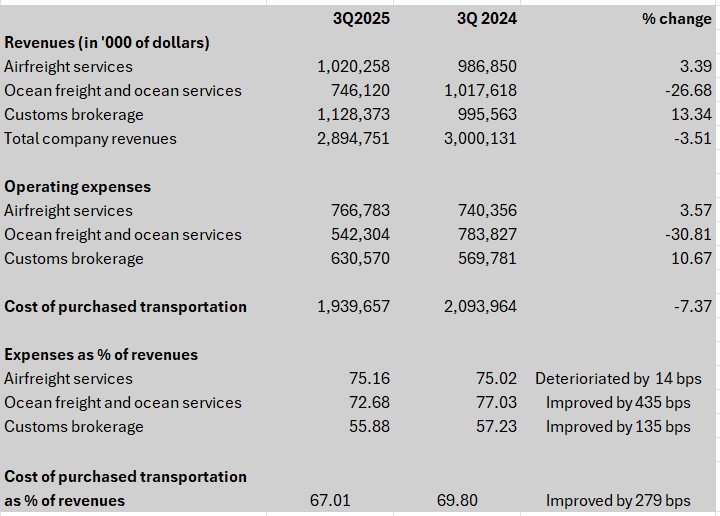
The company’s earnings on their face were not particularly strong. Diluted net earnings declined 1% to $1.64, with net earnings dropping 3% to $222 million. Operating income was down 4%, as were revenues.
But the $1.64 was better than Wall Street estimates, helping to lead to the higher stock price.
Beat Wall Street consensus
The transportation research team at TD Securities led by Jason Seidl said the earnings per share figure “easily exceeded” its forecast of $1.42 and a Wall Street estimate of $1.39. Revenue of $2.9 billion also was better than forecasts, as well as EBIT margins.
A bright spot at Expeditors was higher volume in its airfreight business. Shipments measured in kilos were up 4% overall for the quarter, though the gains decreased as the three months went on: July was up 6%, August rose 3% and September inched up just 2%.
Wall said of the air business that the capacity it buys was looser, following the expiration of the de minimis exception which he said had tightened space as importers rushed to get goods into the U.S. before that development at the end of August. “That extra capacity led to slightly lower sell and buy rates during the quarter,” Wall said.
Tariffs lift Customs Brokerage
Another strong area was Customs Brokerage, which saw its revenue grow 13.3% year-on-year.
In a prepared statement released in conjunction with the earnings–Expeditors does not hold an earnings call with analysts–president and CEO Daniel Wall cited Customs Brokerage as a strong performer in the quarter.
Wall said the group is “(continuing) to perform at a high level” and has been positively affected by tariffs and the need for information and guidance among shippers and importers.
“The increase in volume and complexity of entries continues to test our customs group,” Wall said. “We are investing in and exploring ways to further enhance our productivity in this area, including enhancements from AI and other technology solutions.”
But the strength in air freight and customs brokerage was not matched in Expeditors’ ocean freight business. Measured in forty foot equivalents, ocean traffic was down 3% on the quarter, with volume deteriorating as the quarter went on. It was up 3%in July, but down 4% in September and 6% in October.
“In the first half of the year, U.S. importers accelerated shipments in advance of expected tariffs,” Wall said in his prepared statement. “Volumes declined in the third quarter, primarily related to retail customers and, as additional capacity came on-line, sell and buy rates declined substantially. Despite these market challenges, we remained disciplined and efficient while adjusting our ocean business for slower market growth, as we recognize that the ocean capacity/demand imbalance could continue for some time.”
Seidl’s report also saw a negative outlook in Expeditors’ ocean business. “We expect to see this segment to see continued pressure over ‘26 as peer commentary has indicated that 6% to 9% additional ocean capacity is anticipated next year and rate recovery would require a significant turnaround in the demand picture, which faces trade headwinds,” Seidl said.
More articles by John Kingston
DAT execs in two forums discuss how it seeks to reshape the freight sector
NMFTA’s freight classification overhaul: surprising shipper preparedness
Beautiful women, open doors and drivers: trucking cybersecurity risks proliferate
Brokerage Compliance Symposium
The day before F3. Every compliance issue you face - fraud exposure, carrier liability, FMCSA rules, cargo theft, insurance gaps - navigated by attorneys and operators defining best practices in a changing industry.
F3 Awards Dinner
The night before F3. FreightTech100 companies honored. FreightTech 25 and Shipper of Choice winners revealed live. Cocktail reception into dinner and live music - 300 industry leaders in one purpose-built room.
F3: Future of Freight Festival
Industry-defining keynotes, rapid-fire technology demos, and industry leaders networking in experiences across Chattanooga - plus the inaugural F3 Awards Dinner featuring the FreightTech and Shipper of Choice reveals.
The day before F3. Every compliance issue you face - fraud exposure, carrier liability, FMCSA rules, cargo theft, insurance gaps - navigated by attorneys and operators defining best practices in a changing industry.
The Signal at Chattanooga Choo Choo • Chattanooga, TN Register NowThe night before F3. FreightTech100 companies honored. FreightTech 25 and Shipper of Choice winners revealed live. Cocktail reception into dinner and live music - 300 industry leaders in one purpose-built room.
The Signal at Chattanooga Choo Choo • Chattanooga, TN Register NowIndustry-defining keynotes, rapid-fire technology demos, and industry leaders networking in experiences across Chattanooga - plus the inaugural F3 Awards Dinner featuring the FreightTech and Shipper of Choice reveals.
The Signal at Chattanooga Choo Choo • Chattanooga, TN Register Now