




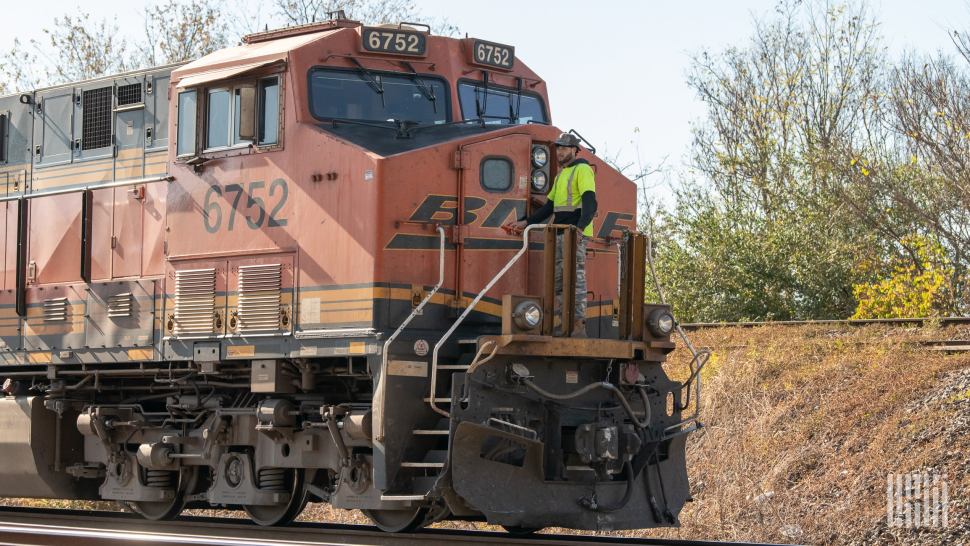
WASHINGTON — Large freight railroads will have to undergo a rigorous approval process if they want to streamline operations down to one-person train crews.
The new requirement is part of the Federal Railroad Administration’s final rule announced on Tuesday mandating a two-person crew minimum on trains operated by Class 1 railroads unless a railroad can obtain approval for a one-person crew from FRA.
Such an approval will require railroads to demonstrate to FRA, through a petition and public comment period, that they can maintain appropriate safety levels. Railroads that do receive special one-person train crew approval must submit an annual report to FRA summarizing the safety of the operation.
“Common sense tells us that large freight trains, some of which can be over three miles long, should have at least two crew members on board — and now there’s a federal regulation in place to ensure trains are safely staffed,” said U.S. Transportation Secretary Pete Buttigieg in announcing the final rule.
“This rule requiring safe train crew sizes is long overdue, and we are proud to deliver this change that will make workers, passengers, and communities safer.”
The Department of Transportation said codifying crew staffing requirements at the federal level also ensures that rail operations are governed by consistent safety rules in all states. “This is an on-going issue as Ohio, Virginia, and Colorado, among others, have recently considered legislation to require two-person rail crews,” DOT stated.
The rule differs slightly from the initial proposed rulemaking issued in 2022 in how it treats Class II and III freight railroads, according to FRA. It allows, in limited cases, such smaller railroads to start or continue certain one-person train crew operations by notifying the agency and complying with new safety standards.
The rule was supported by the Transportation Trades Department (TTD) of the AFL-CIO.
“Rail workers experience the risks of the job daily, and have made it clear that two-person crews are inherently necessary to ensure the safe operation of our rail systems,” commented TTD President Greg Regan.
“While the FRA has considered action on crew size for almost a decade, operational and safety changes across the rail industry the last several years have only heightened the need for strong crew size regulations.”
The new regulation departs from actions taken by the FRA under former President Donald Trump. In 2019, the agency withdrew a previous consideration of a train crew size rule, explaining that railroads had maintained a strong safety record in the absence of regulation and that regulating train crew staffing was not necessary or appropriate for rail operations to be conducted safely.
Rail lobby slams rule
That point was underscored by the Association of American Railroads in opposing the rule.
“FRA is doubling down on an unfounded and unnecessary regulation that has no proven connection to rail safety,” said AAR President and CEO Ian Jefferies. “Instead of prioritizing data-backed solutions to build a safer future for rail, FRA is looking to the past and upending the collective bargaining process.”
Because collective bargaining has historically managed railroad staffing and crew size policies, AAR contends, FRA’s “overreach” now inserts the agency between labor and management.
“Railroads are committed to working with our union counterparts and policymakers to build on this momentum and advance proven solutions that meaningfully advance safety,” Jefferies said. “Unfortunately, the crew size rule takes the industry in the exact opposite direction.”
Related articles:
Brokerage Compliance Symposium
The day before F3. Every compliance issue you face - fraud exposure, carrier liability, FMCSA rules, cargo theft, insurance gaps - navigated by attorneys and operators defining best practices in a changing industry.
F3 Awards Dinner
The night before F3. FreightTech100 companies honored. FreightTech 25 and Shipper of Choice winners revealed live. Cocktail reception into dinner and live music - 300 industry leaders in one purpose-built room.
F3: Future of Freight Festival
Industry-defining keynotes, rapid-fire technology demos, and industry leaders networking in experiences across Chattanooga - plus the inaugural F3 Awards Dinner featuring the FreightTech and Shipper of Choice reveals.
The day before F3. Every compliance issue you face - fraud exposure, carrier liability, FMCSA rules, cargo theft, insurance gaps - navigated by attorneys and operators defining best practices in a changing industry.
The Signal at Chattanooga Choo Choo • Chattanooga, TN Register NowThe night before F3. FreightTech100 companies honored. FreightTech 25 and Shipper of Choice winners revealed live. Cocktail reception into dinner and live music - 300 industry leaders in one purpose-built room.
The Signal at Chattanooga Choo Choo • Chattanooga, TN Register NowIndustry-defining keynotes, rapid-fire technology demos, and industry leaders networking in experiences across Chattanooga - plus the inaugural F3 Awards Dinner featuring the FreightTech and Shipper of Choice reveals.
The Signal at Chattanooga Choo Choo • Chattanooga, TN Register Now