




WASHINGTON — Regulators are being asked to ensure that cross-border truck drivers and trucking companies are included in the upcoming split-duty period pilot project that the Federal Motor Carrier Safety Administration announced last week.
Join the leaders shaping freight’s future at
F3: Future of Freight Festival, Oct 21-22.
Network with the industry’s best and discover what’s next.
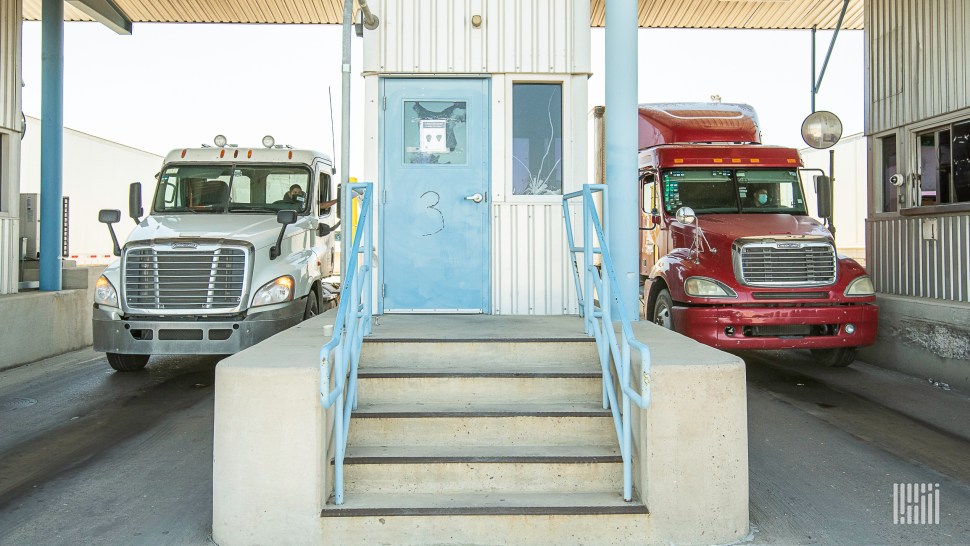
“Carriers operating between the United States and Mexico spend a significant portion of their workday waiting at border crossings, undergoing CBP [Customs and Border Protection] inspections, USDA [U.S. Department of Agriculture] agricultural inspections, and state DOT [Department of Transportation] checks,” wrote Guillermo Carbajal, one of the first to comment on FMCSA’s pilot.
“These mandatory processes often extend for several hours, consuming service time and limiting operational efficiency.
“Excluding binational operations from these programs would overlook a critical sector of the trucking industry, which faces unique scheduling challenges not encountered in purely domestic operations. Participation of cross-border carriers would provide valuable data on how flexible rest periods can improve safety, regulatory compliance, and supply chain efficiency under real-world binational conditions.”
The split-duty period pilot will allow participating drivers to pause their 14-hour on-duty period – known as their “driving window” – for up to three additional hours and no less than 30 minutes, with the goal of providing more flexibility for rest time depending on their fatigue level. FMCSA is proposing a concurrent pilot on rest-period options related to sleeper berth time.
The agency plans to limit participation in the split-duty pilot to “approximately” 256 commercial driver’s license (CDL) holders who meet the eligibility criteria – which currently does not explicitly limit participation based on geographic location or operating types.
Driver eligibility includes possessing a valid CDL and medical certificate, but would be ineligible if, during the two-year period immediately preceding the participation date his or her license was suspended, revoked, cancelled, or has been disqualified for a conviction of certain disqualifying offenses.
During the public comment period, which ends on Nov. 17, FMCSA is asking for any additional factors – such as driver sex, geographic location, age, operating types, or driver experience – it should consider when selecting participants to ensure a representative sample.
The agency stated in the program proposal that the temporary exemption from current regulations allowed in the pilot “provides the flexibility to take extra rest, avoid driving during traffic congestion, and mitigate the impacts of unreasonable ‘detention times,’ thereby improving the working conditions of America’s truck drivers.”
Related articles:
Brokerage Compliance Symposium
The day before F3. Every compliance issue you face - fraud exposure, carrier liability, FMCSA rules, cargo theft, insurance gaps - navigated by attorneys and operators defining best practices in a changing industry.
F3 Awards Dinner
The night before F3. FreightTech100 companies honored. FreightTech 25 and Shipper of Choice winners revealed live. Cocktail reception into dinner and live music - 300 industry leaders in one purpose-built room.
F3: Future of Freight Festival
Industry-defining keynotes, rapid-fire technology demos, and industry leaders networking in experiences across Chattanooga - plus the inaugural F3 Awards Dinner featuring the FreightTech and Shipper of Choice reveals.
The day before F3. Every compliance issue you face - fraud exposure, carrier liability, FMCSA rules, cargo theft, insurance gaps - navigated by attorneys and operators defining best practices in a changing industry.
The Signal at Chattanooga Choo Choo • Chattanooga, TN Register NowThe night before F3. FreightTech100 companies honored. FreightTech 25 and Shipper of Choice winners revealed live. Cocktail reception into dinner and live music - 300 industry leaders in one purpose-built room.
The Signal at Chattanooga Choo Choo • Chattanooga, TN Register NowIndustry-defining keynotes, rapid-fire technology demos, and industry leaders networking in experiences across Chattanooga - plus the inaugural F3 Awards Dinner featuring the FreightTech and Shipper of Choice reveals.
The Signal at Chattanooga Choo Choo • Chattanooga, TN Register Now