




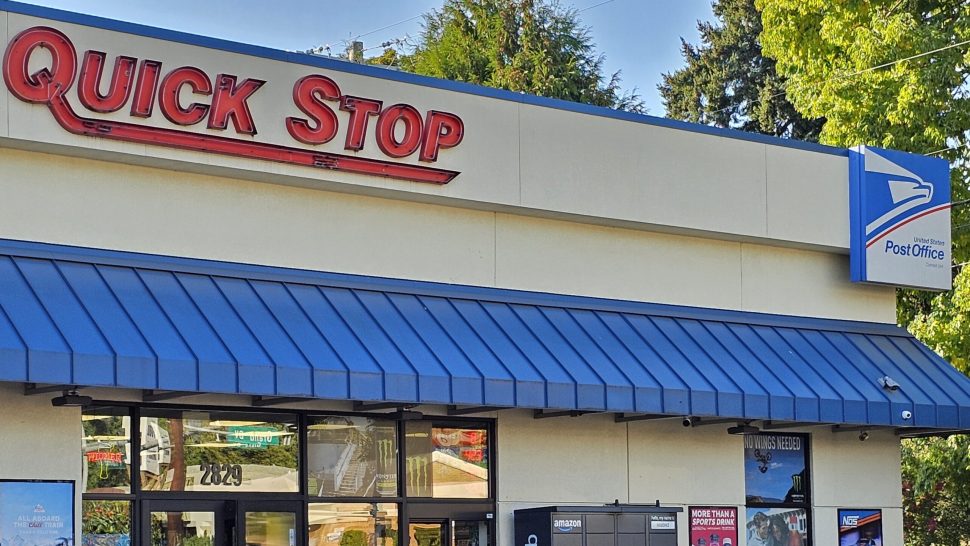
A U.S. Postal Service plan to close dozens of contract post offices inside local retail stores has drawn fire from lawmakers, who say the embedded service stations provide vital service in smaller communities.
On Tuesday, Rep. George Whitesides, D-California, and Rep. Rick Allen, R-Georgia, introduced legislation that would require the Postal Service to provide reports on how the closure of contract postal units will impact residents and allow for public hearings before any closure takes place.
Contract postal units are mini post offices inside privately-owned facilities that provide postal products and services to the public at Postal Service prices, often operating as full-service locations. They are staffed by the retailer.
“In my district, the Quartz Hill post office’s contract was abruptly terminated with no transparency or rationale provided,” said Rep. Whitesides, in a news release. “This full service CPU has served our community since 1952, and my constituents deserve to know how they will be impacted by the sudden closure. My bill will increase transparency and involve the community in this process.”
Rep. Allen complained that a USPS substation located at the Surrey Center Pharmacy in Augusta was abruptly placed on the chopping block.
Post office officials say the changes are being made to save money because nearby postal facilities are able to serve the communities. No figure on the total number of contract locations being closed has been disclosed.
Vendors were notified in June that their contracts would end on Sept. 30.
Several retail USPS locations inside Lewis Drug and Hy-vee stores in, and around, Sioux Falls, South Dakota, will cease operations at the end of the month, according to Dakota News Now. In June, the USPS notified Pony Express, Delta Sonic and Kraus Department Store in Erie, Pennsylvania, that their contracts will be terminated, YourErie.com reported.

One CPU located in Tacoma, Washington, has mounted a petition drive to stop the closure. Businesses and residents there say they get better service than at a traditional post office, The News Tribune said. Similar shutdowns are scheduled for CPUs in Salem, Oregon, and Cincinnati. The owner of an Ace Hardware store in Cincinnati told The Enquirer that the Postal Service provided no data showing that other post offices could fully serve his community.
The bipartisan Contract Postal Unit Transparency Act would require the national post to publicly report on the impact closures will have on residents and what steps it is taking to ensure continued access to postal services in affected areas. The Postal Service would also need to submit a report to Congress detailing the reasons for closing or consolidating specific CPUs and hold public hearings on each planned closure. No CPU could be closed six months after a summary of the hearing is published.
Reps. Frank Mrvan, D-Indiana, and Andrea Salinas, D-Oregon, co-sponsored the bill.
“My community is up in arms over this planned closure. My office has received an outpouring of public support for the Quartz Hill CPU, which has provided customers with short lines and top-notch customer service since 2003. I’m concerned that closing the go-to postal location for Quartz Hill residents would cost my constituents more time, money, and fuel in order to access basic postal services,” Rep. Whitesides said in a June letter to new Postmaster General David Steiner seeking answers for the closure. “I’m especially worried that this would impose a large burden on elderly folks who will have to travel significantly longer distances and may not be physically able to wait in long lines. Many residents would be forced to travel up to 10 miles each way to the nearest alternative post office, which is unreasonable considering the additional required time, energy, and costs in doing so. I also am concerned this closure may increase wait times at the Lancaster and Palmdale post offices and put unnecessary strain on customer service operations.”
Reps. Whitesides and Allen said the Postal Service has consistently ignored requests for hard data and explanations for closing CPUs in their districts.
Write to Eric Kulisch at ekulisch@freightwaves.com.
Click here for more FreightWaves/American Shipper stories by Eric Kulisch.
RELATED STORIES:
Brokerage Compliance Symposium
The day before F3. Every compliance issue you face - fraud exposure, carrier liability, FMCSA rules, cargo theft, insurance gaps - navigated by attorneys and operators defining best practices in a changing industry.
F3 Awards Dinner
The night before F3. FreightTech100 companies honored. FreightTech 25 and Shipper of Choice winners revealed live. Cocktail reception into dinner and live music - 300 industry leaders in one purpose-built room.
F3: Future of Freight Festival
Industry-defining keynotes, rapid-fire technology demos, and industry leaders networking in experiences across Chattanooga - plus the inaugural F3 Awards Dinner featuring the FreightTech and Shipper of Choice reveals.
The day before F3. Every compliance issue you face - fraud exposure, carrier liability, FMCSA rules, cargo theft, insurance gaps - navigated by attorneys and operators defining best practices in a changing industry.
The Signal at Chattanooga Choo Choo • Chattanooga, TN Register NowThe night before F3. FreightTech100 companies honored. FreightTech 25 and Shipper of Choice winners revealed live. Cocktail reception into dinner and live music - 300 industry leaders in one purpose-built room.
The Signal at Chattanooga Choo Choo • Chattanooga, TN Register NowIndustry-defining keynotes, rapid-fire technology demos, and industry leaders networking in experiences across Chattanooga - plus the inaugural F3 Awards Dinner featuring the FreightTech and Shipper of Choice reveals.
The Signal at Chattanooga Choo Choo • Chattanooga, TN Register Now