




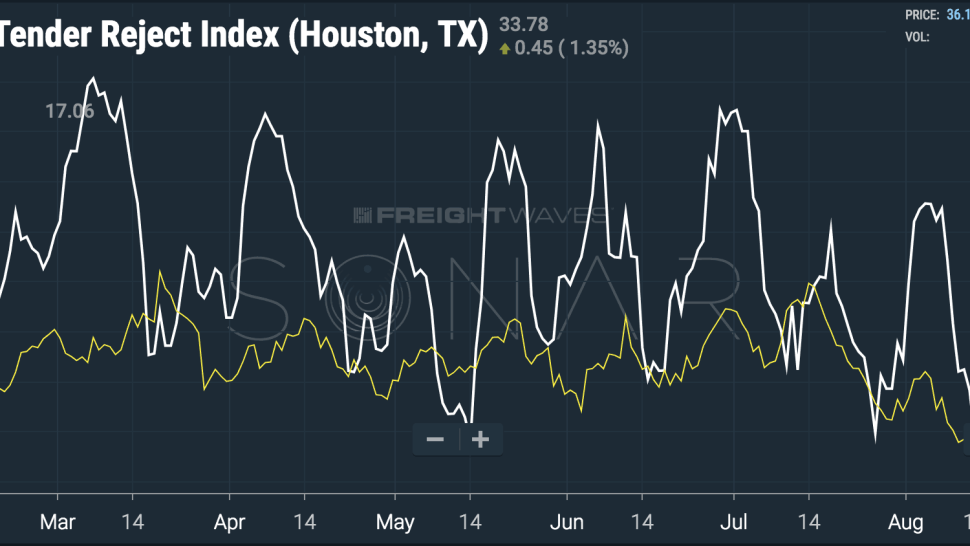
Houston, we have a problem – the Houston reefer market has shown a pattern of extreme volatility for the last several months, with no apparent end in sight.
Since the beginning of the year, the reefer tender rejection index for Houston (RTRI.HOU) shows dramatic increases and decreases in an almost predictable pattern. The overall reefer tender rejection has decreased significantly year to date, falling from a high of nearly 60% in the first quarter to a much more agreeable 33% in August. While this decrease in rejection rates over time would lead one to believe the market has stabilized, rejection rates are volatile each month in an observable pattern.
In June alone, the Houston experienced two surges of reefer tender rejection. Between May 28 and June 6, reefer rejections increased by 72.2%. Again, between June 14 and June 28, there was a staggering 107.16% increase in reefer tender rejections. June was a hot month for freight overall, so it may be tempting to explain away these increases as a result of higher volume and lower capacity. However, similar patterns occurred in July and even into August though the freight volumes have slowed considerably. Between July 25 and August 5 there was a 112.59% increase in reefer rejections. For comparison, van tender rejection rates actually fell in Houston between those dates by 26.90%. These peaks in rejection rates have not just been observable in the summer months, but date back to the first quarter. Between February 26 and March 7, Houston saw a reefer tender rejection increase of 49.57%. Not nearly as dramatic as the 155.19% increase between May 14 and May 19, but definitely present. Similar peaks occur each month, sometimes even more than once. These surges in rejection rates last between 4 and 15 days, typically in the beginning and middle of the month. End of month typically presents the highest volume of tenders as shippers clear their inventory, so the timing of these surges is even more curious.
The Dallas market has experienced similar peaks and valleys in almost the same date ranges as the Houston market, but the magnitudes have not been nearly as pronounced. For example, between June 15 and July 1, the Dallas market experienced an increase in reefer tender rejections of 22%. Though a far cry from the 101% increase along those same dates in Houston, it does show that other markets are being affected by this volatility, though to a lesser degree.
There are usually two reasons for a carrier to reject a load: the carrier does not have the capacity to meet volume requirements, or they elect to put their trucks on a more attractive lane. The value of a load to a carrier is often determined by two things: length of haul, and price. According to DAT’s RateView tool, reefer spot and contract rates in the south central region have stayed fairly consistent over the last year, ranging from between 2.05 per mile before fuel to 2.25 per mile before fuel. The exception to this lies in lanes that stay in the same region. For loads moving from the south central region to other parts of the south central region, the rates are elevated to as much as 2.80 per mile. Though this per mile rate is higher, carriers are actually more likely to take a load with a lower rate per mile if the lane has more miles overall. For a driver, there are two keys to happiness: miles and money.
Keeping this in mind, the volatility could be due in part to an increase of lanes in the Houston market that are more attractive than regional lanes. Anheuser-Busch is one of the largest reefer shippers in the Houston market. According to their website, their Houston facility handles domestic shipments that either stay in Texas, or ship to Louisiana or Mississippi. These shorter hauls may be less lucrative for drivers than lanes from other competing shippers on lanes to the northeast or the Midwest. For example, according to DAT RateView, contract lanes from the Houston market to the New Orleans market paid around 2.80 per mile on average in the last year. The rate is good, but the mileage is short. Drivers would be more likely to wait on spot lanes with more miles, even at a lower per mile rate. The average spot rate from the Houston market to the Philadelphia market was 2.43 per mile in the last year, for example.
There are other factors at play in the market as well. These patterns could also be due to an influx of volume on a weekly or biweekly basis from one or several shippers in the area. The shippers could be adjusting to this lack of capacity slowly, which would account for rejection of tenders gradually decreasing with monthly spikes in between.
While seasonality can often account for these types of fluctuations, this regularity cannot be explained by a few seasonal commodities – the pattern is too established.It stands to reason that the reefer tender rejections would have increased in the summer months overall, due to produce season and the additional volume. However, the reefer tender rejection rates have only declined since January, in spite of large spikes in May and June.
When there are higher volumes of rejected tenders, loads will often end up in the spot market in order for the freight to be serviced and rates can increase. For shippers, this volatility can pose a number of problems as far as coverage and servicing shipments. For brokers, this volatility can present opportunity. While the underlying cause is still a mystery, only time will tell if this volatility pattern will continue through the remainder of 2018.
Brokerage Compliance Symposium
The day before F3. Every compliance issue you face - fraud exposure, carrier liability, FMCSA rules, cargo theft, insurance gaps - navigated by attorneys and operators defining best practices in a changing industry.
F3 Awards Dinner
The night before F3. FreightTech100 companies honored. FreightTech 25 and Shipper of Choice winners revealed live. Cocktail reception into dinner and live music - 300 industry leaders in one purpose-built room.
F3: Future of Freight Festival
Industry-defining keynotes, rapid-fire technology demos, and industry leaders networking in experiences across Chattanooga - plus the inaugural F3 Awards Dinner featuring the FreightTech and Shipper of Choice reveals.
The day before F3. Every compliance issue you face - fraud exposure, carrier liability, FMCSA rules, cargo theft, insurance gaps - navigated by attorneys and operators defining best practices in a changing industry.
The Signal at Chattanooga Choo Choo • Chattanooga, TN Register NowThe night before F3. FreightTech100 companies honored. FreightTech 25 and Shipper of Choice winners revealed live. Cocktail reception into dinner and live music - 300 industry leaders in one purpose-built room.
The Signal at Chattanooga Choo Choo • Chattanooga, TN Register NowIndustry-defining keynotes, rapid-fire technology demos, and industry leaders networking in experiences across Chattanooga - plus the inaugural F3 Awards Dinner featuring the FreightTech and Shipper of Choice reveals.
The Signal at Chattanooga Choo Choo • Chattanooga, TN Register Now