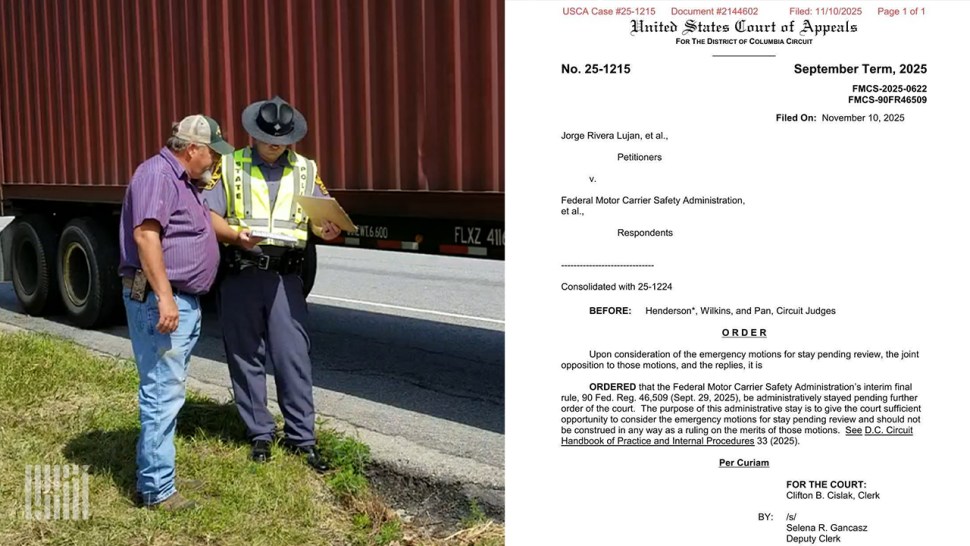
The federal government’s most aggressive commercial licensing enforcement action in years sits in legal limbo after a federal appeals court determined FMCSA likely violated multiple legal requirements when it attempted to strip approximately 200,000 drivers of their commercial privileges.
The U.S. Court of Appeals for the District of Columbia Circuit delivered two decisive blows to DoT’s emergency rulemaking within days. On November 10, a three-judge panel issued an administrative stay blocking implementation of the interim final rule titled “Restoring Integrity to the Issuance of Non-Domiciled Commercial Drivers Licenses” (90 Fed. Reg. 46,509). The order in Rivera Lujan v. FMCSA (Case No. 25-1215, consolidated with 25-1224) was not unanimous, Circuit Judge Karen LeCraft Henderson dissented, signaling early disagreement about whether the stay was warranted.
Three days later, on November 13, the court upgraded that procedural pause to a full emergency stay pending judicial review, with the majority finding petitioners “likely to succeed” on multiple claims that FMCSA violated federal law, acted arbitrarily, and failed to justify bypassing standard rulemaking procedures.
Understanding What FMCSA Bypassed
The controversy centers partly on how FMCSA implemented the rule, not just what the rule requires. Under the Administrative Procedure Act, federal agencies must follow specific procedures when creating regulations that affect the public. This typically means:
Standard Rulemaking Process:
- Notice of Proposed Rulemaking (NPRM): The agency publishes proposed rules in the Federal Register, explaining the problem, proposed solution, legal authority, and regulatory impact analysis.
- Public Comment Period: The agency must allow at least 30-60 days (often longer for complex rules) for public input. Industry stakeholders, affected individuals, state agencies, safety advocates, and any interested party can submit comments raising concerns, providing data, or suggesting modifications.
- Agency Response: FMCSA must review and consider all substantive comments, addressing major concerns in the final rule’s preamble. This often results in modifications based on industry feedback or additional data.
- Final Rule Publication: After considering comments, the agency publishes the final rule with an effective date (typically 30+ days out), giving affected parties time to prepare for compliance.
- State Consultation: For CDL-related rules, federal law specifically requires FMCSA to consult with states before establishing standards, a recognition that states actually administer licensing programs and implementation requires coordination.
This process typically takes 6-18 months, sometimes longer for controversial or complex regulations. The deliberate pace serves important purposes: it prevents hasty decisions, surfaces unintended consequences, incorporates stakeholder expertise, and ensures affected parties can prepare for changes.
What FMCSA Did Instead:
FMCSA issued an “interim final rule” on September 29, 2025, effective immediately. The agency invoked “good cause” exceptions under 5 U.S.C. § 553(b)(B), claiming that notice-and-comment procedures were “impracticable, unnecessary, or contrary to the public interest” given urgent safety concerns.
The rule took effect the moment it was published. No advance notice, no comment period before implementation, no state consultation. Approximately 200,000 drivers lost eligibility to renew their CDLs overnight.
FMCSA did open a post-implementation comment period (Docket No. FMCSA-2025-0622), allowing feedback after the rule already took effect, but this inverts the normal process where agencies consider input before finalizing regulations. As of late November, over 7,200 comments had been submitted, but the rule’s immediate effectiveness meant drivers faced license denials while the agency theoretically considered whether the rule should exist.
Why Emergency Procedures Exist, And Their Limits
Emergency rulemaking authority serves legitimate purposes. When agencies discover immediate threats, contaminated food, unsafe vehicles, imminent security risks, waiting months for standard procedures could allow ongoing harm. The “good cause” exception lets agencies act quickly when genuinely necessary.
But courts scrutinize emergency claims carefully. Agencies can’t manufacture urgency from problems they tolerated for years. They can’t bypass procedures simply because following them would be inconvenient or might generate opposition. They must demonstrate that immediate implementation addresses genuine emergencies where delay would cause concrete harm.
FMCSA argued advance notice would trigger a “concentrated surge” of non-domiciled CDL applications from individuals rushing to obtain credentials before new restrictions took effect. The agency pointed to historical precedent, when the Entry-Level Driver Training rule’s effective date approached in February 2022, CDL applications spiked as people sought to avoid new requirements.
The agency also cited five fatal crashes involving non-domiciled CDL holders with questionable qualifications, state compliance audit results showing widespread licensing failures, and fundamental verification gaps allowing drivers with unknown foreign driving histories to obtain U.S. commercial privileges. FMCSA characterized these as immediate safety threats requiring emergency response.
The Genesis of Crisis
The non-domiciled CDL program was designed as a limited exception allowing non-U.S. residents engaged in interstate commerce to obtain commercial driving privileges. Over two decades, what began as a narrowly tailored program evolved into what critics describe as a licensing vulnerability exploited by states with inadequate verification protocols.
State implementation varied wildly. Some jurisdictions maintained rigorous standards matching or exceeding those for domiciled licenses. Others operated what became credential mills, issuing CDLs with minimal verification of training, driving experience, or even basic identity documentation. The problem compounded incrementally while FMCSA’s compliance review process, designed specifically to catch these failures, proved inadequate.
California’s admission that it issued approximately 20,000 non-domiciled CDLs violating its own state laws illustrates how completely verification safeguards had broken down in some jurisdictions. FMCSA’s emergency rulemaking identified six states with “substantial” compliance failures: California, Illinois, Nevada, New York, Pennsylvania, and South Dakota. But the agency’s data suggests problems extended beyond those jurisdictions.
The critical question isn’t whether problems existed, they clearly did. The questions are whether those problems justified FMCSA’s chosen remedy, whether the remedy would actually improve safety, and whether the agency followed legal requirements when implementing it.
The Legal Challenge
Public Citizen Litigation Group filed suit October 20 on behalf of Jorge Rivera Lujan, a DACA recipient who came to the U.S. at age two, has driven commercially for eleven years, operates his own small fleet, and faced CDL renewal denial under the new rule, along with Aleksei Semenovskii, an asylum seeker, and unions representing government employees and teachers. King County, Washington joined separately (Case No. 25-1224, later consolidated), citing impacts on public transit operations employing non-domiciled CDL holders.
The petitioners’ emergency motion argued FMCSA violated multiple legal requirements:
Failure to Consult States: The Commercial Motor Vehicle Safety Act requires FMCSA to consult with states before establishing CDL standards. This isn’t advisory, it’s mandatory. States administer licensing programs, and implementation requires their cooperation and input. FMCSA claimed consultation wasn’t “practicable” given time constraints and that compliance costs to states wouldn’t be “substantial,” suggesting these factors exempted the agency from the requirement.
Insufficient Emergency Justification: The Administrative Procedure Act’s “good cause” exception requires demonstrating that notice-and-comment procedures are “impracticable, unnecessary, or contrary to the public interest.” Courts interpret this narrowly, agencies must show genuine emergencies, not merely that following procedures would be inconvenient or time-consuming. Petitioners argued FMCSA failed to meet this threshold, pointing to the agency’s own admission it lacked “sufficient evidence, derived from well-designed, rigorous, quantitative analyses, to reliably demonstrate a measurable empirical relationship between the nation of domicile for a CDL driver and safety outcomes in the United States.”
Arbitrary and Capricious Action: Under the APA, agencies must provide reasoned analysis for regulatory decisions, consider relevant factors, and explain choices made. The lawsuit claimed FMCSA failed to articulate how the rule improves safety, didn’t adequately consider less restrictive alternatives, and ignored serious harm to drivers who built careers and businesses under existing regulations.
Constitutional Concerns: Petitioners raised equal protection arguments, claiming the rule discriminates based on citizenship status without adequate justification, particularly troubling given FMCSA’s concession that immigration status doesn’t correlate with driving safety.
What The Court Found
The November 10 administrative stay was procedural, simply pausing the rule to give the court time to consider the emergency motions without prejudging merits. But Judge Henderson’s noted dissent even at this stage signaled disagreement about whether temporary relief was appropriate.
The November 13 emergency stay order delivered far more substantive analysis. The court didn’t just pause the rule, it found petitioners likely to prevail on multiple claims, a significant indicator of judicial skepticism toward FMCSA’s approach.
On State Consultation: The court rejected FMCSA’s attempt to bypass statutory requirements, finding the agency’s “rationale is plainly flawed.” The law requires state consultation for CDL standards. It “contains no exceptions for insubstantial costs or impracticability.” FMCSA “conceded in the rulemaking that the Commercial Motor Vehicle Safety Act subjects this rule to the state-consultation requirement” but tried to avoid it anyway. The court wasn’t persuaded.
On Emergency Justification: The court highlighted devastating contradictions in FMCSA’s own data. According to the agency’s figures, non-domiciled CDL holders represent approximately five percent of all CDL holders but account for only 0.2 percent of fatal crashes. The court compared the five crashes FMCSA cited to the agency’s estimate of 2,399 fatal crashes involving large trucks and buses through September 26, 2025, noting the statistical insignificance of the highlighted incidents.
FMCSA’s own rulemaking admitted it lacked “sufficient evidence, derived from well-designed, rigorous, quantitative analyses” connecting domicile status to safety outcomes. The agency relied on anecdotal crashes rather than systematic analysis, exactly the kind of evidence courts typically find insufficient to justify emergency rulemaking.
On Safety Benefits: The court questioned whether the rule would generate any safety improvement at all. FMCSA projected that displaced non-domiciled drivers would “exit the market within approximately two years as their credential comes up for renewal, and that the market will respond to this change in capacity as it has in the past, with rates adjusting and drivers and carriers entering the market where needed.”
The court observed that “given the FMCSA’s anticipation that less-experienced drivers would replace the non-domiciled ones forced out of the market, it does not appear to have shown that the rule would produce any net safety benefit.” This is devastating analysis, FMCSA admitted replacement drivers would likely be less experienced, but couldn’t explain how replacing experienced drivers with inexperienced ones improves highway safety.
On Arbitrary and Capricious Standards: The court found FMCSA failed to “articulate a satisfactory explanation” for how the rule promotes safety. The agency also failed to adequately consider harm to drivers with “serious reliance interests” who built lives and businesses under existing regulations permitting their employment.
The rulemaking suggested displaced drivers could find “similar employment in other sectors” with “some de minimis costs” but provided no evidence supporting these assumptions. The court found this cavalier dismissal of economic harm to 200,000 workers inadequate.
Judge Henderson’s Dissent: Henderson argued emergency stay was inappropriate and issues should be resolved through expedited merits review rather than preliminary injunctive relief. She emphasized FMCSA’s concern about drivers with “unchecked driving histories” operating commercial vehicles and cited historical application surges when requirement changes were announced in advance, specifically the rush before February 2022 Entry-Level Driver Training requirements took effect.
Henderson found the agency’s safety concerns reasonable and its emergency justification sufficient, writing: “It should go without saying that our Nation’s roadways are safer the fewer people there are operating eighteen-wheelers, buses and delivery trucks with unchecked driving histories.”
The majority wasn’t persuaded by these arguments. Two judges found the petitioners met the “stringent requirements for a stay pending court review”, suggesting FMCSA’s justifications failed to overcome serious legal deficiencies.
Current Status and Practical Reality
The November 13 stay blocks the interim final rule while litigation proceeds. States can continue issuing non-domiciled CDLs under pre-September 29 regulations, except states under corrective action plans must maintain their pauses until demonstrating compliance with FMCSA’s pre-rule regulations.
This creates messy practical complications. Some states complied immediately with DOT’s September directive, reviewing programs and pausing issuance. Others resisted or moved more slowly. Even after the court’s clear directive, many states remain reluctant to resume non-domiciled CDL issuance.
Jorge Rivera Lujan attempted to renew his CDL at Utah DMV days after the November 10 administrative stay. Despite the court order and FMCSA’s notification to states about the pause, Utah refused, a decision Lujan documented on TikTok. Overdrive’s survey of more than a dozen states found not one willing to issue non-domiciled CDLs despite the stay, citing ongoing uncertainty about compliance requirements and corrective action expectations.
Pennsylvania confirmed it hadn’t restarted non-domiciled CDL issuance, stating the state paused “as directed by FMCSA when they issued the IFR” and will “continue to review our next steps relative to non-domiciled CDLs and CLPs.” South Dakota said it found and corrected six discrepancies from the audit but keeps issuance on hold while ensuring compliance with FMCSA guidance.
This highlights the fundamental disconnect between legal rulings and on-the-ground implementation. Approximately 200,000 drivers remain in limbo, their credentials technically valid under court order but practically inaccessible for renewal in many jurisdictions.
The Comment Period and What Comes Next
FMCSA kept its public comment docket open through November 28, accepting feedback on Docket No. FMCSA-2025-0622 even while the rule sits stayed by court order. Over 7,200 comments were submitted, ranging from strong support to vehement opposition.
Supporters, including OOIDA and many individual truckers, emphasized safety concerns and licensing integrity. One commenter wrote: “I strongly support the FMCSA amendment to restrict the issuance of CDLs to foreign-domiciled drivers. A CDL should only be issued on the basis of full compliance with FMCSA rules and regulations… The recent uptick in violent crashes involving drivers unable to properly communicate with law enforcement and safety personnel is of great concern.”
Opponents argued the rule discriminates against legally authorized workers, lacks evidentiary foundation, and causes severe economic harm without corresponding safety benefits.
Recent reports indicate FMCSA requested the lawsuit be paused until an updated final rule is issued, suggesting DoT plans to address the court’s concerns through revised rulemaking that includes state consultation and strengthened safety justification. Petitioners apparently agreed to this approach.
This tactical retreat makes strategic sense. Rather than fighting uphill litigation on a rule the court signaled will likely fail, FMCSA can incorporate state input, strengthen its evidentiary foundation, and re-issue regulations through proper procedures. The question is whether any revised rule can overcome the fundamental problems the court identified, particularly the lack of statistical evidence connecting non-domiciled status to crash risk and the likelihood that replacing experienced drivers with inexperienced ones produces no net safety benefit.
What Standard Rulemaking Would Look Like
If FMCSA withdraws the interim final rule and starts fresh with proper procedures, the process would look substantially different:
Notice of Proposed Rulemaking: FMCSA would publish detailed analysis explaining the problem (state licensing failures, verification gaps), proposed solutions (enhanced requirements for non-domiciled CDLs), legal authority, regulatory impact assessment, and alternatives considered. This document might run 50-100+ pages in the Federal Register.
State Consultation: Before or concurrent with the NPRM, FMCSA would consult with state licensing agencies through the Commercial Driver’s License Program (CDLP) and American Association of Motor Vehicle Administrators (AAMVA). States would provide input on implementation challenges, cost implications, technical feasibility, and alternative approaches.
Extended Comment Period: Given the rule’s significance affecting 200,000 drivers and all 50 state licensing programs, FMCSA would likely provide 60-90 days for public comment. Industry associations, labor unions, individual drivers, carriers, states, safety advocates, and other stakeholders would submit detailed analyses.
Public Hearings: For controversial rules, FMCSA sometimes holds public hearings allowing oral testimony. Given the attention this issue has received, hearings would likely occur in multiple regions.
Comment Analysis and Response: FMCSA would review thousands of comments, categorize substantive issues raised, and address them in the final rule’s preamble. Significant concerns might lead to modifications in the final rule.
Regulatory Impact Analysis: More rigorous economic analysis would be required, including detailed assessment of costs to drivers, carriers, and states, analysis of safety benefits using actual data rather than anecdotes, and consideration of alternatives.
Final Rule with Delayed Effective Date: The final rule would include responses to major comments, any modifications based on feedback, and an effective date 30-60+ days out, giving affected parties time to prepare.
This process would take 12-18 months minimum, possibly longer given the complexity and controversy. But it would produce a legally defensible rule incorporating stakeholder input and addressing the court’s concerns about rushed implementation without adequate justification.
Likelihood of Success for Current and Future Rules
The interim final rule as written faces 70-80% probability of being struck down or substantially modified if litigation continues. The court’s willingness to grant emergency stay with detailed findings on likely success strongly suggests the current rule cannot survive judicial scrutiny on multiple independent grounds.
A revised rule following proper procedures faces different odds, perhaps 50-60% success depending on how effectively FMCSA addresses fundamental problems:
What Would Help: Rigorous statistical analysis demonstrating correlation between verification gaps and crash risk. Evidence that enhanced verification requirements (rather than categorical bans) can’t adequately address safety concerns. Detailed state consultation showing implementation feasibility. Economic analysis acknowledging real harm to drivers but justifying it with concrete safety benefits. Clear explanation of how the rule improves safety given that replacement drivers will likely be less experienced.
What Won’t Help: Continued reliance on anecdotal crashes without statistical support. Failure to demonstrate why enhanced verification requirements for ALL CDL programs (domiciled and non-domiciled) wouldn’t address the actual problem, credential integrity. Inability to explain net safety benefit when experienced drivers are replaced with inexperienced ones. Dismissing economic harm to 200,000 workers as “de minimis” without evidence.
The most likely outcome involves FMCSA withdrawing or substantially revising the interim final rule, conducting proper notice-and-comment rulemaking with genuine state consultation, and implementing enhanced verification requirements that apply to both domiciled and non-domiciled programs rather than categorical prohibitions based on domicile status.
What This Really Addresses
The controversy exposes necessary reforms to commercial licensing oversight regardless of litigation outcomes. The non-domiciled program’s failures revealed gaps in federal-state coordination, insufficient compliance review processes, and inadequate enforcement when states fail to maintain standards.
Secretary Duffy’s commitment to keeping unqualified drivers off American roads reflects appropriate focus on qualification standards. The fundamental issue isn’t where drivers live, it’s whether licensing agencies properly verify that credentials represent genuine competency and training.
Strengthening the system requires parallel efforts:
Rigorous Compliance Reviews: State CDL programs (domiciled and non-domiciled) need frequent, comprehensive audits with meaningful consequences for jurisdictions failing to maintain standards. FMCSA’s compliance review process failed to catch California issuing 20,000 non-compliant credentials, that’s a regulatory oversight failure, not just a state failure.
Modernized Verification: Identity verification protocols need standardization and technological enhancement across all fifty states. The underlying problem, inability to verify foreign driving histories, affects domiciled and non-domiciled programs when applicants have international backgrounds.
Enhanced CDL Testing Integrity: Testing must occur under fraud-resistant conditions with proper identity verification, regardless of applicant domicile status. The California cases involving identity fraud could happen in domiciled programs just as easily.
Meaningful Training Standards: Entry-Level Driver Training requirements should be rigorously enforced with verification that training actually occurred and met standards. Again, this applies equally to all CDL applicants.
These improvements address the actual problem, credential integrity, rather than using domicile status as proxy for qualification. A reformed non-domiciled program with proper safeguards could serve legitimate cross-border commerce while protecting highway safety.
For the trucking industry, outcomes matter enormously. Legitimate carriers and qualified drivers benefit from rigorous licensing standards that maintain public confidence. Inadequate credential programs undermine professional integrity and expose responsible operators to unfair competition from unqualified drivers who obtained credentials through compromised systems.
The traveling public deserves assurance that every commercial vehicle operator earned privileges through legitimate qualification processes. That’s not about immigration status, it’s basic highway safety. Fraudulently obtained domiciled CDLs pose identical threats to fraudulently obtained non-domiciled credentials.
Broader Implications
This case will establish important precedents about agency emergency authority, Administrative Procedure Act requirements, and how transportation safety regulations interact with constitutional protections. Beyond immediate questions about 200,000 CDLs, the litigation addresses fundamental issues about regulatory power during claimed crises.
The stakes extend beyond one rule. Courts will define boundaries of administrative power, establish precedent for emergency rulemaking justification, and determine how agencies balance public safety against procedural safeguards and individual rights when claiming urgent circumstances require bypassing standard processes.
Secretary Duffy and FMCSA are defending authority to address genuine safety threats through emergency measures when warranted. That authority serves important purposes beyond this specific controversy. But courts must ensure agencies don’t manufacture emergencies from longstanding problems they previously tolerated, don’t bypass stakeholder input that might surface better solutions, and don’t impose severe consequences on hundreds of thousands of people without rigorous justification.
How courts balance agency flexibility against procedural safeguards will shape regulatory practice for years beyond non-domiciled CDLs. The outcome matters for every future crisis where agencies claim emergency authority to bypass standard procedures in the name of protecting Americans.
The litigation will take months to resolve. Meanwhile, vulnerabilities that prompted DOT’s action persist. That’s the frustrating reality of crisis response in systems designed to balance competing interests and protect individual rights during emergencies. The Administrative Procedure Act and Constitutional due process sometimes slow responses to urgent problems, but those protections also prevent government overreach and ensure better-informed decisions result from incorporating diverse perspectives.
Whether FMCSA’s emergency action was justified response to immediate threats or regulatory overreach manufacturing urgency from longstanding problems it failed to address, that’s ultimately for courts to decide based on evidence, legal standards, and proper application of administrative law principles that govern how federal agencies exercise power affecting millions of Americans.
Brokerage Compliance Symposium
The day before F3. Every compliance issue you face - fraud exposure, carrier liability, FMCSA rules, cargo theft, insurance gaps - navigated by attorneys and operators defining best practices in a changing industry.
F3 Awards Dinner
The night before F3. FreightTech100 companies honored. FreightTech 25 and Shipper of Choice winners revealed live. Cocktail reception into dinner and live music - 300 industry leaders in one purpose-built room.
F3: Future of Freight Festival
Industry-defining keynotes, rapid-fire technology demos, and industry leaders networking in experiences across Chattanooga - plus the inaugural F3 Awards Dinner featuring the FreightTech and Shipper of Choice reveals.
The day before F3. Every compliance issue you face - fraud exposure, carrier liability, FMCSA rules, cargo theft, insurance gaps - navigated by attorneys and operators defining best practices in a changing industry.
The Signal at Chattanooga Choo Choo • Chattanooga, TN Register NowThe night before F3. FreightTech100 companies honored. FreightTech 25 and Shipper of Choice winners revealed live. Cocktail reception into dinner and live music - 300 industry leaders in one purpose-built room.
The Signal at Chattanooga Choo Choo • Chattanooga, TN Register NowIndustry-defining keynotes, rapid-fire technology demos, and industry leaders networking in experiences across Chattanooga - plus the inaugural F3 Awards Dinner featuring the FreightTech and Shipper of Choice reveals.
The Signal at Chattanooga Choo Choo • Chattanooga, TN Register Now