





J.B. Hunt Transport Services remains focused on improving its freight profile and removing costs as it awaits a positive inflection in demand.
The Lowell, Arkansas-based company reported earnings per share of $1.31 for the second quarter, which was largely in line with analysts’ expectations and flat year over year.
Consolidated revenue of $2.93 billion was also flat y/y and in line with the consensus estimate. Operating income slid 4% to $197 million but margins have largely stabilized across its various business units.
The multimodal transportation provider has identified $100M in cost takeouts, which include a variety of efficiency and asset utilization improvement initiatives. Some of the reductions will be realized this year with the bulk occurring next year.

Intermodal sees another mixed-bag quarter
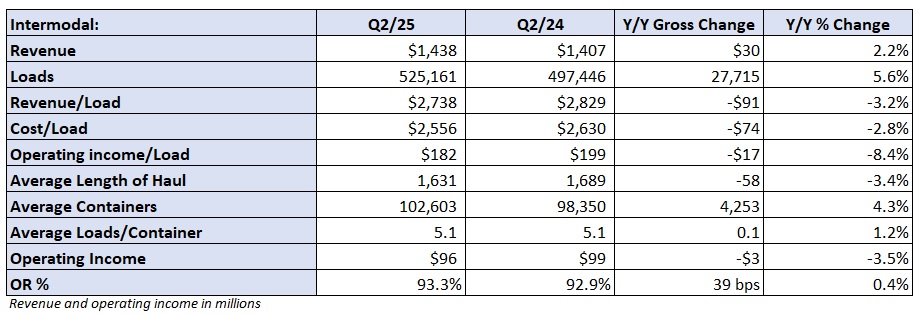
J.B. Hunt’s (NASDAQ: JBHT) intermodal revenue increased 2% y/y to $1.44 billion as loads increased 6% and revenue per load fell 3%. A 15% jump in loads originating in the East weighed on the yield metric given a shorter length of haul. Transcontinental loads were down 1% in the quarter. By month, loads were up 11% y/y in April, 3% in May and 4% in June.
By comparison, total intermodal traffic on the U.S. Class I railroads was up 2% y/y (container-only traffic was up 3%) during the quarter, according to the Association of American Railroads.
The choppiness in load trends during the quarter was largely due to changing customer behaviors in reaction to the trade war.
Some of J.B. Hunt’s customers have pulled freight shipments forward while others have not. Other customers have changed where they source their goods, away from countries that are likely to see punitive tariffs from the U.S. The changes in customer demand pushed J.B. Hunt to pull forward its peak season surcharge programs this year.
During the recent intermodal bid season, the company captured positive rate increases for the first time in two years. However, positive pricing in head haul lanes, was partially offset by pricing weakness in back haul lanes. While management was hopeful for bigger rate increases, it said the modest increases it received along with a reduction in its cost profile has allowed it to stabilize margins in the unit.
The unit’s operating ratio (inverse of operating margin) deteriorated 40 basis points y/y to 93.3%. The result was 30 bps better than the first quarter.
Dedicated unit to return to net truck additions
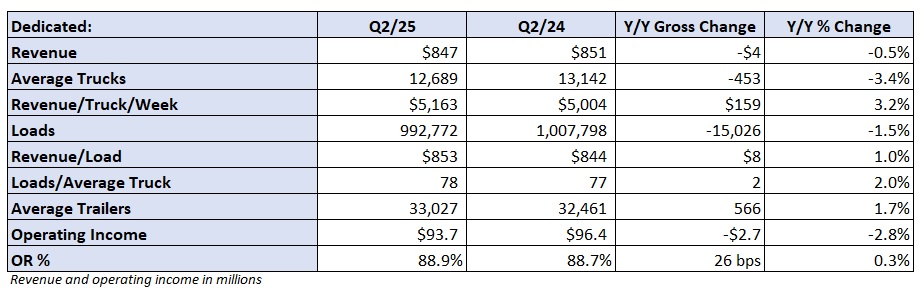
Dedicated revenue dipped less than 1% y/y to $847 million as a 3% decline in average trucks in service was largely offset by a 3% increase in revenue per truck per week (up 5% excluding fuel surcharges).
The company sold service on 275 trucks during the quarter, all of which was offset by customer attrition. It said planned account closures covering 85 trucks spilled into July, which positively impacted the period. The delays, however, could impact a prior expectation for y/y operating income growth in the unit this year.
J.B. Hunt reiterated a longer-term goal for net growth of 800 to 1,000 units annually. It expects to return to net fleet growth in the back half of this year.
The unit’s OR was 30 bps worse y/y at 88.9%.
Brokerage logs 10th straight operating loss, cost profile improves
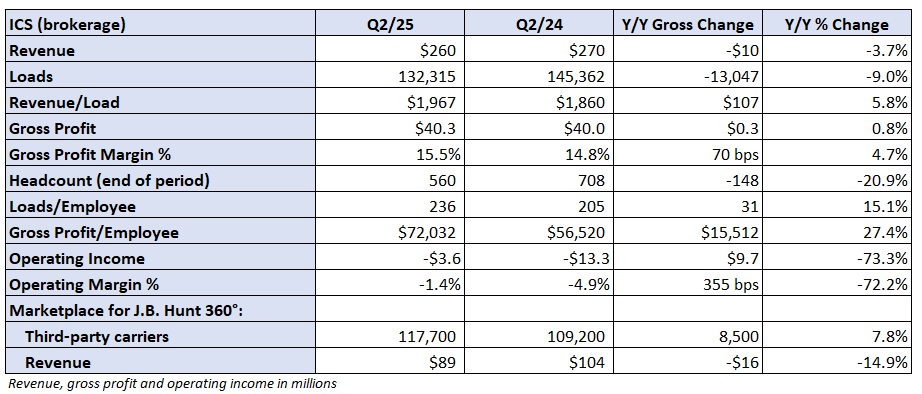
The second quarter marked 10 straight operating losses for the brokerage unit. The segment booked a $3.6 million loss in the period, nearly $10 million better y/y but $1 million worse than the first quarter.
Revenue declined 4% y/y to $260 million as a 9% decline in loads was partially offset by a 6% increase in revenue per load.
May saw some market tightening due to an annual safety blitz known as Roadcheck. That led to compressed margins during the month as purchased transportation expenses increased around the event. However, margins improved in June as spot rates softened. Recent account awards in the unit carried low- to mid-single-digit rate increases.
A portion of the consolidated cost reduction plan is tied to cost takeouts in the brokerage unit. Head count was down 21% y/y (nearly level with the first quarter at 560 employees). Loads per employee in the unit grew 15% y/y and gross profit per employee was up 27% y/y.
Shares of JBHT were off 1.1% in after-hours trading on Tuesday following a 2.2% decline during the full-day session.
Brokerage Compliance Symposium
The day before F3. Every compliance issue you face - fraud exposure, carrier liability, FMCSA rules, cargo theft, insurance gaps - navigated by attorneys and operators defining best practices in a changing industry.
F3 Awards Dinner
The night before F3. FreightTech100 companies honored. FreightTech 25 and Shipper of Choice winners revealed live. Cocktail reception into dinner and live music - 300 industry leaders in one purpose-built room.
F3: Future of Freight Festival
Industry-defining keynotes, rapid-fire technology demos, and industry leaders networking in experiences across Chattanooga - plus the inaugural F3 Awards Dinner featuring the FreightTech and Shipper of Choice reveals.
The day before F3. Every compliance issue you face - fraud exposure, carrier liability, FMCSA rules, cargo theft, insurance gaps - navigated by attorneys and operators defining best practices in a changing industry.
The Signal at Chattanooga Choo Choo • Chattanooga, TN Register NowThe night before F3. FreightTech100 companies honored. FreightTech 25 and Shipper of Choice winners revealed live. Cocktail reception into dinner and live music - 300 industry leaders in one purpose-built room.
The Signal at Chattanooga Choo Choo • Chattanooga, TN Register NowIndustry-defining keynotes, rapid-fire technology demos, and industry leaders networking in experiences across Chattanooga - plus the inaugural F3 Awards Dinner featuring the FreightTech and Shipper of Choice reveals.
The Signal at Chattanooga Choo Choo • Chattanooga, TN Register Now