The benchmark diesel price used for most fuel surcharges has risen for the 12th consecutive week, with few prospects of it stopping its relentless climb anytime soon.
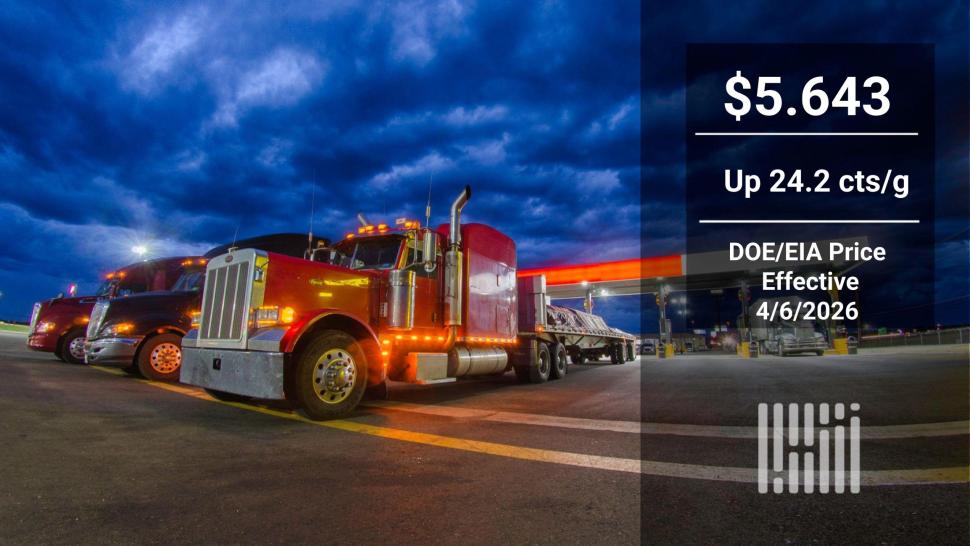
The Department of Energy/Energy Information Administration average weekly retail diesel price rose 24.2 cents/gallon, effective Monday but published Tuesday, to $5.643/g. During those 12 weeks, which started to see increases in anticipation of the Iran war before the shooting actually began in late February, the DOE/EIA price has added $2.184/g
The latest price is the highest since July 4, 2022, when it was $5.675/g. That was during a long string of prices more than $5/g during the post-pandemic surge in inflation. The high price during that time was $5.81/g on June 20.
Absent a stunning turnaround in oil markets in the next few days, it is likely that the 12-week run of increases will stretch to at least 13 weeks. There are essentially no signs of weakening coming from the futures market for ultra low sulfur diesel (ULSD) on the CME commodity exchange, and the numbers in physical markets from around the world for crude or products to be delivered in a shorter time span are sending out even stronger signals for higher prices.
Futures market up again Tuesday
ULSD at approximately 10 a.m. EDT Tuesday morning was trading at $4.4141, up 8.57 cts/ from Monday’s close, an increase of 1.98%. It has been as high as $4.5841/g Tuesday.
ULSD settled April 1 at $4.0568/g. It soared more than 30 cts/g the next day, did not trade Friday due to Good Friday, and fell slightly Monday. But even that Monday settlement of $4.3284/g was still well above the April 1 settlement, and was higher than the strong closing numbers for the April contract in the final day of trading in March.
But the futures market is only one indicator of what is happening to diesel markets. Oil is in an enormous structure known as backwardation, where the nearest delivery dates for crude or products carry the highest prices. The steepness of the backwardation is near historic levels.
ULSD on CME is trading May barrels for delivery into New York harbor. Those dates could be in early May; they could be in late May. The backwardation means the futures price will be lower than what is going on in the physical market for oil to be delivered in a short-term window.
Physical markets are running higher than futures
Mike Wirth, the CEO of Chevron, was quoted as saying at the recent CERAWeek conference in Houston that the futures market was not reflecting everything going on in that more short-term physical world. “There are very real, physical manifestations of the closure of the Strait of Hormuz that are working their way around the world and through the system that I don’t think are fully priced into the futures curves on oil,” Wirth said.
Energy economist Philip Verleger, who has long focused on diesel as an overlooked part of the forces that drive oil prices, was more stark in his weekly report.
Citing numbers from the close of business April 2, the last day of trading before Good Friday, Verleger said ultra low sulfur diesel in New York was $188/b. The settlement that day on CME was about $183/b.
Big numbers elsewhere
But the U.S. is likely to be the last place where rising physical diesel prices wash over the world from Asia on out. And in those areas, the prices are a lot higher, according to Verleger.
“European consumers confronted a price of almost $220 per barrel for the same product, a premium of $30 to New York,” Verleger wrote of that April 2 market. “Meanwhile, buyers in Singapore must pay more than $290 per barrel, a premium of $110 to New York and $150 to spot supplies in Chicago.”
“Prices in all markets hovered around $100 per barrel at the end of February 2026,” he wrote. “In the following five weeks, prices in Singapore tripled, prices in Europe rose by more than 100%, and prices in the US increased by 80%.”
Gas stations in Asia are limiting sales per customer and some businesses are curtailing operations, according to a Tuesday article in The Wall Street Journal.
Verleger makes the point that the loss of diesel supplies from exports out of the Persian Gulf have been softened somewhat by an easing of sanctions on Russian exports–that country is a major diesel supplier–and large quantities of oil held in inventory at sea, which was the market’s situation when the war began.
“For a time, refiners can replace the missing crude with the Russian and Iranian oil held at sea,” Verleger wrote. “However, diesel supplies will decline further as summer begins if the strait remains closed. In that case, the decline in diesel will at least double to roughly 3 million barrels per day.”
Verleger’s analysis draws on a rough estimate that diesel exports out of the Strait of Hormuz before the war were likely to be about 1.5 million b/d, though he concedes there is no firm figure on the level of exports.
The wide price gaps between the U.S. and the rest of the world inevitably means that the arbitrage window is wide open and exports out of the U.S. are incentivized.
The most closely-watched figure going forward will need to be the weekly EIA data on exports. In the week ended March 27, the most recent data released, the U.S. exported 1.406 million b/d of all non-jet distillates. ULSD would be expected to be the vast majority of that.
That was the highest figure since January, when it was above 1.4 million b/d twice, and once was almost 1.5 million b/d. So the figure is relatively high but not extraordinary.
More articles by John Kingston
3 carriers and Kroger blocked hiring of ex-Quickway drivers: lawsuit
Indiana’s new CDL rule pushes ahead on English proficiency
Two solid ‘yes’ votes for Echo Global’s acquisition: Moody’s and S&P
Brokerage Compliance Symposium
The day before F3. Every compliance issue you face - fraud exposure, carrier liability, FMCSA rules, cargo theft, insurance gaps - navigated by attorneys and operators defining best practices in a changing industry.
F3 Awards Dinner
The night before F3. FreightTech100 companies honored. FreightTech 25 and Shipper of Choice winners revealed live. Cocktail reception into dinner and live music - 300 industry leaders in one purpose-built room.
F3: Future of Freight Festival
Industry-defining keynotes, rapid-fire technology demos, and industry leaders networking in experiences across Chattanooga - plus the inaugural F3 Awards Dinner featuring the FreightTech and Shipper of Choice reveals.
The day before F3. Every compliance issue you face - fraud exposure, carrier liability, FMCSA rules, cargo theft, insurance gaps - navigated by attorneys and operators defining best practices in a changing industry.
The Signal at Chattanooga Choo Choo • Chattanooga, TN Register NowThe night before F3. FreightTech100 companies honored. FreightTech 25 and Shipper of Choice winners revealed live. Cocktail reception into dinner and live music - 300 industry leaders in one purpose-built room.
The Signal at Chattanooga Choo Choo • Chattanooga, TN Register NowIndustry-defining keynotes, rapid-fire technology demos, and industry leaders networking in experiences across Chattanooga - plus the inaugural F3 Awards Dinner featuring the FreightTech and Shipper of Choice reveals.
The Signal at Chattanooga Choo Choo • Chattanooga, TN Register Now