




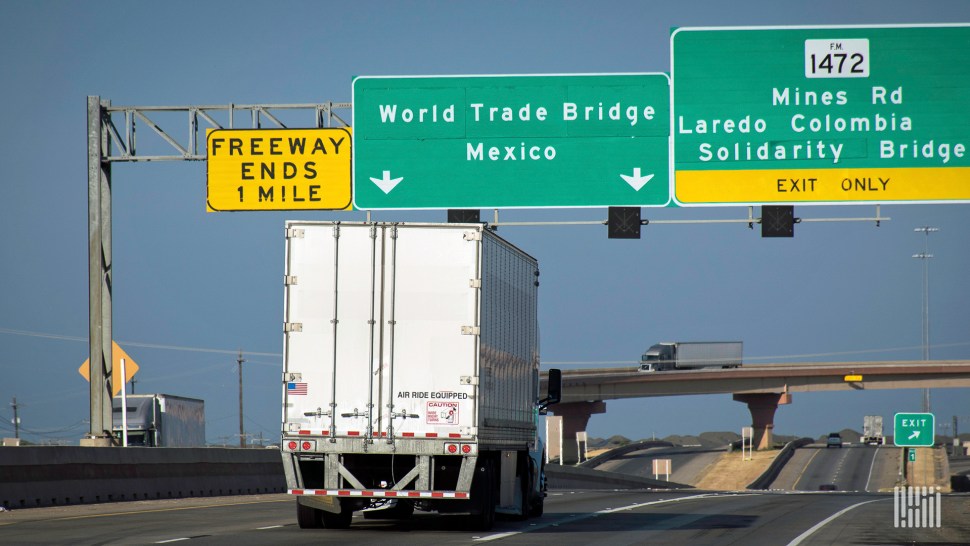
WASHINGTON — Legislation introduced last week could take the Federal Motor Carrier Safety Administration’s recent restrictions on foreign truck drivers to a whole new level.
Join the leaders shaping freight’s future at
F3: Future of Freight Festival, Oct 21-22.
Network with the industry’s best and discover what’s next.
The Protecting America’s Roads Act, introduced by Rep. Beth Van Duyne, R-Texas, is largely aimed at codifying into law FMCSA’s recent Interim Final Rule (IFR) cracking down on non-domiciled commercial driver’s licenses, and by extension foreign truck drivers.

But Van Duyne’s bill would push those restrictions further by attempting to end CDL reciprocity agreements with foreign countries – which currently exist only between Mexico and Canada.
“It is time to end the danger posed by illegal immigrant and foreign national truck drivers who are not capable of safely operating an 18-wheel commercial vehicle or, in many cases, understanding English language warning signs and road instructions,” Van Duyne said in a statement.
“To any state bothered by these new rules and proposed legislation, do our country a favor and stop endangering the lives of Americans with your reckless actions or suffer the consequences of having federal highway funds removed.”
FMCSA has previously determined that CDLs issued by Mexican states and by Canadian provinces, and which conform with those countries’ safety codes, are in compliance with FMCSA’s CDL regulations.
“Under these reciprocity determinations, drivers that live in Canada and Mexico … operate in the United States with the license issued by their country of domicile,” according to FMCSA, thereby prohibiting them from obtaining a non-domiciled CDL from a U.S. state under the “single license” provision.
However, Section 3 of Van Duyne’s legislation states that, not later than six months after enactment, the FMCSA “shall take such actions as are necessary to terminate any existing reciprocity agreements that recognize foreign commercial driver’s licenses in the United States or permit holders of foreign commercial driver’s licenses to operate a commercial motor vehicle in the United States, unless expressly authorized by statute.”
Terminating those agreements would mean that CDLs issued from Canada or Mexico would no longer be considered valid in the U.S., potentially forcing drivers holding those licenses who want to operate across the border to get a new U.S.-recognized credential – most likely a non-domiciled CDL under the new restrictions being enforced by FMCSA.
In addition to terminating reciprocity agreements, the legislation would also ban states from issuing a CDL to an individual not domiciled in that state, as well require CDL applicants to present proof that they are domiciled within the state of registration.
While FMCSA’s IFR requires foreign-jurisdiction applicants for a non-domiciled CDL (or Commercial Learner’s Permit) to have lawful immigration status in the U.S. and provide evidence of lawful immigration status, no proof of domicile is required.
Related articles:
Brokerage Compliance Symposium
The day before F3. Every compliance issue you face - fraud exposure, carrier liability, FMCSA rules, cargo theft, insurance gaps - navigated by attorneys and operators defining best practices in a changing industry.
F3 Awards Dinner
The night before F3. FreightTech100 companies honored. FreightTech 25 and Shipper of Choice winners revealed live. Cocktail reception into dinner and live music - 300 industry leaders in one purpose-built room.
F3: Future of Freight Festival
Industry-defining keynotes, rapid-fire technology demos, and industry leaders networking in experiences across Chattanooga - plus the inaugural F3 Awards Dinner featuring the FreightTech and Shipper of Choice reveals.
The day before F3. Every compliance issue you face - fraud exposure, carrier liability, FMCSA rules, cargo theft, insurance gaps - navigated by attorneys and operators defining best practices in a changing industry.
The Signal at Chattanooga Choo Choo • Chattanooga, TN Register NowThe night before F3. FreightTech100 companies honored. FreightTech 25 and Shipper of Choice winners revealed live. Cocktail reception into dinner and live music - 300 industry leaders in one purpose-built room.
The Signal at Chattanooga Choo Choo • Chattanooga, TN Register NowIndustry-defining keynotes, rapid-fire technology demos, and industry leaders networking in experiences across Chattanooga - plus the inaugural F3 Awards Dinner featuring the FreightTech and Shipper of Choice reveals.
The Signal at Chattanooga Choo Choo • Chattanooga, TN Register Now