




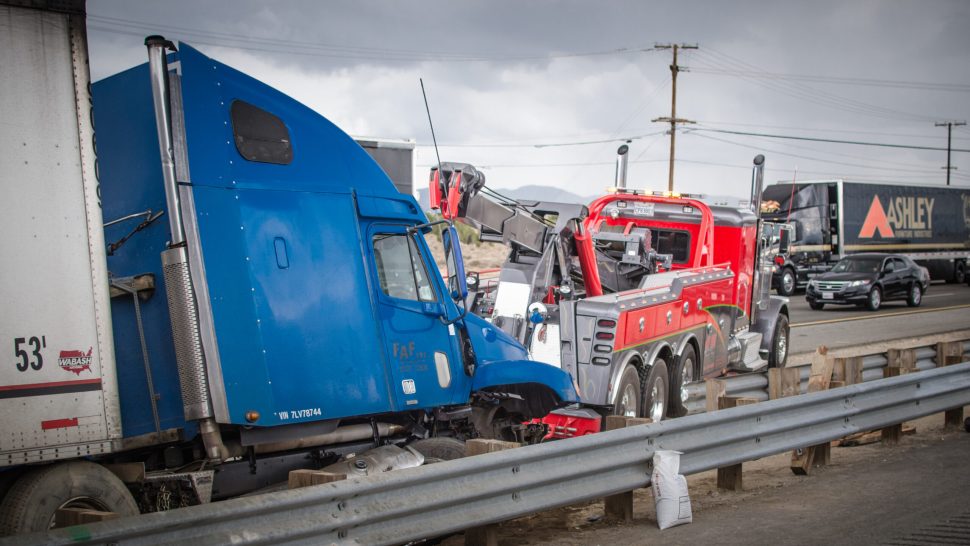
WASHINGTON — Legislation introduced on Wednesday would allow tow truck operators to transport large, disabled trucks to nearby locations instead of being required to disassemble them on the side of the road.
“As someone who ran my own company for decades, I would never want to put the lives of my workers or first responders at risk on the side of the road,” said U.S. Rep. Dave Taylor, R-Ohio, the lead sponsor of the Towing Safety Act, in a press release.
“Accidents and breakdowns on the shoulders of interstates and highways create hazardous conditions for drivers, tow truck operators, and police officers who are responding to an incident. My bill will save lives and ensure safety on our nation’s roads for all drivers by giving tow truck drivers flexibility in responding to wrecked or disabled vehicles in the case of an emergency.”
The bill addresses a regulatory gap in commercial trucking: a tractor-trailer can be legal while driving under its own power, but if it breaks down and is hooked to a wrecker, the combined unit suddenly becomes an illegal over-length load in the eyes of some state regulators. This can result in hefty fines for tow operators or forced, dangerous disconnects on the side of busy highways.
“With semi-trucks being a standard of 70 feet in length, tow truck drivers are rarely able to transport semi-trucks without disassembling them in order to comply with federal regulations,” Taylor’s office pointed out.
The legislation aims to close the gap by amending transportation regulations to establish that a “covered heavy-duty tow and recovery vehicle” is one transporting a wrecked or disabled vehicle to the nearest appropriate repair facility or other location as directed by an agency.
The change would prevent states from imposing overall length limits on a combination of vehicles if the wrecked or disabled vehicle combination was in compliance with length limits at the time and place of the initial disablement.
The bill would also prohibit states from limiting the number of vehicles in a combination during a recovery tow if the initial configuration was legal – a vital provision for towers handling “doubles” or “triples.”
By allowing recovery teams to transport disabled vehicles from the “place where the vehicle became wrecked or disabled” to a repair facility without fear of length violations, the bill helps ensure accident scenes are cleared faster, potentially reducing the risk of secondary crashes – a major hazard for both truckers and first responders.
In addition, the bill addresses infrastructure concerns by requiring that recovery vehicles maintain axle weights and configurations that can safely operate on highway bridges, as determined by the transportation agency of jurisdiction.
Several states have recently passed reforms to curb “predatory towing” and establish weight and length exceptions for heavy-duty truck recovery. Taylor’s bill seeks to codify similar protections into Title 49 of the U.S. Code.
Related articles:
Brokerage Compliance Symposium
The day before F3. Every compliance issue you face - fraud exposure, carrier liability, FMCSA rules, cargo theft, insurance gaps - navigated by attorneys and operators defining best practices in a changing industry.
F3 Awards Dinner
The night before F3. FreightTech100 companies honored. FreightTech 25 and Shipper of Choice winners revealed live. Cocktail reception into dinner and live music - 300 industry leaders in one purpose-built room.
F3: Future of Freight Festival
Industry-defining keynotes, rapid-fire technology demos, and industry leaders networking in experiences across Chattanooga - plus the inaugural F3 Awards Dinner featuring the FreightTech and Shipper of Choice reveals.
The day before F3. Every compliance issue you face - fraud exposure, carrier liability, FMCSA rules, cargo theft, insurance gaps - navigated by attorneys and operators defining best practices in a changing industry.
The Signal at Chattanooga Choo Choo • Chattanooga, TN Register NowThe night before F3. FreightTech100 companies honored. FreightTech 25 and Shipper of Choice winners revealed live. Cocktail reception into dinner and live music - 300 industry leaders in one purpose-built room.
The Signal at Chattanooga Choo Choo • Chattanooga, TN Register NowIndustry-defining keynotes, rapid-fire technology demos, and industry leaders networking in experiences across Chattanooga - plus the inaugural F3 Awards Dinner featuring the FreightTech and Shipper of Choice reveals.
The Signal at Chattanooga Choo Choo • Chattanooga, TN Register Now