




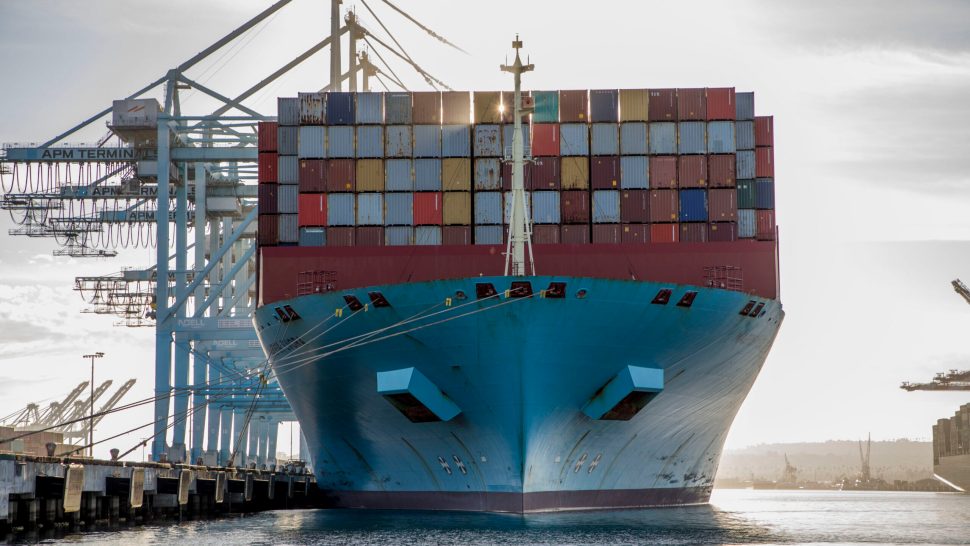
WASHINGTON — A unilateral strategy to prevent foreign ship owners and operators from undercutting America’s trade interests could backfire if US regulators decide to take that approach, shipping giant Maersk warns.
In comments filed in response to the Federal Maritime Commission’s flag registry investigation, Maersk (MAERSKb.CO) recognized the need to crack down on flag states with weak regulations and enforcement measures that can be exploited by vessel owners and operators to undermine fair competition.
But FMC’s effort to raise standards for so-called flags of convenience – registries with relatively little regulatory oversight – could be potentially harmful for the industry, according to Maersk, if the agency were to create its own enforcement regime, such as a national list of “approved” or “unapproved” flag registries.
“International shipping is inherently a cross-border global industry, and only international rules can secure a level playing field,” the company told the agency.
“A situation whereby countries or regional entities start to develop their own lists of approved or banned flags would in our opinion lead to potential situations where certain regions may weaponize national flag lists, also against U.S. interests. This would inevitably lead to more inefficient and more costly global trade patterns.”
Maersk acknowledged that some flag states lack the ability or political will to rigorously enforce standards. It pointed out, however, that existing oversight by the International Maritime Organisation and other international agreements provide a framework for improvement.
“Only by reinforcing the existing international regime can we maintain a level competitive playing field while safeguarding the safety of seafarers, the environment, and the integrity of global trade.”
Global Financial Integrity (GFI), a Washington, DC-based research group specializing in trade-based financial crime, believes the FMC should take the opposite approach. It recommends that the agency establish its own regulations to address the issue.
“GFI believes that [FMC] efforts to influence responsible flagging laws outside the United States will be ineffective,” wrote GFI President and CEO Tom Cardamone, in comments to the agency. “Rather, the United States should take measures … to inoculate against harmful practices most associated with [flags of convenience] ships.”
To support that strategy, Cardamone cited research GFI conducted in 2022 on seizures made by U.S. Customs and Border Protection (CBP) of goods taken from foreign vessels. Between 2018 and 2021, in instances where CBP publicly disclosed the name of the ship, more than half of the cases revealed that the ship was flying a flag of convenience, GFI’s research found.
“Given that about 30 percent of commercial vessels globally fly flags of convenience, we see the higher incidence of [flag of convenience] ships related to CBP seizures as significant,” Cardamone stated.
Based on this data and reports linking flag of convenience ships with a higher likelihood of operating unsafe and non-compliant vessels, GFI recommended, among other things, that FMC, CBP, and the U.S. Coast Guard deem ships flying flags of convenience as “having an inherent increased risk to the United States,” and that the FMC implement regulations that require mandatory safety inspections for all such ships.
Related articles:
Brokerage Compliance Symposium
The day before F3. Every compliance issue you face - fraud exposure, carrier liability, FMCSA rules, cargo theft, insurance gaps - navigated by attorneys and operators defining best practices in a changing industry.
F3 Awards Dinner
The night before F3. FreightTech100 companies honored. FreightTech 25 and Shipper of Choice winners revealed live. Cocktail reception into dinner and live music - 300 industry leaders in one purpose-built room.
F3: Future of Freight Festival
Industry-defining keynotes, rapid-fire technology demos, and industry leaders networking in experiences across Chattanooga - plus the inaugural F3 Awards Dinner featuring the FreightTech and Shipper of Choice reveals.
The day before F3. Every compliance issue you face - fraud exposure, carrier liability, FMCSA rules, cargo theft, insurance gaps - navigated by attorneys and operators defining best practices in a changing industry.
The Signal at Chattanooga Choo Choo • Chattanooga, TN Register NowThe night before F3. FreightTech100 companies honored. FreightTech 25 and Shipper of Choice winners revealed live. Cocktail reception into dinner and live music - 300 industry leaders in one purpose-built room.
The Signal at Chattanooga Choo Choo • Chattanooga, TN Register NowIndustry-defining keynotes, rapid-fire technology demos, and industry leaders networking in experiences across Chattanooga - plus the inaugural F3 Awards Dinner featuring the FreightTech and Shipper of Choice reveals.
The Signal at Chattanooga Choo Choo • Chattanooga, TN Register Now