




Old Dominion Freight Line provided positive commentary around demand on its fourth-quarter call on Wednesday. The less-than-truckload carrier’s leadership said recent customer conversations point to lean inventories, suggesting that improved volumes may be ahead in the new year. January manufacturing data surpassed expectations, lending further support to this constructive outlook.
“We certainly feel like the stars are coming into alignment but we’ve felt that way before,” said CFO Adam Satterfield on the quarterly call with analysts.
Manufacturing data released on Monday showed activity in the industrial complex turned positive for the first time in 12 months. The Purchasing Managers’ Index registered a 52.6 reading in January, 470 basis points higher than December. (A reading above 50 signals expansion while one below 50 indicates contraction.) The dataset has been underwater for the bulk of the past three years.
The new orders subindex — an indicator of future activity — surged 970 bps to 57.1 (the highest reading since February 2022).
Management said PMI data typically leads LTL volumes by a couple of months, but noted similar positive reports would be required in the coming months for a true demand inflection to occur.
Changes in weight per shipment can also be a tell on demand and the third quarter could mark a cycle trough at 1,458 pounds. Weight per shipment moved sequentially higher in the fourth quarter, reaching 1,520 pounds in December, 100 bps ahead of the normal seasonal pattern. January shipment weights averaged 1,492 pounds, which was only in line with seasonality, but winter storms were a drag. (The last peak occurred in the 2020 fourth quarter at 1,619 pounds.)
Tonnage down 19% over past 2 years
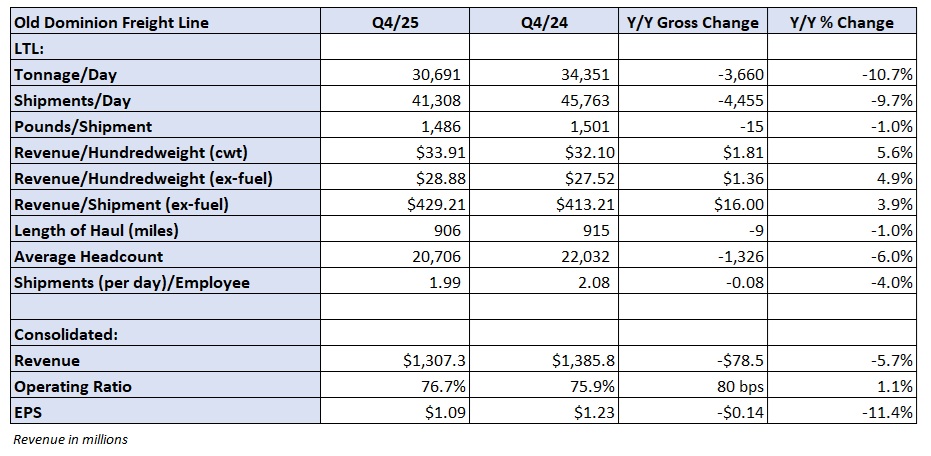
Old Dominion (NASDAQ: ODFL) reported fourth-quarter earnings per share of $1.09, which was 3 cents above the consensus estimate but 14 cents lower year over year. (A Higher tax rate compared to the 2024 fourth quarter was a 5-cent drag on EPS.)
Revenue of $1.31 billion was 6% lower y/y but slightly ahead of consensus.
Tonnage per day was down 11% y/y as daily shipments fell 10% and weight per shipment was off 1%. Revenue per hundredweight (yield) was 6% higher in the period (5% higher excluding fuel surcharges).
Tonnage fell faster in the fourth quarter. Year-over-year tonnage declines were 9% in the second and third quarters. Old Dominion’s tonnage was down nearly 19% on a two-year-stacked comparison in the fourth quarter, which could prove to be the trough of the cycle if demand is indeed improving.
However, inclement weather caused January demand trends to lag normal seasonality. Revenue per day was down 6.8% y/y as tonnage fell 9.6% and yield was up 3.9% (excluding fuel). (Revenue per day was down 5.7% y/y in the fourth quarter.)
The company guided revenue to a range of $1.25 billion to $1.3 billion for the first quarter, which was lower than a $1.32 billion consensus estimate at the time of the print. The top end of range assumes normal seasonality and would come in 5% lower y/y.
A 4.5% y/y yield increase is baked into the revenue assumption. Higher shipment weights are a headwind to the yield metric, but the improved volume density leads to better operating margins.
Q1 margin likely the trough
Old Dominion posted a 76.7% operating ratio (inverse of operating margin), which was 80 bps worse y/y and 240 bps worse sequentially. That was better than management’s guidance (250 to 350 bps of sequential deterioration) and in line with the normal seasonal change rate (200 to 250 bps of degradation).
Salaries, wages and benefits (as a percentage of revenue) were 180 bps higher y/y even as head count was down 6% y/y to 20,706 (1.7% lower sequentially). Shipments per day per employee were down 4% y/y.
Depreciation and amortization expense was 70 bps higher y/y. The carrier has been maintaining over 35% excess terminal capacity, awaiting a turn in the market.
Cost per shipment was up 5.6% with revenue per shipment up 4.6%, a 110-bp negative spread, but 170 bps better sequentially.
Management said direct operating costs have been held to 53% of revenue, consistent with 2022 levels when the company achieved a 70.6% OR. This suggests that incremental operating margins could reach the mid-40% range during an upswing.
Old Dominion normally sees 100 to 150 bps of OR deterioration from the fourth to the first quarter each year. It expects 150 bps of erosion this year, implying a 78.2% OR, which would be 280 bps worse y/y. (The guide contemplates annual cost inflation of 5% to 5.5%, excluding fluctuations in fuel prices, as employee benefits expenses are on the rise.)
The carrier normally sees a 7% sequential increase in revenue in the second quarter, along with 300 to 350 bps of margin improvement. That would put revenue and OR near flat on a y/y comparison.
The company is targeting capex of approximately $265 million in 2026. Capex totaled $415 million last year. The step down comes as the company already has significant excess capacity and the network is capable of handling 55,000 shipments per day versus the 41,000 it is currently moving. The budget includes $125 million for real estate.
Shares of ODFL were up 8.3% at 2:18 p.m. EST on Wednesday compared to the S&P 500, which was down 0.6%. The stock is up 63% since the week before Thanksgiving when trucking stocks began moving higher along with truckload spot rates.
Brokerage Compliance Symposium
The day before F3. Every compliance issue you face - fraud exposure, carrier liability, FMCSA rules, cargo theft, insurance gaps - navigated by attorneys and operators defining best practices in a changing industry.
F3 Awards Dinner
The night before F3. FreightTech100 companies honored. FreightTech 25 and Shipper of Choice winners revealed live. Cocktail reception into dinner and live music - 300 industry leaders in one purpose-built room.
F3: Future of Freight Festival
Industry-defining keynotes, rapid-fire technology demos, and industry leaders networking in experiences across Chattanooga - plus the inaugural F3 Awards Dinner featuring the FreightTech and Shipper of Choice reveals.
The day before F3. Every compliance issue you face - fraud exposure, carrier liability, FMCSA rules, cargo theft, insurance gaps - navigated by attorneys and operators defining best practices in a changing industry.
The Signal at Chattanooga Choo Choo • Chattanooga, TN Register NowThe night before F3. FreightTech100 companies honored. FreightTech 25 and Shipper of Choice winners revealed live. Cocktail reception into dinner and live music - 300 industry leaders in one purpose-built room.
The Signal at Chattanooga Choo Choo • Chattanooga, TN Register NowIndustry-defining keynotes, rapid-fire technology demos, and industry leaders networking in experiences across Chattanooga - plus the inaugural F3 Awards Dinner featuring the FreightTech and Shipper of Choice reveals.
The Signal at Chattanooga Choo Choo • Chattanooga, TN Register Now