




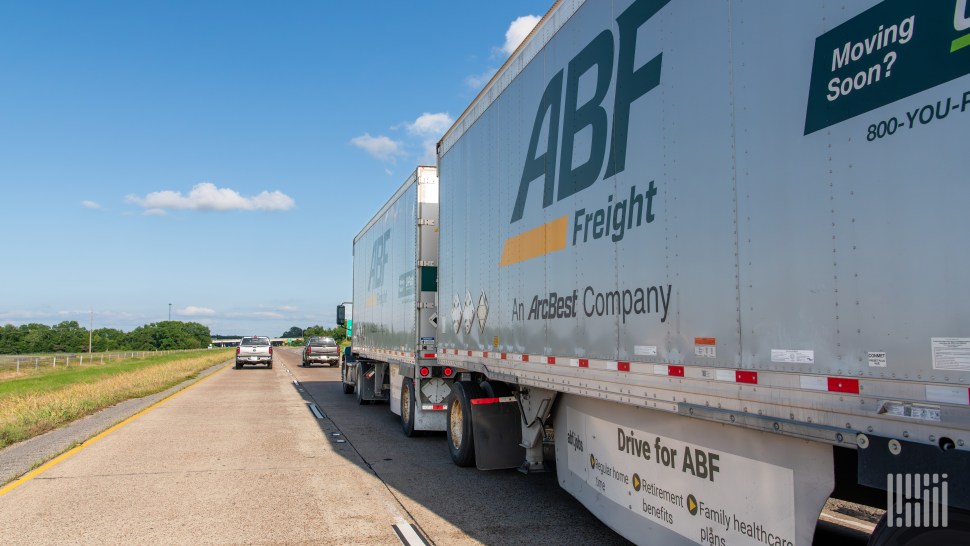
ArcBest is continuing to prep its less-than-truckload network and asset-light business for an eventual recovery. The company is hoping the implementation of better technology tools, along with structural cost takeouts, will amplify returns when demand improves.
ArcBest (NASDAQ: ARCB) reported a fourth-quarter headline net loss of $8.1 million, or 36 cents per share, on Friday ahead of the market open. The number included a noncash impairment charge in its asset-light business and other one-off items. Adjusted EPS of 36 cents in the period was 97 cents worse year over year and 6 cents below the consensus estimate.
Consolidated revenue of $973 million was $6 million ahead of expectations.

Asset-based OR backing up before improving
The asset-based unit, which includes LTL subsidiary ABF Freight, saw revenue dip 1% y/y to $649 million (revenue per day was down 0.3%). Tonnage per day was up 3% but revenue per hundredweight (yield) was down 3%.
The tonnage increase was driven by a 2.4% increase in daily shipments (to 20,163) and a 0.3% increase in weight per shipment. The higher shipment weights along with a 0.4% decline in length of haul were modest drags on the yield metric.
Wins with new LTL customers that have heavier shipments helped offset lower shipment weights from ABF’s legacy manufacturing customers.
Contract renewals averaged 5% in the quarter, the highest increase in six quarters, and 9.5% higher on a two-year-stacked comparison. Management said bid activity has slowed and that the pricing environment remains “rational.”
Tonnage per day improved on a y/y comparison in each month of the quarter. Tonnage was down 1.2% in October, 3.3% higher in November and 6.7% higher in December. The fourth quarter had a relatively easy comp to the 2024 fourth quarter when tonnage was down 7.3% y/y. However, the prior-year comps get tougher starting in February (negative-2%), turning positive in April (plus-3.6%).
Revenue per day in January was flat y/y as an 8% tonnage increase (on a negative-9.2% comp) was offset by an 8% decline in yield. The mix included more dynamically priced truckload shipments versus January 2025, which pushed weight per shipment 5% higher and dragged the yield result lower. Weakness in the manufacturing and housing sectors has forced the company to take on noncore LTL freight to keep the network full. First-quarter tonnage is expected to increase by roughly 4% to 5% y/y.
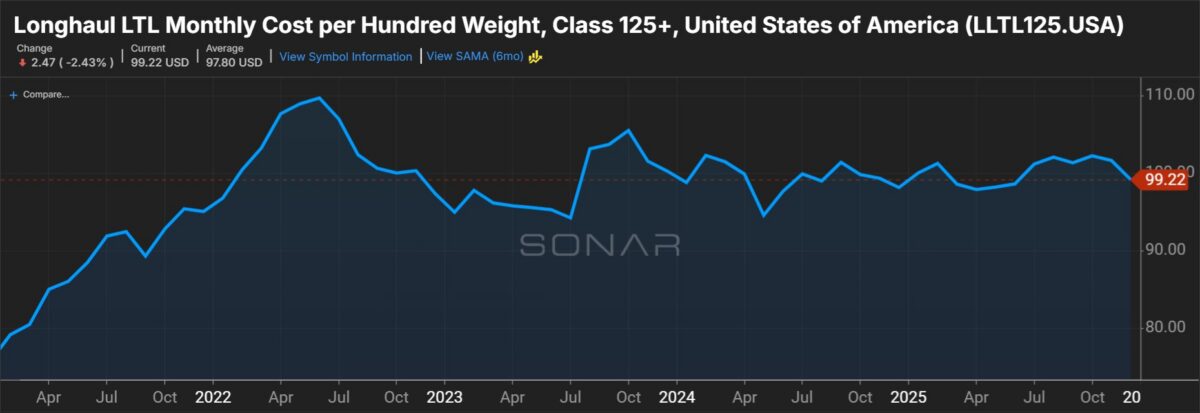
The unit posted a 96.2% adjusted operating ratio (inverse of operating margin), which was 420 basis points worse y/y and 370 bps worse than the third quarter. The sequential change was slightly better than management’s guidance, which called for 400 bps of degradation. The unit normally sees just 100 to 200 bps of sequential margin deterioration in the fourth quarter, but weaker demand led to the outsized decline. Also, inclement weather was an overhang and the fourth quarter had three fewer work days than the third quarter.
Labor and benefits costs (as a percentage of revenue) were 310 bps higher y/y. The company said added labor to support shipment growth and an annual bump in union pay were the culprits. Depreciation and amortization expenses were 100 bps higher y/y.
The LTL OR normally deteriorates by 260 bps sequentially in the first quarter. ArcBest expects to outperform the change rate this year given cost actions and the diminished starting point. It’s guiding to 100 to 200 bps of deterioration, implying a 97.7% OR at the midpoint, 180 bps worse y/y.
A training initiative and tech enhancements across 60% of the network have resulted in $24 million in annual cost reductions. A city route optimization program has entered its next two phases, having already generated $15 million in cost savings. Also, the impact from startup costs at new and expanded facilities (800 doors added over the past year) will be better absorbed when volumes return.
ArcBest reiterated long-term guidance provided at a September investor day. It guided to an OR target of 87% to 90% by 2028, which assumes an annual 80-bp positive spread between revenue per shipment and cost per shipment. (The spread was 430 bps negative in the fourth quarter.)
The asset-light segment, which includes truck brokerage, reported breakeven results on an adjusted basis. That was ahead of management’s guidance, calling for an adjusted operating loss of $1 million to $3 million. Revenue was down 6% y/y as shipments per day were up 1% and revenue per shipment fell 6%.
Asset-light guidance calls for an operating loss of up to $1 million in the first quarter. Automation and the use of AI agents are removing structural costs from the business. Shipments per person per day improved 19% y/y in the fourth quarter.
Shares of ARCB were 3.5% higher at 1:37 p.m. EST on Friday compared to the S&P 500, which was off 0.9%.
Brokerage Compliance Symposium
The day before F3. Every compliance issue you face - fraud exposure, carrier liability, FMCSA rules, cargo theft, insurance gaps - navigated by attorneys and operators defining best practices in a changing industry.
F3 Awards Dinner
The night before F3. FreightTech100 companies honored. FreightTech 25 and Shipper of Choice winners revealed live. Cocktail reception into dinner and live music - 300 industry leaders in one purpose-built room.
F3: Future of Freight Festival
Industry-defining keynotes, rapid-fire technology demos, and industry leaders networking in experiences across Chattanooga - plus the inaugural F3 Awards Dinner featuring the FreightTech and Shipper of Choice reveals.
The day before F3. Every compliance issue you face - fraud exposure, carrier liability, FMCSA rules, cargo theft, insurance gaps - navigated by attorneys and operators defining best practices in a changing industry.
The Signal at Chattanooga Choo Choo • Chattanooga, TN Register NowThe night before F3. FreightTech100 companies honored. FreightTech 25 and Shipper of Choice winners revealed live. Cocktail reception into dinner and live music - 300 industry leaders in one purpose-built room.
The Signal at Chattanooga Choo Choo • Chattanooga, TN Register NowIndustry-defining keynotes, rapid-fire technology demos, and industry leaders networking in experiences across Chattanooga - plus the inaugural F3 Awards Dinner featuring the FreightTech and Shipper of Choice reveals.
The Signal at Chattanooga Choo Choo • Chattanooga, TN Register Now