




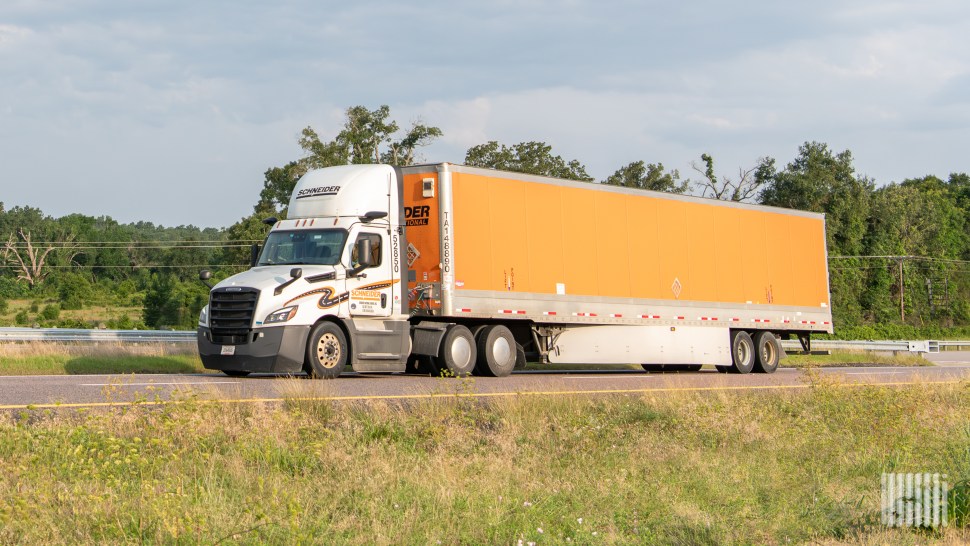
Multimodal transportation provider Schneider National’s fourth-quarter result and full-year 2026 guidance came in below expectations on Thursday, sending shares 16% lower in after-hours trading.
Schneider (NYSE: SNDR) reported fourth-quarter adjusted earnings per share of 13 cents, 7 cents below both the consensus estimate and the year-ago result. Consolidated revenue of $1.4 billion was up 5% year over year, but $50 million light of consensus.
Management said on a Thursday call with analysts that “softer than expected market conditions” in November gave way to “material tightening in December” as severe weather gripped the Midwest. However, the late demand surge wasn’t enough to save the quarter. Also, its dedicated business experienced some weakness from “unplanned auto production shutdowns” in the quarter.
A jump in purchased transportation (truckload spot rates) and weather-related costs to close the year, along with “heightened healthcare costs,” were the drivers behind the earnings shortfall.
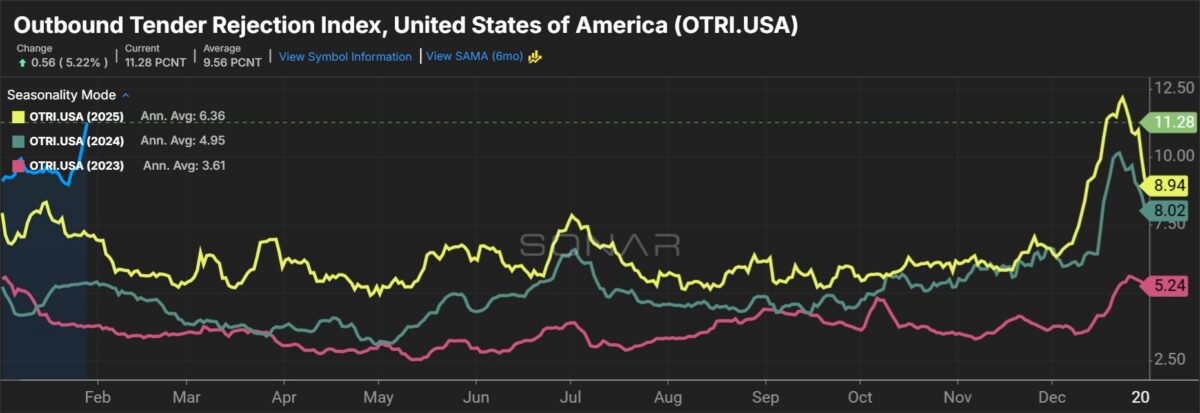
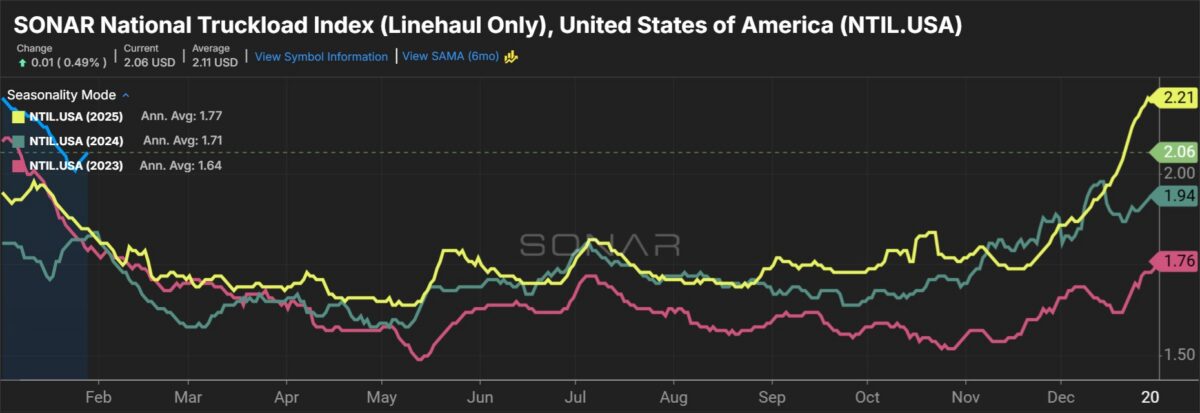
(Schneider’s stock ran 44% higher from the week ahead of Thanksgiving to the Thursday print. The move was largely in lockstep with a steep rise in tender rejections and spot rates.)
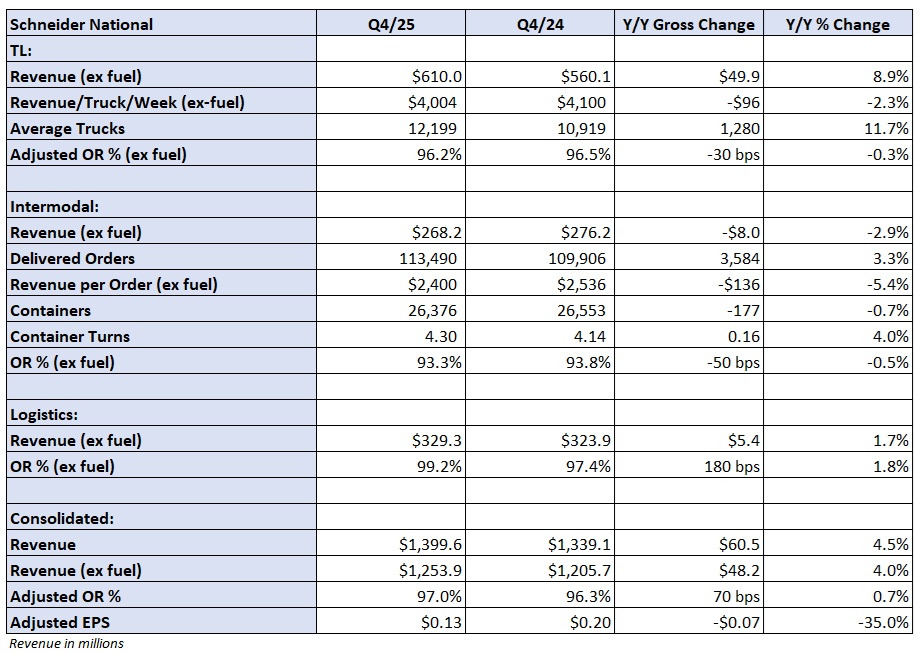
Schneider’s TL unit reported a 9% y/y increase in revenue to $610 million as a 12% increase in truck count was partially offset by a 2% decline in revenue per truck per week.
Dedicated revenue was up 13% y/y, due to the acquisition of Cowan Systems in the 2024 fourth quarter. Dedicated truck count was 18% higher with revenue per truck per week down 4%. The network, or one-way, fleet saw flattish results across the same metrics.
The TL unit reported a 96.2% adjusted operating ratio (inverse of operating margin), 30 basis points better y/y and 60 bps better than the third quarter. The dedicated business saw cost headwinds from onboarding new customers (sold service on 956 trucks last year) while the network business remained unprofitable.
Management said heightened regulatory enforcement on the driver pool is having an impact. It said “the most irrational capacity is what’s exiting” and that some of its shippers are inquiring about mini bids as shrinking capacity is becoming a risk. Schneider has set spot rate exposure at historical highs in its network business as it prepares for a material rate inflection.
Intermodal revenue was down 3% y/y to $268 million as a 3% increase in loads was offset by a 5% decline in revenue per load. The unit reported a 93.3% OR, which was 50 bps better y/y. Container turns improved by 4% in the quarter. Management said it can grow volumes by 20% to 25% without adding containers.
Schneider continues to engage with all railroads as service alliances form in anticipation of Union Pacific’s (NYSE: UNP) merger with Norfolk Southern (NYSE: NSC). Schneider said it is content with its current Eastern rail partner, CSX (NASDAQ: CSX), but that it continues to talk with both railroads in the East.
Logistics revenue increased 2% y/y to $329 million. The OR deteriorated 180 bps to 99.2% as an undisclosed increase in gross revenue per order was more than offset by a run up in spot rates, pushing purchased transportation costs up.
2026 outlook disappoints
The company issued full-year 2026 adjusted EPS guidance of 70 cents to $1.00, which was below the consensus estimate of $1.07 at the time of the print. The outlook is somewhat back-half loaded, with the midpoint assuming normal seasonal patterns from January’s starting point. Management acknowledged “some conservatism” at the low end of the range.
The company reported full-year 2025 adjusted EPS of 63 cents, which was worse than the “approximately 70 cents” forecasted in the third quarter. (Schneider’s initial 2025 outlook contemplated EPS of 90 cents to $1.20).
Schneider has realized $40 million in cost reductions and has identified another $40 million in cost takeouts (approximately 70 bps of margin) for 2026.
Net capex guidance is $400 million to $450 million for 2026, mostly slated for equipment replacements. Net capex totaled $289 million last year.
Net debt leverage was reduced to 0.3x from 0.7x at the end of 2024. It will use free cash flow to fund share repurchases and dividends. It announced a new $150 million share repurchase plan on Thursday. It is also eyeing M&A.
Succession plan
Schneider announced Wednesday that President and CEO Mark Rourke will become the executive chairman of the board on July 1. At that time, Jim Filter, Schneider executive vice president and president of transportation and logistics, will succeed Rourke as the company’s president and CEO. Filter, who has been with the company for 27 years, is also expected to be appointed to the board at a later date.
As part of the succession plan, Schneider Chairman James Welch will become lead independent director of the board.
Brokerage Compliance Symposium
The day before F3. Every compliance issue you face - fraud exposure, carrier liability, FMCSA rules, cargo theft, insurance gaps - navigated by attorneys and operators defining best practices in a changing industry.
F3 Awards Dinner
The night before F3. FreightTech100 companies honored. FreightTech 25 and Shipper of Choice winners revealed live. Cocktail reception into dinner and live music - 300 industry leaders in one purpose-built room.
F3: Future of Freight Festival
Industry-defining keynotes, rapid-fire technology demos, and industry leaders networking in experiences across Chattanooga - plus the inaugural F3 Awards Dinner featuring the FreightTech and Shipper of Choice reveals.
The day before F3. Every compliance issue you face - fraud exposure, carrier liability, FMCSA rules, cargo theft, insurance gaps - navigated by attorneys and operators defining best practices in a changing industry.
The Signal at Chattanooga Choo Choo • Chattanooga, TN Register NowThe night before F3. FreightTech100 companies honored. FreightTech 25 and Shipper of Choice winners revealed live. Cocktail reception into dinner and live music - 300 industry leaders in one purpose-built room.
The Signal at Chattanooga Choo Choo • Chattanooga, TN Register NowIndustry-defining keynotes, rapid-fire technology demos, and industry leaders networking in experiences across Chattanooga - plus the inaugural F3 Awards Dinner featuring the FreightTech and Shipper of Choice reveals.
The Signal at Chattanooga Choo Choo • Chattanooga, TN Register Now