Full circle: benchmark retail diesel price is about where it was a year ago

The benchmark price of retail diesel is just about where it was a year ago, having recouped all of the lower numbers posted since the middle of July 2024.

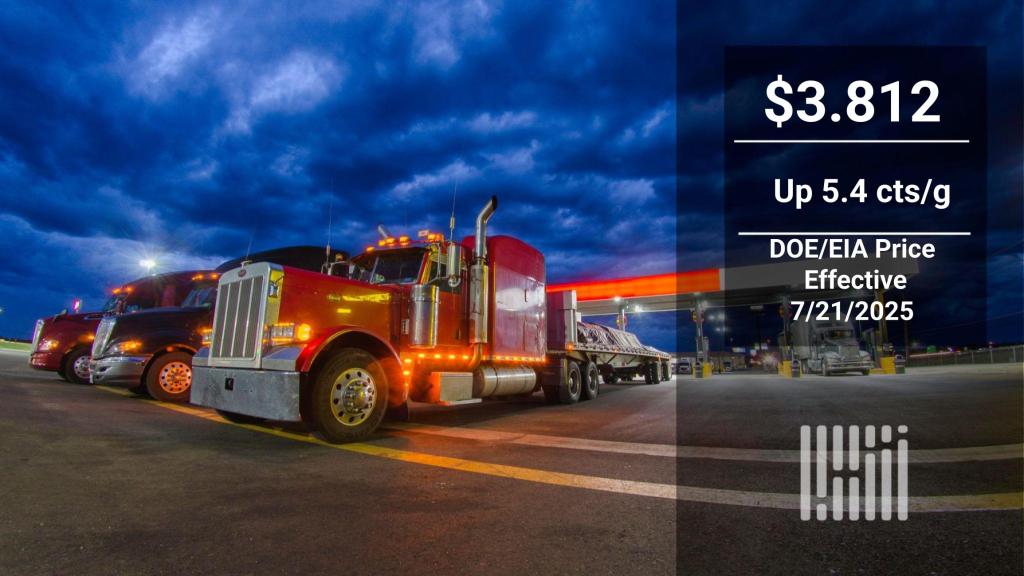
The Department of Energy/Energy Information Administration’s average weekly retail diesel price rose 5.4 cents/gallon Monday, published Tuesday, to $3.812/b. It marked the seventh increase in the last eight weeks for the price that is the basis for most fuel surcharges.

Those increases have added 36.1 cts/g to the price published June 2, after which the 7 out of 8 increase sequence began.

The latest price is also the highest in just over a year. On July 15, 2024, the DOE/EIA price was $3.826. Every price since then has been less than the $3.812/g published Tuesday.

The increase in diesel prices can only be partly attributed to a rise in the price of crude. And crude has gone up: it settled June 2 at $64.63/barrel on the CME commodity exchange, and by the settlement Monday was up to $69.21/b. It has crossed the $70/b mark for a settlement a few times during that stretch.

But that increase is just 7%. Meanwhile, the price of ultra low sulfur diesel on the CME commodity exchange is up 22.7% during that time, settling Monday at $2.5092/g compared to a June 2 settlement of $2.0445/g.

During those two parallel yet different tracks, the front month ULSD price on CME has blown out to a diesel/Brent spread of more than 85 cts/g. On June 2, that spread was about 50 cts/g.

A chart released by the consulting firm Energy Aspects, in its monthly report on middle distillates–which includes diesel–tells a great deal of the story about why diesel is outpacing gains in crude.

While the data behind the chart was available only to subscribers, the chart clearly shows that global inventories of diesel are well below last year. But more importantly, they are also well below the five-year average for this time of year, and have been for several months.

An article published by Bloomberg Monday notes the specifics: that U.S. diesel stockpiles are “sitting at the lowest levels since 1996 for this time of year.” The EIA publishes its weekly data on all inventories each Wednesday. 

Historically low

While U.S. inventories of ultra low sulfur diesel rose almost 5 million barrels in the week ended July 11 to 98.2 million barrels, they were still more than 4% below the smallest total for the second week in July in the last 10 years, and below most other weeks by a far greater amount.

The calendar may say July, but it’s close enough to cooler weather that the tight diesel market is beginning to talk about winter. Heating oil is a distillate, like diesel, and as winter looms and distillate molecules are increasingly turned into heating oil at the expense of diesel, there is a risk that the low inventories in the diesel market have already squandered a chance to recover.

Bloomberg quoted Samantha Hartke, Americas head of market analysis at Vortexa, as saying the diesel market “feels like a vicious cycle. “If stocks aren’t up in a few months, you’re setting up for a tight winter, which then rolls into next year with turnaround season in the spring of 2026.” Turnaround is the season, both in the fall and spring, when heavy refinery maintenance is undertaken and operating rates temporarily decline.

The Bloomberg article–and other commentary–noted a wide range of reasons for the growing tightness of diesel supplies. 

New sanctions on Russia are being levied against that country, which is a major diesel exporter. Wildfires in Canada and Venezuela have affected exports from those two countries, whose slate of crude sold into the market is heavy and generally rich in a diesel yield when it is refined. Refiners are moving more of their distillate feedstocks into producing jet fuel, where market demand has been strong. But that comes at the expense of making diesel.

Refinery closures around the world also have a role. And while the closures impact gasoline as well, all major supply/demand models have been reporting for months that gasoline demand on the margin has been weakened by the gradual increase in the automobile fleet made up of electric vehicles.

That isn’t the case for diesel. But changes in refinery operations to compensate for that shift can’t be made overnight.

“This is a long-term shift based around refining capacity and product ratios,” Joe DeLaura, global energy strategist at Rabobank, was quoted as saying by Bloomberg. “A refinery cannot make diesel without first making gasoline, and it takes capital and time to retool that process.”

More articles by John Kingston

Oregon ties itself closer to California’s Advanced Clean Trucks rule, even though it may have no future

Yet another broker liability case, this time in the Fifth Circuit, adds to the growing mix 

Much happened at Triumph Financial during the quarter; USPS dispute settled
Check Call: Broker liability hits the headlines once again

(GIF: GIPHY)

The legal landscape for freight brokers continues to grow more complex, as yet another court case has put broker liability under scrutiny. The latest development comes from the Fifth Circuit Court of Appeals, which is now considering whether a freight broker can be held liable for a fatal crash involving a contracted carrier. The case, Crane v. Liberty Lane, is centered around a 2018 accident in Texas that claimed the life of Lyndon Meyer, and it could tip the balance in an already divided judicial system.

The ever constant issue in this fight is whether the Federal Aviation Administration Authorization Act (F4A), which generally protects brokers from state laws affecting their “price, route, or service,” also shields them from negligence claims related to carrier selection. While a district court initially dismissed the case in favor of Penske Logistics and Penske Transportation Solutions, which brokered the load in question, the plaintiffs have appealed. They argue that the case qualifies under F4A’s so-called “safety exemption,” which allows certain state-level claims if they relate to motor vehicle safety.

This case is just the latest in a growing number of broker liability lawsuits. The legal consensus is anything but settled. Courts in the Seventh and Eleventh Circuits have ruled in favor of broker immunity, while decisions in the Sixth and Ninth Circuits have gone the other way, allowing lawsuits against brokers to proceed under state negligence laws. Meanwhile, an Illinois state court recently denied a motion to dismiss against Echo Global Logistics in a similar case, adding further weight to the trend.

The outcome of the Fifth Circuit’s review could have national implications. If the court rules in favor of the plaintiffs, it would mark the third federal appeals court to allow broker liability claims, tipping the balance in the ongoing circuit split. That could increase the likelihood that the U.S. Supreme Court steps in to resolve the issue. Two high-profile cases, Caribe v. Montgomery and Cox v. TQL, are already petitioning the Court for review.

While F4A may still offer some legal shield, it’s not impenetrable, and the current wave of lawsuits is testing its limits. The Fifth Circuit’s decision is expected to land in the coming months. The Supreme Court has denied hearing broker liability cases in the past, but with the added cases and lower courts with contradicting outcomes, it could finally be the reason for the courts to take the case. 

To get the full newsletter in your inbox every Tuesday, subscribe below.

Trade disputes hit CN volumes and prompt railway to cut outlook

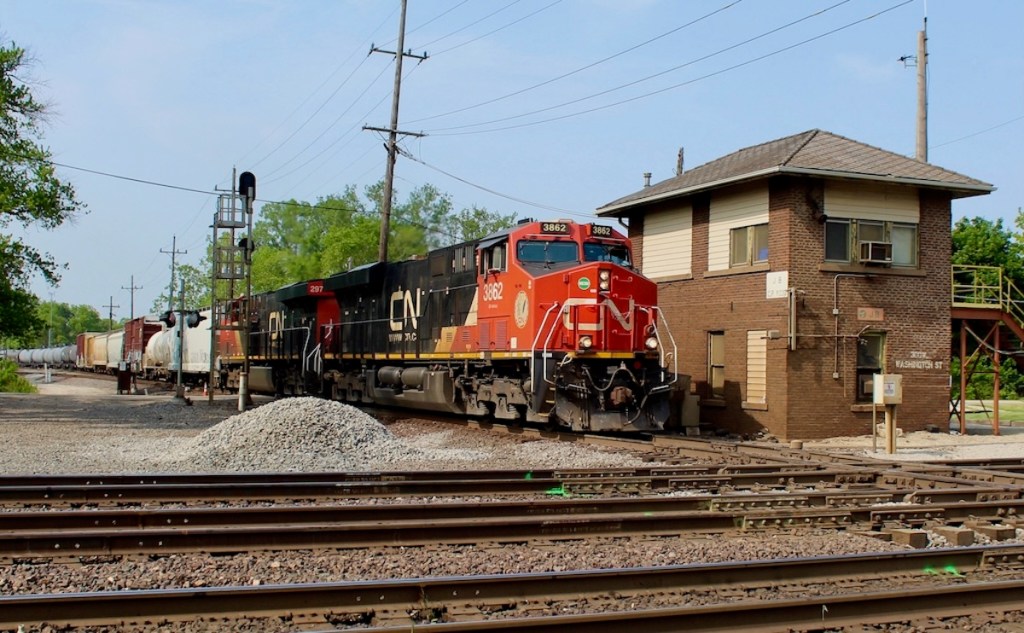
Canadian National lowered its outlook for the year — and pulled its longer-term guidance Tuesday — in response to ongoing trade- and tariff-related economic uncertainty.

CN (NYSE: CNI) delivered the news while releasing its second-quarter financial results, which included higher operating income despite lower revenue and flat volume.

“A few months ago, trade deals seemed imminent. And instead there is an increasing uncertainty around the tariff and trade environment, particularly in Canada,” CEO Tracy Robinson told investors and analysts on the company’s earnings call.

The current and threatened U.S. tariffs on Canada include a 35% tariff on various Canadian goods set to take effect on Aug. 1, alongside existing tariffs of 25% on certain imports and 50% on steel and aluminum.

The trade disputes, along with softening economic conditions, have had a negative impact on CN’s forest products, metals, international intermodal, and automotive traffic. Overall for the quarter, volume was down 1% based on revenue ton-miles and flat when measured by carloads and containers.

Strong bulk volumes — including grain and potash — and domestic intermodal growth were unable to offset declines in international intermodal and merchandise volume, said Janet Drysdale, interim chief commercial officer. Although grain and fertilizer revenue was up 12%, revenue declined in intermodal, automotive, and every merchandise segment.

As volume softened, CN took steps to reduce costs, including furloughing train crews and storing locomotives. “This team has proactively and progressively adjusted the operating plan resources throughout the quarter, maintaining good tensions between costs and network fluidity and performance,” Robinson said.

As a result, operating income increased 5%, to $1.2 billion, as revenue declined 1%, to $3.13 billion. Earnings per share rose 7%, to $1.37. The railway’s operating ratio improved 2.3 points, to 61.7%. CN trimmed its $2.5 billion capital budget by $36.7 million.

CN now expects to deliver earnings per share growth of between 5% and 9%, down from previous guidance of 10% to 15% growth. And the railway withdrew its 2024-2026 outlook, which was drawn up prior to trade disputes that have weighed on the railway’s merchandise and intermodal volumes. Further complicating CN’s financial outlook: Unfavorable exchange rates that have a negative impact on earnings per share.

Nonetheless, CN still expects several growth projects in Western Canada to come online as expected over the next couple of years.

Derek Taylor, CN’s chief field operations officer, said CN ratched down costs as merchandise volume declined. At the end of the quarter, 560 train and engine crew members were on furlough, 200 locomotives were parked, and 4,000 additional freight cars were stored.

The railway continued to run well, with car-miles per day, through dwell, and local service all improving over last year’s second quarter.

Subscribe to FreightWaves’ Rail e-newsletter and get the latest insights on rail freight right in your inbox.

Related coverage:

BNSF aims to grow carload traffic with rail service upgrades

Report: Goldman Sachs advising BNSF on potential merger

Analysis: UP-NS rail merger spotlights individual legacies in a legacy business

Union Pacific, Norfolk Southern in merger talks: WSJ

FreightWaves Infographics: Navigating the Complexity of Today’s Freight Market 

To learn more CLICK HERE

The English-Only Fight in Trucking – A Rule, A Reckoning, or a Distraction?

If you’ve been watching the freight headlines lately—or reading the comments on socials—they all seem to circle back to the same loaded question: Should drivers who can’t speak or read English be allowed behind the wheel of an 80,000-pound truck?

It’s a fair question. But the deeper you dig, the more complicated the answer becomes.

Because this conversation isn’t just about English. It’s about labor. About regulation. About identity. And depending on who you ask, it’s either a long-overdue safety crackdown—or a smokescreen designed to shift blame away from the real issues gutting the industry.

Let’s peel back the layers.

How Did We Get Here?

The rule isn’t new. English Language Proficiency (ELP) has technically been a requirement under FMCSA guidelines since the 1980s. Drivers are supposed to be able to read traffic signs, understand inspection instructions, and speak clearly with law enforcement.

But for years, enforcement was inconsistent at best. States didn’t apply it evenly. Inspectors looked the other way. Carriers found workarounds. The rule sat quietly on the books—until June 25, 2025.

That’s when FMCSA officially reinstated ELP as an enforceable Out-of-Service (OOS) violation. If a driver can’t demonstrate English proficiency at the time of inspection, they can be shut down on the spot.

Some states jumped in right away. Texas, Tennessee, Missouri, Wyoming, and others began reporting ELP violations in significant numbers. Others—like California—have reportedly directed officers not to enforce the rule, citing political and legal concerns.

Now the industry is split.

Some see this as common sense finally catching up with reality. Others view it as coded language for something much uglier.

What the Supporters Say: “Safety and Fairness”

The pro-ELP crowd says the issue is cut and dry.

“If you can’t read a ‘bridge height’ sign, you shouldn’t be driving,” one inspector told us privately. “We’re not targeting anybody—we’re trying to prevent preventable crashes.”

That’s echoed by Secretary of Transportation Sean Duffy, who recently said, “Only truckers proficient in our national language—English—will drive on our roads.”

To many American drivers, this enforcement feels like long-overdue justice. They argue that non-citizen drivers have been allowed to enter the industry through the back door—obtaining non-domicile CDLs in states with looser oversight, avoiding taxes and insurance, and undercutting wages.

Graphics like the one showing “Unbalanced Labor Practices” have gone viral. On one side: American citizens paying taxes, holding insurance, spending in their local communities. On the other: non-citizens supposedly skating by without any of it.

That may be oversimplified—but for those struggling to stay afloat in a brutal rate environment, it hits a nerve.

To them, this isn’t about language. It’s about survival.

What the Critics Say: “Weaponized Bureaucracy”

But let’s not pretend the other side isn’t speaking loudly, too.

Critics of ELP enforcement call it a “solution in search of a scapegoat.” They argue that cracking down on English proficiency won’t fix the root issues: market volatility, weak enforcement of fraud, or unchecked broker power.

And they ask a fair question: If ELP is really about safety, why wasn’t it enforced for the last decade?

Some suspect the timing is political.

Truckers—especially in the long-haul OTR space—have been squeezed hard by falling rates and rising operating costs. It’s tempting for lawmakers to point to immigrant drivers as the reason, especially in an election year. But the data doesn’t tell a clean story.

While there’s been an increase in non-domiciled CDLs and foreign-born drivers entering the market, the idea of a “foreign invasion” is more social media narrative than statistical fact. The rate drop started long before ELP enforcement became a headline.

And while there are certainly bad actors—carriers using loopholes to skirt the rules—painting all immigrant drivers with the same brush is both lazy and dangerous.

(Source: SONAR, NTI.USA National Truckload Index. The SONAR National Truckload Index shows the market rate in July 2020 was $2.23 per mile—nearly identical to where we are now. But back then, that rate felt like a win. Today, it feels like survival mode. Same number, completely different climate. That’s what makes the ELP debate more complicated than it seems.)

Will This Raise Rates? Not Certain.

Here’s another myth that needs busting.

A lot of folks pushing for stricter ELP enforcement believe it will shrink the driver pool and force brokers to pay more. That may feel logical, but the market doesn’t care about logic.

It cares about capacity and demand.

And right now, there’s still plenty of capacity. Even with a net loss in authorities this year, SONAR data shows we’re still far above pre-2020 carrier counts. Rates won’t jump just because a few hundred drivers get pulled out of service.

Remember 2018? Rates were high not because there were fewer drivers—but because there was more freight than capacity. The minute that flips, prices fall—no matter who’s behind the wheel.

And let’s be honest: if enforcement gets too aggressive, carriers will just find new workarounds. They always do. And even if capacity leaves at a rate enough to drive rates up, history shows that when rates increase, so does one other thing……new authorities…..

This Isn’t the First Time Language Was a Wedge

We’ve seen this before—in other industries.

“English-only” policies have historically been a flashpoint. They sound like neutral safety measures but often become cultural battlegrounds. For many immigrant drivers—especially those from Eastern Europe, Africa, and Latin America—this feels like they’re being singled out, even when they’ve done everything legally.

Several of them can speak functional English—but they get nervous when pulled over. They stumble. They panic. And now that’s grounds for a shutdown?

Where do we draw the line between actual danger and cultural discomfort?

We need to be careful not to turn policy into profiling.

The Bigger Problem: FMCSA Still Can’t Keep Up

Let’s zoom out for a second.

While we’re arguing over ELP, the bigger issue is staring us in the face.

FMCSA’s budget is $926 million. And yet, over 94% of carriers in the system have no safety rating at all. That’s not a typo. It means nearly every new authority has never had an on-site audit.

This isn’t regulation—it’s theater.

Pop-up CDL mills, shell companies, shady brokers gaming the system—none of that gets caught. But a driver fumbling through an inspection in Missouri? That’s who we’re prioritizing?

The agency needs modernization. It needs teeth. And it needs to focus on fraud, training, and safety culture—not just language skills.

What Would Real Reform Look Like?

Instead of leaning too hard on ELP as the fix-all, here’s what smarter regulation could look like:

  • Audit All New Authorities Within 90 Days
    Don’t let new entrants operate unchecked.
  • Standardize CDL Training Requirements Nationwide
    No more state-to-state loopholes for skill testing or residency.
  • Make English Proficiency a CDL Entry Requirement, Not a Gotcha Enforcement Tactic
    Test at the front end—not the roadside.
  • Tie Safety Ratings to Authority Renewal
    No more endless “Not Rated” carriers floating under the radar.
  • Use Data Analytics to Track Fraud Patterns
    Repeat addresses. Phone numbers. Shell behavior. We have the tech—use it.

Final Word: Fairness Has to Go Both Ways

The goal should be to protect the roads, protect the public, and protect the people doing it the right way.

That means holding everyone accountable—regardless of where they were born or what language they speak at home.

It also means calling out bad faith arguments on both sides.

No, not every non-citizen driver is unqualified. But no, the system hasn’t done enough to verify who’s on our roads, either.

We don’t need more noise. We need leadership.

The industry is in a trust crisis. And trust doesn’t come from slogans—it comes from action.

Let’s clean up the fraud. Let’s get back to meaningful audits. Let’s treat carriers, brokers, and drivers like professionals—not pawns in a political game.

And above all—let’s remember this: trucking isn’t just an industry. It’s an ecosystem. If one part breaks, we all feel it. And no matter which side of this debate you fall on, the only way forward is together.

Yet another broker liability case, this time in the Fifth Circuit, adds to the growing mix 

Even as the question of broker liability is already before the Supreme Court for a possible review, with a second case likely to join the clamor for high court resolution of conflicting circuits, a lawsuit in the Fifth Circuit involving two arms of the Penske trucking empire has the potential to add another level of conflict to the mix.

The location of the Penske case–formally known as Crane vs. Liberty Lane–is particularly important. 

There are conflicting precedents on the issue of whether a broker can be held liable for an accident or other damaging outcome (like a theft) if the carrier it hires causes the incident. But those precedents of other federal circuit courts–not the Fifth–lead to the inconsistency that the industry hopes might lead the Supreme Court to granting certiorari and provide legal clarity.

There’s a case in front of it now that could be the pathway for a Supreme Court ruling: Caribe vs. Montgomery. That Seventh Circuit case involves 3PL giant C.H. Robinson (NASDAQ: CHRW). 

A tie ‘vote’ that would be broken, either way

The Supreme Court has chosen not to take up the issue of broker liability under the Federal Aviation Administration Authorization Act (F4A) on three separate occasions in recent years. But the conflict among the circuits is now wider, with what amounts to a 2-2 split in circuit court opinions. A ruling by the Fifth Circuit either way in the Penske case would make it a 3-2 split.

Given that the Fifth Circuit has only just recently begun taking briefs on Crane vs. Liberty Lane, it is unclear whether the case could play a role in whether the nine justices will accept certiorari on Caribe vs. Montgomery.

Trucking attorneys also believe TQL will request certiorari in a case it recently lost in the Sixth Circuit, Cox vs. TQL. 

It is likely to be months before Crane vs. Liberty Lane will be decided and become part of the conflict that the Supreme Court is being asked to clarify.

By the same token, it is not impossible that if the Supreme Court accepts certiorari in coming weeks on Caribe vs. Montgomery, the Fifth Circuit judges might wait to see if there is high court clarification on broker liability that might guide their decision in the Penske case.  

Seventh and Eleventh check in with decisions that back brokers

Decisions that protected brokers from liability in recent years have been handed down in the Seventh Circuit (the Ying Ye and Aspen vs. Landstar cases, as well as Caribe vs. Montgomery) and the Eleventh Circuit (Gauthier vs. TQL)  (NASDAQ: LSTR).

Meanwhile, along with the Sixth Circuit decision in Cox vs. TQL that found F4A did not fully protect brokers, there is a similar finding on the record in the Ninth Circuit in Miller vs. C.H. Robinson). 

The Supreme Court has rejected certiorari in the Ying Ye, Gauthier and Miller cases. 

The case before the Fifth Circuit began in the U.S. District Court for the Southern District of Texas where two units of the larger Penske empire,  Penske Logistics, a provider of logistics services, and broker Penske Transportation Management (PTM), ultimately prevailed in their request for summary judgment to be removed as defendants in the lawsuit.

Legal actions in the case continued to proceed even after the Penske companies exited. After a jury trial testimony concluded, but before a verdict was rendered, a settlement ultimately brought the case to a close for the two sides in the lawsuit.

But attorneys for the plaintiffs also appealed the summary judgment decision that freed the Penske companies from the litigation. That is what is now before the Fifth Circuit. 

Crash in question goes back to 2018

The fatal crash at the heart of the case involved an accident in December 2018 in Bee County, Texas. Lyndon Dean Meyer was killed in a collision with a truck driven by Satnam Lehal, who was driving for a company called OK Transport. Meyer’s surviving parents and child filed suit. (Their guardian is Mike Crane, hence the name of the suit).

Lehal got the assignment to drive the truck after management of the load passed through several hands.

The long chain of events involved Penske Logistics having contracted with Adient USA to provide logistics services for its products, including car seats. Penske Logistics contracted with its sister brokerage company, PTM, to secure transportation to move a shipment of those seats.

PTM then brokered the load to a company called Liberty Lane to haul the cargo. Liberty Lane, according to court documents filed by Penske’s attorneys, was prohibited from re-brokering the freight. 

But its affiliate, Liberty Commercial, did so anyway. The company it brokered the freight to was OK Transport. Lehal was driving for OK Transport when his vehicle collided with Meyer’s Chevrolet Silverado on a wet roadway. 

As is the case with both past and ongoing legal cases involving broker liability, the request from the Penske companies to be granted summary judgment and be removed as defendants focused in part on the preemption clause of the F4A. That clause says no state shall make any law that impacts a “price, route or service” of a transportation company, including trucking. 

It is the legal doctrine that led courts in such cases as Ying Ye to grant protection to brokers for their contracting of carriers involved in fatal accidents.

The grants of summary judgement to the two Penske companies were not solely on the basis of F4A. Penske Logistics successfully argued it was several steps away on the employment chain from the ultimate carrier, OK Transport. It was let loose as a defendant under a legal rule known as the statutory employer doctrine. 

The lower court, Penske Logistics said in its brief to the Fifth Circuit, “concluded that no arrangement existed between PL, OK Transport, or Lehal, and therefore PL cannot be held vicariously liable as the ‘statutory employer’ of Lehal.

PTM, the actual broker given the task of finding transpiration by Penske Logistics, was removed as a defendant on a now-frequent argument: the “route, price, service” core of F4A protected it as a broker.

A spokesman for Penske declined comment on ongoing litigation.

Attorneys for the plaintiffs, in their brief to the Fifth Circuit, take aim at the findings under both the statutory-employment doctrine. 

But the brief also discusses at length the safety exemption under F4A, which does permit states and their courts to act against brokers on issues of safety. It was the safety exemption that led to both C.H. Robinson and TQL winding up on the losing side of their broker liability cases.

“It is implausible that Congress immunized brokers from all liability for personal injury without substituting an alternative remedy,” the Crane brief said as the heading of a section. 

The brief notes that carriers and freight forwarders must carry liability insurance. “Surely Congress would not have required carriers and freight forwarders to insure against personal injury if personal injury claims were preempted.”

Later, in an argument that has long been controversial, the Crane brief notes that while brokers “are not required to maintain liability insurance,” the preemption clause–routes, price and service–“treats carriers, freight forwarders and brokers identically, grouping them together in the same sentence.” 

The question of whether a broker is a motor carrier has been a focus of earlier litigation under F4A.

More articles by John Kingston

At a conference of mostly green investors, AlFleet pushes marriage of AI and trucking

Oregon ties itself closer to California’s Advanced Clean Trucks rule, even though it may have no future

A smaller Marten turns in a second quarter of 2025 much like a year earlier

BNSF aims to grow carload traffic with rail service upgrades

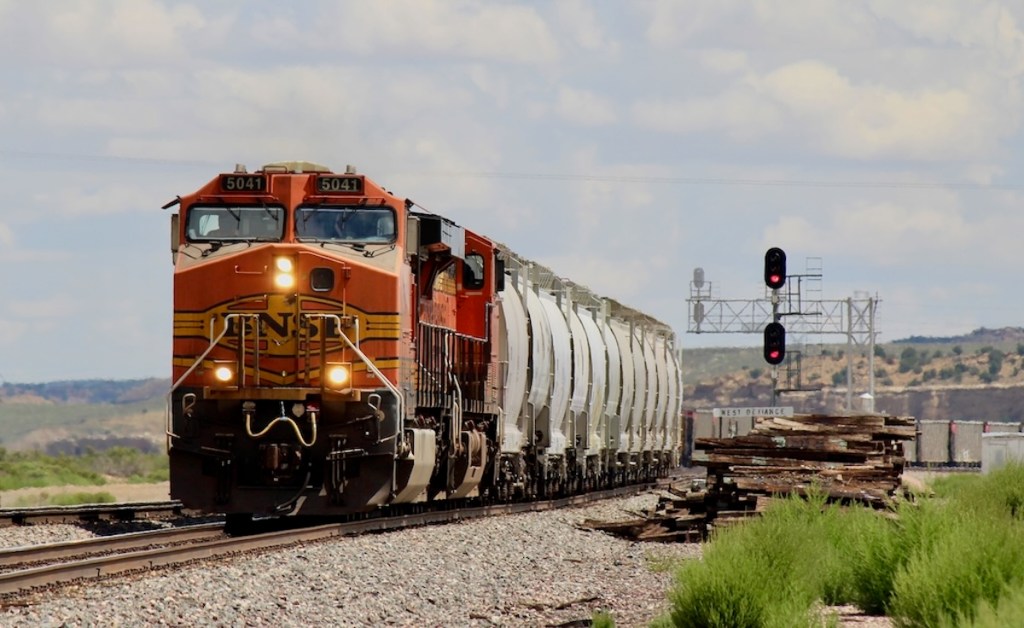
BNSF Railway carries more intermodal, coal, and grain traffic than any other railroad. And now it’s looking to boost its relatively small carload network through a combination of improved service, more frequent customer switching, and tighter partnerships with its top short line connections.

“We know intermodal’s a big part of the growth future. We’ve developed the ag [agriculture] shuttle network on the bulk side, and we certainly like our bulk network,” BNSF Chief Marketing Officer Tom Williams said in a recent interview. “I don’t want it to be lost that we care very much about that single-car merchandise network, too.”

Over the past year BNSF has taken steps to improve the efficiency of its merchandise network, starting with pushing down terminal dwell at its hump yards and emphasizing on-time train departures.

Those efforts paid off as BNSF posted all-time best terminal dwell figures in May. For the second quarter, terminal dwell was 21.9 hours, a 17% improvement compared to the second quarter of 2024.

And — bucking the long-term industry trend — BNSF has increased service frequency for 225 of its merchandise customers. A carload facility that received three days of service per week, for example, might now see a BNSF local on its spurs five days a week. Some five-day-per-week customers, meanwhile, went to daily service.

Tom Williams is BNSF’s chief marketing officer. (Photo: BNSF)

“And that, in total, equates to about 21,000 additional annualized service days per year,” Williams said. The hope is that the more frequent local service will lead to volume growth once the industrial economy rebounds.

The railway’s Short Line Select program, rolled out last fall to improve interchange performance, has cut dwell nearly in half on participating short lines. Volume on the Short Line Select railroads is up around 5% this year, compared to flat volumes on other short line connections as well as the balance of BNSF’s merchandise business.

“The whole name of the game of what we’ve been doing in the merchandise network is improving the velocity,” Williams said.

The combination of more efficient terminals and more frequent local service helps cars spin faster from origin to destination and return. Car-miles per day are up 25% compared to a year ago, which shaves two days off the transit time for a car that moves 1,000 miles.

What this means is that customers can move the same amount of freight using fewer cars, or put their suddenly surplus cars to work hauling more freight. “It’s good for us, it’s good for the customers,” Williams said. “We’ve reduced the inventory year over year by 20%.”

Amid these operational improvements, BNSF in June introduced a new First Mile/Last Mile group that includes the 13 people from its Shortline Development and Industrial Products Business Development teams.

Their focus is on understanding the needs of BNSF’s merchandise customers. “This isn’t about us going to the customer and telling them this is our network and … you fit it or you don’t,” Williams said.

Rather, BNSF wants to collaborate with its carload customers, learn how rail fits into their supply chains, and how local service tweaks could better fit their needs and lead to growth, he explained.

Short Line Select, meanwhile, aims to tighten the commercial relationship with top connecting railroads. Participating lines include Genesee & Wyoming’s Alabama & Gulf Coast Railway, Burlington Junction Railway, Genesee & Wyoming’s Portland & Western Railway, TNW Corporation’s Texas Northwestern Railroad and Red River Valley & Western, and Watco’s Timber Rock Railroad.

“One-third of our carload freight originates or terminates on a short line,” said Mark Ganaway, who leads BNSF’s shortline team. “That’s a significant portion of our business. We needed a way to move from transactional relationships to strategic partnerships.”

Last year BNSF handled 2.43 million merchandise carloads, a figure that does not include coal or grain.

“Interchanging more than 260,000 carloads per year, G&W and BNSF have an outstanding partnership. Having two G&W railroads — Alabama & Gulf Coast Railway in the east and Portland & Western Railroad in the west — participate in the BNSF Shortline Select program is a natural step in the evolution of our relationship,” said Kimberly Thompson, a vice president of sales and marketing at G&W. “BNSF’s program taps into the strengths of both a Class I and a short line to broaden both of our market reach and drive more traffic to rail as a safer and more sustainable alternative to trucking.”

BNSF is adding shortline transload locations to its Premier Transload Program directory. It’s also expanding its Certified Sites to include locations on short lines. The sites are rail-served properties that are ready for development. Among them: A site in the Mobile Gateway Park on the AGR in Alabama and a site on the Portland & Western that’s 45 miles north of Portland and will emphasize import/export containerized traffic.

The next step in BNSF’s merchandise growth efforts will be improving the suite of technology tools that customers use to interact with the railroad, said Williams. Traditionally, BNSF has purchased off-the-shelf technology applications. Now it’s building an in-house tech team that will develop BNSF-specific systems.

Customers should see improvements rolled out over the next six to 18 months, Williams said.

Subscribe to FreightWaves’ Rail e-newsletter and get the latest insights on rail freight right in your inbox.

Related coverage:

Report: Goldman Sachs advising BNSF on potential merger

Analysis: UP-NS rail merger spotlights individual legacies in a legacy business

Union Pacific, Norfolk Southern in merger talks: WSJ

Report: Investment firm advising Union Pacific on potential rail merger

First look: CN Q2 earnings

CN (NYSE: CNI) reported operating income of $1.21 billion for the second quarter ended June 30, up 5% from the previous quarter, while adjusted operating income was unchanged.

Revenues of $3.14 billion were off 1%, as revenue ton miles (RTMs) fell 1% in the quarter, the company said after the close of markets..

Diluted earnings per share improved 7% to $1.37, or 2% on an adjusted basis.

Operating ratio, or operating expenses as a percentage of revenues, was  61.7%, an improvement of 2.3 points. Operating ratio improved 0.5 points on an adjusted basis. 

“Our team’s ability to be nimble and our focus on tight cost control allowed us to adjust our operations and deliver strong results despite a challenging external environment,” said President and Chief Executive Tracy Robinson, in a release. “We are working closely with customers, including those impacted by trade issues, to provide them with the services they need to win in their markets. We remain focused on powering the North American economy and delivering for shareholders.”

The Montreal-based company said persistent trade and tariff volatility led it to cut its full-year earnings forecast from January’s 10-15% to the mid to high single-digit range.

The company said it will still invest approximately $2.5 billion in its capital program.

CN is withdrawing its 2024-2026 financial outlook “due to the continued high level of macroeconomic uncertainty and volatility related to evolving trade and tariff policies.”

Subscribe to FreightWaves’ Rail e-newsletter and get the latest insights on rail freight right in your inbox.

Find more articles by Stuart Chirls here.

Related coverage:

BNSF aims to grow carload traffic with rail service upgrades

Report: Goldman Sachs advising BNSF on potential merger

Analysis: UP-NS rail merger spotlights individual legacies in a legacy business

Union Pacific, Norfolk Southern in merger talks: WSJ

Cass and FreightWaves SONAR Revolutionize Freight Management with Seamless SSO Integration, Unlocking Advanced Supply Chain Intelligence

Complimentary Access to SONAR SCI via Cass’s SSO Integration During July and August

St. Louis, MO & Chattanooga, TN — July 15, 2025 — Cass Information Systems (NASDAQ: Cass), the leading provider of freight audit and payment services, and FreightWaves SONAR, the premier supply chain intelligence platform, are expanding their strategic partnership to offer enhanced value to mutual customers this summer.

As part of the collaboration, all mutual customers of Cass and SONAR will receive complimentary access to SONAR’s Supply Chain Intelligence (SCI) platform throughout July and August 2025. Access will be available seamlessly through Cass’s Single Sign-On (SSO) integration, allowing users to gain insights driven by the combination of their transportation data and FreightWaves SONAR’s real-time intelligence across North American markets and lanes.

The SCI platform within SONAR delivers advanced analytics, predictive rate modeling, and granular transportation market intelligence—enabling shippers to make faster, more informed decisions. With SONAR SCI integrated with Cass’s trusted freight audit and payment solution, shippers can unlock richer context around freight trends, market conditions, and carrier behavior—without leaving their existing workflow.

“This joint initiative reflects our shared commitment to innovation and transparency in the freight and logistics industry,” said Craig Fuller, CEO at FreightWaves. “By offering frictionless access to SCI through Cass, we’re helping shippers turn data into action—especially in an environment where every dollar and decision counts.”

“Cass continues to enhance its Decision Intelligence Suite, a portfolio of products that help our customers make smarter decisions” said Tony Urban, president of Cass’s freight payment organization. “Our expanded partnership with SONAR is another example of how we’re giving our customers a competitive edge through actionable intelligence.”

For Cass customers not yet using SONAR, this exclusive summer access provides an ideal opportunity to explore how SCI insights can enhance supply chain planning, budgeting, and procurement strategies.For more information or a demo of this solution contact your Cass or FreightWaves SONAR representative or visit GoSONAR.com for a demo.

About Cass Information Systems

Cass Information Systems, Inc. (NASDAQ: CASS) is the leading provider of transportation, utility, and waste expense management and related business intelligence solutions. Cass delivers visibility, control, and cost savings through its proprietary platforms and industry expertise.

About FreightWaves SONAR

SONAR is the fastest, most comprehensive freight market data and analytics platform. Built by FreightWaves, SONAR delivers real-time insights into transportation pricing, capacity, volumes, and predictive analytics—empowering shippers, carriers, and 3PLs to stay ahead of the market.

FedEx Freight gives shippers ‘more time’ to adjust to new LTL class rules

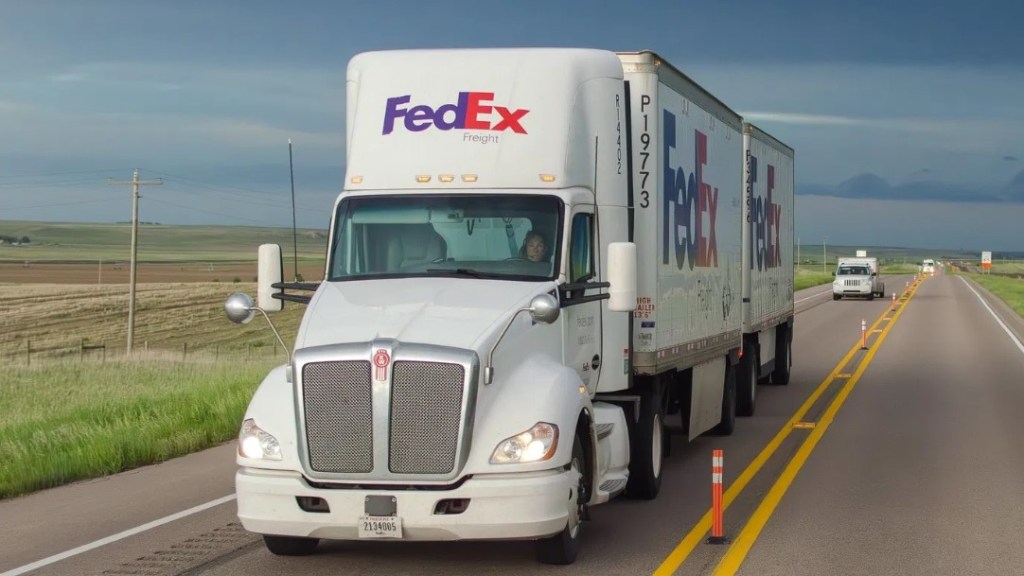
A white FedEx Freight tractor pulling two FedEx pup trailers

The nation’s largest less-than-truckload carrier, FedEx Freight, is delaying enforcement of a new set of freight classification rules until Dec. 1.

The National Motor Freight Traffic Association (NMFTA), a nonprofit trade group, rolled out final updates to its decades-old freight classification ratings on Saturday. The revisions are moving the industry toward a density-based coding system that is expected to more accurately align actual carrier costs with pricing.

For months, the NMFTA, carriers and 3PLs have been working to help shippers prepare for the changes to the 90-year-old National Motor Freight Classification (NMFC) system. The advice to shippers has been: “know your freight.”

Shippers are now tasked with better understanding the full dimensions of their shipments, not just the weights. The more information provided upfront, the more accurate shipment pricing is likely to be, experts say.

However, FedEx Freight (NYSE: FDX) said it is giving its customers “more time to adjust.”

“Since several commodities are moving to density-based classification, it’s more important than ever for shippers to accurately record shipments’ density, weight, and dimensions. If you ship these types of commodities, the density will determine the classification,” a statement on the company’s website said.

The carrier also cautioned that future charges may apply for incomplete details on a bill of lading.

“Once the changes are fully adopted, FedEx Freight may apply an inspection surcharge (Item 980, Item 981) for shipments with incomplete or inaccurate information listed on the BOL.”

The company, however, is encouraging customers to start using the updated class rules now.

“We have delayed enforcement to help our customers adapt and ensure a smooth transition to the new, streamlined NMFC classes,” a spokesperson with FedEx told FreightWaves. “Customers who want to begin using the new classes now are welcome and encouraged to do so; there is no requirement to wait until December 1.”

More FreightWaves articles by Todd Maiden: