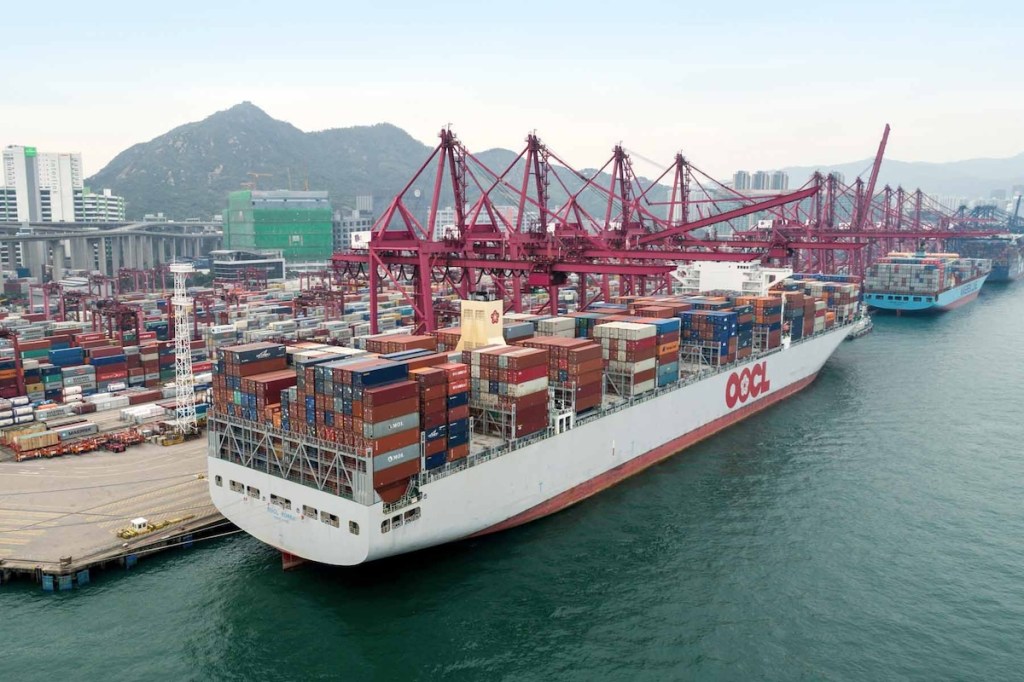
Container Q2 volumes up 4.4% for OOCL parent 

Orient Overseas (International) Limited said it carried 4.4% more containers in the second quarter from the same period a year ago.

The gain was generally in line with global container volumes for the quarter.

The Hong Kong-based parent (0316.HK) of Orient Overseas Container Line, a unit of China’s Cosco, said liner revenue fell 6.5% y/y to $2.12 billion for the quarter ending June 30 as revenue per twenty foot equivalent unit slid 10.4%, from $1,205 to $1,079 per TEU. The largest decline was seen on Asia-Europe services, down 17.2%.

Loadable capacity was 7.5% higher while the overall load factor fell by 2.4%.

For the first six months ended June 30, liner revenue increased by 4.4% and total liftings increased by 6.8% y/y. The carrier’s capacity was 8% higher, while the load factor fell 0.9%. Average revenue per TEU was off by 2.2% compared to a year ago.

Find more articles by Stuart Chirls here.

Related coverage:

Longshore unions to unite for ‘anti-automation’ protest

Tariff pauses ‘unlikely’ to halt tumbling trans-Pacific rates: Freightos

June rebound as West Coast containers best East, Gulf ports

Port Newark opens new electric drayage charging station

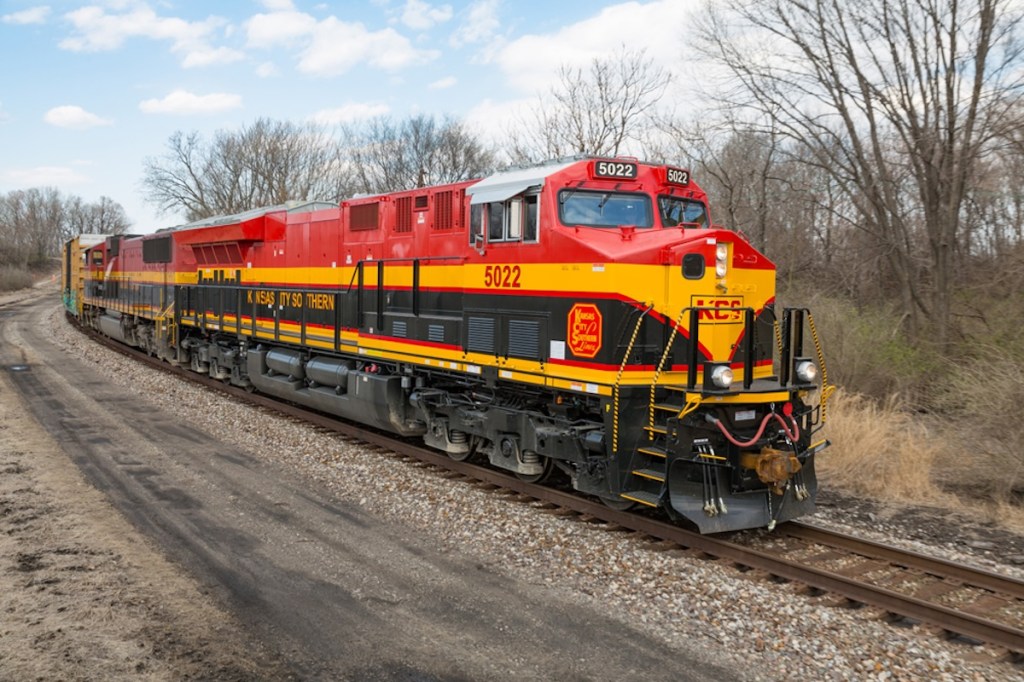
UPDATE: CPKC denies KCS wrongdoing as rail union polls members on strike

A CPKC union is conducting a strike poll of members, claiming the railroad took advantage of a service crisis to make workplace job changes on the troubled Kansas City Southern network. 

The International Association of Sheet Metal, Air, Rail, and Transportation Workers (SMART-TD) Local 457’s General Committee of Adjustment is polling members on a possible strike vote, General Chairman Samuel Habjan confirmed in a brief phone interview with FreightWaves late Saturday. The results of the poll are expected today. Habjan would not speculate on the results of the poll, or the union’s plans.

An email signed by “union members local 781” and obtained by FreightWaves claimed that the railroad was using the service crisis to cut jobs and reduce some employees’ working hours.

The email said that CPKC (NYSE: CP) was already facing a personnel shortage prior to a botched software changeover in May that caused a service crisis on the former KCS, aggravated by leaner operating practices and aggressive cost-cutting. 

“Earlier this month, SMART-TD reached an agreement with CPKC to permit the temporary use of “loan-out” crews from other territories to help address the shortage,” the email stated. “However, following this arrangement, CPKC management proceeded to cut approximately half of the established yard jobs in Shreveport (La.) Terminal. They placed the loan-out crews on a separate [job] board and began assigning them work in place of long-standing KCS and Louisiana & Arkansas [Railway] employees. 

“This decision has effectively restricted the seniority rights of the union employees already on the property and further strained local operations.”

Seniority is based on an employee’s length of service with a railroad, and often dictates which job assignments an employee can choose from. 

Calgary-based CPKC merged with KCS in April 2023, creating the first single-line carrier serving the United States, Mexico, and Canada.

The service disruptions caused significant problems for shippers on legacy KCS lines, including chemical producers in Louisiana, forcing CPKC to deploy personnel to verify the location of individual railcars by hand.

CPKC in a filing last week with the Surface Transportation Board said that local service on the KCS was improving, and that it expects service to return to normal levels later this month.

“From day one of this combination, we have been fully transparent with our unions and worked with them closely concerning operational needs and changes,” CPKC said in an email late Sunday to FreightWaves. “The same has been the case in this situation. Last month, CPKC signed an agreement with the SMART-TD (GCA 457) general chairman to allow the temporary use of CPKC train crews, also represented by SMART-TD, from another CPKC property in order to support the ongoing service recovery in the southern U.S. following the May systems cutover.

“Operational changes put in place during the service recovery and use of the temporary crews have all been done in accordance with the existing collective bargaining agreement for the former KCS territory, as has the application of the June agreement governing the use of temporary crews which was shared with the general chairman. CPKC has met and offered to meet again with local union leaders to discuss their concerns.”

Habjan did not return emails and calls late Sunday seeking the results of the poll.

This article was updated July 13 to include a statement from CPKC.

Subscribe to FreightWaves’ Rail e-newsletter and get the latest insights on rail freight right in your inbox.

Find more articles by Stuart Chirls here.

Related coverage:

Rail freight gains in short week

Setback for rail shippers as court vacates switching rule

BNSF, UP clash over new Salt Lake City intermodal service

CPKC paces all railroad freight gains in latest quarter

Borderlands Mexico: U.S. trade with Mexico rises to $74B in May

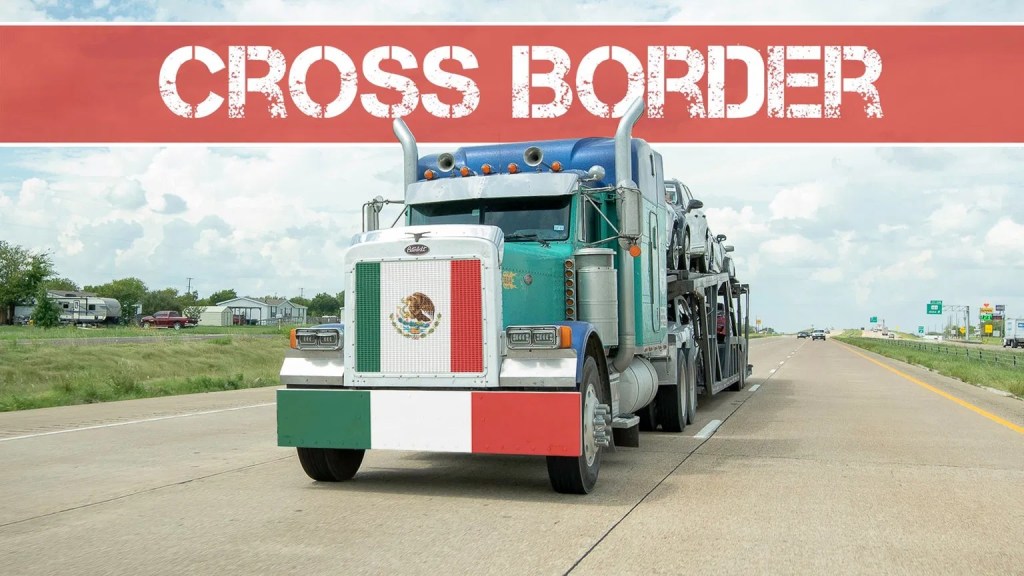
Borderlands Mexico is a weekly rundown of developments in the world of United States-Mexico cross-border trucking and trade. This week: U.S. trade with Mexico rises to $74B in May; Redwood Logistics opens office in Queretaro, Mexico; and Franke Group opens production plant in San Luis Potosí, Mexico.

U.S. trade with Mexico rises to $74B in May

Bolstered by shipments of computers, cars and auto parts to the U.S., Mexico was the top U.S. trade partner in May at $74.5 billion, according to Census Bureau data analyzed by WorldCity.

It was a 2% year-over-year increase compared to May 2024 and 7% gain compared to April.

Canada ranked No. 2 for trade with the U.S. in May at $57.6 billion, and China ranked third at $27 billion.

Mexico’s exports to the U.S. totaled $46.4 billion in May, a 5% year-over-year increase, while imports from the U.S. to Mexico fell 3% year-over-year to $28.2 billion.

Chicago O’Hare International Airport was the No. 1 spot among the nation’s 450 international gateways for trade, totaling $35.8 billion in commerce during May.

The port of entry in Laredo, Texas, was the No. 2-ranked U.S. trade gateway in May, compared to the same month in 2024, when Laredo was the No. 1 gateway for trade. Trade in the month totaled $30.4 billion, a 4% year-over-year increase.

John F. Kennedy International Airport was the No. 3 international U.S. trade gateway in May, totaling $26.3 billion.

The top U.S. imports from Mexico in May were computers ($7.2 billion), cars and pickup trucks (4 billion) and auto parts ($3 billion).

Top exports from the U.S. to Mexico during the month were gasoline and other fuels ($2.2 billion), computer parts ($2 billion) and auto parts ($1.7 billion).

Redwood Logistics opens office in Queretaro, Mexico

Redwood Logistics has opened an office in Querétaro, Mexico, expanding its presence in the country. 

The new location, situated in Mexico’s central Bajío region, is positioned to support nearshoring efforts and strengthen cross-border supply chains, Redwood officials said. 

“Querétaro is the ideal location to deepen our service capabilities for clients across automotive, aerospace, manufacturing and consumer sectors, Jordan Dewart, president of Redwood Mexico, said in a news release.

The Querétaro office, with plans to expand to 100 employees, will house all of the company’s business divisions, including technology solutions and managed services.

In 2023, Redwood Logistics opened new offices in Monterrey, Mexico

Chicago-based Redwood Logistics and Redwood Mexico is one of the fastest growing fourth party logistics providers in North America.

Franke Group opens $82M plant in San Luis Potosí, Mexico

The Franke Group recently opened an $82 million manufacturing facility in the Mexican City of San Luis Potosí, according to a news release.

The 333,681-square-foot facility expands the footprint of Franke Foodservice Systems – a division of the Franke Group and a supplier to global quick service restaurants and convenience store chains across the Americas.

The operation will initially create 200 direct jobs, with the potential to expand to 500 positions.

“This new site is a cornerstone of our strategy to localize production, improve supply chain resilience, and better serve our customers across the Americas,” Patrik Wohlhauser, CEO of the Franke Group, said in a statement. 

The Franke Group is based in Aarburg, Switzerland. The company employs about 7,700 people in 35 countries.

Maritime’s early peak masks rising trade and economic uncertainty

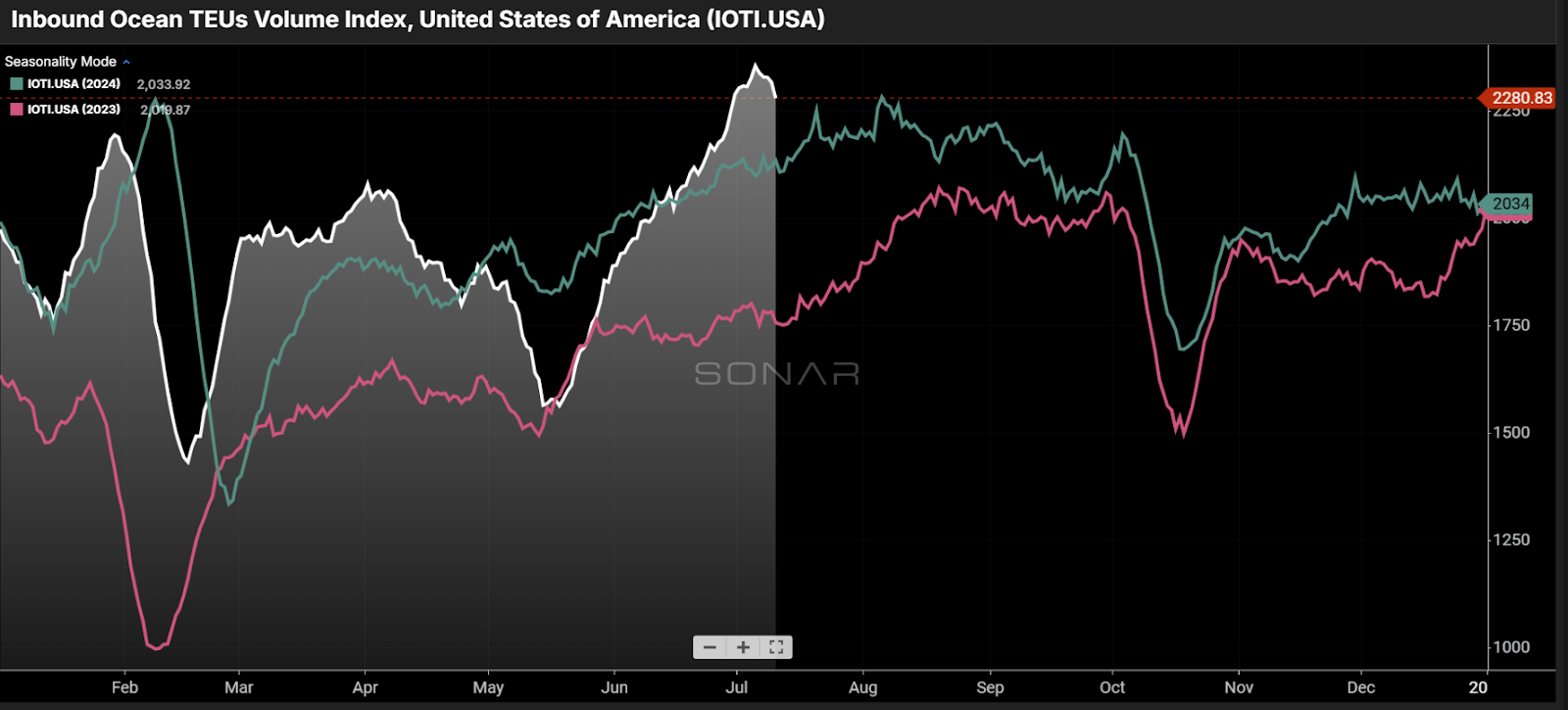
Chart of the Week:  Import Ocean TEUs Volume Index – USA SONAR: IOTI.USA

Booking volumes for container imports, as measured by the Inbound Ocean TEUs Volume Index (IOTI), appear to have peaked in early July—about a month ahead of the typical peak shipping season. While “typical” has become a relative term in recent years due to shifting and increasingly normalized shipping behaviors, this early peak offers valuable insight into what transportation markets might expect for the remainder of 2025.

The IOTI is a 14-day moving average index that tracks twenty-foot equivalent unit (TEU) containers arriving at U.S. ports from around the world. While it generally follows stable seasonal patterns, 2025 has seen significant disruption due to an emerging trade war initiated by the current administration in an effort to rebalance U.S. trade and support domestic manufacturing.

The IOTI reached a multi-year high of 2,356 following the Fourth of July—roughly 4% higher than last year’s peak of 2,273, which occurred on August 5, 2024.

However, this does not necessarily indicate stronger goods demand compared to last year. A portion of this volume increase likely reflects a recovery from lost time earlier in the year when cost-prohibitive tariffs on Chinese imports, enacted in April and early May, temporarily froze activity. Many importers halted purchases from the U.S.’s largest overseas trading partner due to skyrocketing costs, which led to a 15% drop in the IOTI during May.

A wave of uncertainty

When the tariffs were paused (currently set to expire in August), shippers quickly resumed ordering—both to make up for delayed shipments and to ensure sufficient inventory ahead of potential demand spikes.

This situation presents a double-edged sword for many companies. On one hand, tariffs increase direct import costs; on the other, they contribute to broader economic uncertainty and could suppress consumer demand. The extent to which this trade war will impact the broader economy remains unclear.

So far, it has clearly rattled sentiment, as seen in multiple consumer and business confidence indexes. While the jobs market appears healthy on the surface, deeper analysis reveals underlying weakness. According to ADP, private-sector hiring stalled in June, leading to a net loss of jobs. Retail sales also softened in May, prompting many economists to forecast further weakening in the second half of the year as the full impact of tariffs begins to filter into prices.

Although government employment figures showed gains—thanks largely to state and local hiring—that trend may be overstated, as a growing number of people have exited the labor force in recent months.

Holding the ball

All of this uncertainty has left supply chain managers in a difficult position, balancing how much inventory to procure, how much it will cost, and how much they’ll actually need as consumer health remains in question.

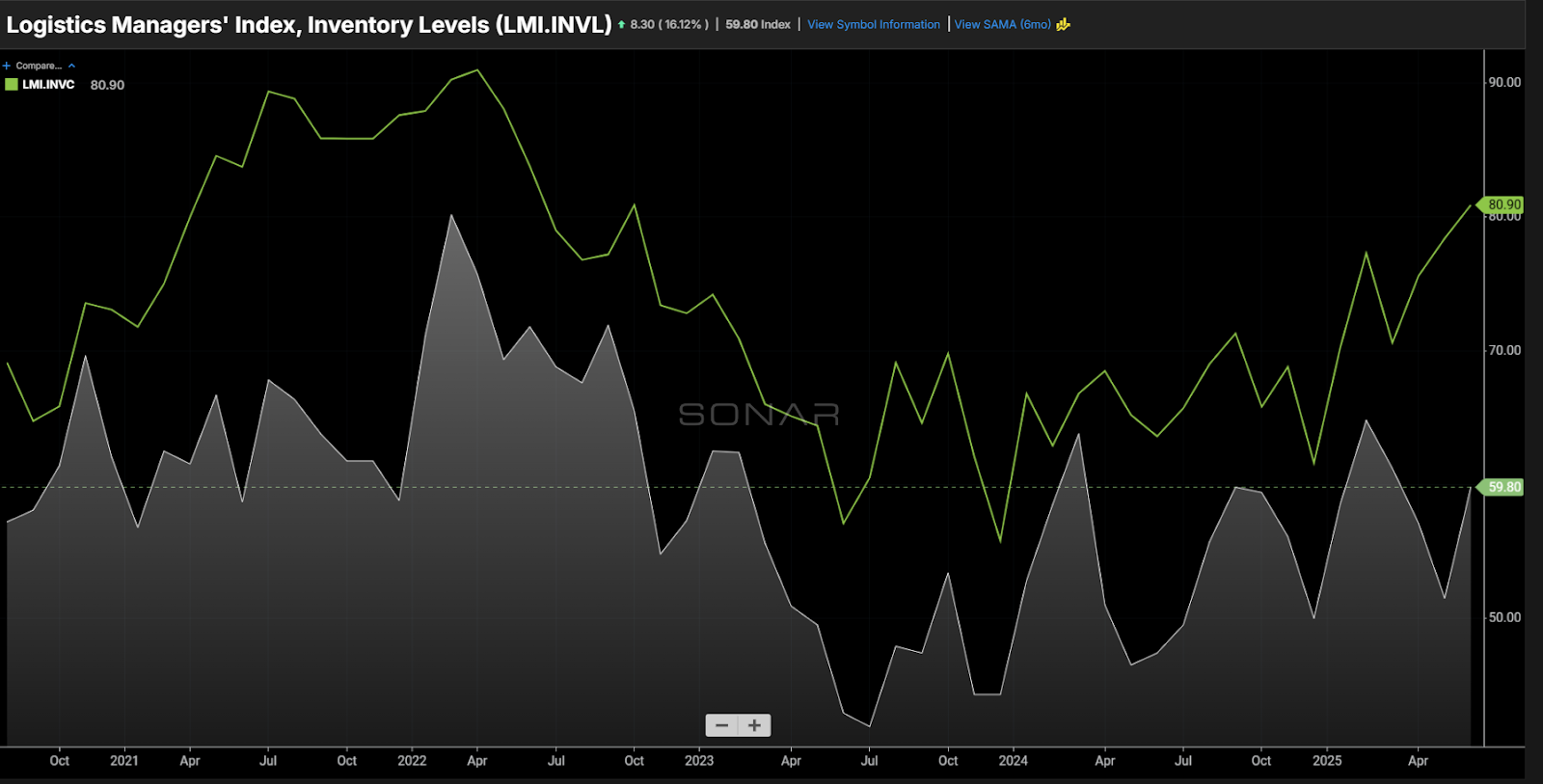
Inventory levels have grown somewhat erratically this year, though they’ve followed a generally upward trend since last summer, according to the Logistics Manager’s Index (LMI). More importantly, inventory costs have risen even faster—driven by tariffs and rising warehousing expenses. This pressure may suppress import volumes in the coming months as companies weigh the cost of holding excess inventory against waiting for more stable economic and policy conditions.

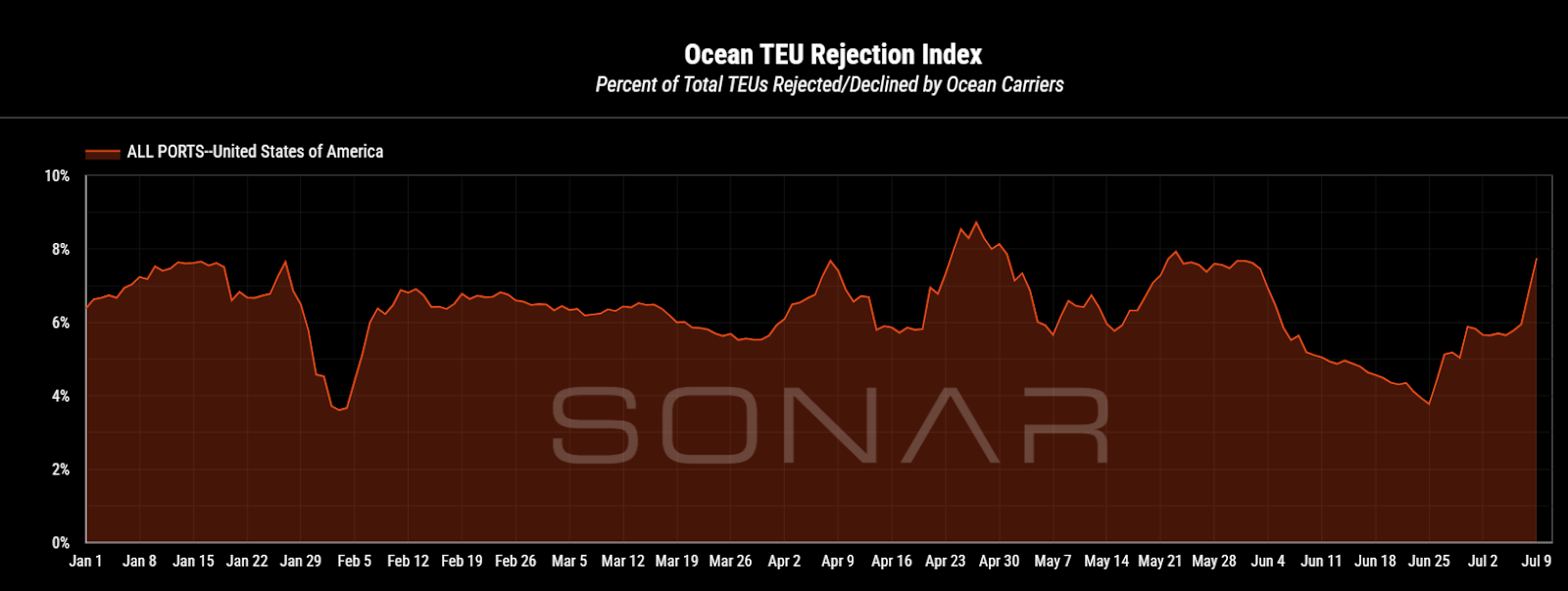
Maritime carriers appear to be anticipating softer demand as well. Early signs of blank sailings have emerged in response to declining bookings.

The Ocean TEU Rejection Index, found in SONAR’s Container Atlas application, shows a recent spike in rejected shipments. While this is a small sample that could reflect a short-term fluctuation, it may also suggest that carriers are starting to manage capacity to prevent rate declines.

This early peak in imports may not signal strength in the same way it once did. Still, that doesn’t necessarily mean surface transportation will weaken in the second half of the year. Rising inventory costs could lead to leaner inventories later on, prompting more last-minute orders. In environments like this, demand forecasts tend to lose accuracy—putting added pressure on transportation networks to remain agile and responsive.

About the Chart of the Week

The FreightWaves Chart of the Week is a chart selection from SONAR that provides an interesting data point to describe the state of the freight markets. A chart is chosen from thousands of potential charts on SONAR to help participants visualize the freight market in real time. Each week a Market Expert will post a chart, along with commentary, live on the front page. After that, the Chart of the Week will be archived on FreightWaves.com for future reference.

SONAR aggregates data from hundreds of sources, presenting the data in charts and maps and providing commentary on what freight market experts want to know about the industry in real time.

The FreightWaves data science and product teams are releasing new datasets each week and enhancing the client experience.

To request a SONAR demo, click here.

Dispatch Handoffs That Don’t Drop the Ball

When dispatch handoffs get sloppy, mistakes multiply and money slips through the cracks. Drivers get left in the dark, loads fall through the cracks, and your business starts to bleed in places you can’t afford. Whether you’re running two trucks or twenty, this article will show you how to build a clean, repeatable dispatch handoff system that keeps your team aligned, your drivers confident, and your operation tight from shift to shift. This isn’t about fancy tools—it’s about discipline, process, and ownership. Because if you’re growing your fleet, you can’t scale chaos. You need clarity.

If your dispatch handoffs are inconsistent—or worse, nonexistent—then your business is leaking money and losing trust somewhere, guaranteed. Don’t blame the driver. Don’t blame the broker. Don’t blame the freight. Blame the system—or the lack of one. It doesn’t matter if you’re new to delegation or trying to build a second shift for the first time. What matters is whether your people can pass the baton without fumbling. Because when they can’t, things break. And in trucking, every mistake has a cost—lost time, lost trust, or lost revenue.

This article is for the owner-operator turning into a small fleet. It’s for the dispatcher stretched thin trying to manage multiple shifts. It’s for the business owner finally stepping back from the day-to-day but tired of getting pulled in every time something slips. No matter your stage, one truth applies: handoffs aren’t optional. They’re not a luxury for big companies. They are the backbone of a professional operation. You want to scale? Then start here.

Why Dispatch Handoffs Matter More Than You Think

Dispatch isn’t just about booking freight and checking ETAs. It’s about managing critical information in real time, making decisions with incomplete data, and coordinating moving pieces across time zones, driver personalities, and shifting customer expectations. It’s fast, it’s stressful, and it leaves zero room for ambiguity. That’s why when information doesn’t transfer cleanly between dispatchers, shifts, or departments, everything downstream gets shaky.

Think about it like a relay race. The fastest runner in the world won’t win if they drop the baton. That’s dispatch. Your team could be made up of smart, hard-working people—but if they can’t pass critical information from one shift to the next without missing a step, you’ll always be reactive. You’ll always be fixing problems that were avoidable.

Handoffs are where good freight turns into bad experiences. They’re where a driver starts doubting your operation. They’re where a broker decides they can’t rely on you anymore. And most importantly, they’re where you, the owner, get dragged back into the weeds. Not because you want to—but because you have to. And that’s a sign of system failure.

What Happens When Handoffs Go Wrong

Let’s get tactical and call out the real symptoms of bad dispatch transitions. These aren’t hypotheticals. These are the pain points that carriers bring up to me week after week:

1. Drivers Left in the Dark

There’s nothing worse for a driver than calling dispatch and realizing the person on the line has no clue what’s going on. “Who dispatched this load?” “Did anyone update the appointment time?” “Why wasn’t I told I needed a TWIC card for this pickup?” It’s exhausting—and it kills morale. When drivers don’t feel supported, they stop trusting dispatch. And once that trust breaks, retention gets shaky.

2. Double-Booked Trucks

One dispatcher thinks Truck 02 is free. Another hasn’t updated the system. Now you’ve got two loads scheduled for the same asset—and no good way to cover both. Canceling means disappointing a broker. Delivering late means upsetting a shipper. Either way, you lose ground. All of it is avoidable with proper coordination.

3. Missed Appointments and Avoidable Fees

Some deliveries are drop-and-hook. Others are strict appointments with late fees if you miss by 15 minutes. If one shift doesn’t flag that for the next, you’re going to pay—literally. Worse, the customer will label you unreliable. It doesn’t take many of those errors to damage your credibility.

4. Paperwork Gaps That Delay Pay

If nobody logs the rate con, scans the signed BOL, or updates delivery notes in your TMS or system of record, you’ve got a mess. Now accounting can’t invoice, you can’t prove delivery, and you’re left chasing paperwork two weeks later with nothing but confusion in the thread.

5. The Owner Gets Dragged Back Into Ops

Let’s call it what it is. When handoffs fail, it’s usually the owner who gets the late call. The angry broker. The missed check call. The confused driver. The lost document. The entire purpose of building a team is to offload that weight. But when your team isn’t aligned, you don’t gain leverage—you just multiply stress.

What a Clean Handoff Should Look Like

A smooth dispatch handoff doesn’t require a six-figure TMS or a massive back office. What it does require is clarity. Everyone needs to know what gets communicated, how it gets documented, and when it must be passed on. This isn’t about micromanaging—it’s about standards.

1. Create Solid SOPs

If you don’t have documented procedures, you’re playing the telephone game. SOPs (Standard Operating Procedures) turn tribal knowledge into institutional knowledge. Document how your team transitions shifts. Include what info gets captured, how it’s stored, and what must be communicated—every time, no exceptions.

2. Centralize Information in One Hub

Text threads, sticky notes, and verbal updates don’t scale. Use one centralized system—whether it’s a TMS, a shared spreadsheet, or a project management tool. The goal is simple: one source of truth that every dispatcher can rely on. Real-time updates, driver notes, broker expectations—all in one place.

3. Use an End-of-Shift Checklist

Before a dispatcher clocks out, they should complete a simple but critical checklist. Things like:

  • Load status updated
  • Driver ETAs confirmed
  • Shipper and receiver instructions clarified
  • All documents uploaded
  • Any problems flagged for the next shift

Think of it like a pilot’s pre-flight check. Boring? Maybe. But it prevents catastrophe.

4. Formalize the Handoff Communication

Don’t assume someone will figure it out. Require a formal signoff—voice note, Slack message, or brief huddle. The next person should start their shift with total visibility, not detective work.

5. Keep Drivers in the Loop

Your dispatch shifts might change—but from a driver’s view, it should feel seamless. If a driver needs to re-explain their situation every shift change, you don’t have a dispatch team—you have a liability. Drivers are your field team. They need to feel continuity. Build trust by making transitions invisible to them.

Real-World Breakdown: What It Looks Like When You Don’t Handoff Clean

Maria handles dispatch during the day. James works nights. Simple enough. One night, James gets a call—the driver’s truck won’t start. There’s a 5am appointment on the books. But guess what? No one noted whether the appointment was strict or flexible. No backup plan was in place. The second truck’s location is outdated. James can’t act fast enough.

By morning, the load is missed, the broker’s calling furious, and the driver’s been sitting for hours without a solution. Maria’s frustrated. James feels set up to fail. And the owner is back in the hot seat, once again, cleaning up something that should’ve never happened.

All of it? 100% preventable—with the right handoff system.

How to Build a Bulletproof Handoff System From Day One

Don’t wait until you “need” one. Build it before the cracks start to show. Here’s how:

1. Define Your Workflow in Writing

Map out your dispatch schedule and identify every handoff point—shift changes, role changes, or dispatch-to-driver communication chains. Write out the flow of data: where it starts, where it goes, and who owns each step.

2. Set Clear Non-Negotiables

Make handoffs mandatory. If you don’t complete the checklist and sign off to the next dispatcher, you don’t clock out. Make it part of your SOPs and performance expectations.

3. Train With Real Scenarios

Walk your team through what great (and poor) handoffs look like. Role-play scenarios. Don’t just train people once—review performance weekly. Call out breakdowns. If someone’s dropping the ball repeatedly, it’s not a system issue. It’s a discipline issue.

4. Choose Tools That Fit Your Operation

You don’t need to go buy a top-tier TMS tomorrow. Start with what fits. A well-structured Google Sheet, Trello board, or Slack channel can be enough if your process is clean. Tools don’t fix broken systems—but systems make tools more effective.

5. Make Drivers Part of the Process

Drivers are your best auditors. Empower them to speak up when something falls through the cracks. If they’re left in the dark during shift changes, make it easy for them to report it. That feedback loop is how you refine and improve.

Final Word

In trucking, every load is a promise. Every mile is an opportunity—or a liability. And every handoff is a chance to either build momentum or introduce risk. Dispatch is the glue holding it all together, and when that glue starts to crack, your entire operation gets shaky.

A clean handoff process keeps your team aligned, your drivers supported, and your customers satisfied. More importantly, it keeps you—yes, you, the business owner—from getting pulled back into the chaos every time someone forgets to update a note or relay a message.

So don’t wait for another breakdown. Build your handoff system now. Document it. Train it. Enforce it. Because in this industry, operational discipline is what separates the amateurs from the professionals.

Let’s tighten it up and run it like a business.

Let’s get to work.

Trump announces 30% tariffs on imports from Mexico, EU 

President Donald Trump on Saturday said he will impose a 30% tariff on imports from Mexico and the European Union (EU) starting on Aug. 1.

Trump announced the tariffs in letters posted to Truth Social, which he has used over the past week to unveil a flurry of new import levies with dozens of U.S. trading partners.

In his letter to Mexican President Claudia Sheinbaum, Trump cited fentanyl as the main reason for the tariffs.

“Mexico has been helping me secure the border, BUT, what Mexico has done, is not enough,” Trump wrote. “Mexico still has not stopped the Cartels who are trying to turn all of North America into a Narco-Trafficking Playground.”

It’s unclear if goods covered by the United States-Mexico-Canada Agreement will remain exempt from the tariffs.

Trade between the U.S. and Mexico totaled more than$840 billion in 2024, making Mexico the top U.S. trade partner for the second consecutive year, according to Census Bureau data

Mexico was also the top U.S. trade partner in May at $74.5 billion.

In a letter to the EU, Trump said that the U.S. trade deficit was a national security threat.

“We have had years to discuss our Trading Relationship with The European Union, and we have concluded we must move away from these long-term, large, and persistent, Trade Deficits, engendered by your Tariff, and Non-Tariff, Policies, and Trade Barriers,” Trump wrote. “Our relationship has been, unfortunately, far from Reciprocal.”

Ursula von der Leyen, the president of the European Commission, said the commission will continue to work toward an agreement before the Aug. 1 deadline arrives.

“Imposing 30 percent tariffs on EU exports would disrupt essential transatlantic supply chains, to the detriment of businesses, consumers and patients on both sides of the Atlantic,” Von der Leyen said in a news release

Northwest Seaport Alliance launches zero-emission drayage truck incentive program

Electric truck at the Port of Tacoma

The Northwest Seaport Alliance (NWSA) recently announced its first-ever incentive program for zero-emission truck and charging deployment in the Puget Sound region. Zeem Solutions was selected as the subrecipient of the program after a competitive bidding process. This marks Zeem’s first deployment in Washington state.

The program was funded by a $6.2 million grant from the Washington State Department of Transportation (WSDOT), and will bring 19 zero-emission trucks and charging infrastructure to the region. The project is part of a larger public-private partnership, with Zeem and its fleet partners contributing a substantial portion of the total project costs.

“We are grateful for the partner we have found in Zeem. This transition is a necessary but expensive one, and we need all the partners at the table that we can get,” said NWSA co-chair and Port of Tacoma commission president John McCarthy.

The Zeem project includes developing a strategically located charging site near the I-5 exit ramp south of SeaTac Airport, along SR-99. The facility will accommodate charging for 250 vehicles daily and provide overnight parking for 70 vehicles. Construction is scheduled to begin in fall 2025, with zero-emission vehicles expected to be operational by 2026.

“WSDOT is pleased to be part of advancing the use of clean energy for zero-emission drayage trucks,” said Jason Biggs, director of WSDOT’s Rail, Freight and Ports Division. “Projects like this one are key to meeting the state’s climate commitment goals.”

The initiative aligns with the recently released Decarbonizing Drayage Roadmap, which outlines nearly 70 recommendations for transitioning the full drayage fleet to zero-emission vehicles by 2050. The incentive program was designed to minimize financial burden and risk to drivers while ensuring the co-development of necessary charging infrastructure.

Drayage trucks, like their larger full-sized Class 8 cousins, contribute large amounts of both diesel particulate matter and greenhouse gas emissions. State, local and municipal governments are looking at ways of reducing emissions, as they disproportionately impact communities near port operations and along freight corridors.

“This is a major milestone, putting the first zero-emission drayage trucks on the road in Washington state,” said NWSA managing member and Port of Seattle commissioner Sam Cho. “We continue to make clear and steady progress, from our overarching strategy with the Northwest Ports Clean Air Strategy to the Decarbonizing Drayage Roadmap.”

Torc Joins Stanford Center for AI Safety to Advance Autonomous Trucking Technology

(Photo: Torc Robotics)

Torc Robotics, an independent subsidiary of Daimler Truck AG, has announced its membership in the Stanford Center for AI Safety. The collaboration establishes a partnership focused on enhancing AI safety for autonomous trucking applications as Torc prepares for full commercialization in 2027.

Headquartered in Blacksburg, Virginia, Torc has additional engineering offices in Austin, Texas, and Montreal, Canada. The company also maintains a fleet operations facility in the Dallas-Fort Worth area and a software developer footprint in Ann Arbor, Michigan.

The membership provides Torc with direct access to Stanford’s research findings, symposiums and seminars, enabling the company to sponsor, collaborate in and co-author research. This access is anticipated to help Torc enhance safety protocols for machine learning models within its autonomous driving systems.

“Torc is proud to join the Stanford Center for AI Safety, reinforcing our mission to deliver safe, scalable and trustworthy autonomous solutions,” said Steve Kenner, chief safety officer at Torc, in a news release. “This membership aligns with our commitment to advancing rigorous safety practices in AI development and supports our goal of providing highly reliable technology to our customers.”

The Stanford Center for AI Safety focuses on developing safety protocols and advanced machine learning techniques to mitigate risks in autonomous systems. As a member, Torc will leverage published research to address critical safety challenges in autonomous driving applications, enhancing the reliability of its machine learning models.

“Collaborating with members in our affiliates program allows us to apply our research in AI safety to real-world challenges,” said Duncan Eddy, director of the Stanford Center for AI Safety. “Our work with Torc will include efforts to enhance the safety and reliability of autonomous driving systems, ultimately contributing to the advancement of this transformative technology.”

You’re halfway there! To read the rest of the Truck Tech newsletter, subscribe below. It’ll be delivered to your inbox every Friday at 11am eastern.

While you’re at it, check out this week’s episode.

How to Build a Bulletproof Safety Binder from Day One

If you’re operating trucks without a complete, organized, and regularly updated safety binder, you’re playing a dangerous game — one that ends with audits, violations, or worse, lawsuits. Too many new carriers treat compliance like an afterthought. They get their DOT number, get insurance, start moving freight, and figure they’ll “clean it up later.” That’s exactly how you get blindsided when the DOT comes knocking or something goes wrong out on the road.

Let’s get one thing straight — your safety binder isn’t paperwork for paperwork’s sake. It’s your defense system. It’s what keeps you out of trouble, keeps you audit-ready, and shows that you’re running a real operation — not a fly-by-night hustle.

And the best time to build it is before you get your first load.

So let’s walk through how to build a bulletproof safety binder from day one — the right way, the smart way, and the way that sets your business up to stay in control, compliant, and scalable.

Why Your Safety Binder Isn’t Optional

Let’s talk about what happens when the DOT walks in and asks to see your safety records — and you don’t have them. Or worse, you have half of them scattered across your inbox, glovebox, and laptop folders. That’s an automatic red flag. And red flags lead to audits, fines, conditional ratings, and potentially even shutdowns.

The safety binder is your insurance policy against that chaos. It shows that you’re proactive, organized, and serious about compliance. It’s not just about checking boxes — it’s about creating peace of mind and avoiding costly disruptions.

What a Proper Safety Binder Actually Does

A real safety binder should do three things:

  1. Protect you in an audit
  2. Keep your drivers on track with FMCSA regulations
  3. Give you quick access to critical info when something goes wrong

This isn’t just for show. When a roadside inspection happens, or a claim hits, or a random audit request comes through, you need to be ready. Not scrambling. Not guessing.

You need to have every piece of documentation ready to go — organized, dated, and signed where it needs to be.

How to Structure Your Binder – The 7 Core Sections You Must Have

Your binder needs to follow a clear format. Whether it’s a physical binder in the office or a digital version on your TMS or cloud drive, the layout should be consistent.

Here’s the exact structure I recommend, broken into seven core sections:

Section 1 – Company & DOT Compliance Info

Start with your foundation.

  • DOT and MC numbers
  • Operating authority letter
  • Certificate of insurance
  • MCS-150 form (updated and current)
  • Unified Carrier Registration (UCR) proof
  • BOC-3 filing
  • DOT drug & alcohol consortium enrollment proof
  • Company safety policy (yes, you need one — even if you’re a one-truck operation)

This is the section auditors flip to first. Don’t make them wait.

Section 2 – Driver Qualification Files

Every driver — including you if you’re the owner-operator — needs a complete qualification file.

Include:

  • Driver application (required by FMCSA)
  • Copy of CDL and medical certificate
  • MVR (Motor Vehicle Record) from the past 30 days at hire
  • Annual MVR review forms
  • Certificate of road test or equivalent CDL proof
  • Signed driver consent for background checks
  • Safety performance history inquiries from past employers (3 years)
  • Driver training certifications (ELDT, safety videos, etc.)
  • Driver policy acknowledgement form

Keep each driver in a separate tab or digital folder. No exceptions. These are the first things an auditor or insurance investigator will ask to see.

Section 3 – Hours of Service & Logs

Even if you’re using an ELD system, you need a physical or digital paper trail.

  • ELD provider registration and user manual
  • HOS policy statement
  • Driver ELD training records
  • Malfunction procedures (how to handle ELD failure)
  • Any logs for exempt drivers (short-haul, etc.)
  • Supporting documents for hours of service verification (fuel, toll, etc.)

Don’t assume the tech will cover you. You still need to show policy, process, and backup.

Section 4 – Vehicle Maintenance & Inspection Records

DOT loves to dig into maintenance records — and if you can’t prove your trucks are road-ready, they’ll shut you down.

Include:

  • Pre- and post-trip inspection forms (DVIRs)
  • Annual DOT inspection reports
  • Maintenance logs (oil changes, tire replacements, repairs)
  • Repair receipts or work orders
  • Preventive maintenance schedule per vehicle
  • Brake system inspection records
  • Out-of-service repairs and clearance documentation

Organize these by truck unit number. Keep it clean. Keep it consistent.

Section 5 – Drug & Alcohol Testing Records

This is a must-have. FMCSA is strict on this — no gray areas.

Include:

  • Proof of consortium enrollment
  • Pre-employment drug test results
  • Random drug and alcohol test results
  • Post-accident test documentation
  • Reasonable suspicion training certificates (if you have supervisors)
  • Refusal records (if any)
  • Chain of custody forms
  • SAP referral and return-to-duty forms (if applicable)

Missing or outdated forms here can result in immediate fines. No excuses.

Section 6 – Accident Register & Investigation Reports

Accidents happen. The question is whether you’re documenting them properly.

  • DOT accident register (even if it’s blank)
  • Accident report forms
  • Witness statements
  • Police reports
  • Photos and damage estimates
  • Post-accident drug and alcohol testing documentation
  • Corrective action plans

Keep these for three years minimum. And yes — even “minor” incidents count.

Section 7 – Training & Safety Programs

This is where most carriers fall short. They never document their safety efforts — so they get no credit when it counts.

Include:

  • Driver onboarding checklists
  • Safety meeting agendas or sign-in sheets
  • Defensive driving course certificates
  • Hazmat or specialized cargo training
  • Quarterly safety review logs
  • Policy updates with driver signatures
  • Cell phone policy, dash cam policy, seatbelt policy — all signed and acknowledged

The more documented effort you put here, the stronger your defense in any claim or audit.

Physical Binder vs. Digital Binder – What Works Best?

Both can work — but you need accessibility, structure, and backups.

A physical binder is great for roadside use or small fleets without tech infrastructure. But it needs to be kept up-to-date weekly. No exceptions.

A digital binder (Google Drive, Dropbox, or inside your TMS) is cleaner, easier to organize, and better for multi-truck operations. Just make sure it’s:

  • Easy to navigate
  • Backed up regularly
  • Shared securely with your team

Pro tip: use naming conventions like “Truck_101_AnnualInspection_2025-06-01.pdf” to keep everything clean and searchable.

Don’t Just Build It — Use It

Here’s where most safety binders go to die: they get built once, then forgotten. Sitting on a shelf or buried in a file folder. That’s not a system — that’s a liability.

Review your binder monthly. Update logs. Add new training. Purge expired forms. The DOT doesn’t care what your binder looked like last year. They care what it looks like right now.

Make it a habit. Set a calendar reminder. Hold your team accountable. Because in safety, consistency isn’t optional — it’s everything.

Final Word

You don’t wait for a fire to build an exit plan. You don’t wait for the DOT to build a binder. If you’re serious about protecting your business, your trucks, and your future — you build a safety system from day one.

The safety binder isn’t just for compliance. It’s a reflection of how you run your business. Are you disciplined? Are you prepared? Are you legit?

Because one roadside inspection, one DOT audit, one incident — that’s all it takes to find out if you were organized or exposed.

Build your safety binder before you need it. Keep it clean. Keep it current. And run your business like it’s built to last.

Let’s get to work.
Broker Transparency – A Fight for Fairness or Just a Flashpoint

When you bring up broker transparency at a truck stop or in an owner-op Facebook group, you’ll see two things happen fast: tension and division. Some drivers will shout, “Show me the money!” Others will tell you it doesn’t matter — that chasing rate details is just noise. What started as a call for fairness has now become a wedge in the trucking community. And depending on who you ask, the fight over broker transparency is either long overdue… or a complete waste of time.

So let’s break it all the way down. Not from a place of outrage or bias — but from a place of context. Because before we can decide what’s fair, we need to understand what’s actually true.

Where It All Began – The Origins of the Rule

To get to the heart of the matter, we have to roll the tape back to 1980 — the year President Carter signed the Motor Carrier Act. This was the moment that deregulated much of the trucking industry, breaking the stronghold of government control over rates, routes, and who could haul what.

Before 1980, brokers and carriers worked under tight federal oversight. Rates were publicly filed with the ICC (Interstate Commerce Commission), and everyone knew what was being charged. Back then, transparency wasn’t a luxury — it was baked into the system. But deregulation flipped the switch. It allowed brokers and carriers to negotiate freely. And with that freedom came a new rule: 49 CFR §371.3.

This rule says that brokers must keep a record of every load, and that motor carriers are legally allowed to inspect the record upon request. In theory, this meant carriers could see what the broker made. In practice, it created a gray area that’s still being fought over today.

The Rule That Everyone Knows — But Very Few Follow

Here’s what 49 CFR §371.3(c) actually says:

“Each party to a brokered transaction has the right to review the record of the transaction required to be kept by these rules.”

Sounds simple, right? But there’s no teeth behind it. No enforced penalties. No enforcement mechanism. And brokers aren’t exactly lining up to open their books — especially in a world where tech platforms and digital freight networks have become the norm.

Today, many carriers who request load records get blacklisted. Brokers cite NDAs, privacy clauses, or simply ignore the request. And even if you file a complaint with the FMCSA, nothing usually comes of it. So the rule sits there. Known. Ignored. Weaponized only when convenient. There are some brokers who are openly transparent but not the majority. 

How We Got Here – The Shift in Broker-Carrier Dynamics

In the 1980s and 90s, the broker-carrier relationship looked a lot different. Brokers were often small outfits. They worked closely with the same carriers, sometimes building deep relationships. Many started as drivers themselves. And because rates were more stable, there wasn’t as much fighting over margins.

But as technology took over — and as mega-brokers emerged — things changed.

Freight marketplaces exploded. Load boards multiplied. Brokerages scaled up fast. And what was once a handshake business became a tech-first industry built on volume, margins, and automation. The human connection between carrier and broker took a backseat to load velocity.

Today, most carriers never meet or speak to the people moving their freight. The relationship has become purely transactional. And in that vacuum, distrust grows. Especially when rates drop and drivers start wondering, “If I’m only getting $1.95 a mile, what’s the broker pulling on this?”

That’s the root of this fight. Not just money — but the lack of transparency in how it’s divided.

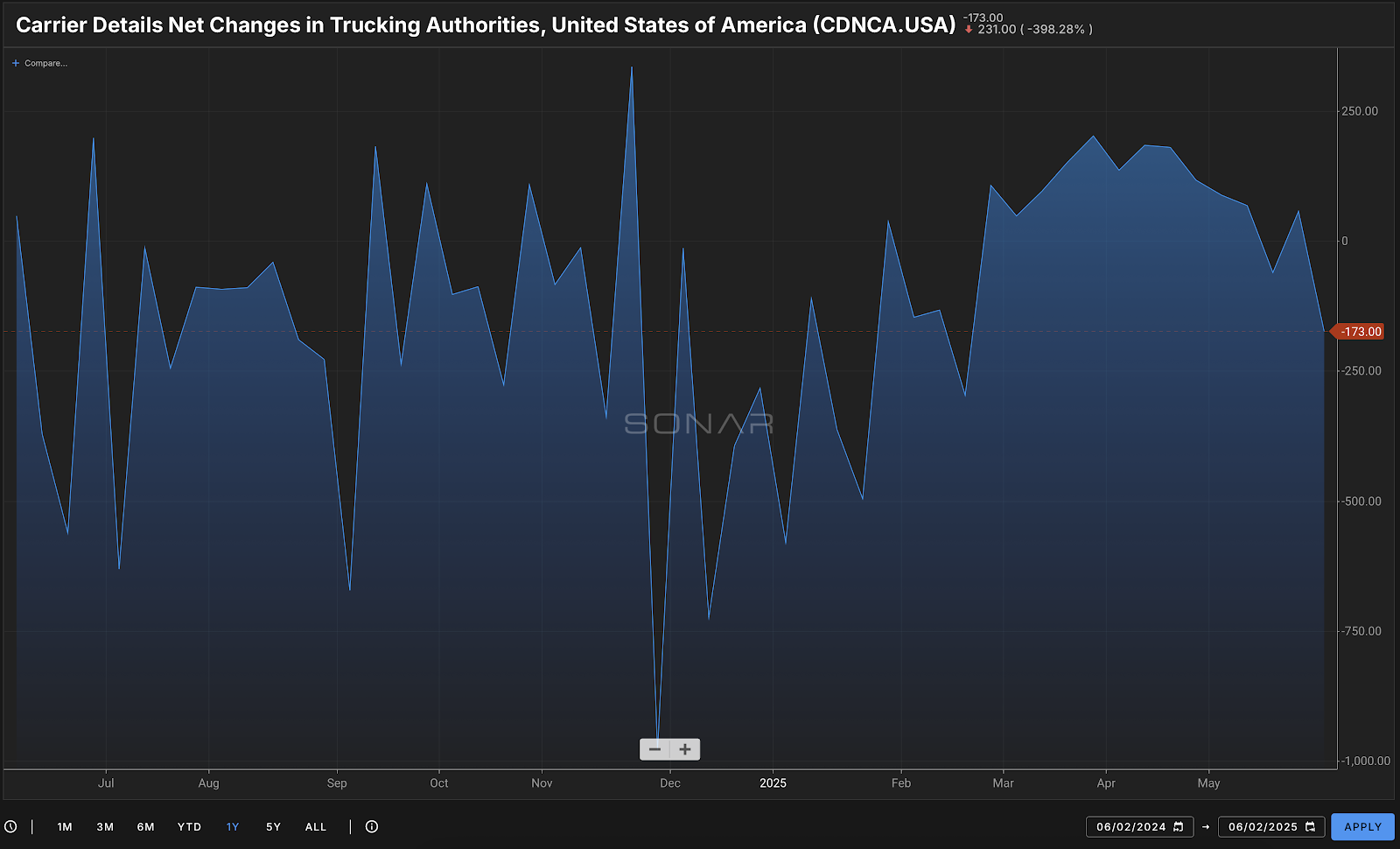
(Photo: SONAR, CDNCA.USA Carrier Details Net Changes in Trucking Authorities. As broker-carrier trust continues to erode, many small fleets are pulling out of the market altogether. This SONAR chart shows net changes in trucking authorities over the past year, with steep drop-offs in late 2024 and volatile swings through mid-2025—signaling instability and ongoing exit of small carriers. Behind every dip is a carrier that gave up, often not because of freight—but because of a system they no longer trust.)

Why Carriers Are Pushing for Transparency Now

To understand the current wave of frustration, you have to feel the reality of today’s spot market. For many small carriers, rates have dropped to unsustainable levels. Fuel is high. Repairs are high. And brokers — often protected by contracts and tech platforms — are the only ones with full visibility into what the shipper actually paid.

That’s why carriers are asking for transparency. Not out of greed — but out of survival.

They want to know if they’re being treated fairly. They want to protect themselves from getting lowballed. And in a market where shippers are still spending billions, they want to see where the margin is going.

There’s a sense among many small carriers that they’re doing the hardest part — moving the freight — but are the last ones to know the full value of the load. That resentment is real. And it’s what’s fueling this fight.

Why Brokers Push Back – And What They’re Not Saying

Now let’s flip the script.

Brokers will tell you that transparency isn’t realistic. That contracts are confidential. That their margin is their business. And that the market determines the rate, not some secret formula.

They’ll also say this: if carriers get to see what the shipper paid, brokers will lose their competitive edge — and some shippers could just stop using brokers altogether. They argue that brokers bring value by handling billing, compliance, risk, and customer relationships — things carriers may not see but that cost real money.

And they’re not wrong. The best brokers absolutely earn their cut. They cold call countless hours, manage chaos, field late-night calls, and keep freight flowing across thousands of lanes. The problem isn’t that brokers exist. It’s that bad ones hide behind technology and treat carriers like numbers, not partners.

Here’s what most brokers won’t say out loud: they’re afraid that if transparency becomes law, they’ll have to explain their value and it will encourage a race to the bottom for shippers looking to cut costs. Not just in general — but on every load. And for brokers who add value, that won’t be a problem. For the ones who don’t? Game over.

The Truth: Transparency Alone Won’t Fix the Market

Let’s get one thing straight: even if brokers opened their books tomorrow, it wouldn’t magically solve the spot market crisis.

Carriers would still have to deal with rising costs, market volatility, and broker consolidation. Knowing the margin doesn’t guarantee you a higher rate. It just gives you more information — and a possible reason to walk away.

Also, let’s face it, not every single owner operator or small fleet owner is built the same in regards to business.

In fact, there’s a real risk that mandatory transparency could backfire. Shippers might demand margin caps. Brokers might cut service to leaner levels. And smaller carriers might still get left out — only now they’ll be angry and broke.

That’s why some carriers and industry vets are warning: don’t chase a headline fix. Transparency is a step — not the solution.

But Here’s Why It Still Matters

With all that said, transparency isn’t meaningless. It’s a signal — a declaration — that the people doing the actual work deserve a seat at the table.

It’s about fairness. About knowing when you’re being taken advantage of. About pushing back against systems that hide behind complexity.

For carriers, especially owner-ops with one or two trucks, it’s not about seeing every invoice. It’s about respect. About feeling like a partner, not an afterthought. And in a spot market that’s tilted so heavily in cycles, even small steps toward clarity matter.

Because here’s the truth: if a broker is scared to show their margin, it usually means they know it won’t hold up in the light.

What Can the FMCSA Should Do

So where do we go from here?

The FMCSA reviewed public comments on broker transparency, and the industry is waiting to see what comes next. Here’s what could actually move the needle without blowing up the entire market:

  1. Enforce the Rule Already on the Books
    • Require brokers to respond to written record requests within 30 days.
    • Penalize consistent non-compliance with suspensions or fines.
  2. Modernize 371.3
    • Clarify what records must be provided, in what format, and what redactions are allowed.
  3. Encourage Third-Party Verification
    • Allow carriers to request audits through a neutral third party without violating shipper confidentiality.
  4. Create a Voluntary Transparency Certification
    • Brokers who agree to open-book practices could earn a compliance badge — making them more attractive to top-tier carriers.

This isn’t about punishing brokers. It’s about balancing a system that’s lost touch with its roots.

Final Word: It’s About More Than Just a Rate

At the end of the day, this fight over transparency is about something deeper than cents per mile. It’s about ownership, partnership, and accountability.

It’s about small carriers who built their companies from the ground up — often with nothing but grit and a dream — finally saying, “We deserve better.”

But it’s also about being honest: not every broker is the enemy. Not every load is worth fighting over. And not every fix needs to come from Washington.

What we need is a freight culture that rewards fairness, values trust, and encourages carriers and brokers to build relationships — not just transactions. Transparency might not fix everything, but it’s a step toward a market where honesty isn’t seen as a liability.

Let’s keep fighting for that.

The Real Cost of Hiring the Wrong Dispatcher – And How to Avoid It

In this business, your dispatcher can either be your biggest asset or your biggest liability. Period. They’re not just booking freight — they’re controlling cash flow, driver morale, and your company’s reputation with every call they make. And if you hire the wrong one, you’re not just dealing with inefficiency. You’re setting your whole operation up to bleed from the inside out.

I’ve seen too many small fleets go under because they brought in the wrong person and waited too long to course-correct. They confuse “busy” with “productive. They let someone who doesn’t understand cost per mile run the show. And before they know it, they’re stuck with missed loads, frustrated drivers, poor relationships, and profits disappearing into thin air.

So let’s talk about the real cost of hiring the wrong dispatcher — and more importantly, how you can avoid that mistake before it drags your business down.

Why the Dispatcher Role Is More Critical Than Most Realize

Your dispatcher is the bridge between your business and the road. They’re making decisions that directly impact:

  • Which loads you haul (and how profitable they are)
  • How efficiently your trucks move
  • Whether your drivers stay loyal or start looking elsewhere
  • How quickly you invoice and get paid
  • How you’re perceived by shippers and brokers

This is not just a load-booking job. This is an operations-critical, cash-flow-sensitive, leadership-in-the-middle role. If you hire someone who doesn’t fully understand the weight of that responsibility — they’ll break more than they build.

The Real Cost of the Wrong Hire

Let’s break it down. Here’s what the wrong dispatcher can cost you — in hard dollars and hard lessons.

1. Missed Revenue

Booking cheap freight, sitting on the load board too long, or failing to negotiate can cost you thousands in a single month. Multiply that by several trucks, and you’re bleeding tens of thousands in missed opportunities.

2. Wasted Fuel and Poor Routing

Bad dispatchers don’t think in terms of fuel optimization or lane efficiency. They send your trucks chasing low-rate loads across dead zones, stacking up deadhead miles, and destroying your margin before the wheels even turn.

3. High Driver Turnover

Drivers don’t leave companies — they leave dispatchers. A dispatcher who disrespects a driver’s time, runs them recklessly, or communicates poorly will push your team out the door faster than any paycheck delay ever could.

4. Broker and Shipper Reputation Damage

A dispatcher who doesn’t follow up, misses check calls, or fails to communicate updates burns bridges you can’t afford to lose. Shippers and brokers remember who dropped the ball. And when your MC number gets flagged, good freight dries up — fast.

5. Stress on You as the Owner

You started your business to build freedom, not babysit someone who books freight like it’s a guessing game. A bad dispatcher keeps you in firefighter mode — always reacting, always fixing their mess.

Now ask yourself: can your business afford that?

What the Right Dispatcher Looks Like

Now that we’ve talked about what can go wrong, let’s get into what to look for when you’re hiring — or evaluating — a dispatcher for your team.

1. Operational Awareness

A good dispatcher understands margins, not just miles. They can break down the rate per mile, know when to turn down cheap freight, and understand how to make the truck profitable — not just busy.

2. Strong Communication Skills

They know how to talk to drivers, brokers, shippers — and to you. They follow up, they give updates before you have to ask, and they’re professional in every interaction.

3. Real-Time Problem Solving

Things go wrong in trucking every day. A good dispatcher stays calm under pressure, adjusts fast, and never leaves the driver — or the freight — hanging.

4. Lane and Market Knowledge

They know your lanes, your equipment, and your goals. They stay in tune with market shifts and can read the boards with strategy, not desperation.

5. Ownership Mentality

They treat your business like it’s theirs. They take pride in clean dispatches, happy drivers, and maximizing revenue. You don’t have to micromanage them — because they hold themselves to a higher standard.

How to Avoid the Wrong Hire in the First Place

This is where a lot of carriers mess up — they hire out of urgency instead of process. You get overloaded, desperate, and bring in someone who talks a good game but can’t execute.

Here’s how to do it right:

1. Use a Skills-Based Interview Process

Stop hiring based on “I’ve been trucking for 10 years.” Years don’t equal competence. Test them.

Give them real scenarios like:

  • You’ve got a reefer truck in Atlanta on Friday afternoon. What lane do you aim for next and why?
  • A driver is going to miss their 6am appointment. Walk me through how you handle that with the broker and the driver.
  • A load offers $2.05/mile going into Florida. What questions do you ask before accepting it?

If they can’t talk through real-world logic, they’re not ready.

2. Don’t Ignore Red Flags

Late to the interview? Poor communication? Blaming others for past failures? That’s who they’ll be when they’re in your seat. Believe what people show you the first time.

3. Hire for Values, Train for Skill

If they align with your company’s values — integrity, ownership, professionalism — you can train them on tools and lanes. But you can’t teach hustle, honesty, or emotional intelligence. That has to come built-in.

4. Start with a Trial Period

Make it clear upfront: this is a 30- to 60-day working interview. Set KPIs — average revenue per truck, driver satisfaction, on-time performance — and review weekly. If they’re not adding value fast, move on fast.

Build the System, Not Just the Seat

Even the best dispatcher will struggle in a messy system. If your intake process is sloppy, if you’re not using a TMS, or if your driver communication is inconsistent, you’ll set them up to fail.

Before you hire, make sure your foundation is solid:

  • Do you have a structured load intake process?
  • Do you have a TMS or at least a central system for dispatching and tracking?
  • Do you have clear SOPs for driver check-ins, paperwork handling, and broker updates?

Hiring the right dispatcher is only half the equation. You’ve got to build a system they can plug into — one that’s built to win.

Final Word

The wrong dispatcher won’t just slow you down — they’ll sink you. They’ll cost you money, time, drivers, and relationships you spent years building.

But the right dispatcher? They’ll help you scale. They’ll free you up to focus on the business. They’ll protect your margin, lead your drivers, and build a reputation that keeps freight coming to you.

So don’t rush the hire. Vet with intention. Build the right systems. And when you find someone who checks all the boxes, invest in them. Train them. Empower them.

Because in this business, the dispatcher isn’t just part of the team — they’re the engine behind everything you do.

Let’s get to work.