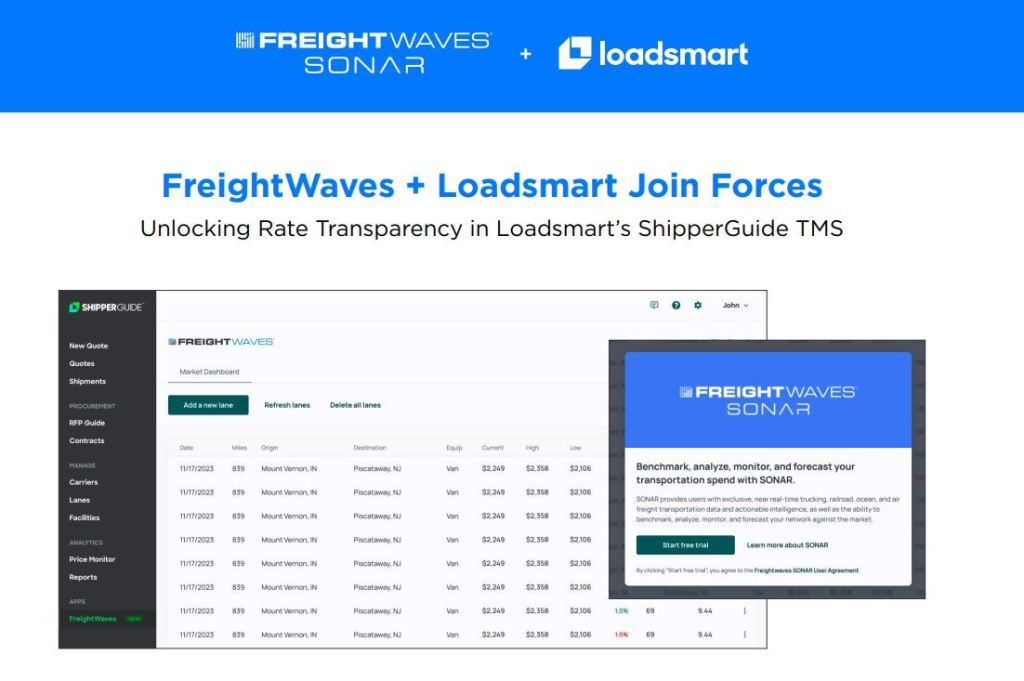
Loadsmart and SONAR have worked together for years to improve pricing accuracy and optimize freight procurement. The initiative started in 2020 as a way to help shippers and carriers better understand market rates and move away from the guessing game that comes with blindly using load boards. Today, Loadsmart continues to grow its solutions for shippers. The Loadsmart team believes strongly in the power of SONAR data and is bringing certain leading indicators to their own ShipperGuide TMS.
ShipperGuide TMS is a user-friendly transportation management system that provides shippers the ability to plan, procure and execute shipments for all modes with end-to-end visibility and control of their carrier network. ShipperGuide’s real-time spot and contract price comparison feature, now combined with SONAR’s market indicators, helps shippers know they are choosing a carrier with competitive prices for every shipment without sacrificing service.
More than just rates
SONAR offers more than $200 billion in annual domestic rate data to customers, but the most meaningful intel lives beyond rates. The Loadsmart team believes in this and is planning to deliver a simple way for shippers to view additional SONAR data within existing shipper workflows. Joint Loadsmart and SONAR customers will be able to access market-level Outbound Tender Reject Index (OTRI) data, along with Contract Rate Benchmark based on SONAR algorithms and data science inside ShipperGuide TMS. Stacking this onto the most accurate and unbiased high, medium and low contract rate data available to the market paints a picture of pricing and proactive market intelligence.
Start getting SONAR data in Loadsmart
SONAR and Loadsmart are excited to announce a 60-day free trial for any ShipperGuide TMS customer interested in testing this integration. Getting started is fast and seamless, so shipper teams can begin reaping the benefits of industry-leading supply chain intelligence right away. This improves immediate decision-making and opens the door for broader benchmarking, analysis and forecasting. From there, shippers can explore the power of more than $1.7 trillion in annual global supply chain data across 300,000 unique deliverables from the most up-to-date source available.
Contact shipperguide@loadsmart.com or bd@www.freightwaves.com to get started today.
Platform Science secures $125M to grow OEM partnerships
Platform Science, a provider of connected vehicle solutions, announced on Tuesday a significant milestone in its growth journey, securing $125 million in funding aimed at bolstering its presence in the commercial trucking sector.
Participating in this round are existing investors 8VC, NewRoad Capital Partners, and Prologis Ventures (NYSE:PLD), joined by new backers Activant Capital, Manhattan Ventures Partners and BDT & MSD Partners.
This expansion round also witnessed participation from Platform Science’s strategic allies, including C.R. England, Cummins (NYSE:CMI), and Paccar (NASDAQ:PCAR), all of whom forged partnerships with the company in 2023.
Additionally, past partners such as Daimler Truck North America (DTNA), RyderVentures (NYSE:R), and Schneider National (NYSE:SNDR) reiterated their support, underscoring the continued momentum of Platform Science’s collaborative efforts within the industry.
The company last announced its Series C raise in 2022, led by SoftBank Vision Fund 2 for $115 million, valuing the company at $575 million. Platform Science has raised $309 million since 2017.
“This funding has the potential to help us accelerate the launch of additional OEM partners and it will enable us to accelerate the number of on-vehicle applications and service partners we add to the vehicle ecosystem,” Jack Kennedy, CEO of Platform Science said while continuing to elaborate on the success of its Virtual Vehicle platform that was developed in collaboration with DTNA, Navistar, Paccar and other OEMs.
Virtual Vehicle facilitates direct access to real-time vehicle data for enterprise fleets, telematics service providers (TSPs), third-party developers, shippers, fleet managers and OEMs. By integrating telematics hardware during production, Virtual Vehicle eliminates the need for costly aftermarket installations.
8VC, NewRoad Capital Partners, and Prologis Ventures
Secondary investors
Activant Capital, Manhattan Ventures Partners, BDT & MSD Partners, C.R. England, Cummins, Paccar, DTNA, RyderVentures and Schneider National
Business goals for the round
Expand partnerships with OEMs
Total funding
$309 million*
*According to Pitchbook
At the same time, fleet managers gain access to a diverse catalog of tailored solutions, while TSPs and developers tap into a vast customer base and distribution channel.
In May 2020, DTNA became the first OEM to integrate factory-installed telematics with cloud and in-dash technology onto Virtual Vehicle.
“We see OEMs who partner with Platform Science becoming more and more creative as they leverage our platform and tools to become software developers providing value-added applications and services to the vehicles they design and manufacture,” Kennedy told FreightWaves.
Kennedy explained that with the investment and participation of its OEM partners, Platform Science will have the potential to leverage the OEMs’ pool of data to build AI models, “to capture more and more nuance to fine-tune predictive maintenance, supply chain optimization, traffic flow management, fuel and power consumption and an endless number of other use cases.”
Platform Science has also recently announced partnerships with LTL provider Averitt in August and truckload transportation company Cheema Freightlines in December.
ABX Air pilots choose cooperation over confrontation
(UPDATED: April 11, 2024, 9:30 a.m. EST)
LOUISVILLE, Ky. — The exhibit hall at the Omni Hotel here was filled in mid-February with booths representing airlines, logistics providers, airports, truck delivery companies and technology vendors marketing their capabilities to industry peers attending the AirCargo 2024 conference. The stall with a handful of ABX Air pilots from the Airline Professionals Association stood out.
Pilots never attend air logistics conferences, let alone rent space for a display. Why would they? They don’t have anything to sell. They fly the planes. But here was the pilots union selling a precious commodity: good will.
Friction is common between unionized labor and employers. That’s especially true in the airline industry, where contract negotiations with pilots take years and unions often raise the prospect of going on strike for better pay. The rise in tensions is currently playing out with pilots at FedEx Express and Air Transport International. Both groups have authorized leaders to call a strike if they ever exhaust strict bargaining procedures under U.S. law.
The pilots at cargo airline ABX Air are trying to break the cycle of adversarial relations in the airline industry and lay the groundwork for a favorable contract by drumming up business for the company.
“We feel that if we present a positive image with our customers at these events it will garner some recognition for our commitment to their service,” said Andrew Whobrey, a Boeing 767 freighter captain and leader in the Airline Professionals Association, in an interview. “We’re pledging that there will be no delays and we’ll do everything we can to serve the customer to the utmost of our ability.”
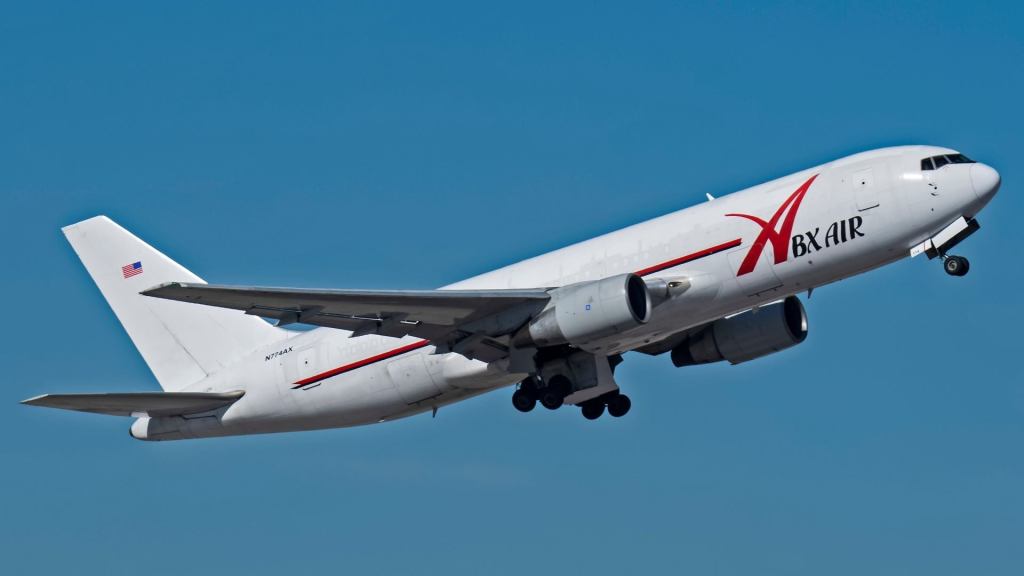
ABX Air operates 24 aircraft — a mix of Boeing 767-200 and 767-300 converted freighters — and has about 300 pilots. The bulk of the fleet supports DHL Express, with about four aircraft providing dedicated transport for Amazon’s air network.
ABX and Air Transport International are owned by the same company — Air Transport Services Group (NASDAQ: ATSG) — but the ATI pilots are represented by the Air Line Pilots Association.
Building a cooperative relationship with management is an approach rarely seen in the airline industry. The company’s perspective is to save money and boost shareholder returns. Pilots account for a large share of labor costs at airlines. Unions want to get as much compensation for their workers as the market will support.
Ken Jacobs, co-chair of the University of California-Berkeley’s Center for Labor Research and Education, said there’s a long history of unions promoting good union employers. Hotel workers’ union Unite Here!, for example, lists good union employers on its local websites. “They want to drive people to employers that do right by their workers,” he said.
That level of collegiality is not frequently seen in the airline industry, Jacobs acknowledged.
Capt. Andrew Whobrey, a member of the ABX Executive Council, second from right. (Photo: Airforwarders Ass.)
The ABX pilots have internalized the English proverb that you catch more flies with honey than vinegar. The philosophy that there is a better chance of winning over management to their contract expectations by playing nice is born from the repercussions of a work stoppage nearly eight years ago.
Pilots walked off the job days before the Black Friday shopping weekend in November 2016, forcing dozens of flights to be canceled. But a judge ordered them back to work one day later after determining the strike would cause severe economic harm.
He also rejected the union’s claim that ATSG had violated the collective bargaining agreement by not allowing pilots compensatory time or to take earned vacation after asking them to work overtime for two years.
Airlines fall under restrictive labor rules designed to prevent damage to interstate commerce that could have a widespread economic impact. Any impasse in collective bargaining has to go through a lengthy process, including mediation and arbitration, before either side can take unilateral action.
The short-lived strike raised concerns at DHL and Amazon about ABX Air’s reliability. It took several years before the express carriers requested additional flying from ABX.
Six years after the prior contract was eligible for amendment in 2014, the ABX pilots finally ratified a six-year contract on Dec. 30, 2020.
The bruises from that battle have motivated the pilots to act as brand ambassadors for ABX and ATSG.
“It was a long road to a collective bargaining agreement. It was a very lean time,” Whobrey said. “If we can help ABX grow and get business, that’s good for the pilots. Because a rising tide raises all boats.”
In addition to AirCargo 2024, the Airline Professionals Association has attended symposiums for freighter operators and manufacturers held in San Diego and Amsterdam since last summer.
The number of freighters ABX flies for Amazon has recently declined with lease expirations on 767-200s that have reached the end of their life cycle. Whobrey expressed hope that Amazon will eventually lease newer 767-300s from ATSG and place the aircraft on ABX’s operating certificate.
Derek Lossing, a supply chain and e-commerce transportation consultant who held senior management positions at Amazon Logistics last decade, said on LinkedIn that the ABX union has itself to blame for not having more Amazon business. The unannounced strike affected hundreds of thousands of Amazon and DHL customers because the interruption also effectively shut down the rest of the network that connects to the ABX flights. Amazon now has about 80 aircraft in its fleet and only four are with ABX Air, which could be employing many more pilots and mechanics if business with Amazon had increased, he said.
The collective bargaining agreement with ABX and ATSG is eligible to be updated at the start of 2026. The union pilots would look for improvements based on market conditions and for parity with peer airlines, but aren’t seeking pay scales like those at United Airlines or UPS.
“We don’t feel like we have to be the highest paid, but we don’t want to be the lowest paid,” Whobrey said.
Whobrey said it makes sense for ATSG to wait and see what happens with the Amazon contract because they have to know what their potential revenue is going to be before giving pilots an increase.
He predicted other airline unions will follow the Airline Professionals Association’s path if ABX grows and economic benefits flow to the pilots.
“We want to be part of the solution, not part of the problem.”
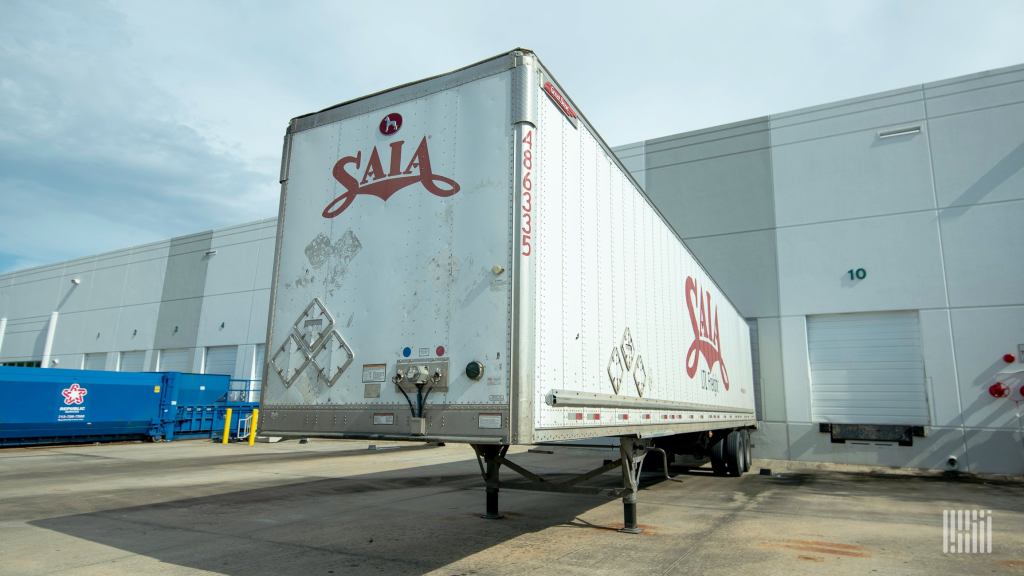
Less-than-truckload carrier Saia announced Monday the opening of two new terminals, which is part of a previously disclosed $1 billion capital plan for 2024.
The new locations are in Garland, Texas, and Missoula, Montana. The Garland location will be the company’s fourth terminal in the Dallas-Fort Worth market, while the Missoula site will be its first in that state.
“We’re eager to add coverage across our network,” said Patrick Sugar, Saia’s EVP of operations. “These new terminals were built, or renovated, to enable us to provide our customers with enhanced service so we can meet their supply chain needs.”
Saia (NASDAQ: SAIA) has added 25 terminals in the past three years and nearly 50 since it embarked on an expansion project in the Northeast in 2017. It plans to open as many as 20 terminals this year and relocate as many as 10 current locations into larger spaces.
It plans to spend a total of $550 million on real estate during the year, which includes amounts spent making repairs and upgrades at the acquired sites.
“Beyond these two, we intend to open another 16 to 17 new terminals over the next several months, in addition to relocating several existing facilities to larger or strategically advantageous locations to reduce shipping time, improve pickup and delivery flexibility, and increase capacity in key areas,” Sugar said.
It reported an 18% year-over-year increase in shipments during the fourth quarter alongside a 12% increase in yield (excluding fuel surcharges). Its shipments were up 12% and 19% y/y, respectively, in the first two months of the year.
The company’s guidance implies it will be operating a network of 210 to 215 service centers by year-end, approximately a 12% to 14% increase in total door count.
Saia also plans to spend $400 million to $450 million on tractors and trailers this year.
Benchmark diesel price heads higher; so do world oil markets
Retail diesel prices as measured by the Department of Energy/Energy Information Administration weekly average are starting to react to an overall bullish market in crude oil and petroleum products.
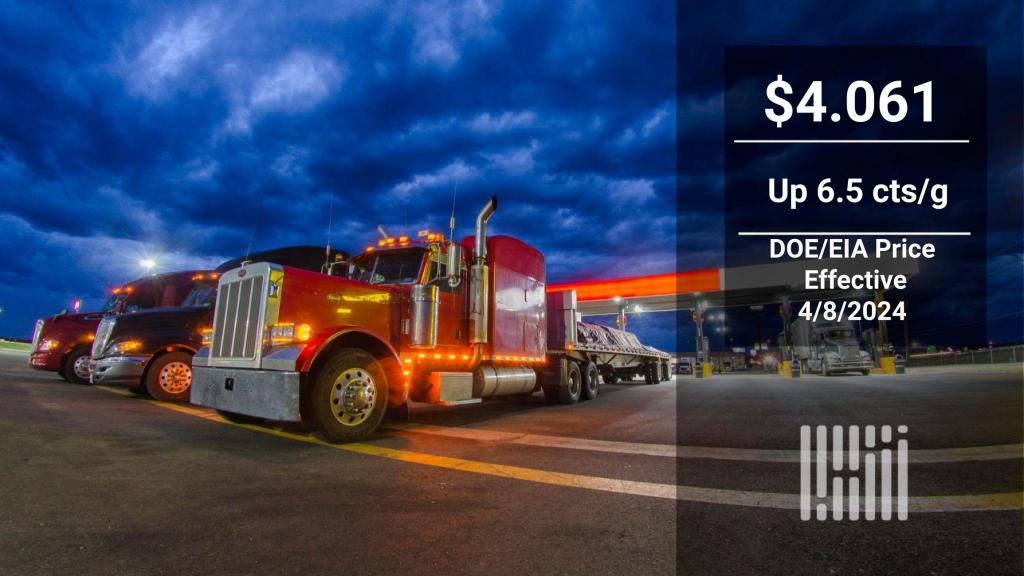
The weekly number, the benchmark used in most fuel surcharges, rose 6.5 cents a gallon Monday to $4.061 a gallon. It’s the largest one-week increase since a big 21-cent increase on Feb. 12.
But even after that rise two months ago, the price stood at $4.109 a gallon. With Monday’s increase, the benchmark still is less than that.
Sentiment and news developments in oil markets have been decidedly bullish in the past week. That sort of market push generally is seen most prominently in the market for Brent or West Texas Intermediate crude. Brent, the world benchmark, settled Monday at $90.38 a barrel, down 87 cents on the day but almost $5 higher than a recent low of $85.43 per barrel on March 22.
And though Brent, WTI and petroleum products declined Monday, it came on a day when the headlines all pointed to higher levels. One prominent headline an article in Bloomberg summed up that view. The news agency’s take: “The odds of $100 oil are rising as supply shocks convulse the market.”
Oil prices are moving higher in part on tension in the Middle East, though there is no evidence that any production has been cut as a result of that uncertainty. But the drumbeat of potential conflict involving Iran, Israel and possibly the U.S. is helping to light a fire under the market price.
Ultra low sulfur diesel (ULSD) has mostly failed to keep pace with the increase in crude prices on the CME commodity exchange. The spread between diesel and Brent on March 18 was almost 72 cents per gallon. On Monday, in CME trading, it was down to 58.3 cents, a key reason why retail prices are not climbing at the same rate as crude numbers.
That fact, combined with stability in physical market trading for diesel in key hubs such as the Gulf Coast, has helped insulate diesel slightly from the vagaries of the more bullish market, a reason why diesel has trailed Brent.
In the physical market, pipeline or barge quantities of diesel are traded as a differential to the CME ultra low sulfur diesel prices. In all the key markets — New York Harbor, Chicago and the U.S. Gulf Coast, for example — that spread has moved little in the past few weeks. If those spreads had been stronger, it might have resulted in retail diesel prices increasing at the same rate of increase as crude. But there’s been no extra lift from the physical market differentials, so any increase in retail diesel prices all have come from movements in the ULSD contract on CME. And in that market, since Feb. 12 — the most recent high-water market for the DOE/EIA price — Brent is up 10.2% but ULSD is down almost 20 cents a gallon.
Among the smorgasbord of developments that all pointed to higher levels were these unrelated news headlines:
In its article abouit $100 oil, Bloomberg reported that crude shipments out of Mexico were down 35% to their lowest level since 2019. That does not mean that the country produced less oil. Instead, it is trying to divert as much of its crude as it can to domestic Mexican refineries and substitute home-refined products like gasoline and diesel for crude exports. Theoretically, that activity should have a neutral impact on oil prices, but for now, physical market prices for crudes that compete with Mexican grades are showing the effect. According to Bloomberg, Mars crude, produced in the U.S. Gulf of Mexico and similar to some key Mexican grades, is at a “multi-year premium over WTI,” though it “usually trades at a discount to WTI.”
JP Morgan, according to reports, said its analysis of pipeline data suggests that U.S. crude production in the Lower 48 states has fallen recently to about 12.32 million barrels a day from 12.71 million a week earlier. The report did note that output among the Lower 48 over time has generally been less than in March. But it is U.S. production that has done the most to offset the continuing cuts by the OPEC+ members.
The British Defense Ministry reported that Ukraine struck Russian refineries five times in March. Its total, according to the ministry, is 10 strikes during the war through drone attacks. The attacks have taken about 10% of Russian refining capacity off the market, according to the report.
At the Financial Times Commodities Global Summit in Switzerland, Sebastian Barrack, the head of commodities at the Citadel hedge fund, said oil markets are likely to be “extremely tight” in the second half of 2024, according to several news reports. The discipline shown by OPEC+ in sticking to its biggest cuts shows that the group has “definitely regained control” over oil markets.
FMCSA has rejected 34% of under-21 truck driver applications
WASHINGTON — The Federal Motor Carrier Safety Administration says only 113 motor carriers have applied for its under-21 truck driver apprenticeship program since the agency began accepting applications in July 2022, a dismal sign for an initiative that had been expected to recruit up to 1,000 carriers and 3,000 drivers.
The data, included in a fiscal year 2022 report submitted to Congress last week by FMCSA, also revealed that as of February 2024, FMCSA has rejected 34% – or 38 of the 113 applications received. The agency has fully approved only 30%, or 34 of the applications.
The applications that were rejected “have been disapproved due to not meeting FMCSA’s safety performance criteria,” the agency stated. “An additional 36 applications have met FMCSA’s safety qualification criteria (“pre-qualifier”), but do not yet have a registered apprenticeship in place or have not yet provided their registered apprenticeship number to FMCSA.”
In a report covering FY2021 — also submitted to Congress last week — FMCSA provided similarly lackluster results for an under-21 CDL pilot program it launched in 2019 and completed in August 2021 for those that had been in the military.
“Despite significant outreach and recruitment efforts, only a very small number of drivers participated” in the under-21 military program, FMCSA stated. There was not enough interest from the intended participants in operating a CMV in interstate commerce as a profession to justify continuing the program.”
Creating apprenticeships for 18-to-20-year-old drivers – who currently are barred from hauling freight across state lines — has been lauded by the Biden administration as a way to bolster the ranks of truckers across the country.
But the initiatives have been controversial from the start. When FMCSA sought comments for an under-21 driver pilot proposal in 2020, 127 respondents favored it while 50 opposed. Supporters included the American Trucking Associations, the Commercial Vehicle Training Association and the National Retail Federation, which see apprenticeships as a way of addressing what they consider to be a chronic shortage of drivers.
Those opposing it included the National Transportation Safety Board and the Owner-Operator Independent Drivers Association. OOIDA has asserted that carriers’ inability to retain drivers has more to do with pay and working conditions as opposed to a driver shortage.
Opponents also focused on safety, noting that “younger drivers are more distracted and have higher rates of crashes,” FMCSA stated in addressing the comments filed on the 2020 proposal, which was never implemented.
FMCSA’s current pilot project, known as the Safe Driver Apprenticeship Pilot Program (SDAP), was required by Congress as part of the 2021 infrastructure bill and is slated to continue through November 2025.
In an attempt to improve participation in SDAP, an appropriations bill signed by President Joe Biden last month removes two restrictions that had been part of the pilot program and which many saw as barriers to participation: requirements that trucks used in the program be equipped with inward-facing cameras and that motor carriers register their program with the Department of Labor.
ATA was a strong supporter of removing the restrictions, which was proposed by lawmakers in May 2023.
Last week, FMCSA sought emergency approval from the White House to begin collecting data for the program under the revised restrictions.
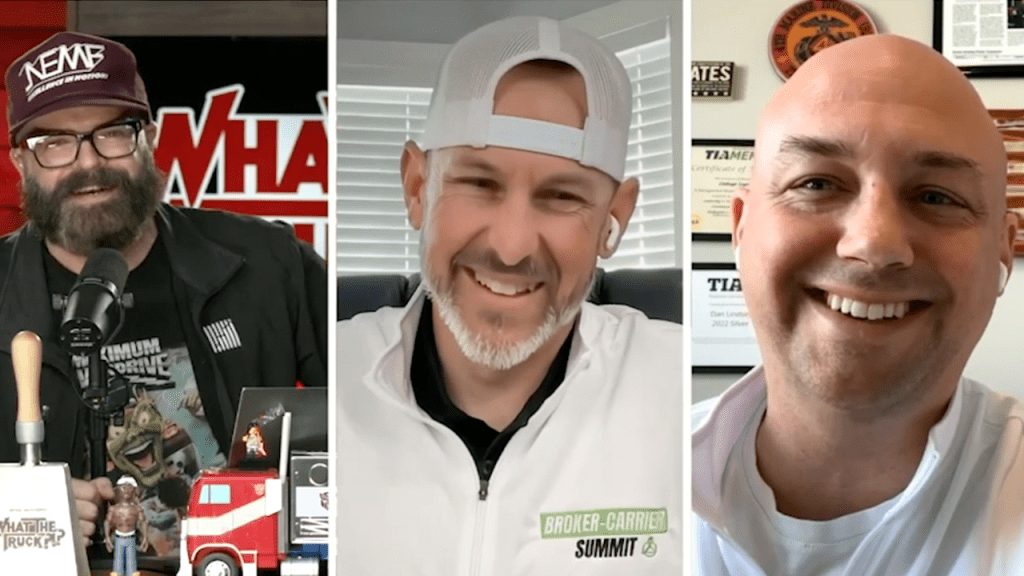
For brokers and carriers used to finding each other only through load boards, the upcoming in-person Broker-Carrier Summit on April 22-24 in Kansas City, Missouri, seeks to take those relationships to the next level.
“What we’re doing is creating something completely new in the industry. We’re bringing brokers and carriers together, especially those small to medium-sized brokers and carriers who have trouble finding each other, who are constantly dependent upon load boards,” said Trey Griggs, founder and CEO of Beta Consulting Group, during a recent interview on FreightWaves’ What the Truck?!? “Carriers, for example, often struggle to find those brokers who really want to treat them well and give them consistent freight and help them grow their fleet.”
The semiannual event, sponsored by the factoring company Tafs, draws hundreds of carriers and brokers together to network, build connections and create brand awareness for both parties. Dan Lindsey, founder of the Broker-Carrier Summit and co-founder of Linkage Logistics, said, “The biggest thing that you will be able to benefit from right off the bat is getting to know the brokers and carriers that are worth getting to know.”
In a highly competitive and fragmented industry, putting a face to an email or a phone number remains a key way to create business opportunities. It’s astounding, Lindsey adds, noting that “if you’re a carrier and brokers are your customers, you rarely, if ever, meet each other.”
The organizers note another benefit is enacting industry change. Lindsey says one ongoing challenge in the industry has been a lack of trust between the parties.
“Everyone knows and has known for a long time the relationship between brokers and carriers has been broken. It’s rooted in distrust and there’s a lot of animosity. If you want to remain in logistics for a long period of time and improve the industry … this is the best event in the industry bar none,” he said.
But broker-carrier relationships can be complementary rather than adversarial. Small carriers lack the resources for a dedicated sales team and are often unable to have a seat at the table with larger shippers, which set minimum truck count requirements to be considered. For brokers who have relationships with large shippers, the challenge is finding the right carriers and creating relationships to service their awarded freight. In-person events are a great way to foster those relationships.
Griggs believes an added advantage of in-person events is leveling the playing field. “This is really about creating a network of partnerships that are going to be ongoing and lasting. You know we want drivers out there in small fleets to find partners and help them with consistent freight that they’re getting and the lanes that they’re moving,” said Griggs.
The conference has over 43 speakers, including Dan Meers, also known as KC Wolf. A motivational speaker and mascot for the Kansas City Chiefs, Meers will talk about courageous leadership. Additional speakers include industry leaders such as Mike Riccio, Desmond Clark and Adam Wingfield.
“For us it’s all about conversation and not presentation; we want conversations to happen, not just listening to somebody up on stage. There’s value in that and we have some incredible speakers this year, but we’re really focused on fostering conversations and communication.” adds Griggs.
The event also includes the Inaugural Post & Pray Classic golf tournament presented by 123Loadboard and Sigma Solve Logistics Tech. The first-of-its-kind two-person team event will kick off the Broker-Carrier Summit at Tiffany Greens Golf Club at 9 a.m. April 22 to find out which company in transportation and logistics has the best golfers.
Also distinguishing the summit from other conferences is the lack of static exhibit booths. Griggs notes, “Our sponsors are right in the conference: They’re in the sessions, they’re at lunch, they’re having conversations with brokers and carriers as well.” He believes tech vendors and other service providers need to hear what’s working for brokers and carriers rather than wait for feedback or for attendees to approach them.
The views expressed here are solely those of the author and do not necessarily represent the views of FreightWaves or its affiliates.
Although transportation rates are still relatively low, companies have seen their overall logistics costs increase over the past few years. A big part of that has been due to increased last-mile costs as well as higher inventory carrying costs.
According to a McKinsey study published in November 2023, cost management continues to be the No. 1 pain point for both shippers and providers in transportation. With an increasing number of supply chain disruptions and labor shortages, logistics costs are not expected to decrease anytime soon. As the economy picks up in 2025, we can expect transportation rates to finally increase, which will have a further impact on logistics costs.
Supply chain companies have invested over the past decade in TMS solutions to optimize their transportation and are continuing to invest in freight procurement solutions. However, there is still a process and solution gap around the freight rates that are procured and how these rates are being applied during execution. That is where freight spend management (FSM) comes in. Companies applying FSM have done this more as an after-the-fact historical analysis of their spend and rates. The rise of e-commerce, volatile fuel prices and fluctuating market conditions necessitate a more dynamic, real-time approach to managing freight spend based on real-time data supported by advanced analytics using artificial intelligence. This allows companies to very quickly adjust based on the data insights, resulting in cost efficiencies.
Traditional freight spend management often relied on fixed contracts and historical data to negotiate rates with carriers. While this method offered some predictability, it failed to account for the dynamic nature of the transportation market. Dynamic FSM leverages real-time data, automation and machine learning to optimize freight costs on a shipment-by-shipment basis, in line with today’s industry needs.
Dynamic FSM involves the strategic as well as tactical control and optimization of transportation expenses. It encompasses a wide range of activities, including budgeting, cost control and expense reduction, and allows a workflow to quickly adapt to changed conditions.
There are different ways in which FSM helps companies. First, it helps you set budgets for your transportation expenses and actively manage costs to ensure they stay within budgetary constraints. Armed with accurate data from freight audits and analytics, FSM also allows you to negotiate better rates with carriers and suppliers, securing more favorable terms for your logistics operations. Through continuous analysis of your supply chain data, you can identify areas where costs can be reduced or eliminated, further improving profitability. Dynamic management allows businesses to adapt to unexpected disruptions and market changes.
Companies can leverage a wider network of carriers beyond traditional contracts, accessing capacity when needed. Effective FSM further ensures that resources are allocated efficiently, focusing on areas that provide the most value while eliminating wasteful expenditures. Finally, FSM enforces compliance with corporate policies and government regulations, reducing the risk of financial penalties and legal issues.
While the benefits of dynamic freight spend management are clear, implementing it has its challenges.
Seamless data exchange between internal systems and external platforms is crucial for accurate decision-making. New cloud-based, connected platforms allow for better connection of the multiple data points.
The biggest challenge of transitioning from static contracts to a more dynamic environment is the shift in mindset for both logistics teams and carriers. Establishing trust and transparent communication with your carriers is crucial for successful dynamic partnerships.
Despite these challenges, the benefits of dynamic freight spend management are undeniable. As technology continues to evolve, the integration of AI and machine learning will further enhance dynamic solutions, encompassing better data exchanges, more valuable insights and an easier, more automated workflow. These will create opportunities for even more accurate cost projections and predictive analytics.
Companies that embrace dynamic FSM are well positioned to navigate the complexities of the modern logistics landscape. This approach offers greater control over transportation costs, increased efficiency and the agility needed to thrive in the current highly dynamic market.
By investing in technology, fostering collaboration and adapting to a data-driven approach, businesses can transform their logistics operations and unlock a new era of cost optimization and competitive advantage.
Look for more articles from me every week on FreightWaves.com.
About the author
Bart De Muynck is an industry thought leader with over 30 years of supply chain and logistics experience. He has worked for major international companies, including EY, GE Capital, Penske Logistics and PepsiCo, as well as several tech companies. He also spent eight years as a vice president of research at Gartner and, most recently, served as chief industry officer at project44. He is a member of the Forbes Technology Council and CSCMP’s Executive Inner Circle.
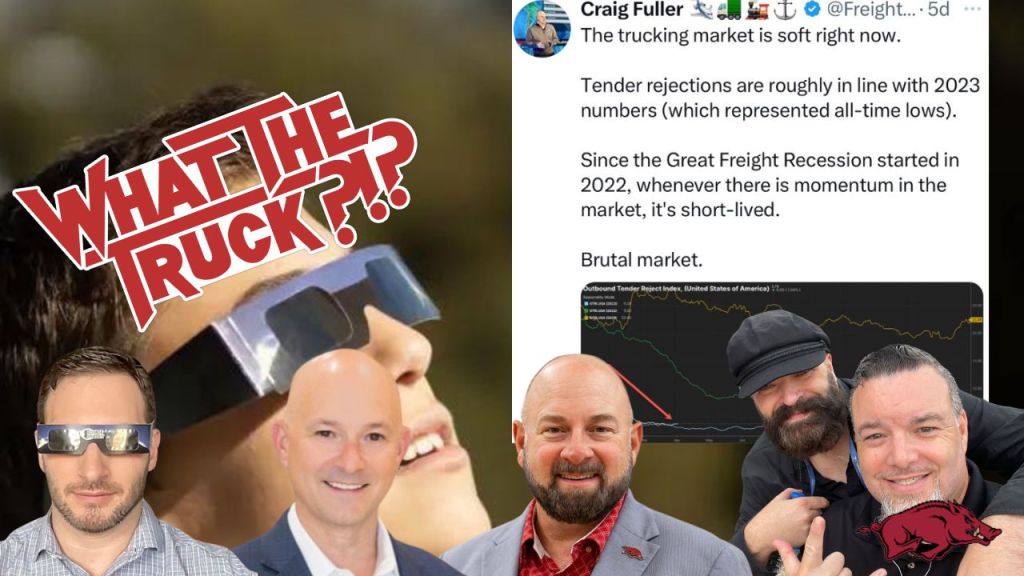
Freight’s path of totality; University of Arkansas; AB5 and drivers – WTT
On Episode 703 of WHAT THE TRUCK?!?, Dooner is kicking off the eclipse by taking a look at the freight market. Will eclipse disruptions have any impact on rates?
Woo pig! We’re talking to the University of Arkansas about its supply chain program — what students are learning, how the program works, how you get your master’s degree online and more. David Dobrzykowski, Brian Fugate and students join us.
Armchair Attorney Matthew Leffler is breaking down the latest in the project44 vs. FourKites defamation case, updates us on AB5 and how it will impact truckers, and talks about the dangers of ELD certifications.
John Oldham Jr. talks about the Rock River Valley Traffic Club’s upcoming truck driving competition. Who’s taking home the trophy this year?
Plus, two Fontana, California-based carriers shut their doors; trucks vs. wind; Tesla Semis seen hauling cars; and more.