Baltimore bridge collapse: One week later – WTT

On Episode 700 of WHAT THE TRUCK?!?, Dooner is talking to Campbell University’s Sal Mercogliano about the latest on the Francis Scott Key Bridge collapse. Who is on the hook to pay for it, how long will it take, what will it cost, and how will it impact shipping? Mercogliano has some answers.

FreightWaves’ Thomas Wasson dives into the data behind the market. How did Q1 look, and will Q2 be an improvement?

Dickgistics’ Matt Dickman calls himself the Gordon Ramsay of warehousing. We’ll learn the latest on what’s happening in that market, find out what makes an eye-popping logo and learn how to survive a screwup. 

Plus, Tekken goes to Waffle House, opportunistic dealer ads, tiny trucks for tiny truckers and more.

Watch on YouTube

Subscribe to the WTT newsletter

Apple Podcasts

Spotify

More FreightWaves Podcasts

Borderlands Mexico: Saia partners with Mexican carrier for cross-border service

Less-than-truckload carrier Saia Inc. announced a new partnership with Fletes Mexico, one of the largest trucking companies south of the border.

Fletes Mexico’s less-than-truckload division, Carga Express, and Saia will provide cross-border freight transport for customers. Saia will service Carga Express’ shipments entering the U.S., while Carga Express will transport Saia’s freight traveling into Mexico.

“Our customers will benefit from Carga Express’ network of distribution centers and commitment to providing leading LTL service into and across Mexico,” Saia Vice President of International Juan Barroso said in a news release.

Johns Creek, Georgia-based Saia (NASDAQ: SAIA) operates 194 terminals across the country, handling over 33,000 daily shipments. Near the border, Saia has terminals in El Paso, Laredo, and La Feria, Texas; San Diego and El Centro, California; and Tucson, Arizona.

Juarez, Mexico-based Fletes Mexico is the fifth-largest trucking company in the country. The company has more than 1,800 tractors and 4,200 trailers, according to T21. Carga Express has terminals in Juarez, Nuevo Laredo, Guadalajara, Monterrey, San Luis Potosi, Queretaro and Puebla.

“Our customers will greatly benefit from Saia’s extensive network of terminals around the U.S. and with access to our network throughout Mexico, we will be able to offer Saia’s U.S. customers unparalleled north and southbound cross-border services,” Miguel Gomez, CEO of Fletes Mexico, said in a statement.

Saia plans to open 15 to 20 new terminals this year, according to the news release. In February, Saia announced a $1 billion capital expenditures plan outlined in the company’s fourth-quarter earnings report.

“These terminals, once opened, will allow us to provide direct coverage in new markets, add density in existing markets and serve as replacement terminals for some of our existing leased and owned facilities,” Fritz Holzgrefe, Saia’s president and CEO, said during an earnings call with analysts Feb. 2.

More articles by Noi Mahoney

Investment surges in Mexico as companies shift supply chains, plan new factories

State of Freight: Reasons to be bullish on second half of 2024

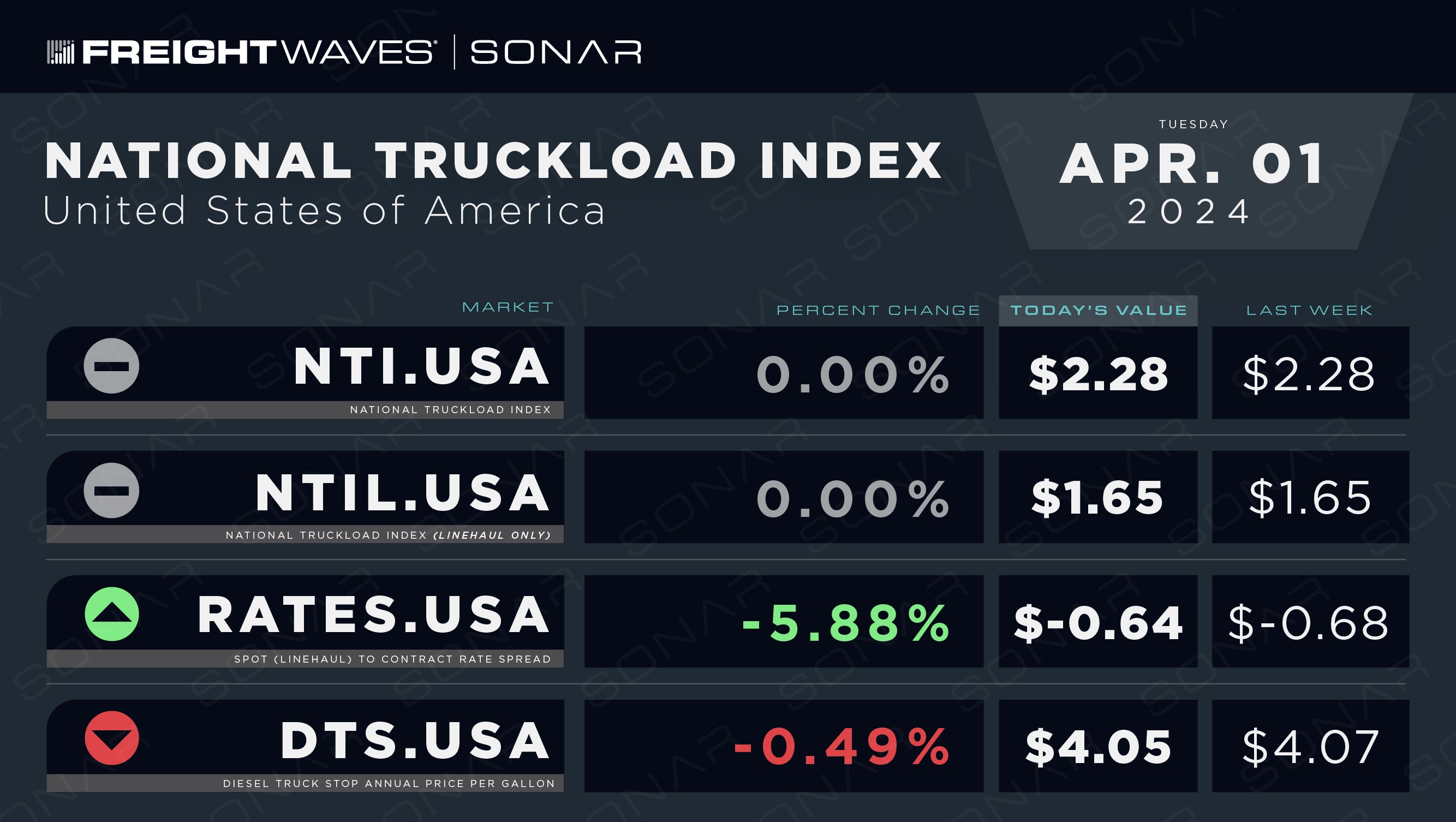
Weekly NTI Update: April 01, 2024


Learn more at SONAR.FreightWaves.com

Port of Baltimore calamity shows supply chain’s vulnerabilities

By Bart De Muynck

The views expressed here are solely those of the author and do not necessarily represent the views of FreightWaves or its affiliates.
Companies continue to make their supply chains more resilient to respond very quickly to supply chain disruptions. Some disruptions can be modeled or even predicted in some cases. But others are hard to predict and show that even with all the technology and process improvements in the world, supply chains remain vulnerable.

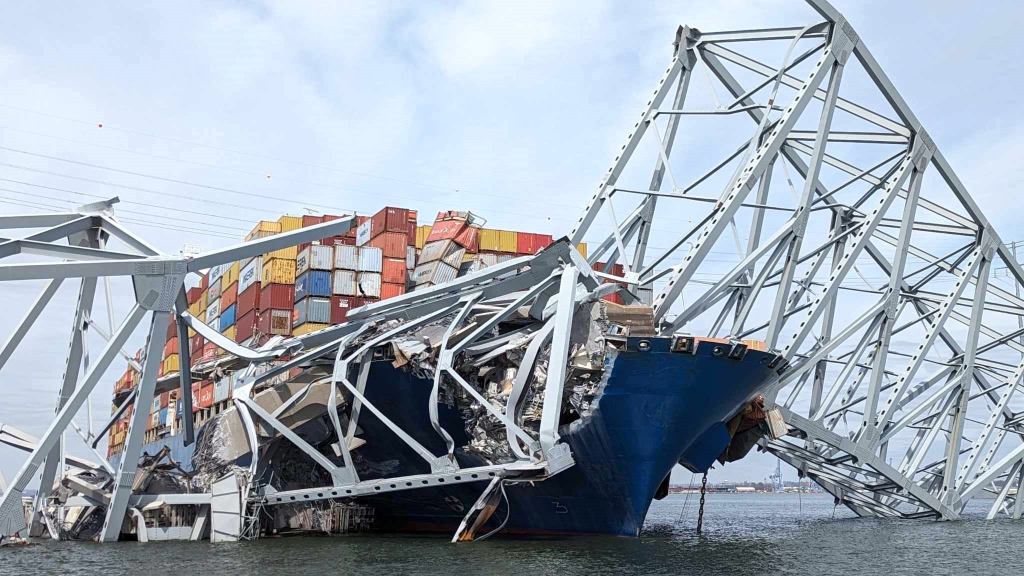
We’ve seen this over the winter period with the heavy floods in California and more recently this week with the accident at the Port of Baltimore. On Tuesday, a ship named the Dali hit a support column of the Francis Scott Key Bridge in the early hours of the morning, causing the bridge to collapse. The bridge spanned the entrance to the Port of Baltimore, the busiest port in the U.S. for car exports and the ninth-busiest for foreign cargo. Not only was this a tragedy that claimed several lives, but it also showed that even as we’re building up a more resilient supply chain, these networks remain fragile and can be hit at any point.

This event will have a ripple effect in the supply chain as Baltimore is the busiest U.S. port for car shipments and the largest U.S. port by volume for handling farm and construction machinery. It is also the second-biggest port for U.S. coal exports.

The event leaves the port very quiet and is “the port’s version of the global pandemic,” according to Maryland Senate President Bill Ferguson. Besides the flow of goods, many people’s lives will be affected as the Port of Baltimore is responsible for some 15,000 jobs and supports an estimated 140,000 more. Small business supporting the port expect to have to lay off workers in the coming weeks.

Could new regulations be introduced for vessel operators after this event? This was not the Dali’s first incident. The ship suffered damages in July 2016 when it hit the stone wall of the quay at the Port of Antwerp in Belgium while unmooring, according to shipping traffic website Vesselfinder. Separately, an inspection of the Dali in San Antonio, Chile, in June last year found propulsion and auxiliary machinery deficiencies, NBC News reported Tuesday.

The impacts on the supply chain will be big and long-lasting, especially for those industries that have large container volumes going through the Port of Baltimore. The automotive industry is one of those, with major automakers including, but not limited to, Nissan, Toyota, General Motors and Volvo being affected. According to project44, disruptions to manufacturing are expected in the automobile market until companies can establish dray networks through neighboring ports. The automobile industry is notoriously lean, meaning any disruptions will have ripple effects throughout the manufacturing process. While the automobile industry might be the most impacted, the port is one of the 15 largest in the U.S. and handled over $80 billion in freight in 2023. This freight will likely have to bypass the Port of Baltimore until the area is cleared. Generally, vessels that call at the port also continue to call at ports up and down the East Coast of the United States. It is likely that these containers will be discharged at the nearest port. Customers will likely have the option to choose to dray containers from the port of discharge to their final locations, or the ocean carriers will be responsible for getting these containers to the Port of Baltimore for customers to pick up at the planned location.

Project44 indicated that in addition to the already mentioned impacts on the automobile industry specifically, there will be a general increase in transit time for truckloads in the area. This bridge is part of a major highway in the Baltimore area, and with the closure, routes will be less direct and more congested. The Francis Scott Key Bridge was the bridge completing the Interstate 695 loop around Baltimore, so both cars and trucks will need to detour or be directed to neighboring bridges on Interstates 895 and 95. Project44 is monitoring impacts on truckload transit times for shipments into and out of Baltimore to understand the full scope of the impact.

This event definitely is testing supply chains and where high velocity is a key requirement to pivot based on the impacts of the supply chain network by diverting movements of goods to other locations and making sure inventory flows are minimally disrupted. But even with the best technology, including AI, these events cannot be forecast, which leaves supply chains vulnerable.

Should companies start simulating all the possible impacts on U.S. infrastructure? Besides the impacts from damage to infrastructure like the Port of Baltimore event or last year’s vehicle fire forcing I-95 to shut down, we also see cost impacts. In Europe, more specifically in Germany, companies are being charged for the use of the infrastructure. It is called the German Maut, officially known as the Infrastructure Usage Charge or Infrastructure Levy. It was introduced to finance and maintain Germany’s extensive road and highway infrastructure. On July 1, the German Maut system will be expanded to include vehicles with a technically permissible total weight of 3.5 tons or more and will cost up to 35 euro cents per kilometer.

Major infrastructure incidents act as real-world stress tests for the supply chain, exposing vulnerabilities and highlighting areas for improvement. An incident at a critical infrastructure point, like a major canal blockage, a bridge or highway breakdown, or a cyberattack on a key port, exposes the dangers of overreliance on single routes or transportation hubs. These incidents highlight the need for diversified transportation routes, carrier networks and even production facilities to minimize disruptions caused by a single event.

A seemingly isolated incident can have cascading effects across the entire supply chain. Delays in one region can lead to stockouts in another, impacting production and ultimately consumers. These events showcase the need for a global perspective on risk management. Companies need to consider potential disruptions not just in their own backyards but across the entire supply chain network. These incidents require us to improve our communication and collaboration. Effective communication and information sharing between different players in the supply chain, from manufacturers to retailers, are crucial during disruptions. This allows for coordinated efforts to mitigate the impact. Stronger collaboration among governments, logistics companies and manufacturers can lead to more resilient supply chains with better contingency plans in place.

Technology plays an important role to manage in case of disruptive events. The ability to track goods in real time throughout the supply chain allows for quicker identification of disruptions and faster response times. Leveraging data analytics can help companies predict potential bottlenecks and make informed decisions to optimize their operations during disruptions.

Look for more articles from me every week on FreightWaves.com.

Bart

About the author

Bart De Muynck is an industry thought leader with over 30 years of supply chain and logistics experience. He has worked for major international companies, including EY, GE Capital, Penske Logistics and PepsiCo, as well as several tech companies. He also spent eight years as a vice president of research at Gartner and, most recently, served as chief industry officer at project44. He is a member of the Forbes Technology Council and CSCMP’s Executive Inner Circle.

UPS wins air cargo contract with Postal Service, replaces FedEx

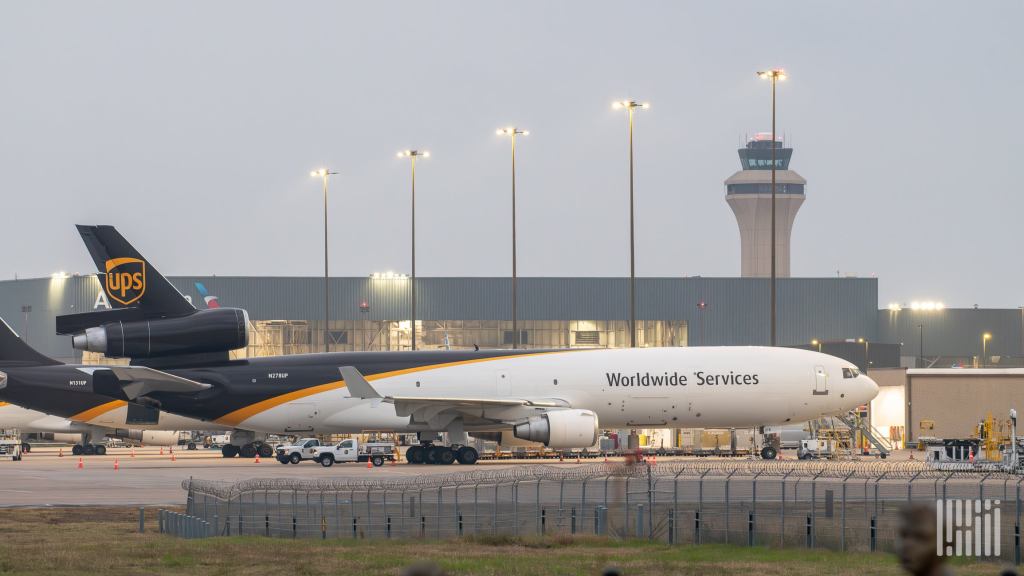
A brown-tailed UPS jet parked at an airport on a cloudy day.

UPS will replace FedEx as the dominant provider of domestic air cargo for the U.S. Postal Service for the first time in more than 20 years. The express delivery giant on Monday announced that the Postal Service has awarded it a “significant” contract to move the majority of the mail agency’s air cargo in the United States.

The contract will take effect on Sept. 30 and calls for a 5.5-year minimum base term, according to the Postal Service. FedEx’s (NYSE: FDX) contract with the U.S. Postal Service expires Sept. 29.

“Together UPS and USPS have developed an innovative solution that is mutually beneficial and complements our unique, reliable and efficient integrated network,” said UPS CEO Carol Tomé in a statement.

The Postal Service is one of FedEx’s largest customers, but it was clear the relationship would change this year. The Postal Service has been shifting more air parcels to its ground network since 2021 as part of a productivity drive. The agency’s transportation strategy intends to reduce overall transportation costs by $3 billion over the next two years, including $1 billion in airfreight costs savings already achieved. 

Lower postal volumes have left FedEx with excess fixed infrastructure for its daytime air network and higher operating costs per unit. FedEx officials have said the contract with the Postal Service was barely breaking even and that they were prepared not to renew the contract if better terms couldn’t be arranged.

FedEx’s revenue from its Postal Service contract in the fiscal year ending Sept. 30, 2022, fell $236 million to $1.9 billion and was expected to continue decreasing. The contract previously generated annual revenue of at least $2 billion.

How UPS will be better able to turn a profit is unclear. The company declined to provide further details.

But it’s likely the new deal involves a streamlined daytime network that focuses more on truck routes and smaller aircraft, and doesn’t commit as many aircraft to dedicated Postal flying, something that FedEx officials said they were trying to achieve in negotiations.

During FedEx’s third-quarter earnings call on March 21, Chief Customer Officer Brie Carere said the sides were making progress on an agreement that would provide service to fewer markets and allow FedEx to adjust the service to demand. FedEx is in the midst of restructuring its own air and ground networks and said it needed any Postal work to fit within its new, more efficient structure.

“FedEx and the United States Postal Service have had a long and productive relationship for more than 20 years. Over time, our respective strategies have shifted as we transform our networks and operations for the future,” FedEx said in a statement. “We have long said we would extend the contract with the USPS if we could agree to commercial terms in the best interests of FedEx shareholders. Although we were unable to reach mutually agreeable terms, we remain committed to delivering outstanding service through the completion of our contract in September. 

“Upon the conclusion of the contract, we will implement adjustments to our network that will drive efficiencies and create more flexibility. The elimination of structural costs currently in place to support postal service volume will be addressed and, in conjunction with our DRIVE efforts, FedEx profitability will improve in FY25 and beyond.” 

DRIVE is the name of FedEx’s cost-reduction initiative.

Equity analysts have argued that FedEx’s airline was much bigger than necessary, in part because of commitments to fly postal shipments during the daytime in addition to its overnight express operation. UPS operates a smaller daytime network and only flies shipments when ground transportation can’t meet two-or-three day delivery commitments.

FedEx devotes about 100 aircraft to carry postal business at an annual cost of about $3 billion, according to an earlier analysis by Brandon Oglenski, senior transportation and logistics analyst at Barclays Bank. In its December earnings report, the company identified the Postal Service contract as a $400 million drag on earnings. The Priority Mail packages that FedEx primarily hauls have a similar service (two to three days) and pricing profile to packages moved by ground transport, which translates to lower yields and margins when using air transport. Oglenski estimated FedEx could cut 50% of its daytime network capacity if it doesn’t renew the postal contract, which could save the company $1.5 billion.

Still, the Postal Service breakup could represent a loss of 1% to 1.5% of FedEx revenue, Morgan Stanley analyst Ravi Shankar said in a client note. Analysts were uncertain about how quickly can FedEx can further shed structural costs associated with the postal business and improve profit margins.

“Finalizing this agreement is a key step toward achieving our operational and financial sustainability goals,” the U.S. Postal Service said in a statement.

UPS investors don’t appear enamored with the Postal Service contract. Shares are down 1.2% during early trading on Monday.

Click here for more FreightWaves/American Shipper stories by Eric Kulisch.

Twitter: @ericreports / LinkedIn: Eric Kulisch / ekulisch@www.freightwaves.com

RECOMMENDED READING:

FedEx braces for 50% cut in Postal Service air contract

UPS to close 200 sort centers in modernization push

Red Sea crisis nears boiling point, unable to heat up spot rates

Red Sea Suez Canal

Russian warships entered the Red Sea last Thursday, for what the Russian Pacific Fleet’s press service has stated was the performance of “assigned tasks within the framework of the long-range sea campaign.” This intentional vagueness has invited no small amount of speculation as to the ships’ true objectives.

Theories range from retaliatory pressure on Israel, which decided in late February to co-sponsor a United Nations resolution condemning Russia’s invasion of Ukraine, to supporting beleaguered ally Syria’s military objectives in the region.

Then again, the warships might simply be in the Red Sea to guard against attacks from Yemen-backed Houthi rebels.

‘Not to be trusted’

In late March, Bloomberg reported that the Houthis had promised safe passage to Russian and Chinese vessels in the Red Sea and nearby Gulf of Aden. In exchange, the two countries allegedly agreed to leverage their position as members of the U.N. Security Council to support the Houthis.

Two days after this report, however, Houthi militants fired five missiles at a Chinese-owned oil tanker, causing a fire but minimal damage and no injuries.

Lars Jensen, CEO of Vespucci Maritime and industry analyst, wrote in a post on LinkedIn that the Houthis might have attacked by mistake, believing the ship to be British-owned: “It would for now appear that Houthies [sic] have acted on outdated information and in the process clearly demonstrated that even if there was potentially a deal to grant safe passage, such a deal is not to be trusted.”

If China and Russia find the Houthi problem as intractable as the U.S. and its allies have, it would all but halt what little maritime traffic remains in the region.

Danish shipping giant Maersk, in a late-March update, reaffirmed its commitment to avoiding the Red Sea for the foreseeable future. Maersk cited attacks on the True Confidence — which claimed three lives and marked the Houthis’ first fatalities caused on a commercial vessel — and the Rubymar, the first vessel lost to a Houthi assault.

Scarce motion in the ocean

Despite the unexpected length of the Red Sea crisis, it is not likely to hold spot rates captive for a similar amount of time. Shipping lines have more than enough capacity to accommodate reroutes along Africa’s Cape of Good Hope, having hit shipbuilders with a tsunami of orders during the COVID boom. 

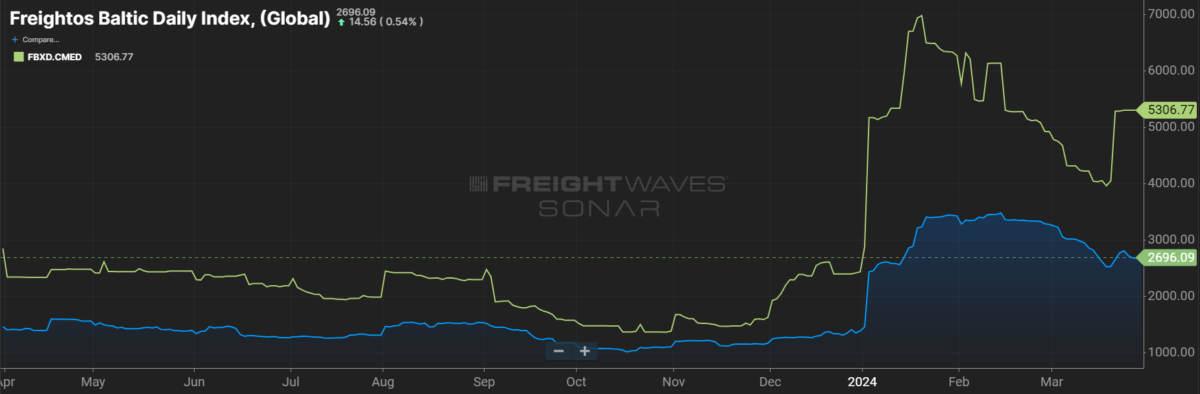
The greatest evidence for geopolitical risk’s limited ability to translate to higher spot rates is seen in lanes from China to the Mediterranean. After the Chinese oil tanker was struck in late March, rates along these lanes unsurprisingly spiked and have held at a plateau since.

Moreover, transit times from China to Spain — host to some of the busiest ports in the Mediterranean — have increased by three days since the start of the year, while vessels face average delays of 12.6 days at both origin and destination. As recently as December, such delays averaged less than a single day.

SONAR: Freightos Baltic Daily Index, global composite (blue) and from China to Mediterranean (green)

Yet these rates’ highs are unable to match those of early-to-mid-February, when China was preparing to shut down operations in advance of its Lunar New Year celebrations. And while rates might hold at their current level for a few days or weeks, there is little cause for them to rise further. Rather, rates will likely trend downward as they had for most of March.

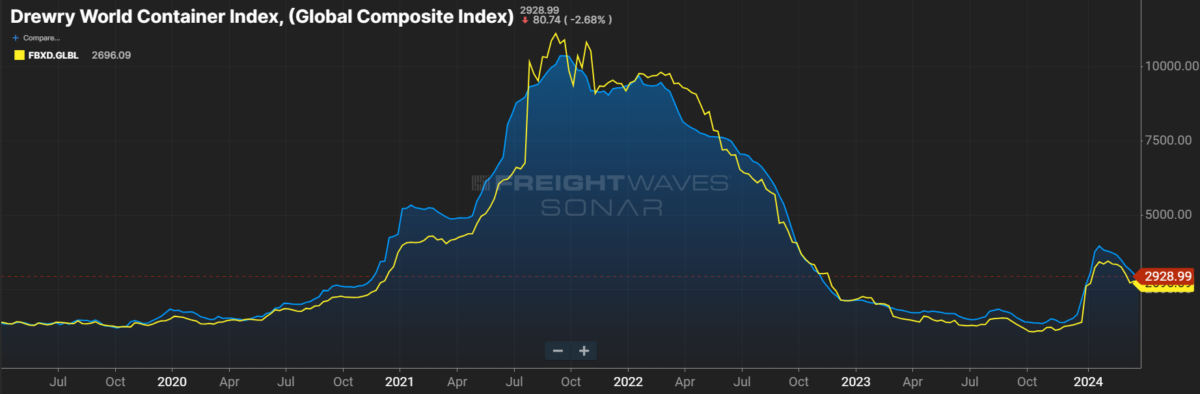
SONAR: Drewry World Container Index, global composite (blue) and Freightos Baltic Daily Index, global composite (yellow)

Such is an examination of lanes most impacted by the Houthis’ recent attacks, which proved to be little more than a drop in the bucket for rates on a global scale. The global composite of the Freightos Baltic Daily Index, which tracks spot container freight rates across 13 lanes, is actually down 17.2% since the start of March. Similarly, Drewry’s World Container Index — which tracks both spot and short-term contract freight rates — has fallen 16.2% over the past four weeks.

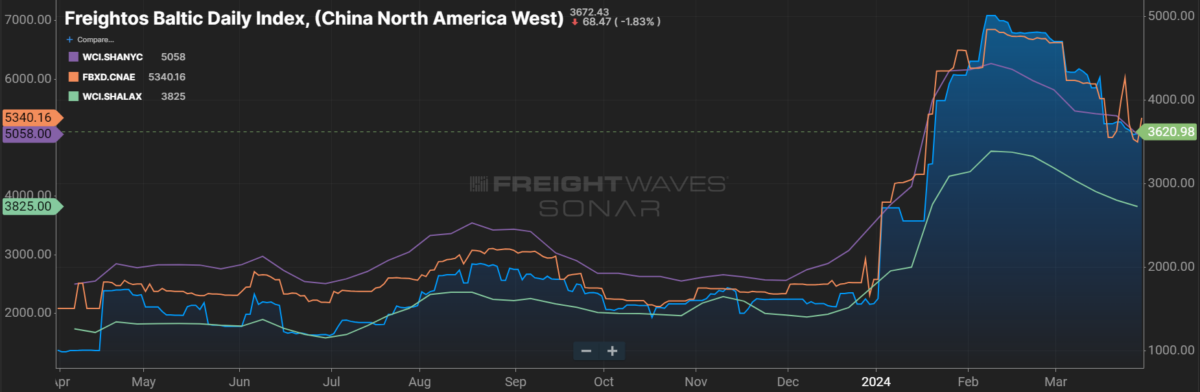
SONAR: Freightos Baltic Daily Index, China to U.S. West Coast (blue) and China to U.S. East Coast (orange); Drewry World Container Index, Shanghai to New York City (purple) and Shanghai to Los Angeles (mint green)

Of course, there is also the domestic matter of the Port of Baltimore, now closed indefinitely after the collapse of the nearby Francis Scott Key Bridge. While this closure is estimated to have a limited impact on the region’s intermodal market, it will rattle the supply chain of automobiles. 

Markets were still quick to react, however, as spot rates from China to the U.S. East Coast jumped 6.7% from where they were a week prior to the incident.

White Paper: Improving Back Office Efficiency in the Freight Industry

Efficiency isn’t optional – it’s the cornerstone of success.

In the fast-paced world of freight, efficiency isn’t just a buzzword – it’s a lifeline. Technology is revolutionizing our industry, ushering in an era where manual processes are replaced by cutting-edge digital solutions powered by artificial intelligence (AI), machine learning (ML), and automation.

Discover how the freight industry is enhancing back office efficiency through evolving technologies in our report, “Improving Back Office Efficiency in the Freight Industry.” Uncover six essential strategies to optimize your back office, from leveraging AI-driven insights to implementing automation for streamlined processes.

Don’t let inefficiency hold your business back. Download this white paper to propel your back office into the future.

Ship OGRE completes acquisition of Brokerage and Transportation Sales

Pioneering brokerage and logistics technology provider Ship OGRE recently completed the acquisition of third-party logistics provider Brokerage and Transportation Sales Inc. (BTS). The merger includes integrating BTS into OGRE’s “Ship Like a Beast”’ platform, which simplifies operations, reduces costs and provides a seamless end-to-end experience from manufacturers to end customers.

Wes Queen, founder and CEO of OGRE, said in a press release, “With BTS’ wealth of expertise and esteemed standing as a dependable logistics ally, we are set to reinforce our mission to empower exceptional individuals and enterprises. The tangible results are clear: a staggering 250% surge in efficiency and customer loyalty.”

“In logistics, speed is king. Every second counts. Accurate speed matters. By eradicating errors, simplifying processes, and cultivating customer loyalty, OGRE is setting new standards for faster, more efficient operation,” said Queen.

Executive Vice President of BTS Dan Delano said: “Our integration with OGRE marks a significant evolution, allowing us to unveil an expanded suite of services and deliver unparalleled value to our clientele. Embracing the OGRE ethos has been transformative, and we’re excited about the strides we’ve made together.”

This is the third merger by OGRE, which continues to expand its portfolio and integrations with its proprietary software following the previous acquisition and integration of ShipTransportal. OGRE is looking to form additional partnerships with like-minded 3PLs as opportunities arise.

The company was founded by Queen and originally began as Simplified Logistic Solutions LLC (SLS) with a focus on outsourced shipping for small and medium-size companies that lacked the resources to manage their supply chains.

By 2014, Queen developed OGRE, a proprietary supply chain management platform to augment and enhance SLS. The simple, intuitive design allowed SLS employees and customers to ship freight faster and with better transparency compared to other platforms on the market.

The recent growth in mergers and acquisitions began in 2022 after OGRE developed an in-house M&A team. “OGRE’s momentum is evidenced not only by its continuous growth — maintaining 60% annual growth rates — but also by its operational proficiency, which outperforms industry standards by a factor of 3.5 to 5 times” added Queen.

The company’s ethos is built on a foundational principle of making shipping fast, effortless and painless, he said. “We exist to eliminate roadblocks, streamline processes, avoid mistakes and enhance decision-making — our platform remains cutting-edge because we use it to navigate the same logistical landscapes as our clients. We remain the most rigorous users, continuously stomping out wasted clicks, user speed bumps, pain points and mistake traps.”

OGRE is where software meets empathy, where technology meets tenacity, and where every shipment is a promise kept.

To learn more about OGRE, visit https://shipogre.com/

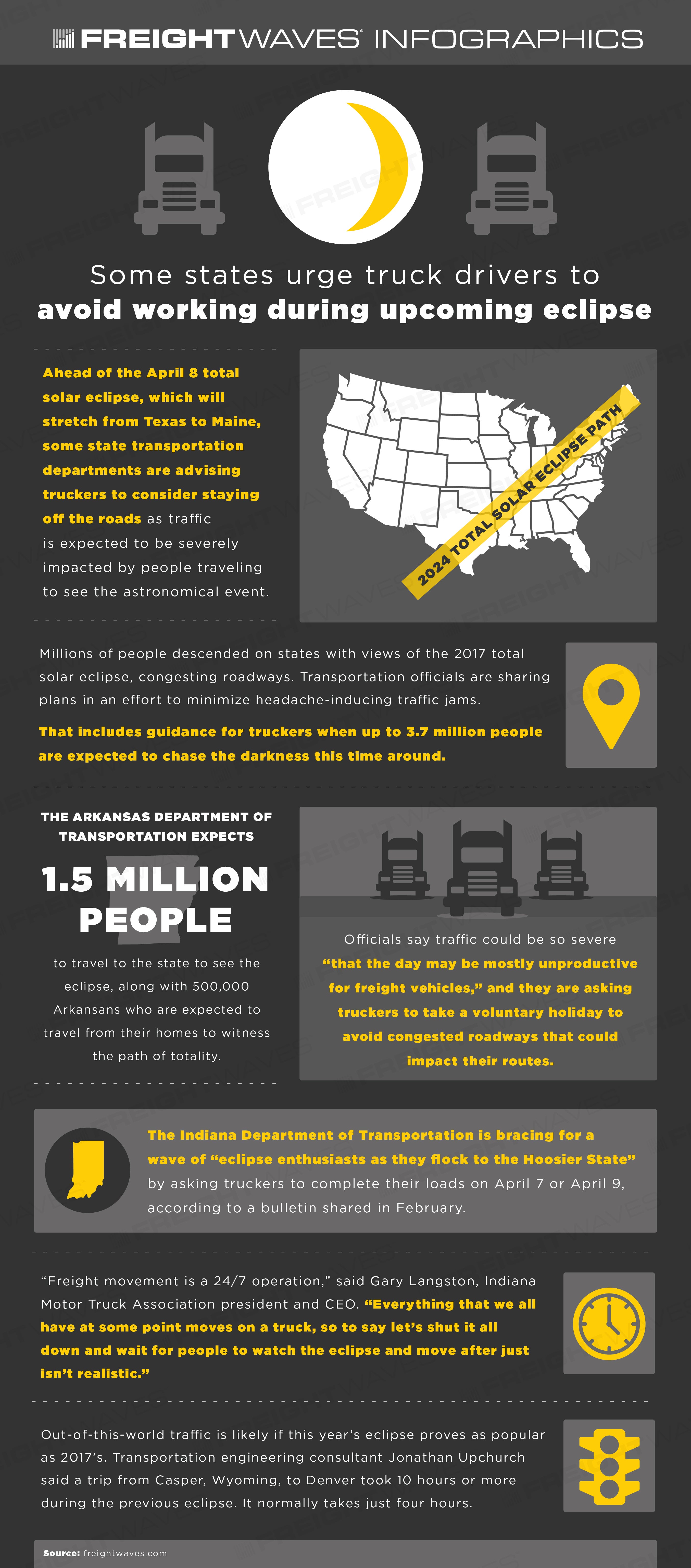
Freightwaves Infographics: Some states urge truck drivers to avoid working during upcoming eclipse


To view more FreightWaves infographics, click here

Missouri court upholds nuclear verdict, blasts carrier’s safety practices

A Missouri appellate court has upheld a $20 million verdict against Great Plains Trucking in a decision in which the judges took the company to task for its safety practices.

But the ruling drew a partial dissent from one judge over the exclusion of evidence about the marijuana habits of the motorist whose son was killed in 2019 when an 18-wheeler from Great Plains Trucking, based in Salina, Kansas, struck the car on Interstate 70.

Robert Schultz was the 19-year-old son of Carrie Schultz, who was driving the car on Aug. 6, 2019. They were headed to a McDonald’s in Lake St. Louis, Missouri, where they worked beginning with the 6 a.m. shift.

Truck driver Lennis Beck was eastbound on I-70 at about 5:30 a.m. in rainy weather. According to the appellate court, which issue its ruling Tuesday, “Beck did not lessen his speed or remove the cruise control set at 70 miles per hour as he drove through the rain from Kansas City. When Beck arrived in Warrenton, the rain continued, the road was wet, and the windshield wipers were still necessary.”

Schultz’s car fishtailed to avoid another car, took a light hit from a pickup truck, hit a retaining wall and ended up stopped on the highway. It was there that the Beck’s truck struck the vehicle, killing Robert Schultz.

A jury in the Circuit Court of St. Charles County, Missouri, ruled against Great Plains in 2022 almost exactly three years after the crash.

The award was $10 million in compensatory damages against Great Plains and Beck, $10 million in “aggravating circumstances damages” against Great Plains, and $25,000 in aggravating circumstances damages against Beck, according to a recap of the case in the appellate court’s decision.

The award of aggravating circumstances damages was one of the points of appeal in the Eastern District of the Missouri Court of Appeals, alongside arguments about legal proceedings.

But it was in the commentary about Great Lakes’ actions — and in upholding the lower court award — that the appellate court took the trucking company to task for its practices before and after the accident.

Court says carrier’s practices continued even after the accident

“There is evidence showing Great Lakes itself engaged in conduct before and after the fatal accident in this case that was tantamount to intentional wrongdoing,” the court said.

Among the criticisms the appellate court leveled at Great Lakes, which echoed the findings of the lower court: Safety requirements in the company’s CDL manual gave drivers “discretion” on how closely to follow them, and the company had an “unwritten policy” that allowed drivers to go 4-5 mph over the speed limit.

“A reasonable juror could have found this policy actively directed and encouraged professional truck drivers to violate CDL manual requirements providing drivers must slow their speed when certain conditions are met,” the appellate court wrote.

A juror “could have also inferred from Great Plains’ policy that Great Plains placed its ability to make a profit by prioritizing speed and time above the well-being and safety of the public,” the court wrote.

Beck’s speed was not a point of disagreement; his cruise control was set to 70 and he did not slow even as the weather remained wet and he approached the curve where the collision occurred.

Beck’s frequent transit of the Kansas-to-Georgia route meant he knew the curve was coming up, according to testimony. The driver “knew he could not see around the curve at issue and that he would be driving blind if he drove too fast to stop within the distance he could see ahead of him,” the court wrote. “Although Beck admitted these circumstances were reasons for a truck driver to slow down when driving into the curve, on the date of the accident in this case Beck did not slow down. Instead, with the cruise control still set at 70 mph Beck’s tractor-trailer truck actually accelerated into the curve.”

The court also said that Great Plains, after the crash, did not review whether Beck had “complied with the requirements of the CDL manual, and Great Plains did not tell Beck to lower his speed while driving on a curve or wet road in the future.”

Phone calls and emails to Great Plains and its attorneys had not been returned by publication time. 

A dissent: Marijuana testimony should have been allowed

As to the question of Carrie Schultz’s marijuana use, she testified to being a heavy user, smoking two to three times daily and having used THC resin shortly before the accident. 

A physician who testified in the case is identified in the appellate court decision only as “Doctor.” In a partial dissent to the appellate court finding, Judge Cristian Stevens does not identify the physician by name but says she is chief medical examiner of St. Louis, St. Charles, Jefferson and Franklin counties, and has been for more than 30 years. That suggests she is Dr. Mary Case, who since the trial has stepped down from her role but was in that position when the trial occurred.

Some of her testimony was excluded on the grounds that it was “not reasonable and not relevant.” The physician was testifying on behalf of Great Lakes.

“It was Doctor’s opinion that [Carrie Schultz] was impaired by THC at the time of the accident,” the appellate court said in its review. “Doctor also believed (Schultz’) alleged impairment manifested itself in the form of divided attention and a slowed reaction time, resulting in Mother losing control of her vehicle and causing the accident.”

But the court notes the witness said she “could not state within a reasonable degree of medical certainty that the marijuana resin [Schultz] smoked the morning of the crash contained any THC concentration or that the THC in her blood toxicology was from the resin.” The effect of THC differs from individual to individual, the physician had testified.

The lower court ultimately did not allow the testimony of the physician. Given her lack of certainty, the lower court barred the testimony because it might have “the likely prejudicial effect of allowing the jury to hear her speculative opinions on those issues.”

Stevens’ dissent — which did not challenge any other parts of the lower court decision — said the impact of THC on Carrie Schultz’s driving is “highly relevant evidence and sets an important precedent,” particularly since recreational marijuana use is legal in Missouri.

The judge did not disagree with the finding to exclude the THC blood levels given that there is no agreed-upon standard for comparison of those measurements.

But Carrie Schultz was a “chronic” marijuana smoker, Stevens wrote. The physician had cited several studies on the impact of such use. One of them: “prolonged reaction time and divided attention.” One of the studies she cited concludes that chronic users, even if they are abstaining, “continue to have impaired psychomotor performance” long after they may have halted marijuana use. And THC continues to affect performance even if it can’t be detected in blood levels, according to the papers cited by the testifying doctor.

“The jury should have heard Doctor’s opinion regarding Schultz’s chronic marijuana use, and resulting impairment and loss of control of her car,” Stevens wrote in his dissent.

More articles by John Kingston

Wisconsin court affirms Amazon Flex drivers were not independent contractors

Texas trucking company employee gets over 5 years for payroll fraud

RXO gets negative outlook from Moody’s but keeps investment-grade rating