Port Houston shows import strength in February

The Gulf Coast ports have received a lot of attention in recent years and rightfully so. The ports along the Gulf Coast provided a pressure relief valve of sorts, though they suffered with congestion throughout the pandemic as well.

What separates the Gulf Coast ports from the major East and West Coast ports is the importance that bulk cargo and the industrial sector as a whole play in port volume. At Port Houston, over a third of all tonnage cleared in 2022 was noncontainerized.
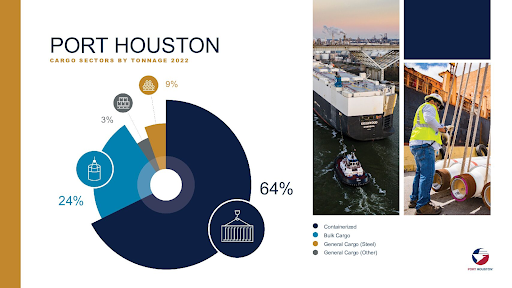
Source: Port Houston 2022 statistics

Port Houston, the country’s fifth-largest container port and largest port for bulk cargo, reported  strong imports in February after a challenging January, despite the challenges of limited transits through the Panama Canal. In February, general cargo imports increased by 49% month over month, but that is largely due to a soft January. Year to date, imported general cargo tonnage is down 10% compared to 2023.

Steel imports, which represented nearly 13% of total tonnage in February, were up 24% m/m in February and 6% year over year. Like the general cargo, tonnage for steel imports year to date is down 25%, highlighting how soft January was.

General cargo and steel imports represented 38.8% of total tonnage, up from 36% of total tonnage in 2022. Year to date, tonnage of general cargo and steel imports is in line with the 2022 values, but it may have been exacerbated by the softness in January, while container imports were strong. From 2018 through 2022, general cargo and bulk tonnage was relatively stable as a percentage of overall imports, in the mid-30s. As expected, 2020 was the most challenging, as consumer freight took precedence over more industrial sectors.
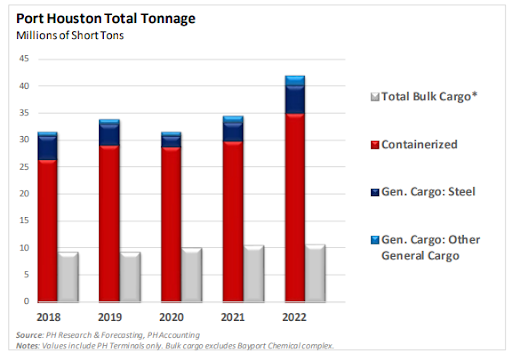
Source: Port Houston annual tonnage statistics

The port is valuable, not only for the imports of these commodities, but for the exports from Port Houston. February was a challenging month for exports of general cargo and steel. Tonnage of steel was down 96% m/m in February and 89% y/y. That was an acceleration from the declines in January as steel exports were down 70.6% y/y.

Export tonnage for general cargo in February was down 4% m/m but up 34% y/y, thanks in part to a strong January in which export tonnage was up 16.3% y/y.

The container side of the port operation has shown substantial growth since 2018. Total containerized imports were 15% higher in 2022 than in 2018, and exports were up a resounding 59%.

The growth in containerized trade at Port Houston highlights the shift that occurred in using ports closer to consumption centers and avoiding the potential for disruption due to labor.

In February, Port Houston reported that total twenty-foot equivalent unit volumes were up 13% m/m and were 20% higher than in 2023. The growth in TEU volume y/y is aided by the timing of the Lunar New Year, but so far in 2024, the growth has shown that Panama Canal challenges and the Red Sea conflict have had very little impact on container volumes so to date. Year-to-date total container volumes at Port Houston are up 12% compared to 2023.

Loaded TEU imports totaled 166,849 in February, up 8% m/m and 18% higher than they were in 2023. Year-to-date loaded TEU imports are 10% higher than they were last year.

Container exports had an even stronger February, rising 17% m/m, up 24% compared to 2023. Year-to-date total container exports are up 17% y/y. Loaded TEU exports totaled 145,766 TEUs, matching the total TEU exports, up 17% m/m. Loaded TEU exports were 25% higher than they were in February 2023.

As labor disruptions become more possible with the ongoing negotiations between labor unions and ports from Maine to Texas intensifying throughout the next few months, there could be significant impacts to East Coast port throughput.

Borderlands Mexico: Echo Global Logistics grows cross-border footprint

Borderlands is a weekly rundown of developments in the world of United States-Mexico cross-border trucking and trade. This week: Echo Global Logistics grows cross-border footprint as trade booms; Maersk launches cross-border warehouse in Tijuana; Yokohama announces $380M tire plant in Mexico; and Legendz Way to open distribution center in North Texas.

Echo Global Logistics grows cross-border footprint as trade booms

Echo Global Logistics has opened new locations in Texas and Mexico, as more global companies are moving production south of the border to seek a manufacturing hub closer to the United States.

Officials for the Chicago-based company said they have been managing shipping solutions along the U.S.-Mexico border for the past eight years, but the recent expansion puts boots on the ground for the first time in Mexico, with locations in Mexico City and Monterrey.

The company also opened a location in Laredo, Texas, and recently named veteran logistics industry executive Troy Ryley as president of Echo Mexico. Ryley said Echo already handles thousands of monthly shipments to and from Mexico and the number will grow with the expansion.

“Echo is obviously a very dynamic company. We work with over 50,000 transport providers, through about 35,000 clients,” Ryley told FreightWaves. “These clients have continued to work with us at the Southern border. For the last decade, Echo has actually had cross-border Mexico shipments that the company has handled, but they’ve handled it from a base in Chicago. Echo has made the decision to increase their investment and put boots on the ground in Mexico, so we can further provide enhanced service for our clients.”

Founded in 2005, Echo Global Logistics is a global provider of supply chain management services.

With the new locations in Laredo, Monterrey and Mexico City, Echo now has 29 operations across the U.S. and Mexico. In addition to Laredo, Echo has Texas operations in Houston and Dallas.

Echo’s strategy follows similar recent moves or expansions in Texas or Mexico by other transportation providers and freight brokers, such as Redwood Logistics, C.H. Robinson, Ryder System Inc., Arrive Logistics and BlueGrace Logistics.

Over the past several years, Mexico has emerged as one of the key players in the global supply chain. In 2023, Mexico surpassed Canada and China as the top U.S. trading partner for the year, totaling $798 billion in trade.

Mexico was also the top U.S. trading partner for the month of January, with two-way commerce totaling $64.5 billion. 

The port of entry in Laredo, Texas, was the No. 2-ranked U.S. trade gateway during January. Trade at the Laredo port of entry totaled $25 billion for the month.

Ryley said having a presence in Mexico will allow Echo to simplify brokerage services on both sides of the border, along with helping shippers and carriers navigate customs and border crossings.

“We’re going to continue to work on the same product we deliver and handle today,” Ryley said. 

“We offer freight brokerage, managed transportation, as well as a bunch of other modes, such as truckload, less-than-truckload, intermodal and expedited shipments all over the Southern border. In the future, we will incorporate those services also into cross-border. We just don’t have an exact timeline yet. Some of the service that is managed transportation, we actually do handle for clients cross-border in and out of Mexico, but not intra-Mexico. That’s another product we’re also looking at, based on client demand, is an intra-Mexico solution.”

Maersk launches cross-border warehouse in Tijuana

Maersk, the world’s second-largest ocean carrier, announced it has opened a 322,900-square-foot warehouse in Tijuana, Mexico.

The facility will focus on cross-border business, targeting customers in the technology, automotive, retail and lifestyle sectors, according to a news release.

Maersk’s new logistics facility in Tijuana, Mexico, is targeting customers in the technology, automotive, retail and lifestyle sectors. (Photo: Maersk)

Situated near the Port of Ensenada, Tijuana is emerging as a hub for international trade, particularly because of its proximity to the U.S. The warehouse in Tijuana increases Maersk’s logistics capacity in Mexico to over 1.6 million square feet of space.

Denmark-based Maersk is a global logistics company operating in more than 130 countries, with around 100,000 employees.

Yokohama announces $380M tire plant in Mexico

Yokohama Tire Corp. announced it is building a $380 million tire plant in Saltillo, Mexico, to boost its tire production capacity for the North American market.

The plant will produce up to 5 million tires a year for passenger vehicles. Construction is scheduled to begin in the second quarter, and the facility will open in the first half of 2027.

“This is a clear signal that Yokohama is committed to the North American market,” Jeff Barna, Yokohama Tire Corp. president and CEO, said in a news release. “The increased production capabilities will supplement existing global capacity for tires destined for our region.”

Yokohama Tire Corp. is the North American manufacturing and marketing arm of Tokyo-based The Yokohama Rubber Co. Ltd.

Legendz Way to open distribution center in North Texas

Legendz Way Distribution Solutions announced it will open a 730,000-square-foot distribution facility in Midlothian, Texas, in May.

The facility will include 50,000 square feet of air-conditioned space and over 70,000 square feet dedicated to racking systems. Midlothian is 28 miles south of Dallas.

Legendz Way will have over 1 million square feet of logistics space once the Midlothian distribution center comes online, according to a news release.

Grand Prairie, Texas-based Legendz Way Distribution Solutions is a third-party logistics company.

“This expansion is more than just growing our space; it’s about carefully adapting our services to meet the distinct needs of each partner and client,” Jeff Doolin, Legendz Way co-founder and COO, said in a statement.

More articles by Noi Mahoney

State of Freight: Reasons to be bullish on second half of 2024

Cargo thefts spiked 68% in Q4, led by food and beverage freight

Container shipments from China to Mexico skyrocketed in January

Desert Center, California Post Office 92239

Desert Center California Post Office

The Desert Center, California Post Office serves ZIP Code 92239. Photo by Jimmy Emerson, some rights reserved. Photo shared under the Creative Commons License.

Desert Center Post Office
44300 Ragsdale Rd
Desert Center, CA 92239

Location at Google Maps

Is Mexico becoming the new China?

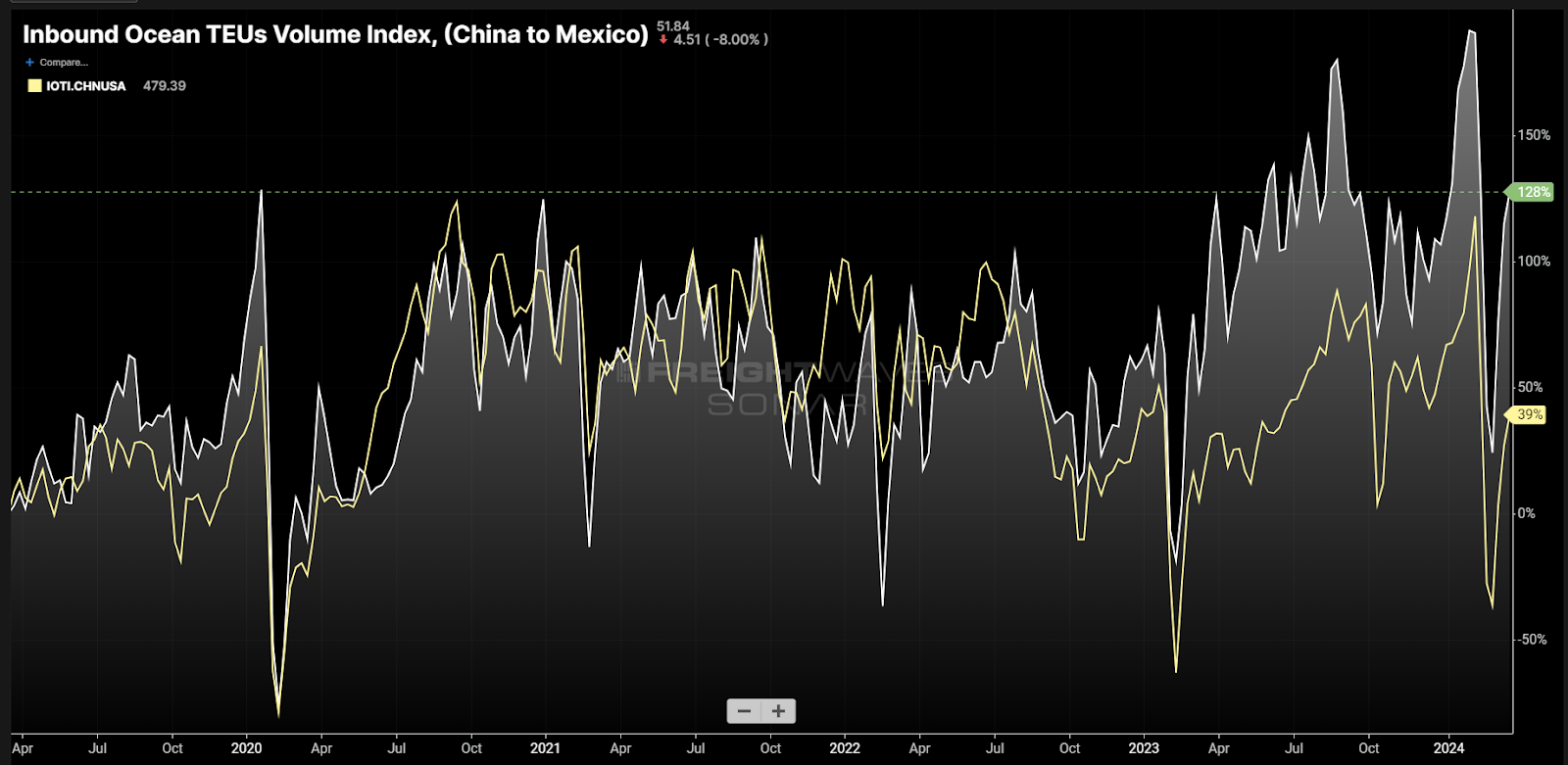
Chart of the Week: Import Ocean TEUs Index – China to Mexico, China to USA  SONAR: IOTI.CHNMEX, IOTI.CHNUSA

Import bookings have doubled from China to Mexico compared to the same period in 2019, with the bulk of the increase coming in the past year. By contrast, import bookings from China to the U.S. are up a still-impressive approximately 40%, but nothing like the Mexico figure. What does this mean for the U.S. freight market?

The Inbound Ocean TEUs Indices (IOTI) measure bookings of twenty-foot equivalent units on a 14-day rolling average based on departure date from the port of lading. They are representative of maritime shipping container demand and a leading indicator of surface transportation demand.

Earlier this month, FreightWaves’ Noi Mahoney wrote about the skyrocketing container shipment growth in this lane based on analysis from Xeneta. While it is nearly impossible to say definitively what is driving this growth, some of the driving theories make strong logical sense.

Nearshoring has been getting a lot of the headlines over the past several years thanks to growing geopolitical tensions, especially with China.

It is not widely discussed that China is nearly as dependent on the U.S. consumer as America is on China’s production. China is actively pursuing solutions to this as many American companies look to diversify their production. One of those solutions may be manifesting in the import data.

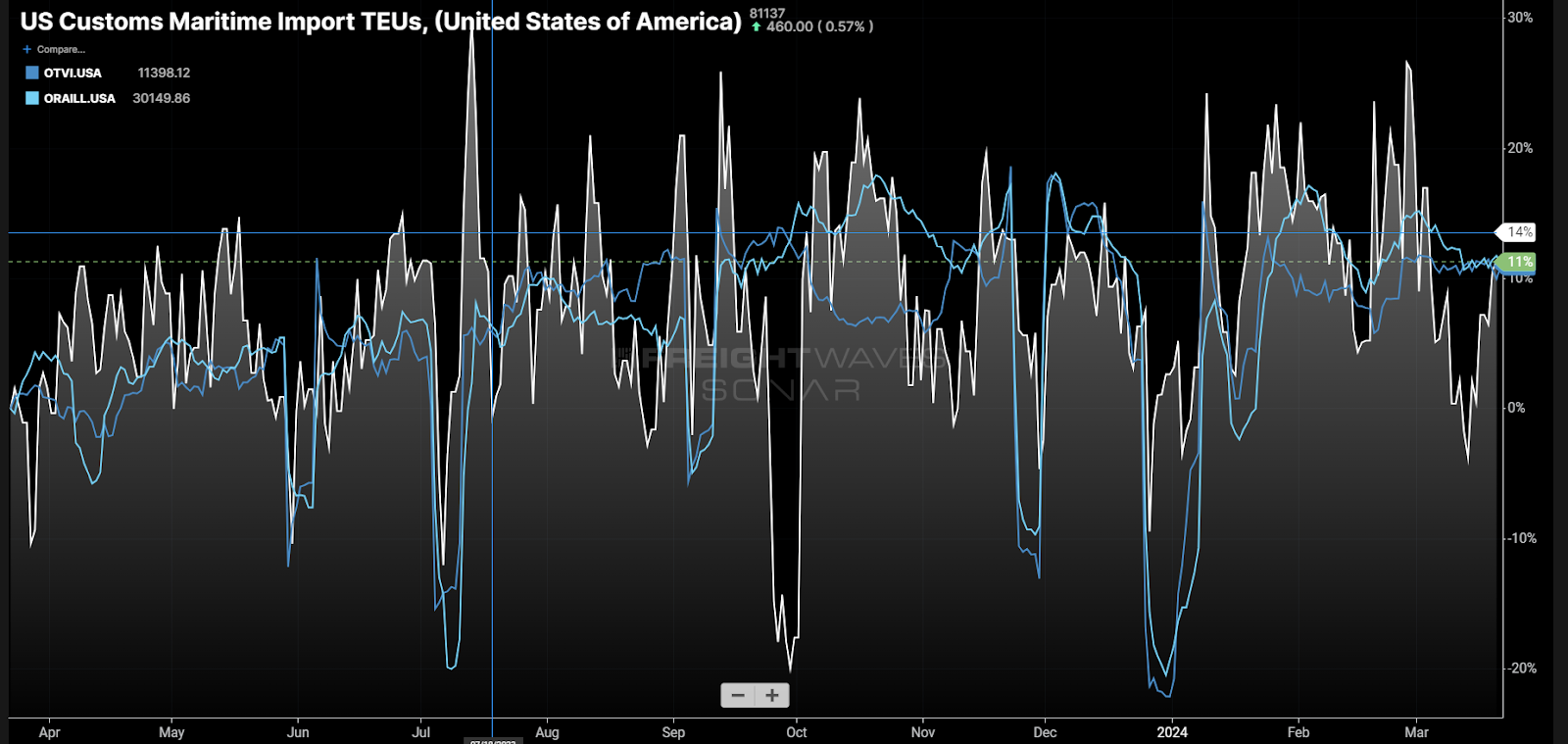
U.S. freight demand has been steadily growing in every mode since the most recently concluded winter. The number of TEUs clearing customs (CSTEU) was up 11% y/y last week, loaded rail container volumes (ORAILL) were up a similar amount, and the national Outbound Tender Volume Index (OTVI) was up 10%.

All three figures show a steadily increasing trend line. The rapid growth in imports in the China-to-Mexico lane is much sharper and expands beyond the organic growth of the American imports.

There are a few theories as to why this is occurring. One of the most popular and somewhat commonsensical is that China and/or its sourcing partners are bypassing tariffs by bringing goods into Mexico before sending them across the border, essentially making them “Mexican” imports and avoiding tariffs. This will be difficult for the U.S. to prove and/or enforce.

A second theory is that China is sending more raw materials into Mexico as it is investing in the country’s manufacturing sector, expecting that the U.S. will be more willing to deal with its Southern neighbor for trade.

If these two theories hold true, then the North American supply chain will continue to see an evolution to more freight coming across the Southern border.

It is difficult to tell if the inbound Mexico imports have eroded any share from the U.S. at this point, thanks in large part to the still-unstable shipping environment created by the pandemic. 

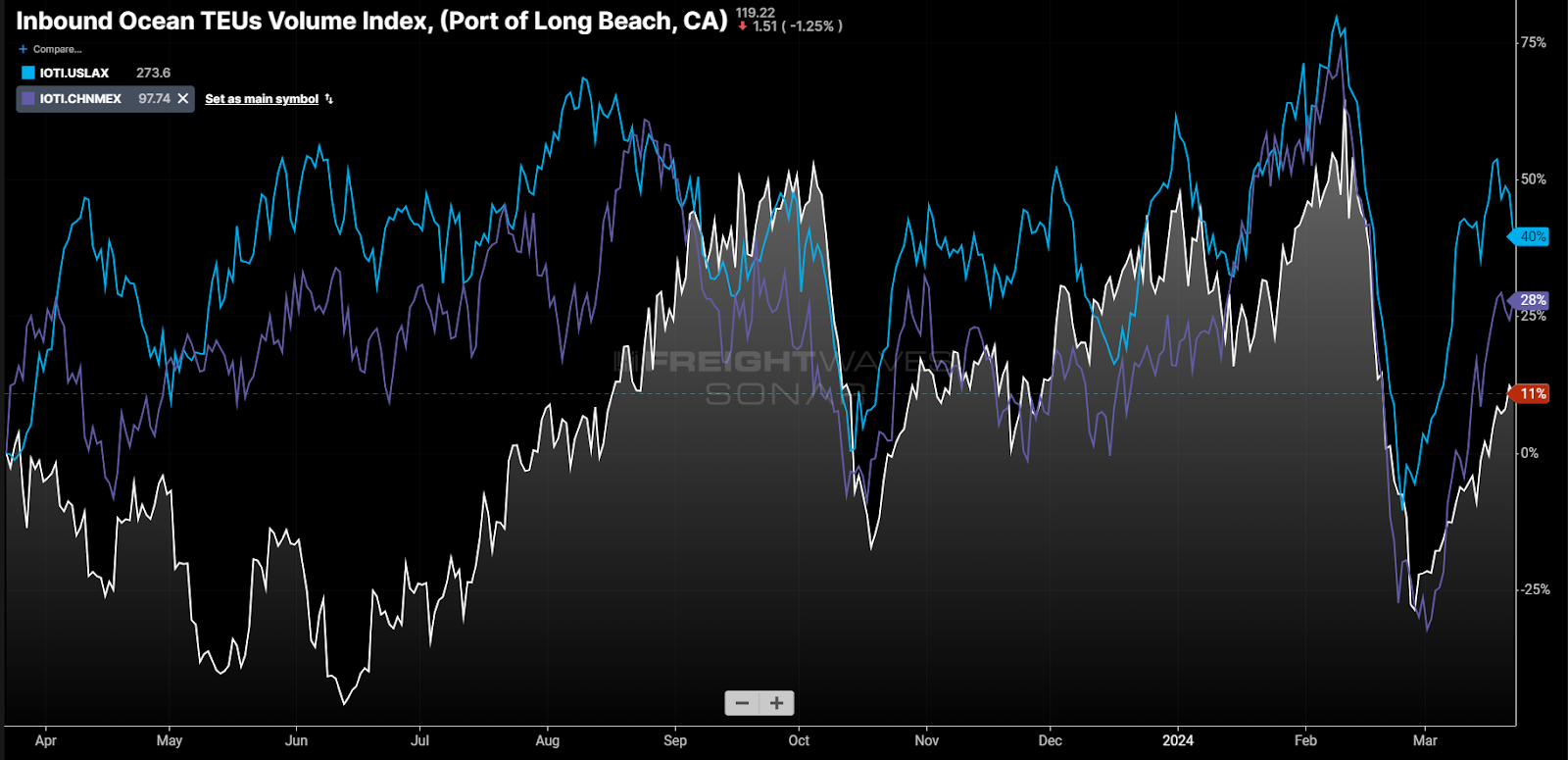
Import bookings into the Port of Los Angeles are up 40% annually, with Long Beach increasing 11%. The IOTI from China to Mexico has somewhat mirrored the Los Angeles import bookings trend over the past year.

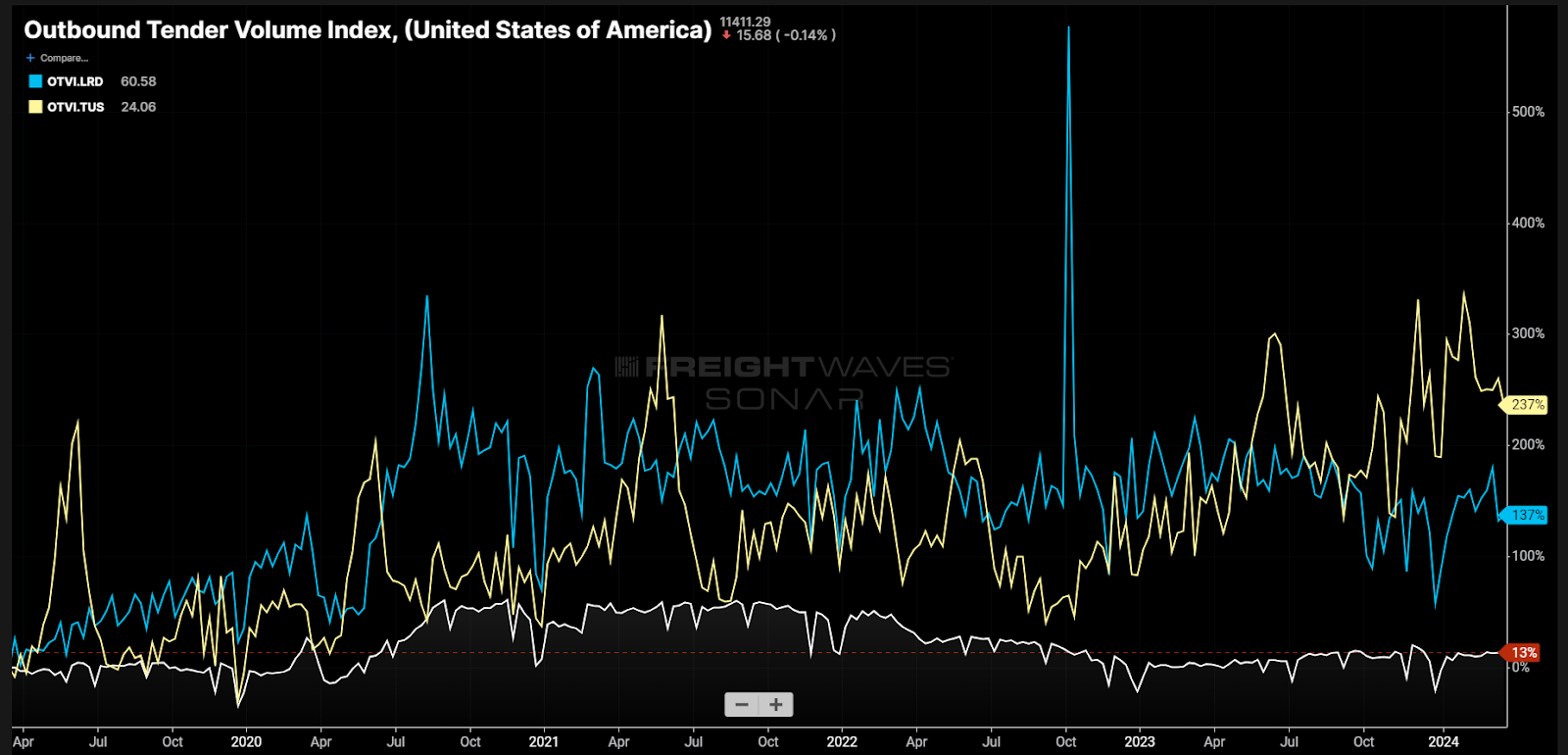
The Laredo, Texas, and Tucson, Arizona, markets are two of the fastest-growing in the U.S. over the past five years. Laredo tender volumes are up 137% versus March of 2019, and Tucson’s are up 237%. Both are home to large border crossing points. 

China cannot be replaced by nearshoring alone, but this is not the only path forward. Whether it is nearshoring, tariff bypasses or something else entirely, the Southern border is increasingly important for domestic transportation.

About the Chart of the Week

The FreightWaves Chart of the Week is a chart selection from SONAR that provides an interesting data point to describe the state of the freight markets. A chart is chosen from thousands of potential charts on SONAR to help participants visualize the freight market in real time. Each week a Market Expert will post a chart, along with commentary, live on the front page. After that, the Chart of the Week will be archived on FreightWaves.com for future reference.

SONAR aggregates data from hundreds of sources, presenting the data in charts and maps and providing commentary on what freight market experts want to know about the industry in real time.

The FreightWaves data science and product teams are releasing new datasets each week and enhancing the client experience.

To request a SONAR demo, click here.

Delta Air Lines taps Peter Penseel to lead cargo division

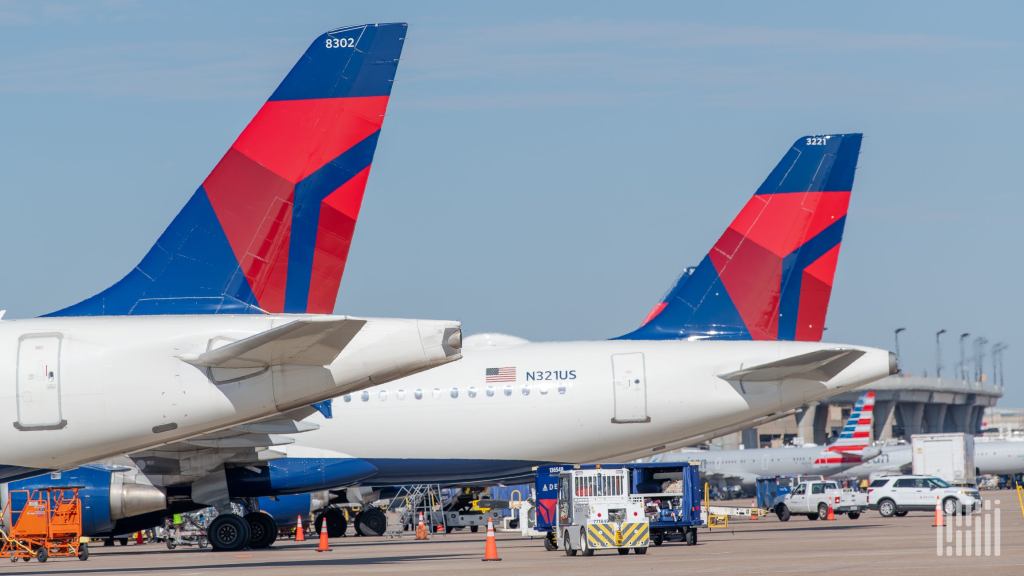
Close up two tails on aircraft painted in Delta blue and red.

Peter Penseel is leaving Ceva Logistics, where he is chief operating officer of the airfreight division, to become president of cargo at Delta Air Lines (NYSE: DAL), effective June 1.

Photo: (Delta Cargo)

The veteran air cargo executive will replace Robert Walpole, who led Delta Cargo for three years. Delta Cargo quietly announced Penseel’s hiring on Wednesday. Walpole’s LinkedIn page shows his employment with Delta ending in February. Delta spokesman Drake Castaneda confirmed Walpole is no longer with the company. (Reached over the weekend, Walpole said he resigned.)

Penseel joined Ceva Logistics in mid-2020 after serving as vice president of cargo sales and network planning at Qatar Airways, the world’s largest cargo airline by volume. Ceva is the 12th-largest air forwarder by metric tonnage.

His departure follows parent company CMA CGM’s Feb. 29 acquisition of Bolloré Logistics, another large third-party logistics provider based in France, for $5.2 billion. Ceva Logistics officials could not be reached to comment on whether his departure is connected to any corporate integration.

Penseel, a native of the Netherlands, has spent more than three decades in the logistics industry, including stints at DHL Global Forwarding and UTi Worldwide. At Ceva he led the launch of in-house cargo capacity through the partnership with CMA CGM Air Cargo, a 3-year-old airline launched by the ocean shipping giant CMA CGM.

He will relocate to Delta’s headquarters in Atlanta.

(This story was updated to reflect new details about Walpole’s departure.)

Click here for more FreightWaves/American Shipper articles by Eric Kulisch.

Contact Reporter: ekulisch@www.freightwaves.com 

RECOMMENDED READING:

Slide in Delta Air Lines’ cargo revenue decelerates in fourth quarter

‘Truck-to-truck worms’ introduced via ELDs could threaten major fleet disruption

Colorado State University researchers have found that ELDs are “potential cybersecurity threat vectors” and there is an urgent need to make them more secure.

Researchers Jake Jepson, Rik Chatterjee and Jeremy Daily uncovered ELD vulnerabilities that could lead to unauthorized control of vehicle systems and data, as well as widespread fleet disruptions. Product designers, programmers, engineers and consumers should raise awareness of these vulnerabilities and encourage development of safer ELDs, their February paper says.

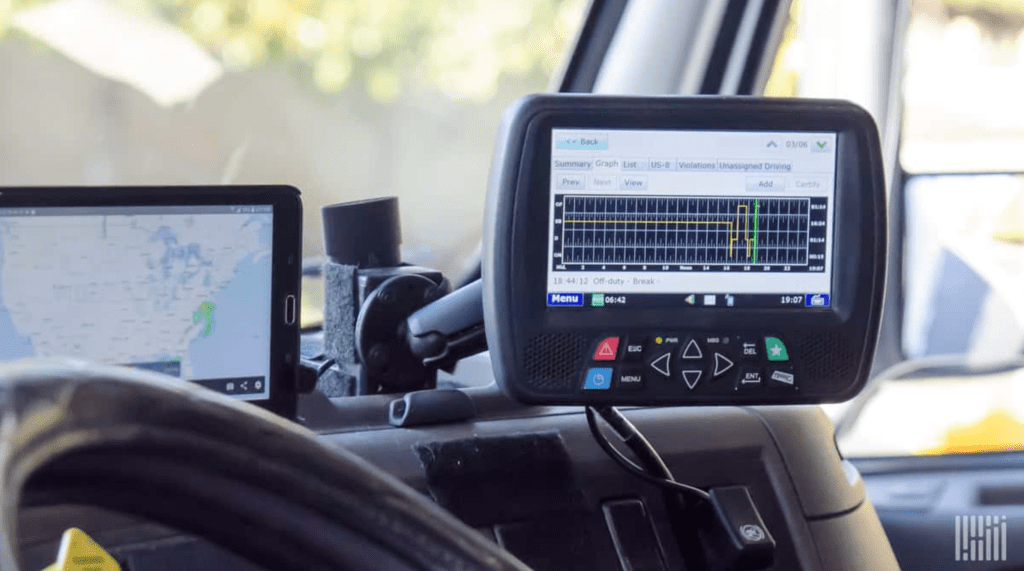
The United States has 14 million medium- and heavy-duty trucks on the road, many of which are required to use ELDs to track truckers’ driving time and ensure compliance with hours-of-service regulations. The devices acquire data by communicating with the vehicle’s engine control module through the vehicle network.

This technology is vulnerable to “truck-to-truck worms,” self-replicating malware that autonomously propagates across a network. Traditionally, these “worms” have targeted computer network systems, but in an age of increased connectivity of systems, technology like ELDs carries a risk of being hacked, the researchers discovered.

“Each system by itself may not have cybersecurity concerns; the truck without an ELD does not have a wireless connection, and the ELD by itself cannot command a truck. The heavy truck acts as a dynamic operational platform, encompassing various mechanical and electronic components, while the ELD serves as a mandated interface for data logging, regulatory compliance, and potentially, vehicle control,” the paper said.

An attacker could connect to a device — and only one device needs to be compromised to begin a larger attack — through a drive-by attack or by waiting at a location frequented by truck drivers, such as truck stops, distribution centers or ports. Then, the malicious firmware can spread to similar devices. Attacks can occur via Wi-Fi or Bluetooth or even through cellular networks, the paper said.

“Our findings revealed that, even in a full parking lot, a connection could be established up to approximately 12 parking spots away, equivalent to about 120 feet,” researchers said.

The researchers recommend the following to strengthen ELDs against attacks:

  • Enhancing default security settings.
  • Implementing high-entropy passwords.
  • Utilizing a secure firmware signing mechanism.
  • Eliminating unnecessary API features.

Leading by example – Taking the Hire Road

Tyler Kivi, COO of Kivi Bros Trucking, joined Jeremy Reymer on this week’s episode of Taking the Hire Road. Kivi discussed being a third-generation trucking company owner and leading by example.

Like most multigenerational logistics professionals, Kivi believes trucking has always been in his blood.

His grandfather began hauling lumber and concrete culverts in the 1950s. At that time, Kivi Trucking was one of the only trucking companies in Minnesota with an authority. When Kivi’s father and uncles came of age, they all bought their own trucks and started working with their father, incorporating Kivi Bros Trucking in the 1990s.

In 2017, Kivi and his two brothers bought the company from his father and uncles, marking the third generation of Kivis to run the business. Their father still works at the company.

Even though Kivi was born into the business, he also worked hard and paid his dues to get where he is today.

“Growing up, my mom embraced the idea that if you want something, you need to work for it,” he said.

Kivi and his brothers took that advice to heart. All three started working at the family trucking company — where they remain today — as pre-teens. Kivi recounted spending his summer breaks washing trucks and learning how to do maintenance in the garage. From there, he started driving: first intrastate at 18, then interstate at 21. Eventually, he ended up in the office, working his way up from there.

In his current position as COO, Kivi is all about flattening hierarchies and treating drivers well.

“Our values include leading by example,” Kivi said. “We like to let people make their own decisions and learn from mistakes.”

By giving employees a higher level of autonomy, he hopes to inspire them to take more ownership and become leaders themselves. In terms of drivers, this means giving them the tools they need to do their jobs — including flatbed training — and trusting them from there.

While the company has been impacted by the volatile ebbs and flows of the trucking industry over the past several years, Kivi has prioritized staying connected, communicating well and treating drivers right the entire time.

As a result, the team at Kivi Bros Trucking continues to work with confidence.

Click here to learn more about Kivi Bros Trucking.

Other highlights from this episode of Taking the Hire Road

Book recommendations: Can’t’ Hurt Me: Master Your Mind and Defy the Odds” by David Goggins

Sponsors: Career Now Brands, The National Transportation Institute, Carrier Intelligence, Infinit-I, Workhound, Asurint, Transportation Marketing Group, Seiza, Drive My Way, DriverReach, F|Staff, Trucksafe

FreightTech Friday: Transportation One releases T1TAN TMS in-house

Logistics provider Transportation One recently announced it has gone live with T1TAN TMS to give its employees an updated experience in managing freight for customers. 

Founder and CEO Jamie Teets told FreightWaves the company had used an off-the-shelf technology for the past 14 years. Still, as transportation management systems had become more sophisticated and easier to white label, it came time for a transition.

“We are trying to customize the areas of our business that have waste to create more efficiencies and productivity. We asked ourselves, how do we do two times the freight with the same amount of people we have today? In those little areas of efficiencies, we can create a better user experience to our employees,” he explained.

With an executive team full of industry veterans, Transportation One specializes in more difficult freight needs like white-glove, temperature-controlled and special projects.

Jim Keating, chief operating officer, discussed how those specialties were worked into the new technology.

“We have taken all of these different specialized load requirements and expectations that customers have beset on us and have applied it to all facets of the TMS,” he said. “In building each module, whether it’s tracking or accounting, we’ve taken all of those unique use cases and baked them into appropriate phases of the system. Each of these, from a user interface standby, have been calculated well in advance to take into account what the customer needs.”

Both leaders told FreightWaves that employees were heavily involved, from suggesting the name T1TAN to giving honest user feedback.

“We had months of user acceptance where we had four employees come in and test every module and try every feature. … After being rolled out for two days, the need for employees to ask for help has already been reduced,” said Keating.

This is important for Teets and his leadership team at Transportation One, as they work to balance the need for new technology and the importance of leveraging employees’ knowledge.

“We are not trying to be a digital freight broker. We do have technology that makes us better for our carriers and our shippers, but we are not trying to automate any of the human elements of this business. I think this system has created accountability around the productivity of servicing our clients,” he said.

Teets went on to explain that this is also a showcase of dedication to the human element of the business.

“It’s a positive culture shock. People see that we are truly investing in helping them push the business forward. We aren’t just talking about it, we are doing it, and in a tough freight environment it has been great for our culture to celebrate something.”

The company does have plans to make portals and apps for its shippers and carriers. Transportation One will zero in on making adjustments to its new platform based on employee feedback.

“Right now we are focused on finding that perfect user experience from the feedback of people who are in the system day in and day out. Then we can comfortably go and deliver a better experience for our shippers and carriers,” Teets explained.

Brief Bytes

Truckstop announced Tuesday the results of its most recent survey, as well as the introduction of two new features. For the survey, 2,000 carriers revealed the challenges they faced in 2023, including increased workload and deadhead travel. Despite lower fuel costs, insurance expenses remain a significant concern for over 60% of carriers. To aid carriers, Truckstop introduced Expanded Search Results and Route Map features, alongside mandatory multifactor authentication for enhanced fraud protection.

On Thursday, Pandion, the residential delivery network for e-commerce founded by Scott Ruffin, former Amazon Air executive, announced a successful Series B funding round of $41.5 million, spearheaded by Revolution Growth. This investment aims to grow Pandion’s parcel delivery network, expand technological capabilities and enhance delivery speed for clients such as Saks Fifth Avenue. Pandion seeks to revolutionize e-commerce delivery by managing the entire package journey and leveraging machine learning for optimized delivery decisions.

GXO Logistics Inc. announced Thursday it has appointed Kristine Kubacki as chief strategy officer, effective April 1. Kubacki will lead growth initiatives, long-term strategy and capital allocation, reporting to CFO Baris Oran. With 20 years of experience in investor relations and analysis, including roles at Wabtec Corp. and Mizuho, Kubacki brings industry insight. CEO Malcolm Wilson highlighted her ability to communicate the value of contract logistics amid global supply chain dynamics.


Recent FreightTech articles:

Uber Freight extends Powerloop drop-and-hook network nationally

Third parties saw emails, court says in letting p44 defamation lawsuit proceed

Flock reports layoffs, path to profitability

Running on Ice: New cold storage and fruit as a package

Blue Truck on a sheet of ice over a blue background and Running on Ice Logo

All thawed out

(Photo: X)

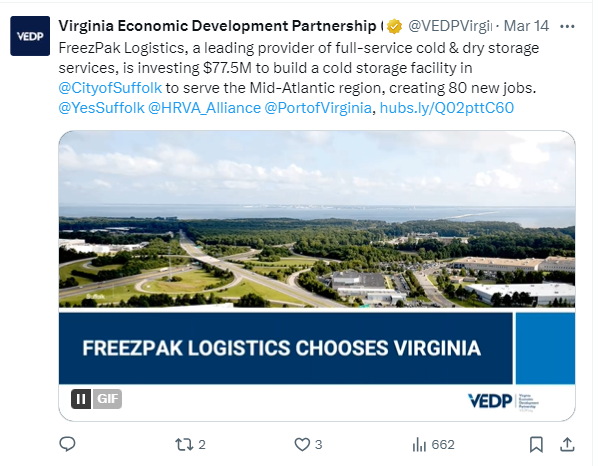
Richmond, Virginia, is about to be the home of the newest FreezPak Logistics cold storage warehouse. FreezPak is building a 245,000-square-foot cold storage facility for a casual $77.5 million. The goal for the new facility is to help support the Port of Virginia. 

Gov. Glenn Youngkin said in a news release, “All of FreezPak’s products will go through The Port of Virginia, a logistical advantage that will increase efficiency and increase its direct access to markets. This is a win for FreezPak, The Port of Virginia, and the Commonwealth.” 

The new facility will have services tailored to frozen, cooler and dry storage for the food and beverage industry. It will be 75 feet tall and will house 49,512 pallet positions within a 191,909-square-foot freezer space, as well as an additional 38,567 square feet of cooler dock. There will also be solar power and a hydrogen fueling station for forklifts, over-the-road trucks and yard switchers.

Temperature checks

(DP World’s freight forwarding service includes global airfreight capabilities. Photo: PR Newswire/DP World)

DP World says it’s time to elevate the global health care sector. The company has launched over 100 freight forwarding offices worldwide that are aimed at capitalizing on trade in the sector. Given that health care solutions have become increasingly complex and require such specific and specialized transportation instructions, the need for strong solutions could not be overstated. Current practices leave shippers susceptible to disruptions at various points that can impact inventory levels and result in massive issues.

Beat Simon, group chief commercial officer for logistics at DP World, said in a news release: “As we continue to grow our freight forwarding footprint, we are building a network that will cover more than 90% of global trade. We are focused on densifying our network as we build a best-in-class, strong and resilient global capability.”

This move comes as health care supply chains are looking to build more resiliency into their programs. The expansion of freight forwarding offices brings the much-needed visibility to pharma and health care companies that gives them more control over goods.

Food and drugs

(Photo: LinkedIn)

The way certain snacks are packaged has changed drastically. Foodberry, a Boston-based startup, has eliminated the need for plastic-based packaging. The company has developed an edible coating that mimics fruit skin. This coating can even work for the trickier-to-transport goods such as ice cream, yogurt and hummus.

CEO Marty Kolewe said in an interview with The Cool Down: “There isn’t just a single Foodberry coating — it’s a library of materials, inspired by the same diversity of coatings and structures found in natural fruits, that all have protective and encapsulating functions. They can be produced in a near-endless variety of sweet and savory flavors and varying textures.”

While it seems a little strange at first to have packaging for hummus that looks like a stuffed cherry tomato, the long-term benefits are immense: 36% of all plastic manufactured is used for packaging, including single-use food and beverage containers. While the newly developed “foodberries” are perishable, they’re safe and edible and most are safe to eat within 60 to 90 days, but frozen items can last more than a year. 

Cold chain lanes

(SONAR Tickers: ROTVI.JAX, ROTRI.JAX)

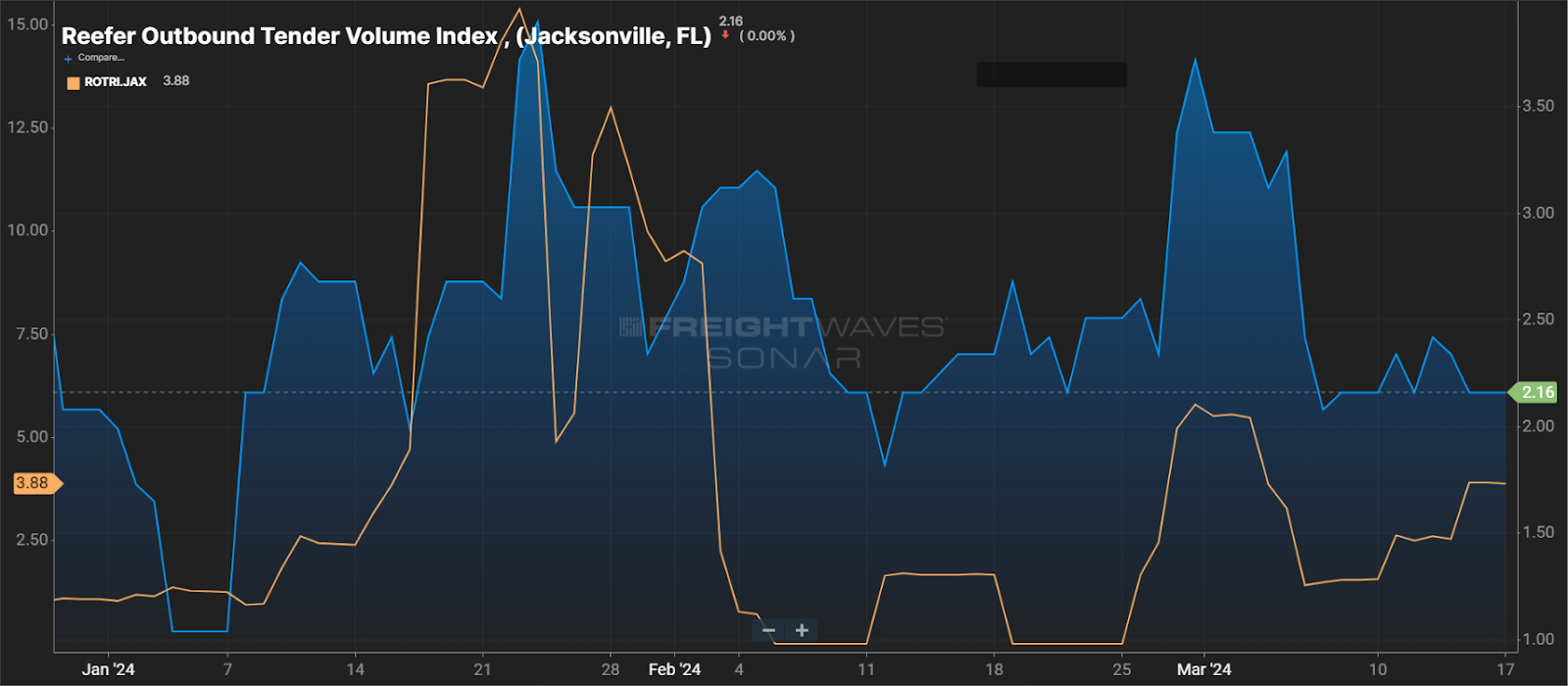
This week’s SONAR market is Jacksonville, Florida. Capacity remains stable in north Florida as outbound tender volumes have changed little week over week. However, outbound tender rejections have shot up 231 basis points week over week to come in at a rate of 3.88%. While rejection rates have increased, it’s not enough to move spot rates in a significant manner. Typically only when rejections surpass 7% do they start having significant impacts on rates.

Is SONAR for you? Check it out with a demo!

Shelf life

Cold-stored table grapes using psychrotrophic yeasts

Northwest Indiana manufacturing has been booming with record 2.4 million square feet of new development

Handling the Hatch: The Complex Egg Supply Chain In India

Farm operations in southern West Virginia take home winnings from pitch competition

Temperature increase improves sustainability of frozen foods

Wanna chat in the cooler? Shoot me an email with comments, questions or story ideas at moconnell@www.freightwaves.com.

See you on the internet.

Mary

If this newsletter was forwarded to you, you must be pretty chill. Join the coolest community in freight and subscribe for more at www.freightwaves.com/subscribe.