Shaping the future of freight at AirCargo Conference 2024
The highly anticipated AirCargo Conference 2024 promises to be the most transformative industry event yet for the freight transportation and logistics sectors.
As the premier gathering for airfreight professionals, AirCargo Conference 2024 will feature an agenda packed with discussions around critical issues impacting the industry. It is co-sponsored by the Air and Expedited Motor Carrier Association and Airports Council International-North America.
With extensive educational sessions, representation across industry roles and abundant networking events, AirCargo Conference has earned the title of “the conference for the rest of us.” It has nearly 50 industry-leading sponsors and an entirely sold-out exhibit hall. AirCargo Conference 2024 is expected to draw a record number of over 1,000 attendees.
The sessions will thoroughly address pressing topics fundamental to stakeholders’ success from cargo security strategies to navigating global regulations and trade impacts. There will also be dedicated networking events, including a women’s gathering focused specifically on furthering diversity and inclusion within the industry.
The highlight will be an exclusive keynote fireside chat with industry leader Capt. Houston Mills, VP of flight operations for UPS.
He plans to share invaluable insights on an array of topics ranging from transportation sustainability to critical trade and regulatory advocacy in the air cargo sector and beyond. His unique perspectives promise to inform attendees’ strategic planning as well as tactical day-to-day decision-making.
Outside of the thought leadership discussions, the goal is to leave attendees with executable solutions for challenges in areas like air cargo facilities development, pharmaceutical cool chain logistics, airport congestion and truck throughput.
As participants gather in Louisville, Kentucky, the intention is to harness the industry’s collaborative spirit in order to proactively navigate freight transportation’s future.
By turning persistent challenges into tomorrow’s opportunities, the hope is to chart a more profitable, efficient and sustainable path forward for all aviation and logistics industry stakeholders.
To view more FreightWaves infographics, click here
FedEx fleet restructure poses threat to freighter operators
(Editor’s Note: Article updated Feb. 6, 2024, at 4:40 p.m. ET with statements from Richard Smith of FedEx)
FedEx has portrayed its new air network redesign in terms of streamlining the high-cost overnight parcel operation, but internal communications show the express delivery giant also sees an opportunity to aggressively go after heavyweight cargo booked by logistic providers to offset slower growth in the main express product and declining postal business.
FedEx Express (NYSE: FDX) historically has concentrated on moving small parcels by air. It gives general cargo — dry goods, hardware, textiles and other everyday items — low priority. Freight forwarders are careful about tendering shipments to the airline because third-party shipments can be left behind when a plane is full of shipments from FedEx customers.
Dedicating fixed space to third-party freight would be a big change and a potential threat to other cargo airlines, experts say.
“If they change strategy and decide that [hypothetically] one third of every FedEx plane, or a group of planes, is now reserved for general heavy cargo and will not be subjected to any offload that would have a huge impact,” said a senior executive at a global freight broker who asked not to be named because of company rules against speaking with the media. “Freight carriers like Cargolux, Qatar Airways, Lufthansa and Emirates, they would not like to see that at all because if you fly freighters you need every single kilo. You don’t have, like FedEx or UPS, another moneymaker, which are the packages.”
In the fall of 2022, FedEx launched an initiative to take out $4 billion in structural costs by fiscal year 2025 and redesign the entire parcel distribution network to create greater efficiency. The air and international unit flew fewer hours in 2023, deactivated aircraft until demand returns, accelerated the retirement of older planes and flew more direct routes.
In conjunction with its latest quarterly earnings on Dec. 19, management spelled out in more detail how it plans to reconfigure airline operations.
The new strategy de-emphasizes the hub-and-spoke system originally built for speed and global connectivity. Instead, a three-pronged approach prioritizes density and improved cash flow by better segmenting shipments between owned freighters, partner airlines, road transport and deferred freight.
FedEx CEO Raj Subramaniam, during a briefing with analysts, characterized the new Tricolor network design as a way to improve efficiency, but internal company communications show it is equally designed to propel Express into sectors in which it has not traditionally operated.
The Purple network, consisting of FedEx’s owned aircraft fleet, will underpin Express’ high priority, high-margin international parcel business utilizing the existing hub model. This part of the network consists of direct flights from gateways such as Paris; Cologne, Germany; Osaka, Japan; and Hong Kong feeding the main night sortation hub in Memphis, Tennessee, as well as locations like Indianapolis and Newark, New Jersey.
“Capturing this priority parcel business is where FedEx Express has historically made its primary profits. However, this worldwide market segment is not projected to grow substantially. Realizing this, over the last 24 months, we have carefully evaluated our network to ensure that our traditional purple tail flying carries as much high-value priority volume as possible and that aircraft gauge and density maximize our load factors,” said Justin Brownlee, senior vice president of flight operations, in a Dec. 21 memo to frontline workers obtained by FreightWaves.
A portion of FedEx’s fleet will be reallocated to the so-called Orange network, which will operate off-schedule to carry heavy freight that doesn’t require maximum speed and is better suited for a truck-fly-truck delivery model than flying the entire trip. These planes will fly into primary and regional sortation centers such as Newark and Oakland, California, during the daytime when workers have more time to build dense pallets.
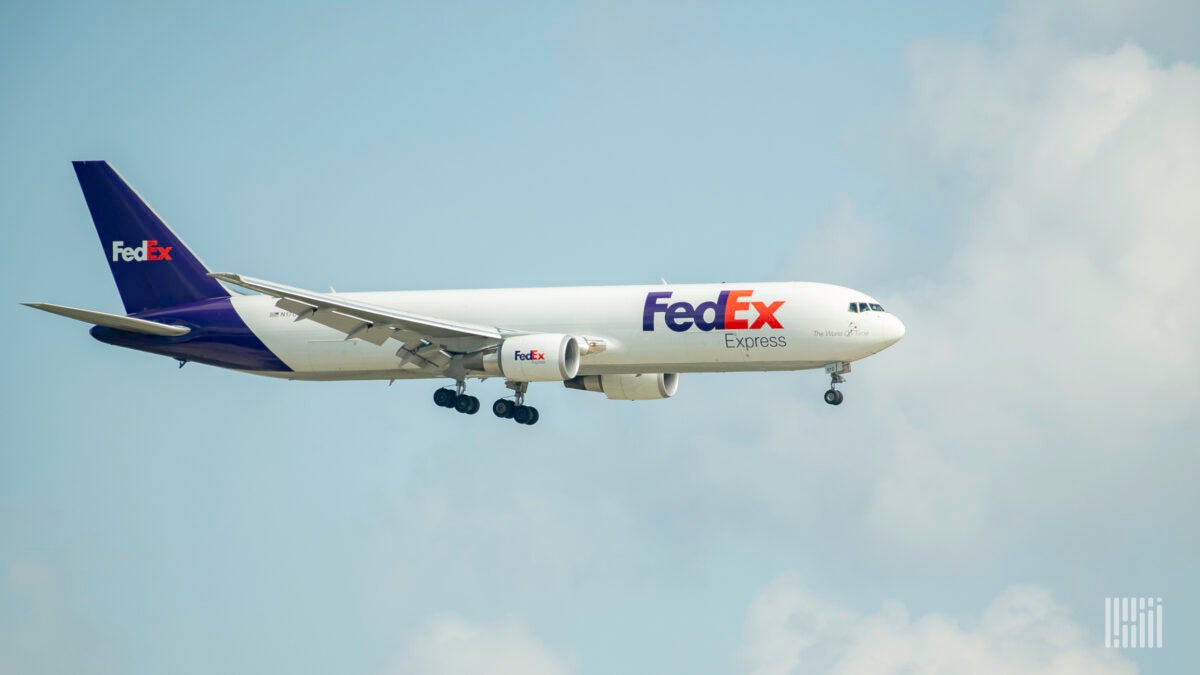
A FedEx 767-300 freighter from Boeing on approach to George Bush Intercontinental Airport in Houston. (Photo: Jim Allen/FreightWaves)
The object is to improve aircraft utilization, feed the ground parcel and freight networks, and help decongest hubs before the priority night sortation. Customers can expect transit times of three to five days.
“Right now, we move all products — parcels and freight pallets, priority and deferred — in the same way, through an air network that is timed and structured to deliver priority goods around the world in the most expedited way possible. However, the global market is broader than just priority parcel shipments, and FedEx needs to restructure our international network to better capture freight shipments (pallets) and less time-sensitive parcels (including e-commerce) in a profitable manner,” Brownlee said. “By adjusting our network to best serve the entirety of the global market, we can broaden our customer base and profitably grow revenue, which will ultimately lead to growth at our airline and increased flying.”
Orange addresses an $80 billion deferred market, of which FedEx only has a 1% share.
“With this structure, FedEx can provide the outstanding service we are known for to customers needing international standard air freight logistics and do so with a cost structure that enables our sales teams to aggressively compete in this space,” Brownlee said.
Upper management’s previous comments about reducing use of nearly 30 widebody freighters created a misperception about air realignment’s purpose, said Pat DiMento, vice president of flight operations and training, in a secretly recorded meeting with pilot evaluators several weeks ago that was shared with FreightWaves. “If we don’t capture some of that middle band, we will never get their [shipper’s] freight that is also in the priority range. Right now, we don’t offer much in that middle band to save money for these companies. So they are trying to capture that so that we can also grow what is our priority, international business.”
Richard Smith, president and CEO of airline and international at FedEx, said in a letter responding to the story that Tricolor “expands FedEx’s offerings across the globe for freight shipments which have similar characteristics to less-than-truckload vs. the much heavier and lower yield per-pound consignments which are the provenance of traditional all-cargo carriers. In addition to international LTL shipments, the Orange network handles International Economy packages that similarly interface with FedEx’s global ground parcel systems at very low incremental costs.”
FedEx, UPS and DHL Express offer excess capacity on their airlines at bargain rates compared to for-hire freighter operators because the main parcel product covers the fixed cost base — much like passenger airlines enhance margins by selling available belly space to shippers. All-cargo airlines are challenged to compete with widebody passenger airlines, which often can offer lower rates because operating costs are allocated to the passenger business. The share of international cargo capacity on freighters has declined the past two years as travel picked up after the COVID crisis and passenger airlines reintroduced more flights.
But freight management companies take a risk shipping with FedEx and UPS because they are offloaded first if there isn’t enough space on a flight. The best time to utilize an integrated package carrier is the summer, when they aren’t as busy, according to logistics specialists.
The Orange network is already being organized. In February, FedEx plans to launch two new daytime flights from Liege, Belgium, to Memphis and Indianapolis. “We are also evaluating the right timing for additional flights from Liege to Oakland and Newark. In Europe, the Liege hub is a key part of the strategy, given its purpose-built capabilities for freight handling and optimal pallet build,” Brownlee said.
He described the changes to the priority parcel network as rightsizing, rather than downsizing, the airline. Some aircraft on low-volume lanes have been parked, but the company also plans to grow in other markets this year. FedEx Express, for example, intends to start a route by September serving El Salvador and Guatemala, utilizing a Boeing 757 freighter. Management also is working to launch service to Argentina, Chile and Ecuador in April with a Boeing 767 cargo jet, subject to necessary government approvals.
Finally, FedEx will use third-party carriers — the White network — as flex capacity and to backfill imbalanced trade routes. “This isn’t an approach that costs anyone jobs or puts at risk the future of FedEx flying. Rather, it gives us extra scalable capacity … which in turn helps us grow our market share in all sectors of the global air freight market,” Brownlee said.
A FedEx employee, who asked not to be identified because of concerns about possible job retaliation, agreed the color-coded strategy actually could be a positive development for pilots, who have seen their billable flight hours sharply reduced in the past year. By handling priority shipments separately from deferred freight, FedEx can go after a greater share of the less time sensitive heavy palletized airfreight and e-commerce markets in a profitable manner.
DiMento stressed in the meeting that FedEx is “not trying to drive product down to other carriers, we’re not trying to wet-lease [outsource] anything. All of that stuff is just crazy talk.”
Can general cargo be profitable?
But logistics experts question whether FedEx can be viable long term in the general cargo sector given its elevated cost structure, including pay scales for pilots that far exceed those of international freighter operators, and the relatively low margins.
“To make a competitive product is difficult and it runs the risk of diluting your core international Express products,” said Derek Lossing, a former head of global freight procurement at Amazon who now runs Cirrus Global Advisors. “It’s not a great time to make a lot of money in air cargo because of the low rates. There’s not a lot of margin” because freight forwarders buy airport-to-airport transportation as a commodity in the wholesale market, and aren’t keen to pay a premium, he explained.
And rates, which have fallen back near 2019 levels excluding fuel surcharges, could go lower this year as more capacity enters the market. The supply of cargo space is about 7% to 13% greater year over year and 4% greater than pre-pandemic levels, primarily because of the strong return of passenger aircraft and their associated belly storage, according to the International Air Transport Association and others. More widebody passenger aircraft are expected to hit the market as China fully reopens to air travel this year.
Some Wall Street analysts believe FedEx hasn’t truly come to terms with the amount of structural cost reductions necessary to achieve decent profits. The DRIVE cost initiative is already losing steam, going from $1.4 billion in savings in the quarter ended May 31 to $600 million in the quarter ended Nov. 30. In Express, expense reduction went from $500 million to $200 million over the same six-month period. FedEx Express’ operating margin was an all-time low of about 2.2% in the prior quarter. Meanwhile, management guidance suggests the next two quarters could be the worst ever for Express profitability.
FedEx has 407 mainline aircraft in its fleet, while rival UPS operates about 290 aircraft, according to fact sheets from each company.
“We applaud management for trying something new with the air network, but suspect this is lending back to the FedEx of old, focused on service improvements. While reallocating air capacity to improve transit times is admirable, the overarching and long-term problem at Express has been and remains excess network capacity,” said Barclays transportation analyst Brandon Oglenski, in a research report. “While it may initially hurt, we think true margin improvement and finally earning returns in excess of the high levels of capital required to run Express would take a structural 20%-to-30% reduction in capacity from current operations, which just does not seem to be in the cards with current management plans.”
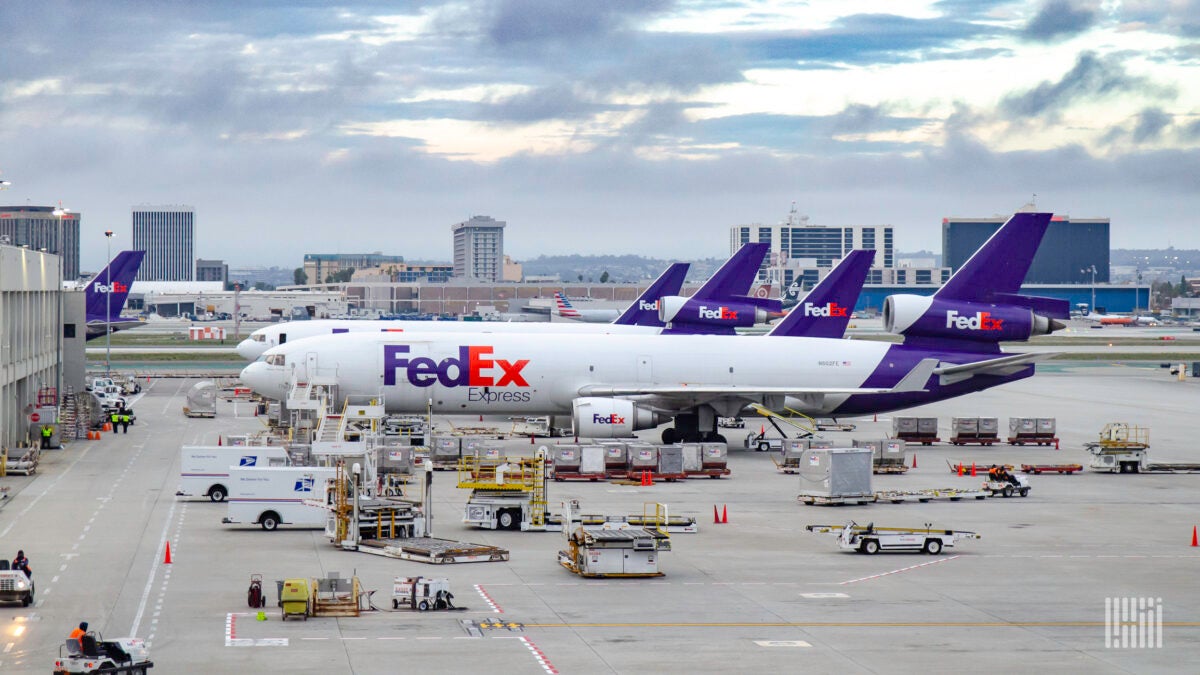
Cargo jets at the FedEx terminal in Los Angeles. (Photo: Jim Allen/FreightWaves)
In the memo, Brownlee said FedEx has deferred taking down four MD-11 freighters in the second half of the fiscal year, ending May 31, because of incremental volume increases in the Asia, Middle East and Africa regions. Nonetheless, the retirement plan for the aging aircraft has not changed. One MD-11 was removed from service at the end of December and 13 more will be idled by the end of May.
During the second quarter, which ended Nov. 30, FedEx parked six aircraft — three Boeing 757s and three Airbus A300s. Since September, it also took delivery from Boeing of six new aircraft — four 767s and two 777s. The airline plans to receive four more 767s from Boeing by June.
The Express unit struggled the most during the most recent quarter, with revenue and adjusted operating profit dropping by 6% and 49%, respectively, even as group profits increased. Adjusted operating margin dipped 1.5% year over year to 1.7%. Express revenues continue to fall faster than total revenue, partly due to lower delivery surcharges and a shift to lower-yielding services.
FedEx cut its fiscal year 2024 revenue forecast, saying it now expects a single-digit year-on-year revenue decline instead of flat revenue.
FreightWaves recently reported that FedEx Express is likely to lose half its business with the U.S. Postal Service, its largest customer, later this year when an existing contract expires. The Postal Service is converting the bulk of its mail transportation to ground services as part of a multiyear efficiency campaign while FedEx is negotiating for better terms in future contracts because its postal work barely makes money.
C.H. Robinson’s Q4 sees little improvement; shift at top of brokerage unit
Any rebound in the fiscal performance at 3PL giant C.H. Robinson looks to be a ways off.
Earnings for the fourth quarter of 2023, released Wednesday, had little good news, whether the comparison was with the fourth quarter a year earlier or sequentially from the third quarter, when the company named its still relatively new CEO and President David Bozeman.
Income from operations came in at $107.4 million, down 34.5% from a year earlier. But that key figure also was down from the third quarter number of $113.5 million.
Down the line, the comparisons were all negative. That they were worse than the fourth quarter of 2022 was not a surprise, but Bozeman cited several statistics regarding C.H. Robinson’s fourth-quarter performance, as well as the normal seasonal changes between the third and fourth quarter reflected in Cass data, to show that sequentially the company’s performance showed signs of improvement.
Still, on an outright basis, the numbers were all negative sequentially and year on year. Gross profits in the fourth quarter were $609.3 million. That was down 20% from a year earlier and down from $626.6 million in the third quarter.
Investors’ first reaction to the earnings was negative. Per Barchart data, C.H. Robinson stock was down 3.77% at about 6:20 p.m., a decline of $3.17, to $80.92. The stock is down a little less than 13% for the 52 weeks.
A new head at NAST
The lagging performance of many months might have been the cause of a significant shakeup in the company’s leadership ranks. C.H. Robinson (NASDAQ: CHRW) used the occasion of the earnings release to announce a change in the top at its North American Surface Transportation unit, the core of its 3PL activities.
It stayed in-house in appointing Michael Castagnetto to president of NAST, effective immediately. His predecessor, Mac Pinkerton, was said by C.H. Robinson to be “transitioning from his current role.”
Castagnetto had been vice president of customer success at NAST. Prior to that, he was president of Robinson Fresh, a leading delivery service of fresh food. He joined the company in 2005.
In the latest earnings report, NAST revenues were just over $3 billion for the quarter, down 15.8% from a year ago. Adjusted gross profit fell 24.3% to $380.1 million, with income from operations falling more, down 41% to $96 million.
Sequentially, revenues at NAST in the third quarter were $3.086 billion, adjusted gross profits were $386.5 million and income from operations was $112 million.
Adjusted gross profits by mode of transportation were all lower sequentially, though not by enormous amounts. Truckload profits dropped to $243.9 million from $245.4 million. LTL transportation was down only slightly, to $136.6 million from $137.9 million. Ocean dropped about $5 million to $99.2 million. But compared to a year ago, adjusted gross profits for all modes of transportation fell to $618.6 million from $634.8 million, a drop of just 2.5%.
The adjusted operating margin for the quarter was 17.4%. A year earlier it was 400 basis points higher at 21.4%. It was also 50 bps less than the third-quarter margin of 17.9%.
Adjusted earnings per share of 50 cents, a non-GAAP measure, were down from 68 cents a share in the third quarter and down 52.8% from a year earlier.
But more significantly, according to SeekingAlpha, the 50-cents-per-share number for adjusted net income came in 31 cents less than the consensus on the company’s projected earnings.
CEO lays out the weak market the 3PL faces
Bozeman, in the prepared statement, was blunt in describing the situation the company faced at the close of 2023.
Saying the outcome “did not meet our expectations,” Bozeman said C.H. Robinson “continue[s] to battle through a poor demand and pricing environment.”
“Weak freight demand in an elongated market trough, combined with excess carrier capacity, continued to result in a very competitive market,” Bozeman said. “With this environment in play, we targeted more truckload volume in the spot market, where we could capture more profit due to seasonal market tension. This led to a sequential improvement in our overall truckload profit per load in October and November. However, in December, our profit per load declined as the cost of purchased transportation moved seasonally higher.”
Bozeman said truckload business at C.H. Robinson was about a 65%-35% contractual/spot mix in securing capacity in the fourth quarter, compared to a usual mix of 70%-30%.
Responding to an analyst question about why C.H. Robinson had shifted more of its freight purchases to the spot market, COO Arun Rajan said the shift to more use of the spot market to secure capacity was “opportunistic. Where we can get profitable demand, we’ll go, and there was opportunity in the spot market. So we went there.”
Rajan said the shift was part of “revenue management” and not a sign of a longer-term shift. “In the short term, we don’t see an inflection in the market,” Rajan said. “So we’re not really triggering any major repricing other than making sure we are trying to grab as much volume as we can in the spot market.” Changes could be made if that inflection develops, Rajan said, “but we don’t quite see that yet.”
One area where changes have had an impact is employee expenses. In the North American Surface Transportation sector at C.H. Robinson, the company said it had cut its operating expenses by 16.3%, “primarily due to cost optimization efforts, including lower average employee headcount, lower variable compensation, and lower technology expenses.” The average head count was 15.8% less than a year earlier.
Better productivity numbers reported
Bozeman has spoken frequently about a push to increase productivity rather than just waiting around for the freight market to bolster C.H. Robinson’s performance. He cited a 17% improvement in the North American Surface Transportation’s group shipments per person per day, which exceeded the goal of a 15% jump “as an indicator of the progress that we’ve made on removing waste and manual touches.”
Asked about the current market past the end of the quarter, Rajan said there had been some tightness in truckload capacity in areas that had been hit by the cold snap of January. The load-to-truck ratio increased the cost per mile in those markets, he said, but “now we’re starting to see that ease up and dissipate as the weather sort of dissipates.”
“From our perspective, everything that we see in the data suggests that any cost increases we saw in January are purely a function of weather.”
CFO Mike Zechmeister, answering an analyst’s question about the strength of C.H. Robinson relative to other 3PLs, said “it is a very stressed market. And one of the things that we believe may be an advantage to use in this stressed market is that we’re still investing.” Zechmeister said when the “inevitable” market improvement comes, “we’ll be stronger as we come out.”
Zechmeister’s retirement is set for May 31 at the latest. His successor has not been named.
Freight broker Landstar System’s fourth quarter was largely as expected, but its outlook for the first quarter was well below analysts’ expectations.
Landstar (NASDAQ: LSTR) reported fourth-quarter earnings per share of $1.62 Wednesday after the market closed. The result was in line with the consensus estimate but nearly $1 lower year over year (y/y). The company closes its books on the last Saturday of the year, which resulted in an extra operating week in the year-ago quarter.
Total revenue of $1.2 billon was 28% lower y/y and worse than management’s guidance. Landstar said the extra week equated to $65 million in revenue last year.
Total loads hauled by trucks were down 22% y/y in the quarter but in line with guidance. Revenue per load was down 9.6%, 260 basis points worse than the midpoint of management’s guidance range.
“The continuation of soft demand, driven by continued weakness in the U.S. manufacturing sector and a weaker than typical peak season, plus the continuation of a loose truck capacity market drove Landstar’s truck revenue per load and volumes in the 2023 fourth quarter below prior year levels,” Jim Gattoni, president and CEO, stated in a news release.
The company is seeing the normal seasonal sequential step-down in demand so far in 2024.
Landstar expects revenue for the first quarter to be in a range of $1.1 billion to $1.15 billion, a 22% y/y decline at the midpoint of the range. Loads hauled by truck are expected to decline between 14% and 16%, with revenue per load down by 8% to 10%. The company is calling for first-quarter EPS of $1.25 to $1.35, well short of the $1.63 estimate at the time of the print.
Variable contribution, or revenue less purchased transportation and commissions, fell 24% y/y to $178 million. The contribution margin improved 80 bps to 14.8% as purchased transportation expenses as a percentage of revenue declined modestly.
The company generated $394 million in cash flow from operations in 2023, a 37% y/y decline.
Landstar will host a call on Thursday at 8 a.m. EST to discuss fourth-quarter results with analysts.
Heartland Express reported net income of $5.1 million for the fourth quarter, which included the benefit of $25.6 million in gains from the sale of three terminals. Excluding the gains, which are unlikely to be replicated on an ongoing basis, the company again booked a notable loss.
“This challenging freight environment combined with two acquisitions in the prior year, have pressured our financial results to a level below our historical results and management expectations,” CEO Mike Gerdin said in a news release.
He said the company will continue to “evaluate its real estate portfolio,” which has expanded through acquisitions in recent years. That may mean more asset sales, but analysts are unlikely to consider those as part of recurring earnings per share.
The Iowa-based truckload carrier reported an adjusted operating ratio of 94.9%, which excluded the impacts of fuel surcharges and acquisition-related amortization expense. However, backing out the gains from the terminal sales, the company’s adjusted OR was 105.8%.
The underperformance is tied to back-to-back acquisitions made in 2022. The Contract Freighters Inc. (CFI) and Smith Transport fleets were acquired during a freight recession, which delayed the expected synergies the increased scale would provide Heartland.
The company’s legacy operations and the Millis Transfer fleet, which was acquired in 2019, operated at an 86.9% OR during 2023. CFI and Smith produced a 103.8% OR during the year.
“We project we can improve our consolidated operating results, within three to four years following the 2022 acquisitions to align with our historical operational results,” Gerdin said.
Heartland (NASDAQ: HTLD) reported a 22% year-over-year decline in revenue to $275 million. The company does not provide operating metrics for utilization and pricing.
“Lower freight volumes, freight rate mix, and an increase in empty miles compared to the same quarter a year ago were products of the continued freight environment weakness,” the news release said.
Heartland generated $165 million in cash flow from operations during 2023. It used $114 million to reduce the balances on its debt and financing lease obligations to $300 million. It has $28 million in cash and an untapped credit line with $88 million in available borrowing capacity.
Grit and determination: In pursuit of the American Dream – Taking the Hire Road
On this week’s episode of Taking the Hire Road, host Jeremy Reymer chatted with Marina Ivanov, co-founder of Apex Transit, a North Carolina-based carrier. The duo discussed the grit and determination required to start a trucking company, as well as the importance of being active and engaged in the industry.
Apex is a true family-run business. The business was co-founded by Ivanov, her husband and her brother-in-law about 10 years ago. The company’s culture is deeply rooted in the family’s values.
Ivanov emigrated from Ukraine when she was 10 years old. In 2000, shortly after the family arrived in the U.S., Ivanov’s father began working as an owner-operator to provide for his family while still adjusting to life in America.
Her father’s trucking career gave Ivanov the opportunity to experience the trucking industry firsthand. While watching her father struggle with industry issues like hours of service, Ivanov actually swore off the trucking industry.
As an adult, however, she realized the trucking world offered a plethora of opportunities for hard-working individuals and innovative thinkers. She fell in love with trucking.
Despite her passion — and her company’s success — Ivanov noted that the ongoing freight recession has created challenges for Apex.
“It hasn’t been easy,” Ivanov said. “We have seen a decline in freight availability, and that has impacted us greatly.”
During this time, Ivanov has been laser-focused on helping Apex continue to thrive while ensuring the company’s drivers do not suffer from the negative state of the industry.
In fact, Apex has been able to retain a large portion of its drivers without reducing benefits, slashing hours or cutting pay.
“I am proud of the way we treat our people and who we are as a company,” Ivanov said. “We have worked really hard to make sure we don’t reduce driver pay or ruin their livelihood.”
Ivanov’s deep empathy for drivers is a direct result of her childhood experience as a truck driver’s daughter. Some of those same childhood experiences pushed her to pursue radical success for the overall business.
Throughout the freight recession, Apex has increased its operational efficiency by taking a detailed look at its policies and procedures to pinpoint areas of potential improvement, then making revisions as needed.
“I believe that, even in the tough times, there are always people doing well. I want to be one of those people,” Ivanov said.
Other highlights from this episode of Taking the Hire Road
UPS cuts 12,000 workers; SoCal port report; an AI-powered dispatch tool – WTT
On episode 676 of WHAT THE TRUCK?!? Dooner is joined by guest co-host Covenant’s Matt McLelland. He’s talking about the best FreightTech he saw at CES and the news that UPS is cutting 12,000 jobs and putting Coyote up for sale.
Junction Collaborative Transports’ Ian Weiland calls in from sunny Southern California to give us a port and drayage update. We’ll also find out how they’re preparing for new regulations like no new diesels at the ports and what WAIRE means for his clients.
TruckBase offers an AI-based dispatch tool that promises to scale fleets. We’ll meet their founder Bryan Jones to find out how it works.
We say goodbye to Justin Martin and as he hits the fast lane toward his future endeavors. Before he goes, we’ll get an update on the “Take Our Border Back” convoy; a CDL bribe scheme; GPS dangers; parking problems; safety tech; and TikTok double brokers.
Understanding the underwriter: How a proactive approach to insurance renewals can save you money
Insurance has been a sore subject across the trucking industry over the past few years. Many companies have struggled with increasing rates — due in large part to the rise in nuclear verdicts — while simultaneously trudging through the ongoing freight recession.
As fleets continue to navigate this cash-strapped environment, it is important for them to take a proactive approach to insurance renewals. With the right approach, and a good insurance agent, it is often possible to save on rates without sacrificing quality.
Reliance Partners Executive Vice President of Sales Jackson Alexander believes that understanding the underwriters point of view can help carriers navigate the insurance renewal process.
During the insurance renewal process, a computer formulates manual rates for trucking companies according to the specific insurance provider’s algorithm. These rates, however, are not set in stone.
Underwriters have the ability to deviate up or down from manual rates by as much as 50%, depending on the state. For trucking companies, this is where taking proactive safety measures — and working with a high-quality insurance agent — can make all the difference. If an insurance agent can make a solid, evidence-backed case for a carrier, significant insurance rate savings are possible.
Each insurance provider assigns different weights to various trucking company characteristics. For example, some providers place an emphasis on driver retention when quoting rates, while others do not mind high turnover. Good insurance agents, like Alexander, understand how insurance providers differ, allowing them to recommend the best partner for each fleet.
While a number of factors contribute to a carrier’s insurance rates, there are a few variables that hold more weight than others across the board.
Individual loss history
The number of accidents and violations a fleet has acquired over the past several years plays a significant role in determining that carrier’s risk profile, and as a result, their insurance rate.
“We use the past to help predict the future. If you have 20 accidents each year for the past five years, you’re probably going to have another 20 next year,” Alexander said.
This means that trucking companies with a strong safety and compliance will receive more attractive rates than their less cautious peers. While most companies understand that loss history impacts rates, the sheer size of the financial impact that a less-than-stellar record can have on a fleet can come as a shock.
Years in business
Newer trucking companies tend to have higher insurance rates than their more seasoned counterparts due to their age.
“Companies that have only been in business for three years with 75 trucks are not going to get as good of a deal as an identical company with 75 trucks that has been in business for 30 years,” Alexander said.
This is simply because younger companies cannot yet provide the long-term data required to secure the same kind of competitive insurance deals as more established companies. This can be tough to stomach at first, but if newer fleets continue to operate safely, they will see their rates go down over time.
CSA scores
CSA scores are the most impactful factor when it comes to deciding a trucking company’s insurance rate. This makes sense since a CSA score is the most universal safety rating available for trucking companies.
In order to access these scores, insurance providers pull a Central Analysis Bureau (CAB) report on each fleet. These reports contain much more than just CSA scores, however.
“CAB contains a lot of information. Of course, it shows your CSA scores and what your DOT rating is, but it also shows your out of service percentage and how you compare to the rest of the trucking companies in the United States. … It gives insurance carriers literally every single DOT violation you have had in the last two years.”
Underwriters rely heavily on CAB reports to determine final insurance rates. If areas of concern are highlighted in the report, underwriters often question trucking companies about what happened and how they plan to fix it. These conversations can have a serious impact on rates.
Understanding insurance rates does not have to feel intimidating. With a little perspective and a top-notch insurance agent, trucking companies can rest assured that they are getting the best rates possible for their unique businesses.
Management from less-than-truckload carrier Old Dominion Freight Line noted “continued softness in the domestic economy” on a Wednesday call with analysts. However, it said the company has been preparing for an eventual recovery and that shipment counts in March typically provide a tell on what the full year will produce.
The carrier’s fourth-quarter report showed head count was up a little more than 2% from the third quarter to nearly 23,000. This was the first increase in six quarters as it is focused on backfilling dockworkers. Following Yellow’s exit, Old Dominion’s daily shipment count increased about 6%, requiring it to put CDL-holding platform workers behind the wheel. The company has also ramped recruiting efforts at its driving schools as it prepares for a recovery.
Old Dominion currently has about 30% excess terminal capacity, which is a little more than it normally carries. It opened just two new service centers last year after opening nearly 10 per year during the upcycle. The company has several more that could be opened quickly if volumes dictate, but it is eyeing four to five additions this year.
Old Dominion (NASDAQ: ODFL) typically takes market share when the cycle turns positive. It has outperformed growth rates of peers by 600 to 1,000 basis points during most market recoveries. The disparity was wider in 2021 as it grew shipments by 20% when the average growth rate for the competition was 4%.
“As demand improves for our customers’ products, we’re in place and we will be able to bring on that freight to the truck line and get back into doing what we do best, which is growth,” said CFO Adam Satterfield on the call.
He said the transition to growth could happen quickly as muted truckload demand is forcing some TL carriers to encroach on LTL freight. Some TL carriers are combining shipments from different customers into a single trailer, which requires multiple stops. When TL demand and rates improve, TL carriers will stop aggregating smaller shipments and will again opt for more efficient one-stop deliveries.
Q4 by the numbers
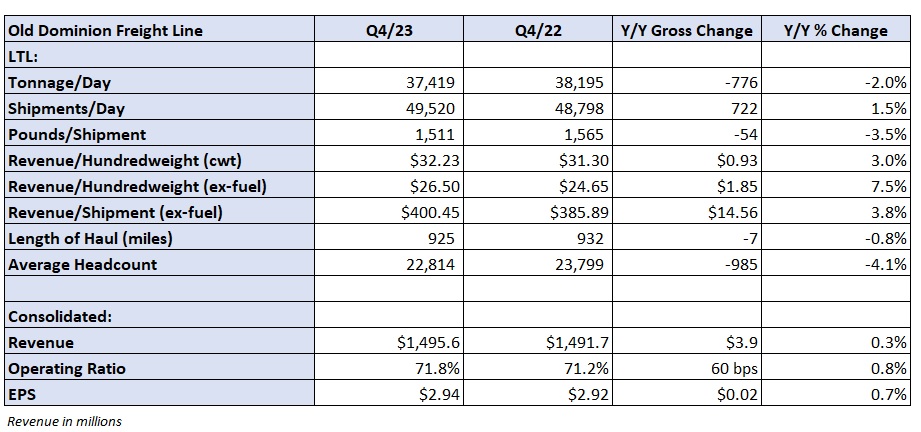
Table: Old Dominion’s key performance indicators
Old Dominion reported fourth-quarter earnings per share of $2.94, which was 2 cents higher year over year (y/y) and 9 cents ahead of the consensus estimate. The number included $15.1 million in gains from the sale of property and equipment, which was a 10-cent benefit. That was partially offset by an 8-cent headwind from higher insurance expenses, which were tied to an annual review of accident claims.
A lower tax rate was a 3-cent tailwind compared to the year-ago period.
Revenue was up just slightly y/y to $1.5 billion as daily tonnage fell 2% and revenue per hundredweight, or yield, was up 3% (7.5% higher excluding fuel surcharges). The metric was positively impacted by a 3.5% decline in weight per shipment.
Management said Old Dominion’s overall share of the LTL market increased in the quarter as daily shipments of 49,520 were 1.5% higher y/y but down slightly from the third quarter.
Revenue per day is expected to be down 3.1% y/y in January as tonnage per day is off 5.1% and yield (excluding fuel surcharges) is 6.4% higher.
A fourth-quarter headline operating ratio of 71.8% was 60 bps worse y/y and 120 bps worse than the third quarter. Netting out the gain on sale and the insurance true-up, OR was roughly 72%, 140 bps worse than the third quarter but still better than management’s guidance of 160 to 200 bps of sequential deterioration.
For the full year, the company recorded a 72% OR, just 140 bps worse y/y, even though tonnage was down 9%. The number included a 100-bp y/y headwind from incremental depreciation and amortization expenses given the growth-oriented investments made during the year.
The carrier normally sees 100 bps of OR degradation from the fourth to the first quarters. It’s forecasting 170 to 220 bps of deterioration this year given the net benefit to the fourth-quarter OR and a still-sluggish demand environment.
The company reiterated a long-term goal of pricing freight 100 to 150 bps above costs.
Old Dominion generated $1.6 billion in operating cash flow during 2023. It repurchased $454 million in stock and paid out $175 million in dividends. The company announced Wednesday it raised its quarterly dividend by 30% to 52 cents per share.
It outlined $750 million in capital expenditures for 2024, which is in line with the $757 million spent in 2023. The new capex program calls for $350 million to be allocated to real estate projects and $325 million for tractors and trailers.
Shares of ODFL were off 0.3% Wednesday at 12:07 p.m. EST compared to the S&P 500, which was down 0.8%.