APM Terminals to invest $500M in container facility on the Mississippi

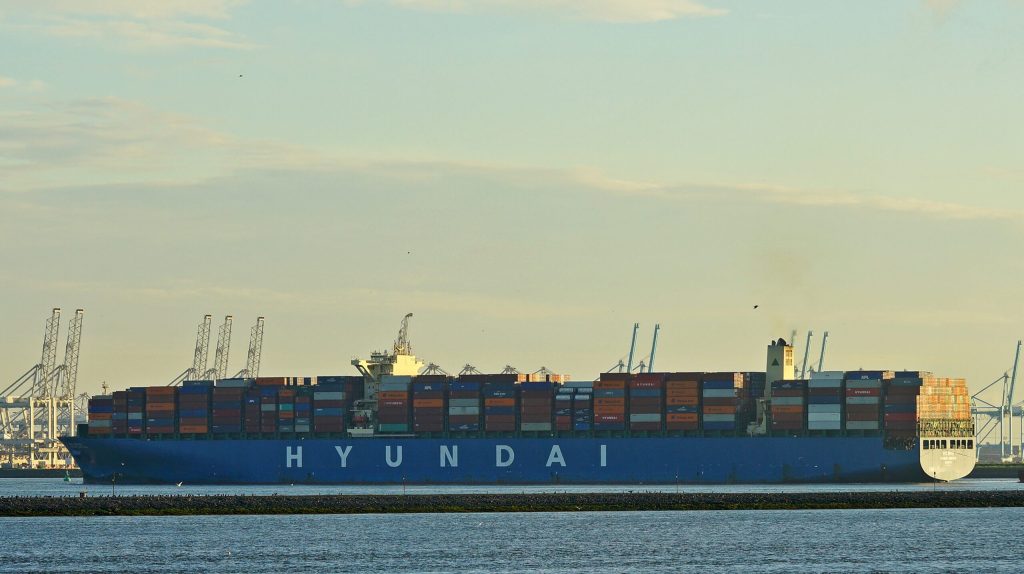
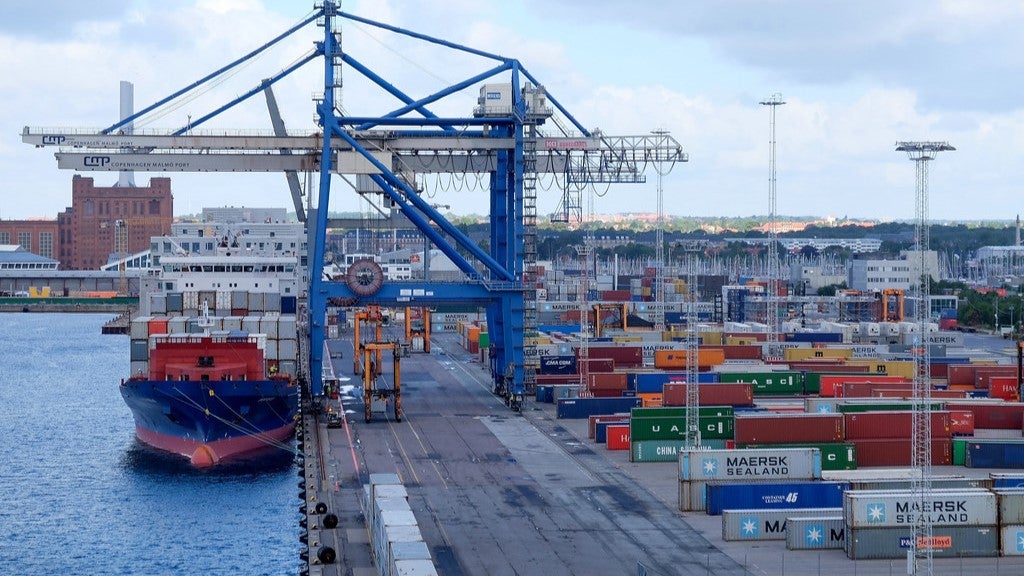
In a race to lure jumbo cargo ships up the Mississippi River, Plaquemines Port Harbor and Terminal District has signed a preliminary deal with APM Terminals to build a 900-acre container terminal about 20 miles south of the Port of New Orleans.

Under terms of the agreement, Plaquemines Port will lease the land to APM Terminals for at least 30 years. The initial construction phase will begin with a 200-acre development that includes a container terminal with on-dock railing and a berth capable of handling ships that carry 14,000 twenty-foot equivalent units.

The land is on the west bank of Plaquemines Parish, Louisiana, about 50 nautical miles from the mouth of the Mississippi, where the river meets the Gulf of Mexico. The agreement includes options to expand the terminal and other logistics activities up to 900 acres.

“In time, this greenfield site has all the potential to evolve into one of the big ship gateways into the U.S.,” Wim Lagaay, APM’s senior investment advisor to the CEO, said in a recent news release. “This venture allows us to build from the ground up, integrating cutting-edge technologies and sustainable practices to create a modern logistics hub that prioritizes safety, efficiency, and productivity.”

Officials for Plaquemines Port said the new terminal will be the largest container terminal located closest to the mouth of the Mississippi River, offering potential for new business.

“This will truly make Plaquemines ‘The Louisiana Gateway Port’ … . [T]he geographic and strategic advantages are overwhelming,” Charles D. Tillotson, executive director of the Plaquemines Port, said in a statement.

The project is in addition to the $1.8 billion Louisiana International Terminal project underway at the Port of New Orleans. The container terminal will be capable of handling 2 million TEUs annually and ultralarge container vessels once it is completed in 2028.

The Port of New Orleans was recently awarded a $73.77 million federal grant to advance the first construction phase of the $1.8 billion Louisiana International Terminal project. 

The project is a partnership among the Port of New Orleans, New Jersey-based Ports America and Switzerland-based Mediterranean Shipping Co.’s investment arm, Terminal Investment Ltd. The partnership has already committed $800 million toward the Louisiana International Terminal.

Officials for the Port of New Orleans did not immediately return a request for comment from FreightWaves regarding the agreement between APM Terminals and Plaquemines Port.

APM Terminals and Plaquemines Port first signed a letter of intent in 2021 to develop the new container facility, announcing “external parties will be the investor in the new port.”

The 2021 initiative fell through when the external investor did not come to fruition. The current plans involve only APM Terminals and Plaquemines Port.

APM estimates the initial investment in terminal infrastructure will be $500 million, which will be privately funded. The company did not identify the source of funding for the project.

The Plaquemines site would become the fifth terminal operated by APM in the U.S., and its 64th globally. APM Terminals is based in the Netherlands and is a division of A.P. Moller-Maersk. The company operates in 38 countries and employs 22,000 people. In 2022, APM handled 30,000 vessel calls at its terminals. 

More articles by Noi Mahoney

Mexico top US trade partner in November, Laredo No. 1 gateway

GXO to shut down Memphis facility, lay off 211 workers

Maersk to use freight rail to circumvent Panama Canal amid drought

Daimler Truck manages small gain in 2023 sales

Market leader Daimler Truck grew sales by a scant 1% in 2023. It blamed supply chain bottlenecks for missing its higher goals. Daimler reports full-year financials on March 1 and expects to meet its revenue and profit metrics.

Group sales, which include Portland, Oregon-based Daimler Truck North America, amounted to 526,053 units. That compared with 520,291 units a year earlier.

Daimler dealt with “a continuously challenging supply situation,” CEO Martin Daum said in a news release.

At its Capital Market Day in July, Daimler raised its 2023 projections for the year to an adjusted return on sales (ROS) in 2023 of 8.5%-10% from 7.5%-9%. The company cited an improved supply chain, strong pricing and a growing service business.

It projected ROS gains in all business units: North America (DTNA), Mercedes-Benz (European-branded trucks), Trucks Asia and Daimler Buses. 

ROS original estimateROS July estimate2023 actual unit sales
North America10%-12%11%-13%4%
Europe7%-9%8%-10%-5%
Asia3%-5%4%-6%3%
Buses2%-4%3%-5%9%
Daimler Group7.5%-9%8%-10%1%

Daimler blamed weak market development in Brazil for Mercedes-Benz’s negative sales results.

Though still a rounding error in its overall numbers, Daimler recorded 3,443 battery-electric vehicle sales in 2023, up 277% from 914 in 2022.

“We have expanded our product portfolio of battery-electric vehicles for our customers in 2023 to 10 different models,” Daum said. “This is the foundation for future growth and underlines our aspiration to lead the transportation of the future.”

Daimler Truck deliveries fall in Q3, outlier to other OEMs

Daimler Truck flexes financial muscle a year after going solo

Click for more FreightWaves articles by Alan Adler.

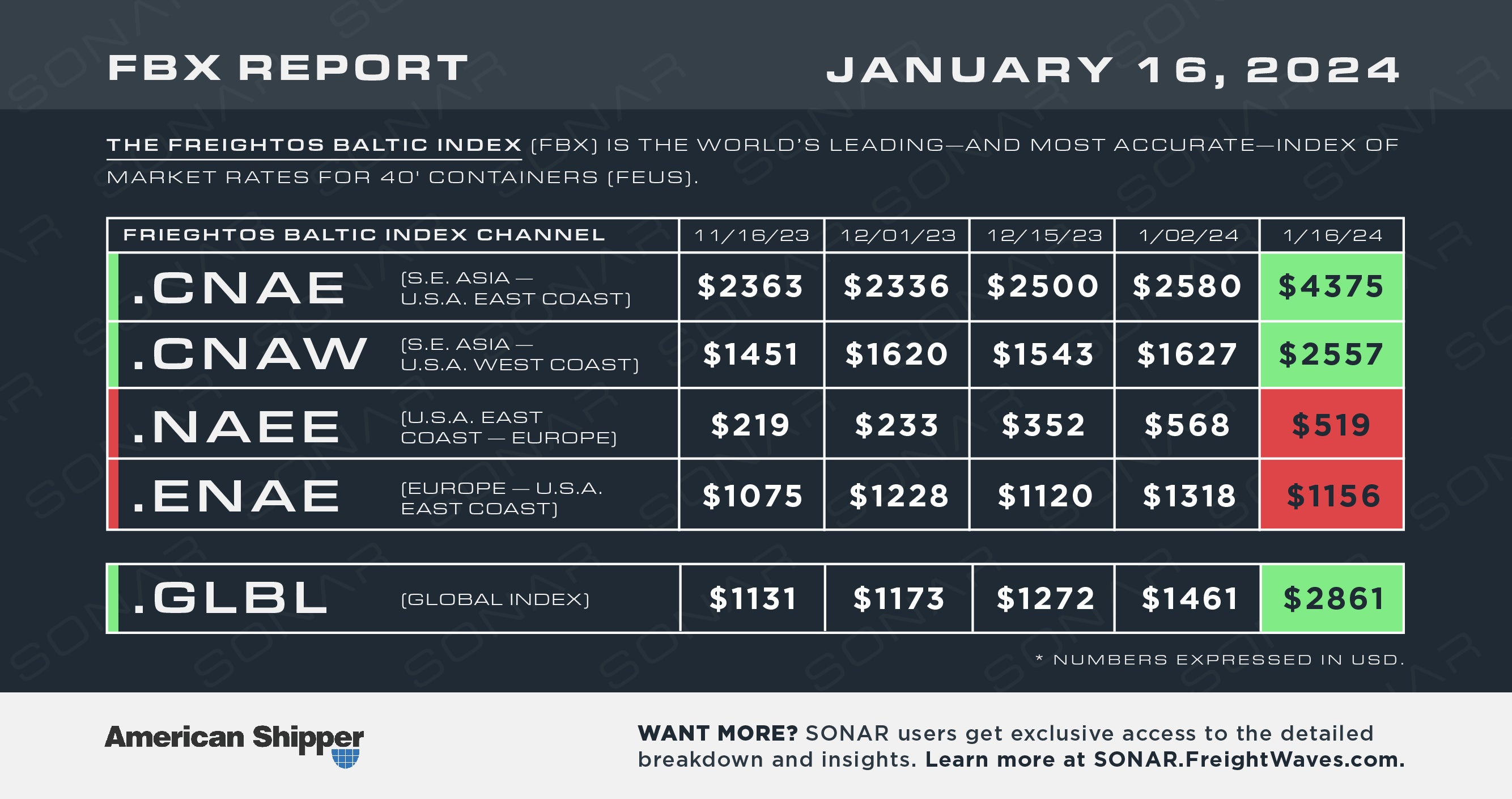
FBX Report: January 16, 2024


To learn more about FreightWaves SONAR, click here.

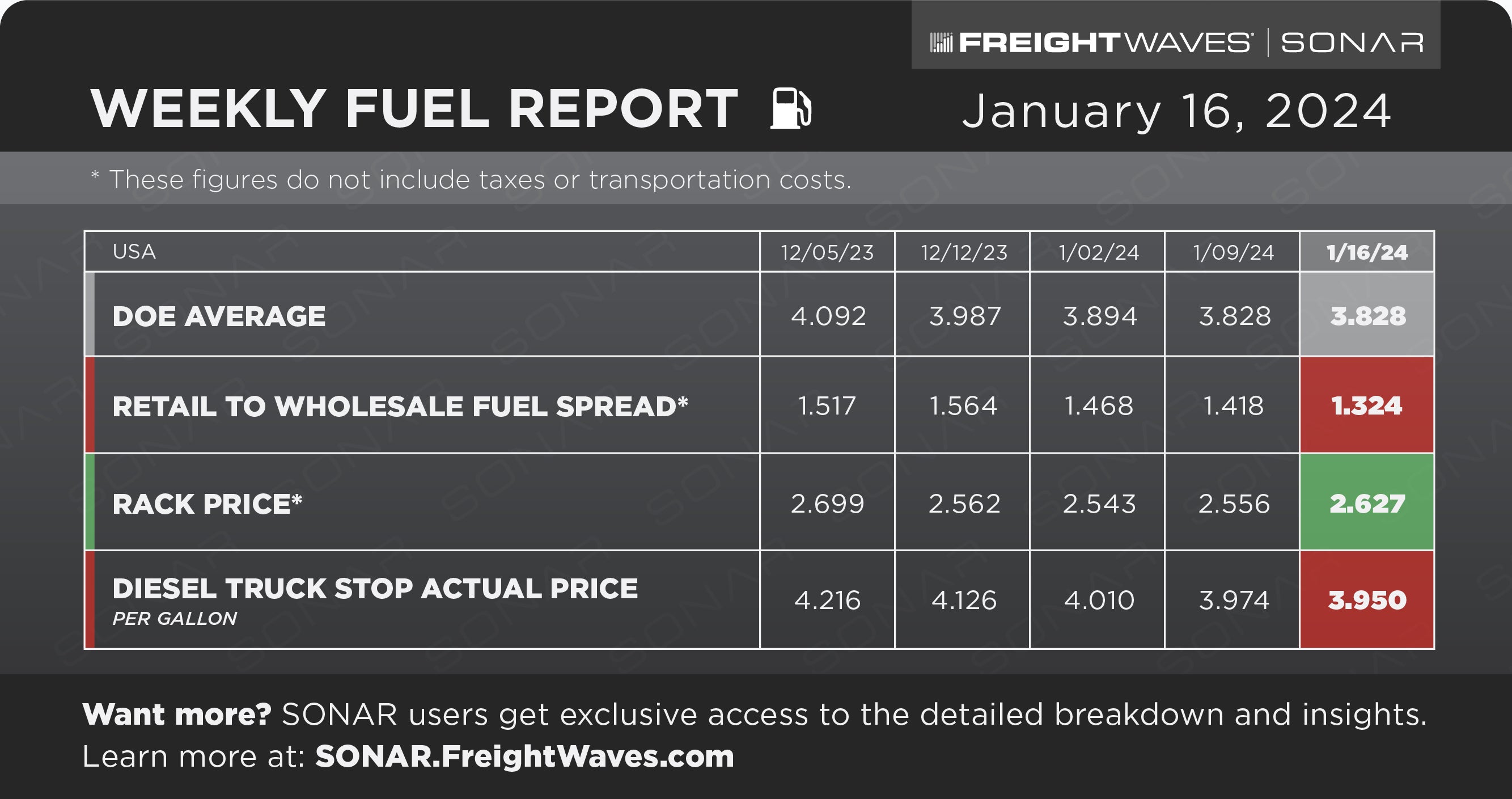
Weekly Fuel Report: January 16, 2024


Learn more at SONAR.FreightWaves.com

Truckload linehaul rates stabilizing, Cass report shows

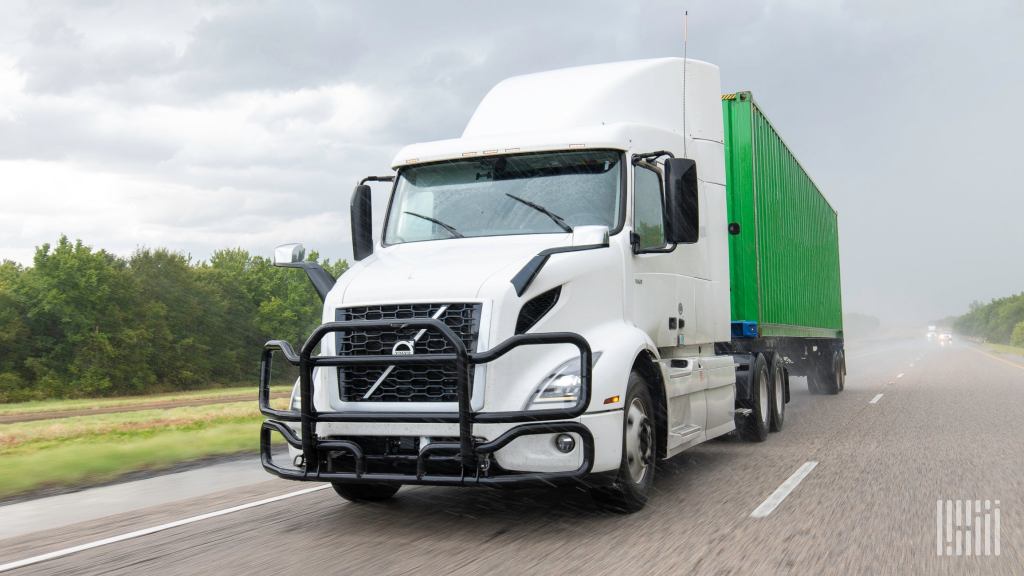
A white tractor pulling a green intermodal container

Year-over-year (y/y) declines in freight shipments and spend continued to taper during December, according to data compiled in the Cass Freight Index.

December shipments outperformed normal sequential seasonal changes, up 2.1% seasonally adjusted. That followed a 0.3% sequential increase in November. Compared to a year ago, volumes captured by the data set were off 7.2%, which was 170 basis points better than the rate of decline in November.

Stripping out seasonal adjustments, December was weak with the shipments index at its lowest absolute level since July 2020 and 10.8% lower than it was in December 2021. If normal seasonal patterns hold, volumes are forecast to decline 8% y/y in January.

December 2023
y/y

2-year

m/m

m/m (SA)
Shipments-7.2%-10.8%-1.6%2.1%
Expenditures-23.7%-26.9%-3.0%0.1%
TL Linehaul Index-6.1%-4.5% 0.4%NM
Table: Cass Information Systems. SA (seasonally adjusted)

The expenditures subcomponent, which measures all dollars spent on freight (including fuel surcharges and accessorials), was down 3% from November but basically flat when seasonally adjusted. The data set was 23.7% lower y/y, marking the seventh straight month of mid-20% declines.

For all of 2023, expenditures were down 19% y/y, but that change rate followed increases of 23% and 38% in 2022 and 2021, respectively. The index is expected to be down an additional 14% in the first half of 2024.

Netting the decline in shipments from the decline in expenditures implies actual freight rates, or “inferred rates,” were off roughly 18% y/y. Inferred rates are expected to decline 11% y/y in the first half of the year.

Spending on truckload shipments accounts for more than half of all dollars recorded in Cass’ expenditures index.

Cass’ TL linehaul index provides a cleaner look at TL rates as changes in fuel and accessorial charges are excluded. The index inched 0.4% higher from November to December, which was just the second sequential increase in 19 months. The index was down just 6.1% y/y, the smallest decline since February.

Cass’ linehaul rates have continued to stabilize, with the index now on par with August and just 1% lower than May. The index captures both spot and contract rates.

“With spot rates steady over the past several months, downward pressure on the larger contract market is lessening, with some instances of contract rate increases bucking the downtrend of late,” stated ACT Research’s Tim Denoyer in the report.

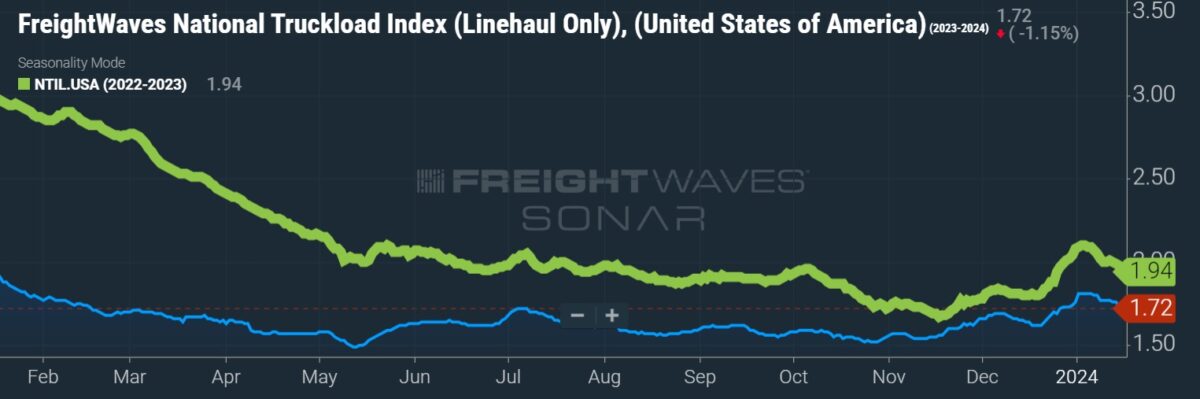
Chart: (SONAR: NTIL.USA). The National Truckload Index (linehaul only – NTIL) is based on an average of booked spot dry van loads from 250,000 lanes. The NTIL is a seven-day moving average of linehaul spot rates excluding fuel. Spot rates are currently 11% lower y/y. To learn more about FreightWaves SONAR, click here.

While rates are stabilizing at lower levels, truck capacity remains high. But carrier exits are increasing.

Carrier exits totaled 4,860 in December, which was 52% higher than the average monthly level of closures recorded during 2023, according to data from fleet solutions provider Motive. New registrations were down for a fourth straight month at 6,503. That put December registrations 18% lower y/y and 43% below December 2021.

Total new registrations in 2023 were 21% higher than in 2019, which was also a down year for the industry.

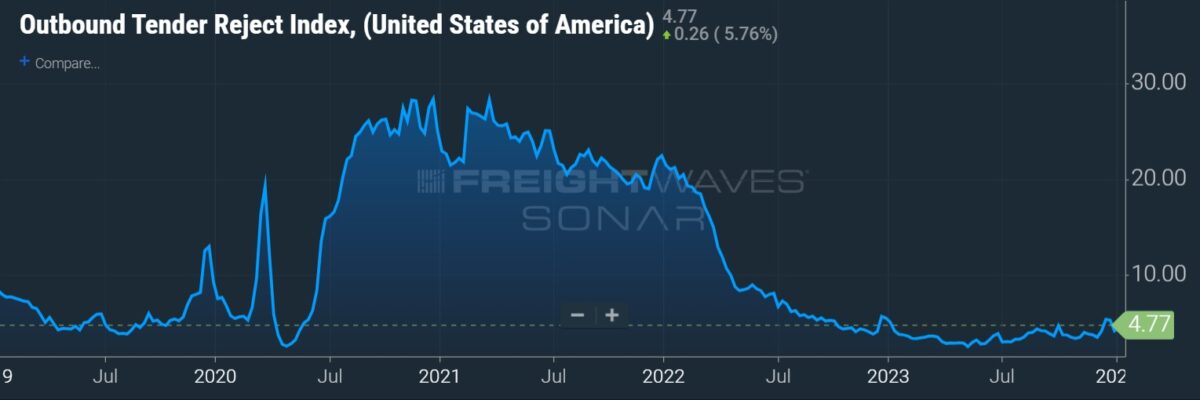
Chart: (SONAR: OTRI.USA). A proxy for truck capacity, the Outbound Tender Reject Index, shows the number of loads being rejected by carriers. Carriers are currently rejecting less than 5% of all loads tendered under contract compared to cycle highs of more than 25%.

“Destocking and declining goods consumption have been key features of the freight recession, but both cycle drivers seem to be starting to reverse course,” Denoyer said. “Real retail sales recently turned positive after a year of declines, and after 18 months of destocking, a restock is drawing near, likely spurred by ocean risks — [conflict in the Red Sea and low water in the Panama Canal].”

Data used in the Cass indexes is derived from freight bills paid by Cass (NASDAQ: CASS), a provider of payment management solutions. Cass processes $44 billion in freight payables annually on behalf of customers.

More FreightWaves articles by Todd Maiden

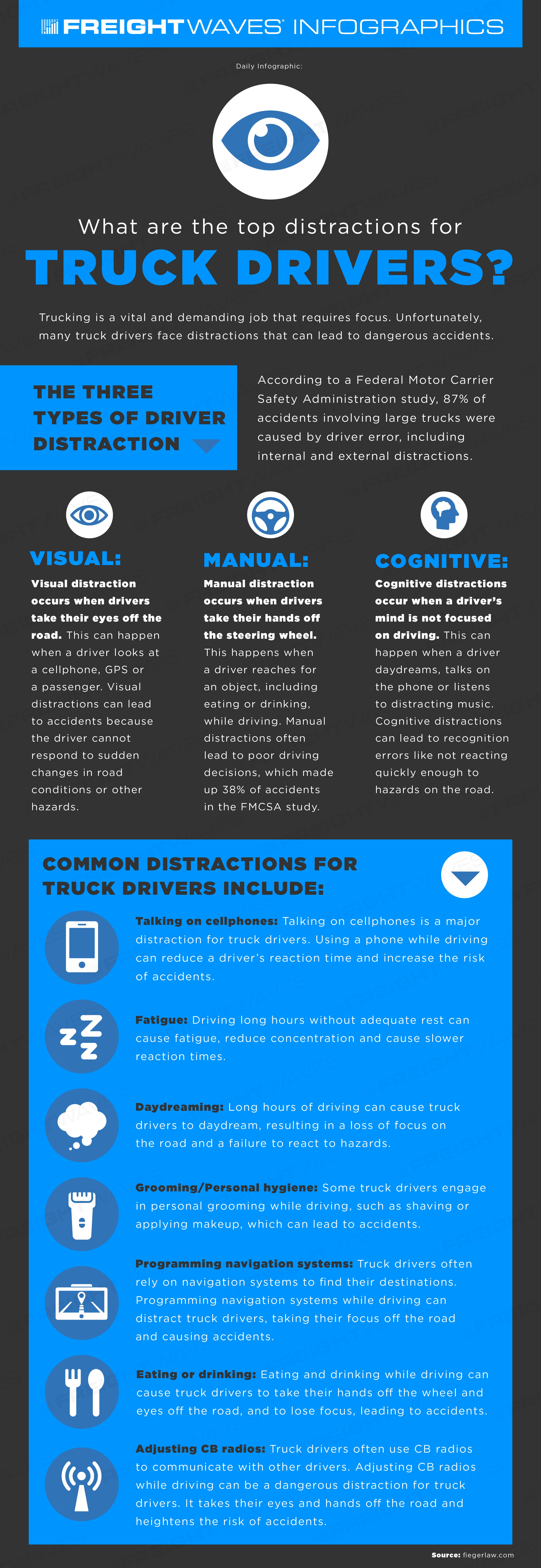
Daily Infographic: What are the top distractions for truck drivers that cause accidents?


To view more FreightWaves infographics, click here

Cargojet reverses course on 777 freighter ambitions

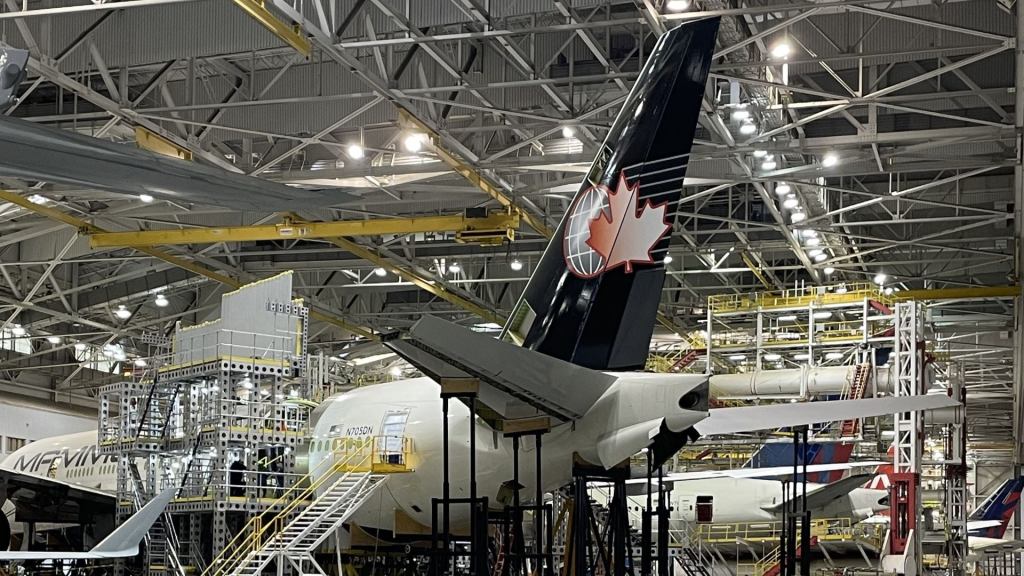
View inside a giant airplane hangar with structural work being done on the airframe.

Canada-based Cargojet announced Monday it has abandoned plans to add four Boeing 777 converted freighters because of lackluster demand for international shipping service so it can concentrate on using profits to reward shareholders and strengthen its balance sheet.

A statement by the Toronto-based airline suggesting it is canceling the order appeared at odds with the interpretation of Mammoth Freighters, the remodeler, which says Cargojet plans to fulfill its contract and subsequently dispose of the aircraft.

The decision means Cargojet (TSX: CJT), which operates a domestic express network in Canada for customers such as Amazon and DHL Express, will stick with its existing fleet of 40 Boeing 757 narrowbody and midsize 767 cargo jets after scaling back its fleet strategy for the third time in the past year. It joins a handful of other North American freighter operators that have recently changed direction on new aircraft investments or disposed of existing aircraft in response to weak market conditions.

“Forecasts continue to indicate that the international air cargo market will remain soft in the short to medium term and deploying B-777s into the market would not be strategically prudent. We have decided to exit our commitments for the four remaining B-777 aircraft, while continuing to flex our B767 fleet to accommodate our organic growth strategy,” said Executive Chairman Ajay Virmani, in the announcement. 

The move translates to a slight pullback in Cargojet’s international business, which consists of long-term contracts providing outsourced aircraft, crews and maintenance, as well as short-term charters, to focus on the domestic overnight network as large customers require less frequent transport with subdued trade. 

Cargojet was the launch customer for aerospace startup Mammoth Freighters, which has a contract to provide four Boeing 777-200 aircraft and modify them to carry containers on the main deck. Cargojet intended to operate the long-haul freighters for DHL Express, one of its main customers and a minority owner, but now says it can accomplish the task with 767s. 

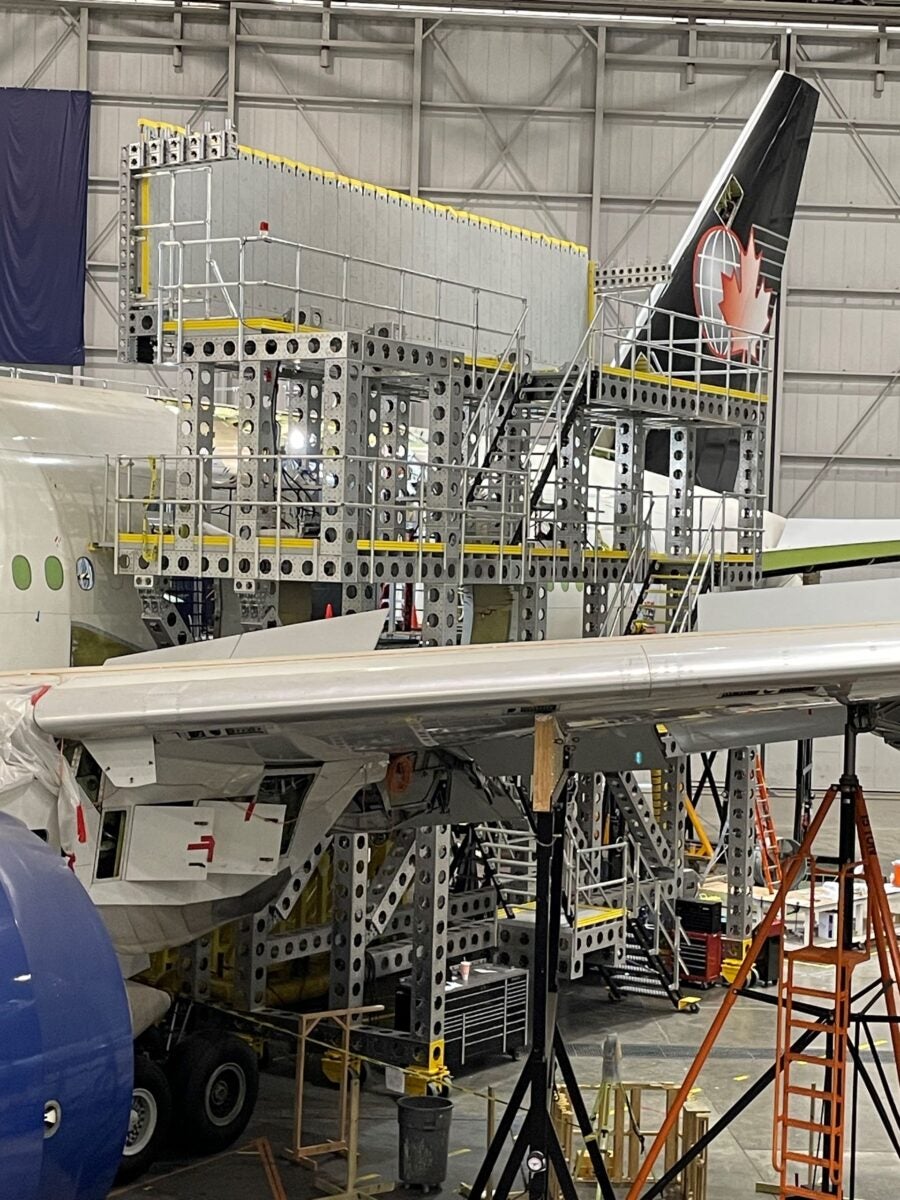
Two freighter conversions for Cargojet are three-quarters completed at Mammoth Freighters’ Fort Worth, Texas, facility — with paint jobs in the Cargojet brand — while the engineering firm strives to obtain certification later this year from the Federal Aviation Administration for the design changes to the 777-200 airframe. 

“Cargojet remains fully committed to the development and build of these aircrafts. Mammoth Freighters is proceeding full speed with the final build and certification efforts,” Brian McCarthy, vice president of marketing and sales at Mammoth, told FreightWaves. The Canadian carrier has paid millions of dollars in deposits and progress payments, still controls the production slots and is responsible for making all payments through final delivery.

A Boeing 777-200 in Cargojet colors. (Photo: Mammoth Freighters)

Cargojet said it pocketed $74.5 million to $82 million from the sale of the four 777-200s, after subtracting acquisition and other costs.

Mammoth Freighters has 35 firm orders for 777 conversions. In October, the first of six 777-300s to be retrofitted for AviaAM Leasing was inserted into Mammoth’s assembly hangar. DHL separately placed an order with Mammoth last spring for the conversion of nine 777-200s. 

Cargojet last year exited commitments with Israel Aerospace Industries for the conversion of four 777-300 aircraft, which were aimed at international opportunities outside DHL. It subsequently sold three planes for $110 million and dropped plans for acquiring the fourth jetliner. Cargojet says it is retaining the rights to production slots for aircraft modifications at both companies in case market conditions improve enough to justify future investments. 

In November, Cargojet said it planned to sell or lease four B757 cargo jets, after recently spending millions of dollars for passenger-to-freighter retrofits, because there wasn’t enough business to operate them economically in its domestic network.

Passenger-to-freighter conversions are complex engineering projects that include removing furnishings from the passenger cabin and installing a cargo door, rigid cargo barrier in front of the cockpit, reinforced floor and sidewalls, and a container handling system. 

Cargojet in 2022 budgeted $1.2 billion for the 777 program. Last year it set aside $133 million in capital expenditures for growth. Management said Monday that projected capital expenditures for fleet growth in 2024 have been slashed to immaterial levels. Stated priorities include maintaining dividend growth and its share buyback program. Without the 777s, Cargojet will have lower costs for pilot hiring, training and maintenance associated with adding a new aircraft type to the fleet. 

Cargojet owns two more 767 passenger aircraft and said it will defer their conversion to cargo configuration until demand improves.

Soft market conditions

Cargojet reported revenue in the third-quarter declined 8% to $155 million and adjusted earnings before accounting measures fell 17% to $50.6 million year over year. The airline flew 8.8% fewer hours during the period versus last year. 

Starting in April 2022, the airfreight market contracted for 16 consecutive months as global supply chains stabilized from the Covid crisis, resulting in much less need for urgent air shipments. Air volumes fell 8.2% year over year in 2022 and are expected to be down another 4% to 5% for 2023, once results are tabulated, after a late rally. The downturn in demand coincided with a sharp increase in capacity as passenger airlines resumed international flying to more destinations, sending yields down more than 30%. 

A growing number of freighter operators have responded by cutting capital expenditures to bolster cash flow. Miami-based Amerijet, squeezed by debt and sharply lower revenues, last week announced it will return six new Boeing 757 converted freighters to lessors. Air Canada in September canceled an order with Boeing for two 777 production freighters. Under pressure from investors, Air Transport Services Group, the largest lessor of freighter aircraft with two cargo airlines of its own, sharply cut back on planned capital expenditures despite confidence in long-term air cargo strength. And it is sitting on six second-hand 767s acquired for conversions until demand improves. 

Virmani stepped down as CEO on Jan. 1 as part of a planned leadership transition. Long-time executives Pauline Dhillon and James Porteous are now sharing CEO duties.

Click here for more FreightWaves stories by Eric Kulisch.

(Correction: An earlier version of this story suggested Cargojet sold the 777-200s for more than $75 million. The figure actually represents the net proceeds from buying and selling the aircraft.)

Air cargo market: From ‘doom mongering’ to stability

Cargojet to sell off new B757 freighters, pause 767 conversions

Cargojet postpones more 777 freighters, tightens belt as shipments slow

Container lines ‘scramble’ to rent more ships amid Red Sea crisis

a photo of a chartered ship; chartered ships in high demand after Red Sea attacks

Red Sea diversions mean container lines need more ships to carry the same amount of cargo. The security situation — which is even more precarious in the near term due to coalition air strikes in Yemen — has already driven spot container freight rates much higher. Now it is starting to push up the price container lines pay to rent ships.

“This week saw a scramble for prompt tonnage,” said MB Shipbrokers (formerly Maersk Broker) in a market report on Friday, referring to ships that can be chartered immediately.

“Owners have certainly become more bullish and are pushing for higher-than-last-done levels in all segments and most regions.” Charter rates are headed higher, “specifically for short periods of three to six months’ duration,” said MB Shipbrokers.

Shipbroker Braemar reported Sunday: “Chartering activity [has] further improved. Various prompt vessels across all sizes and regions [are] seeing increased interest. Charter rates as well as periods are witnessing a firming trend.”

Analytics group Alphaliner commented on charter-market strength in a report last Tuesday, noting that the Red Sea effect is now “starting to show.”  

“Despite a continued influx of newbuilding tonnage of all types, demand for most sizes of charter-market ships … remains strong. The crisis in the Red Sea, with most carriers now avoiding the area, is in part contributing to the market’s brisk activity,” said Alphaliner.

Spot freight rates rise much faster than charter rates

The initial diversions away from the Red Sea caused delays in return trips to Asia, prompting liners to charter ships for short terms as “extra loaders” to pick up the slack.

Now that diversions are more ensconced, liners will need to add additional vessels to service strings to maintain weekly schedules, given the longer voyage distance around the Cape of Good Hope.

To the extent newbuildings and existing fleets don’t fill the gap, they would need to charter or buy more ships.

The Harpex index, which measures six- to 12-month charter rates for ships with capacity of up to 8,500 twenty-foot equivalent units, has risen 12% since mid-December.

That pales in comparison to Red Sea-driven moves in freight rates. The global spot freight indexes of both Freightos and Drewry have more than doubled over the same stretch. 

chart of spot container freight rates
Spot freight rate gains far outpace charter rate gains since mid-December. (Chart: FreightWaves SONAR)

But 2024 was supposed to be a very weak year for charter rates given the tidal wave of newbuilding deliveries, and thanks to the Red Sea effect, the Harpex index is now 28% higher than it was in January 2019, pre-COVID.

“Obviously, a persistent crisis in the Red Sea and, to a lesser extent, ongoing problems at the Panama Canal could partially cushion the risk of overcapacity thanks to the demand for extra tonnage they will generate,” said Alphaliner.

Few container ships available to charter

The challenge in today’s chartering market is that there are very few vessels available to charter. Most of the tonnage is already tied up on long-term leases.

Liners were desperate for ships during the supply chain crisis. The more ships they controlled, the more containers they could carry at stratospheric freight rates, and the more profits they could reap.

The companies that charter ships to liners — so-called non-operating owners (NOOs) — could dictate the terms. Not only did NOOs demand historically high charter rates during the peak of the COVID-era boom, they also forced liners to take the ships on multi-year charters. Most of those leases are still in place.

Among the U.S.-listed NOOs, Danaos (NYSE: DAC) has 90% of its fleet already locked up on charters through the end of 2024. Charter coverage of Costamare (NYSE: CMRE) is 87% for 2024, with Global Ship Lease (NYSE: GSL) at 82% and Euroseas (NASDAQ: ESEA) at 70%.

Another source of chartered tonnage is “relets” — ships that liners have on long-term charter from NOOs that they opt to re-charter to other liners. But some of these relet opportunities are now being withdrawn, reported MB Shipbrokers.

In general, “the limited availability of prompt tonnage” is keeping chartering activity “at a low level,” it said.

Liner stocks up more than NOO stocks

Liner company stocks should benefit more from Red Sea disruptions than NOO stocks, given that freight rates have risen much faster than charter rates, and so many ships are already locked into existing leases.

Stock pricing data from Koyfin, which is adjusted to account for dividends, confirms this.

Shares of liner operator Zim (NYSE: ZIM) are up 65% from mid-December through Friday, with Hapag-Lloyd up 45% and Maersk up 19%.

In contrast, shares of GSL are up only 9% over the same period, with Costamare rising 10% and Danaos 11%. Shares of Euroseas, which have the most open exposure to the 2024 charter market of the four companies, have performed the best, rising 37%, according to Koyfin data.

chart of container stocks post-Red Sea attacks
Green lines: liner stocks. Blue lines: NOO stocks. (Chart: Koyfin)

Click for more articles by Greg Miller 

From pandemic chaos to AI, supply chain panelists have seen it all lately

NEW YORK — Think about what a supply chain leader has gone through in the past few years.

There was the pandemic that at first looked like it would crater demand for virtually all goods and services once the toilet paper rush ran its course.

Then came the whiplash in no time when huge demand for goods replaced demand for services that couldn’t be provided during lockdowns, and the transport and supply of those products failed to keep up. The end result: Old ways of doing business in the supply chain had to be tossed overboard rapidly, and new structures were built, often on the fly.

Or as Peter Smith, the COO of retailer Party City, told executives at a supply chain-focused panel Sunday at the annual meeting of the National Retail Federation: “Congratulations for living through the s— storm of the last three years.” He should know how tough that period was; Party City went through — and emerged from — Chapter 11 bankruptcy as a result of it.

And then in the past year or so has come the promise of generative AI, the next and maybe boldest step in artificial intelligence and machine learning, which already have been revolutionizing supply chain practices in the most forward-looking companies.

Those themes were on display at the daylong supply chain track at the NRF meeting, a giant gathering that always meets at the Javits Center on the shores of the Hudson River and was expected to draw 40,000 attendees this year.

Getting 2030 volume by 2022

It was Beth Rooney, the port director of the Port Authority of New York and New Jersey, who summed up the rate of change the supply chain has experienced the past few years.

“The pandemic gave us a glimpse into the future,” Rooney said of the ports under her management, on a panel specifically devoted to shifts on the waterfront. “We did the volume in 2022 that we didn’t expect to do until 2030.”

The panel kicked off with Suresh Krishna, the CEO of Northern Tool + Equipment. In a chat with Jon Gold, NRF’s vice president of supply chain and customs policy, Krishna said the pandemic “was fortuitous in many ways, because it was a wake-up call and accelerated things that might have taken many years to implement otherwise.” He cited as examples the ability to buy an item online and pick it up in a store or curbside.

But that’s on the micro level. On a more macro level, Krishna talked about “resiliency” and how chasing it as a goal had forced Northern Tool to make numerous, broad changes in its supply chain.

“Resiliency was something that was on the top of our mind throughout COVID,” he said. Getting to resiliency, he said, required pursuit of another broad practice: optionality.

Prior to the pandemic, Krishna said all e-commerce orders — which are now about 35% of the company’s business — were coming from a warehouse near Charlotte, North Carolina. “Think about how long it takes to serve the whole country from one warehouse,” he said.

But since then, additional warehouse capacity has been secured in other parts of the country to speed up deliveries. “That is resiliency,” he said. 

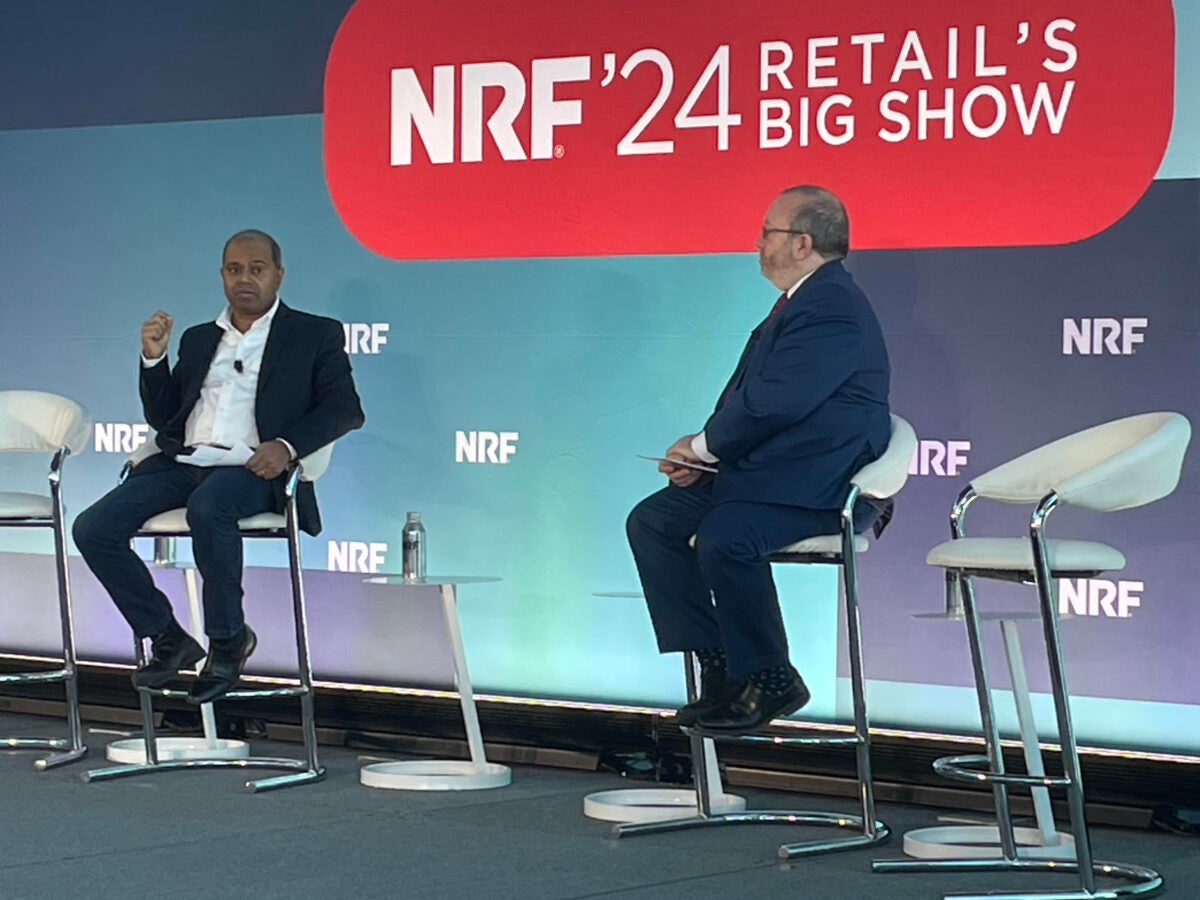
Suresh Krishna, the CEO of Northern Tool + Equipment, talks with Jon Gold, NRF’s vice president of supply chain and customs policy. (Photo: John Kingston/FreightWaves)

And that kind of resiliency, created in part by the optionality that comes from warehouse capacity with a greater geographic reach, has allowed Northern Tool to get close to a goal of meeting customer orders within two days. Prior to the pandemic, that figure was more like five to seven days, Krishna said.

Before recent changes in operations, Krishna said, only 17% of customer orders were being fulfilled the day they were received. Warehouse and office hours didn’t include weekends, guaranteeing a two-day additional delay for an order that came in on Friday.

But by rejiggering hours, rather than simply hiring more people or pushing current workers to do more, as much as 99% of orders can be fulfilled on the day they are received, Krishna said.

Moving away from China

The other big shift in resiliency and optionality came in diversifying Northern Tool’s supply lines away from China. About three years ago, Krishna said, about 90% of the country’s imported products came from China. Coincidentally, it was about that percentage of imports from China that then came under the tariffs first imposed by the Trump administration.

Northern Tools set up offices in India and Vietnam as part of an effort to diversify its supply sources, Krishna said. The result: The figure coming from China is now about 50%.

A new manufacturing facility opened in Mexico, but as Krishna noted, it does get some of its parts to make finished products from China. “We’re not saying we’re not going to be in China,” Krishna said. “But we’re taking this opportunity to source from both.”

When the NRF supply chain track’s attention shifted to the future, AI as a catch-all phrase for the whole range of capabilities that loom as change agents for supply chains took center stage.

Helen Davis, the senior vice president of and head of North America operations at Kraft Heinz (NASDAQ: KHC), spelled out what a company like hers expects out of AI.

AI processes at Kraft Heinz will look to create “data flows and a self-driving supply chain that can automatically reset itself when there are disruptions,” Davis said.

A ‘cognitive decision layer’

She described a two-tiered system in which a base capability can do things like “digest data that tells us when a line is down.” But on top of that would reside what Davis said was a “cognitive decision layer that would react as if they were me … to really react to a change in consumer demand quickly.”

Sean Barbour, senior vice president of supply chain at Macy’s (NYSE: M), is approaching the introduction of greater AI capabilities with some caution, given the field that he’s in. “There is so much in the fashion space that is is unknowable, and I am pessimistic that AI can solve that,” Barbour said, noting rapid shifts in consumer sentiment. 

But he also said that while consumer expectations of what AI is going to deliver are high, “it’s going to enable us to exceed those expectations and make some of the complex decisions more palatable, and that is an exciting concept for us.”

David Hardiman-Evans, senior vice president of U.K.-based online grocer Ocado Group, said AI and machine learning capabilities already allow the company to “predict people’s individuals baskets using algorithms.” With the continued evolution of AI, he said, “that is only going to get more accurate.”

More articles by John Kingston

Teamsters rack up late-2023 wins, stage significant strike in 2024

Supreme Court rejects review in broker liability case, leaving the issue unresolved

Court rules CRST team drivers must be paid for some hours in sleeper berth

Borderlands: Mexico top US trade partner in November, Laredo No. 1 gateway

Borderlands is a weekly rundown of developments in the world of United States-Mexico cross-border trucking and trade. This week: Mexico top US trade partner in November, Laredo No. 1 gateway; PSC Group acquires rail terminal in South Texas; automotive firm inaugurates $55 million expansion in Mexico; and CBP seizes $5M worth of cocaine at Texas border crossing.

Mexico top US trade partner in November, Laredo No. 1 gateway

Nearshoring continues to be a boost for Mexico trade as the country retained its ranking as the United States’ top trade partner in November, with two-way commerce totaling $65.8 billion.

It’s the 10th time in the past 11 months that Mexico ranked No. 1, according to the most recent data from the U.S. Census Bureau.

In November, Canada ranked No. 2 at $65.2 billion, while China was third at $49.4 billion. Rounding out the top five U.S. trade partners in November were Japan at No. 4 with $19.6 billion and Germany with $19 billion.

From January through November, Mexico’s trade with the U.S. rose 2.79% year over year (y/y) to $738.4 billion.

Port Laredo, Texas, was the No. 1-ranked U.S. trade gateway with Mexico, totaling $26.7 billion in November, according to a WorldCity analysis of Census Bureau data. It was the 10th straight month the Laredo border crossing was the country’s top-ranked international commercial trade port.

The Port of Los Angeles ranked No. 2 with $25 billion and Chicago O’Hare International Airport was No. 3, reporting $24 billion in trade during November. John F. Kennedy International Airport was the fourth-ranked trade gateway in November at $18 billion, and Port Houston was No. 5 at $17.7 billion.

The top three imports from Mexico to the U.S. through Laredo were auto parts ($2 billion), passenger vehicles ($1.3 billion) and commercial vehicles ($988 million), according to WorldCity.

The top exports from the U.S. to Mexico through Laredo were auto parts ($1.1 billion), gasoline ($313 million) and passenger vehicles ($232 million).

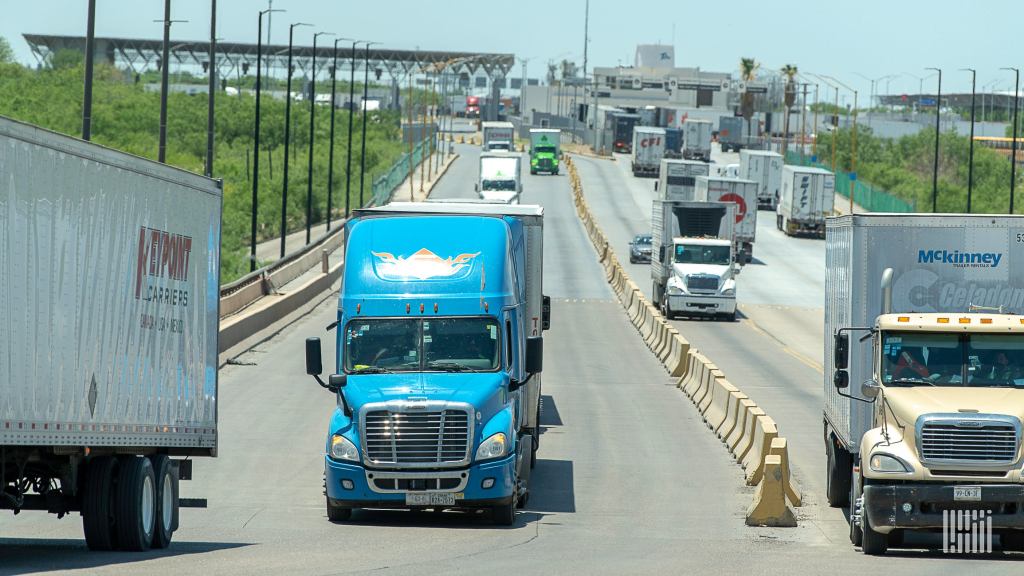
During November, Port Laredo processed 247,343 commercial trucks across its two international bridges, a 7.5% y/y increase compared to the same period in 2022.

PSC Group acquires rail terminal in South Texas

PSC Group has acquired the Bayport Rail Terminal (BRT), a 115-acre rail, truck and container facility in Pasadena, Texas.

BRT offers loaded and empty rail car staging and switching, transloading, as well as on-site railcar repairs and maintenance operations. The facility has storage capacity for 850 rail cars and is serviced by Union Pacific’s Bayport Loop rail line.

BRT is located near the Houston Ship Channel and Port Houston container terminals. Terms of the acquisition were not disclosed.

“BRT is a one-of-a-kind logistics asset strategically situated close to Port Houston and in the heart of the Houston chemical industry,” PSC CEO Joel Dickerson said in a news release. “Access to these markets will enable PSC to expand our offering of critical last-mile logistics services to the more than 80 rail-served manufacturing and logistic facilities housed along the Bayport Loop and the port.”

PSC Group was founded in 1952 and is based in Baton Rouge, Louisiana. The company has over 4,500 employees at more than 125 refineries, terminals, docks, and chemical plants across the U.S. and Canada.

Automotive firm inaugurates $55 million expansion in Mexico

Automotive parts manufacturer Eurotranciatura Laminations recently completed a $55 million expansion in Queretaro, Mexico.

The 107,639-square-foot facility will create up to 500 jobs and produce lamination components for electric vehicle motors, according to a news release.

“We’re proud to inaugurate a new Mexican plant in Queretaro and strengthen our production capacity for the North American EV market, to fulfill already received orders for more than $3.8 billion,” Marco Arduini, CEO of EuroGroup Laminations, said in a statement.

Eurotranciatura is a joint venture between Italy-based EuroGroup and Japan-based Kuroda Precision Industries Ltd. Eurotranciatura has been operating in Mexico since 2016.

CBP seizes $5M worth of cocaine at Texas border crossing

U.S. Customs and Border Protection (CBP) officers recently intercepted 173 pounds of cocaine from a tractor-trailer at the Ysleta port of entry in El Paso, Texas.

On Jan. 3, CBP officers searched a commercial box truck that arrived from Mexico carrying plastic rolls and discovered 64 bundles of alleged cocaine concealed in the freight. The alleged drugs have a street value of $5.5 million.

CBP officers seized the alleged drugs and the truck but did not disclose whether the driver was detained or released.

More articles by Noi Mahoney

GXO to shut down Memphis facility, lay off 211 workers

Maersk to use freight rail to circumvent Panama Canal amid drought

Warehousing and fulfillment startup Flexe lays off 99 workers