Welcome to Check Call, our corner of the internet for all things 3PL, freight broker and supply chain. Check Call the podcast comes out every Tuesday at 12:30 p.m. EST. Catch up on previous episodes here. If this was forwarded to you, sign up for Check Call the newsletter here.
In this edition: 2024 predictions coming in hot; new TRAC Market Dashboard debuts; and TFI is on the prowl again.
GIF: GIPHY
Gather around the crystal ball, it’s time for the hot takes and medium to large predictions for the supply chain in 2024. 2024, there’s a lot of hope for you to be better than 2023. This year companies might have become more guarded and thinking more about staying alive than originally anticipated. I’m thinking 2024 will start to turn the tide.
2024 I foresee as more of a securing the battlements kind of year, enforcing the foundation of organizations and looking strongly at internal processes. What’s working? What’s slowing people down? Where are the pain points? Whether that looks like retraining, establishing training processes or investing in new technology who knows?
Some tech integrations could be on the chopping block. As some companies look to refine internal processes and find the empty promises or not fully integrated systems, I’d expect some hesitancy to renew contracts. On the flip side, if there is a tech provider that isn’t holding up its end of the bargain, it’s time to have a conversation about why it is unable to do that and how it might be time to reevaluate the partnership.
Also making waves in 2024 is going to be reverse logistics. More and more shippers are going to want this solution solved, since it is arguably one of the most difficult things to do well — whether it’s returns for an e-commerce shipper or committing to a sustainability promise to reduce waste and find a solution for products after their life cycles. Whoever figures out how to do this well and in a scalable way stands to make an obscene amount of money from it.
The last and final is less of a prediction and more of a hope — a hope that those who have promised after the pandemic to have more resilient and efficient supply chains have actually accomplished those goals. As 2024 sees a heavy amount of reshoring, nearshoring, wrestling with the aftermath of labor disputes and the rising effect of geopolitical unrest, it’s shaping up to potentially be quite the test for supply chains and their resiliency.
Here’s hoping the last few years have taught us a few things and, more importantly, we learned.
SONAR TRAC Market Dashboard
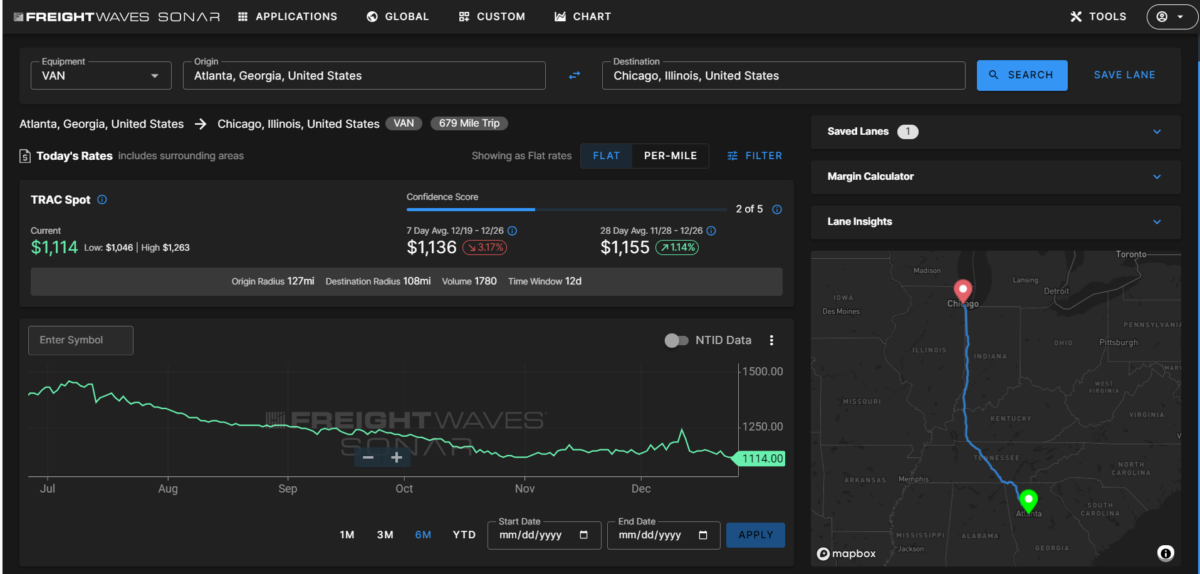
TRAC Tuesday. Well, would you look at that? The SONAR TRAC Market Dashboard took the phrase new year, new you literally. The new and improved market dashboard is here. (If it’s not here for you yet, no worries it’s coming.) This week we’re looking at an Atlanta to Chicago lane. The 679-mile trip between two major freight markets hasn’t seen much of a recovery since a pre-Christmas spike. Right now the all-in rate is about $1,114, before margin, which translates to about $1.64 a mile.
Outbound tender rejections are on the rise in Atlanta as the index has crept up to 3.66%, which is a 37 basis point increase week over week (w/w). Chicago also saw a massive increase in OTRI as a result of the Christmas holiday as rejections shot up to 5.73%, a 234 basis point increase w/w. The brief tightening in capacity is all a factor of the holiday and shouldn’t have any long-term implications to the spot market.
Image: makeameme
Who’s with whom? TFI international, most infamously known for acquiring UPS Freight, the former LTL arm of UPS, a few years ago, has set its sights on a new target. The new deal is for flatbed truckload carrier Daseke for $1.1 billion. Most of the deal will be in cash and debt. Daseke will continue to operate its various brands and will report financial results through TFI’s TL unit. This acquisition comes after Daseke spent the last few years cost cutting and cleaning up past integrations of its own acquisitions.
Quoted in FreightWaves’ Todd Maiden’s article, Alan Bédard, chairman, president and CEO at TFI, said, “This attractive acquisition is highly complementary to our existing operations and scales our Truckload segment into a leading North American truckload transportation and logistics business.”
Relationships provide layer of protection against supply chain fraud
All forms of fraud – from double-brokering schemes to hacking attempts – are on the rise across the logistics industry. Due to a number of isolating factors, companies that tend to operate in a vacuum instead of collaborating with industry partners are the most vulnerable to these scams. As such, they also tend to be the most targeted.
Joining a network of industry professionals provides a tangible sense of security in today’s market. This is especially true in the billing and payment space.
Each member of the TriumphPay network – including brokers, shippers and carriers – is afforded an additional layer of protection against bad actors due to TriumphPay’s unique vantage point.
“It is easy for a bad guy to hide in one broker’s ecosystem. If I claim to have five trucks with FMCSA, as long as I run less than five trucks of freight for you, you’re probably not going to be any wiser about what is going on,” TriumphPay Chief Strategy Officer Garrett Wolfe said. “It is harder to hide from TriumphPay when we can see an aggregate of what’s going on.”
Unlike an individual broker, TriumphPay can see how much freight a carrier is moving throughout the industry as a whole. This allows them to identify instances where the number of power units a carrier reports does not account for the number of miles they appear to be running, uncovering common scams and protecting other industry participants.
The sheer number of payments TriumphPay handles – combined with its impressive suite of security features – also enables the company to pinpoint fraud involving carrier impersonation and bank account inconsistencies, protecting both brokers and real carriers from losing out.
“We can see where things don’t match up. With a network, we can help everybody that participates in the network avoid things that would otherwise be unavoidable,” Wolfe said.
Wolfe noted that there are three main types of carriers: Good carriers, dishonest carriers and situationally dishonest carriers. While brokers should always be fighting to keep good carriers and cut ties with dishonest carriers, it is the third group that tends to stir up unanticipated issues during times of economic stress.
When carriers are running upside down, some of them resort to fraud in order to make ends meet long enough to ride out the current market wave, Wolfe explained. While these carriers are just trying to stay afloat, their fraudulent methods have a negative ripple effect across the entire industry.
TriumphPay has recently been able to help a number of brokers flush a significant number of dishonest carriers from their systems, according to Wolfe. With plenty of capacity continuing to circulate in the market, now is the best time for brokers to batten down the hatches in preparation for potential tightening in 2024.
In addition to spotting – and stopping – fraud, TriumphPay’s deep expertise in the billing and payment space allows them to identify and mitigate common accidents like misdirected payments. This is especially helpful, as carriers may move between factoring companies frequently, making it difficult for brokers to know where to send a payment at any given time.
When brokers partner with TriumphPay, they make it easier on both themselves and their carrier partners. Through this lens, it becomes clear that companies like TriumphPay are an integral part of creating the supply chain of the future.
“We see a future where everybody – at least as it connects to billing and payments – is connected through a structured pay network,” Wolfe said.
Drilling Deep: Looking at 2024 regulatory landscape with Scopelitis
On this week’s episode of Drilling Deep, P. Sean Garney of Scopelitis Transportation Consulting takes a look at the regulatory landscape facing trucking and logistics as 2023 exits and 2024 takes its place.
Also this week, host John Kingston talks about the stubborn strength of diesel prices relative to crude and what is causing it.
Cart.com secures $30M from Trinity Capital to increase profitability
Houston-based e-commerce platform Cart.com announced it has nabbed $30 million from Trinity Capital to help the firm expand while boosting its balance sheet.
The investment is part of a larger $100 million debt refinancing that included Trinity and Silicon Valley Bank, a division of First Citizens Bank. The capital will strengthen Cart.com’s balance sheet as it continues to scale operations, according to a news release.
“With Trinity’s financing, Cart.com will double down on investments that support the growing demand for innovative logistics and commerce infrastructure solutions that help our customers unlock more efficient growth,” Cart.com founder and CEO Omair Tariq said in a statement.
Cart.com is a provider of online commerce and logistics solutions for merchants to sell and fulfill orders around the globe. The company currently has about 6,000 brands on its platform.
Officials for Phoenix-based business development company Trinity Capital (Nasdaq: TRIN) said they look forward to playing a role in Cart.com’s growth.
“We’re excited to add to our portfolio an innovative company that’s proving itself to be an indispensable commerce and logistics partner to a wide range of business-to-business, business-to-consumer and direct-to-consumer merchants,” Ryan Thompson, Trinity’s managing director of tech lending, said in a statement.
In June, Cart.com announced it had raised a $60 million Series C equity funding round to bolster its valuation to $1.2 billion. Since 2020, the company has secured over $430 million in capital.
Cart.com also recently moved its corporate headquarters back to Houston after three years in Austin, Texas, citing the Bayou City’s infrastructure, talent pool and mix of customers as reasons for returning.
Funding details
Cart.com
Funding amount
$30 million
Lead investor
Trinity Capital
Goals for funding
Strengthen Cart.com’s balance sheet, help scale operations
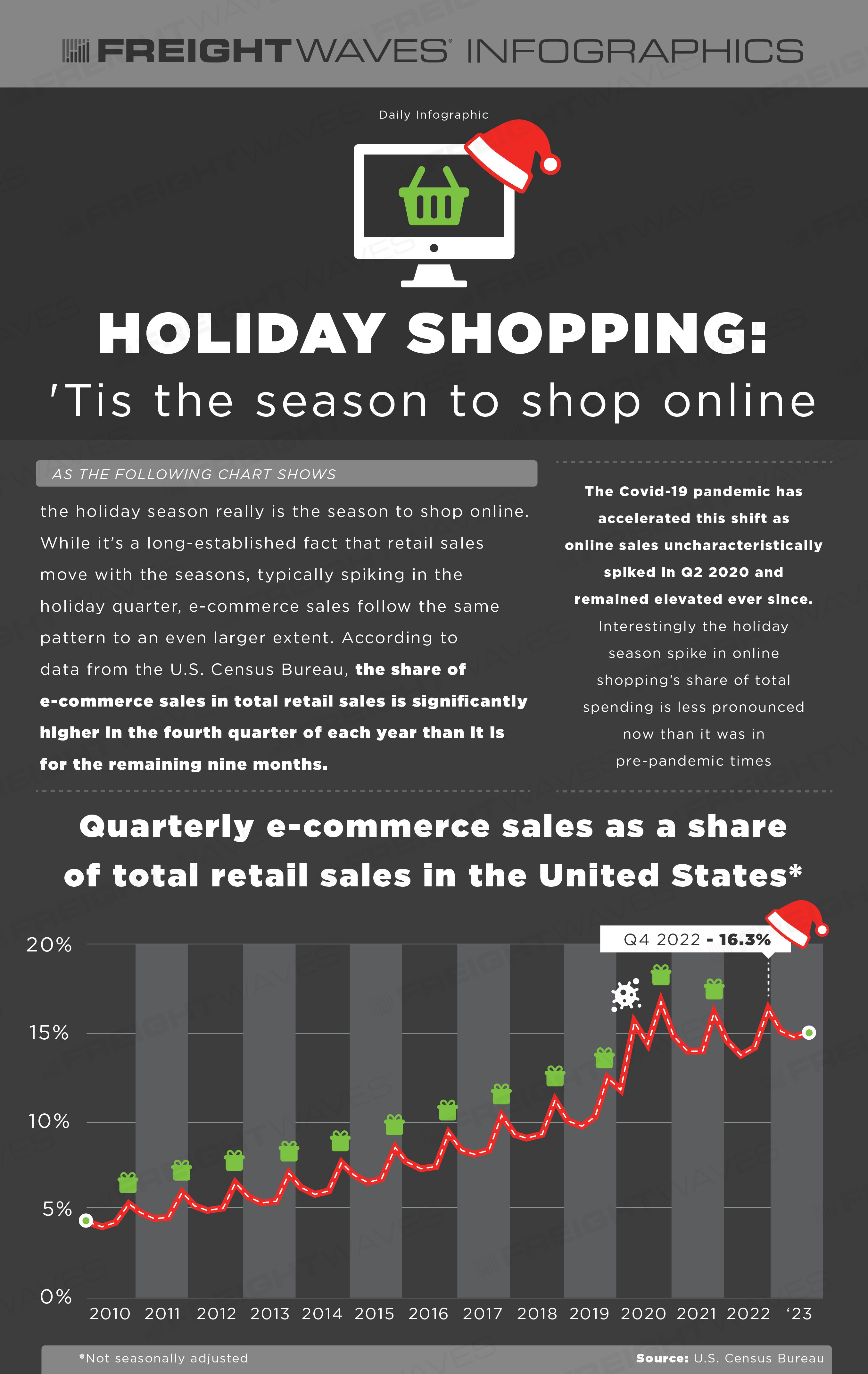
Daily Infographic: Holiday shopping: ‘Tis the season to shop online
To view more FreightWaves infographics, click here
Top ocean shipping stories of 2023: War, drought and detours
Ocean shipping routes are always in flux, but 2023 took it to a whole new level.
Trade routes were blocked or impeded by geopolitics, labor and weather: sanctions on Russia, U.S.-China tensions, dockworker union unrest, drought-driven cuts at the Panama Canal, and attacks on ships in the Red Sea.
Ocean trade detoured around each obstacle. When vessels divert in large numbers, it makes headlines, but that flexibility is one of ocean shipping’s greatest strengths. Ship diversions, as the software saying goes, are a feature, not a bug.
Here’s a look back how FreightWaves covered of a year when ships kept on changing course:
Russia-Ukraine war reroutes tanker and bulker flows
The EU shift away from Russia began in December 2022, with the EU ban on Russian crude, and accelerated in February 2023, with a ban on Russian diesel and other refined products.
The shuffle of global trade flows went into full swing. Russian crude went to China and India instead of the EU. Russian diesel went to Africa and South America. The EU replaced its Russian crude and diesel with volumes from the U.S. and Middle East (story here) — and none of these changes caused fuel prices to spike.
Not only did the destinations change for Russian exports, the fleet of tankers carrying those cargoes changed.
A tanker loads in Russia. (Photo: Shutterstock/Igor Grochev)
In response to sanctions, Russian cargoes were initially carried by the so-called “shadow fleet,” tankers outside Western financial and insurance circles (story here). Then, courtesy of the price-cap “loophole,” they switched to European tankers (story here). And then, when the price cap was breached, they switched back to shadow tankers (story here).
Trade routes for liquified natural gas (LNG) shipping also saw a huge shift due to the war. Previously, two-thirds of U.S. LNG went to Asia, one-third to Europe. This year, two-thirds went to Europe, one-third to Asia (story here).
The Russia-Ukraine war likewise reshuffled dry bulk routes.
Russian coal that previously went to the EU went to India and China instead. The EU replaced Russian supply with coal from Colombia, South Africa, the U.S. and Australia (story here). Ukrainian wheat impeded from leaving via the Black Sea due to the war was replaced by Russian wheat (story here). Global trade reflowed to keep markets supplied.
Trouble ahead: Tensions with China mount
The separation of Russian and Western supply chains was only part of a broader trend that involved China, as well. More Chinese military exercises off Taiwan this year heightened tensions with the U.S.
In general, shipping fleets and cargo flows grew increasingly bifurcated, with the U.S. and EU on one side, and Russia and China on the other (story here).
Geopolitical tensions coincided with a much-weaker post-COVID economic recovery in China than expected, a negative for shipping demand (story here).
More Chinese containerized exports went to Asian countries in 2023, and less to the U.S., with the U.S. sourcing more containerized imports from Southeast Asia and India. But this trade reshuffle has a long way to go.
The U.S. remains extremely reliant on Chinese cargo, which still represented 37% of total containerized imports in November (story here). Thus, the stage is set for a massive supply chain shock in the years ahead if China invades Taiwan.
Leland Miller, CEO and founder of China Beige Book, warned FreightWaves in November: “The odds of something happening before the end of the decade are much, much higher than the markets are giving credit for. The market understanding of this — that it’s way too damaging so it’s not going to happen — is just wrong (story here).”
Labor unrest and the coastal shuffle
Meanwhile, on the domestic front, the first half of this year was dominated by fears of dockworker labor unrest at West Coast ports as the International Longshore and Warehouse Union (ILWU) engaged in contentious negotiations over pay and COVID bonuses (story here).
Importers reacted by rerouting some of their supply chains to the East Coast and Gulf Coast ports, causing volumes in Los Angeles and Long Beach to plummet (story here).
In the second half of the year, trade flows began to shift in the opposite direction. The ILWU reached a contract agreement in June, removing concerns about West Coast ports, and water-level restrictions at the Panama Canal increased, raising importer concerns about East and Gulf Coast ports. West Coast volumes bounced back (story here).
Then the labor threat switched coasts. In November, the International Longshoremen’s Association (ILA), representing East and Gulf Coast dockworkers, warned members to prepare for a strike in October 2024, when the current contract expires (story here).
That deadline may be 10 months away, but importers are already planning which coast to send their cargo to next year.
Importers are “very aware” of the risk, Flexport’s global head of ocean procurement, Nerijus Poskus, told FreightWaves. “Next year, it’s inevitable that some share will temporarily shift back to the West Coast (story here).”
Panama Canal slashes transit capacity
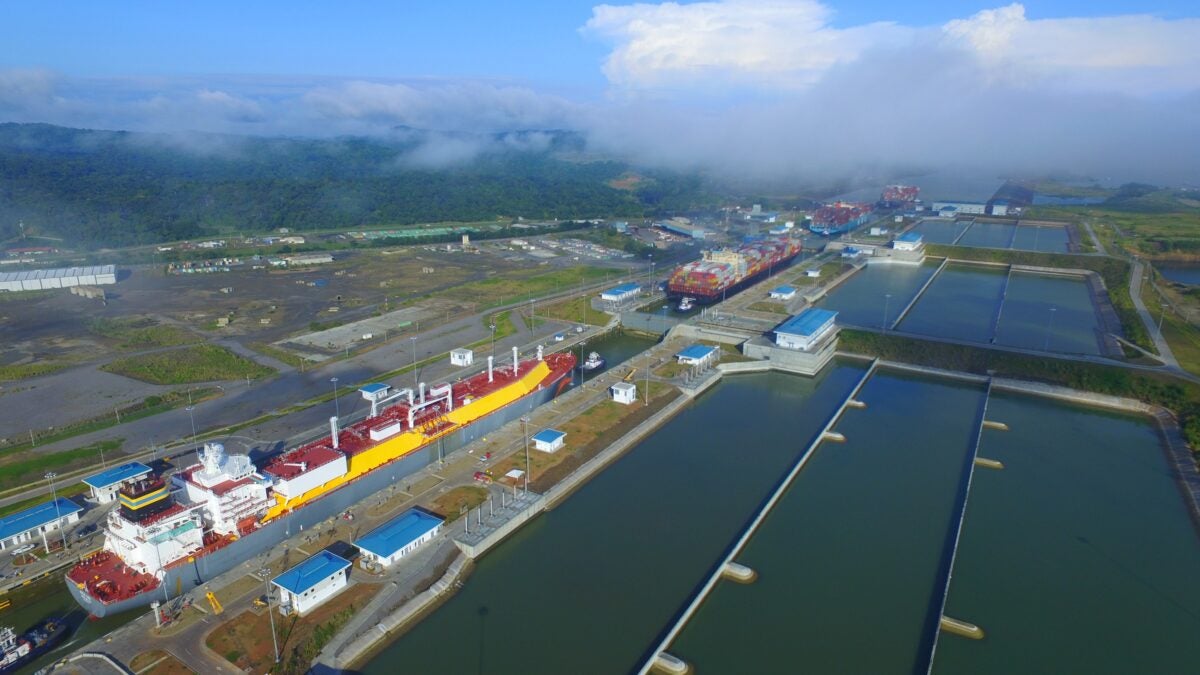
The Panama Canal began warning about a historic drought and the potential effect on transits in August. At that point, delays for some vessel types were not as extreme as they had been in past droughts, and the seriousness of the situation was still unclear (story here).
In the coming months, however, it became obvious that this time was different. The canal had its driest October on record. In November, the canal announced extreme measures to slash transits and preserve water (story here).
Prior to November, one of the major impacts of canal restrictions involved larger tankers designed to carry liquefied petroleum gas (LPG) — propane and butane. Uncertainty over delays caused larger LPG carriers to avert the Panama Canal and reroute to the Suez Canal or Cape of Good Hope, increasing average voyage distance and pushing up spot rates (story here).
Panama Canal transits fell sharply in November. (Photo: ACP)
In November, waiting times for ships without reservations at the Panama Canal surged (story here).
Canal restrictions began hitting Asia-U.S. container shipping flows in November for the first time (story here).
Two of the three global container shipping alliances — Ocean Alliance and THE Alliance — rerouted their Asia-East Coast services from the Panama Canal to the Suez Canal. And that ultimately led to even more diversions.
Israel-Hamas war and Red Sea attacks
The onset of the Israel-Hamas war in October spurred concerns over two key shipping chokepoints: the Strait of Hormuz off Iran and the Suez Canal (stories here and here).
As it turned out, the risk was at the Suez — not because of issues related to the canal, but because any ships transiting the waterway had to pass through the Bab-el-Mandeb Strait off Yemen.
An Israeli-linked car carrier was hijacked in November.
Yemen’s Houthi rebels began attacking ships in the strait in retaliation for Israel’s treatment of Palestinians, initially attacking Israeli-linked ships (story here).
Israeli carrier Zim (NYSE: ZIM) was one of the first companies to divert from the Suez/Red Sea route (story here).
Then the Houthi attacks became more indiscriminate (story here). All of the container shipping lines, as well as numerous operators of bulk commodity vessels, opted to switch to the much-longer Cape of Good Hope route and avoid the Suez and the Bab-el-Mandeb Strait (stories here and here).
It was yet another case of a “double switch” in 2023 routing. Just as some U.S. importers opted to leave the West Coast earlier in 2023 and switch back to that coast later this year, some ocean carriers that switched from the Panama Canal to the Suez Canal had to change course yet again, and divert to the Cape of Good Hope.
The saving grace for supply chains is that there’s plenty of excess capacity in container shipping, due to a historic tidal wave of newbuilding deliveries hitting the water just as the dual canal issues emerged (story here). There is enough capacity to handle the diversions.
For all of the ship detours due to war, labor and weather, there was no supply chain crisis in 2023. The inherently flexible networks of ocean shipping worked as designed.
It should not come as a surprise that 2023 was one of the busiest years for news in the freight industry. Trucking companies large and small shuttered, including the biggest carrier bankruptcy in history. Layoffs continued to pile up amid the ongoing trucking bloodbath. And labor disputes simmered across every mode.
As the year comes to a close, we take a look at some of FreightWaves’ most-read news stories of 2023. It’s just a sample of the thousands of stories FreightWaves’ writers put out this year.
A third-generation family-owned trucking company and brokerage — Certified Freight Logistics, headquartered in Santa Maria, California — ceased operations in October after 95 years. Read more.
Peace Equipment LLC, a company headquartered in Edcouch, Texas, filed for Chapter 11 bankruptcy protection in May, citing rising operating costs and “reduced income in the trucking industry.” Read more.
A July letter from Teamsters leadership to local unions representing all of Yellow Corp.’s network said emergency negotiations hadn’t yielded an agreement. Read more.
Team drivers for Cromex Inc. of Villa Park, Illinois, say things were looking bleak after they were stranded in a Chicago-area hotel for three days more than 1,000 miles from home without a paycheck or a truck until a truckers outreach organization offered to pay their rental car expenses to get them home to Jacksonville, Florida. Read more.
A North Carolina trucking company notified over 200 drivers, employees and mechanics it was ceasing operations after 11 years after some of its major customers demanded “massive rate and volume concessions.” Read more.
The current market is tough enough for owner-operators that a significant chunk of them are considering leaving it altogether. At least that’s according to a recent FreightWaves Research survey. Asked to select statements that applied to them, 35.2% of self-identified owner-operators checked, “If the market does not rebound materially by the end of 2023, I will leave the industry.” Read more.
The number of authorized interstate trucking fleets in the U.S. declined by nearly 9,000 in the first quarter of 2023, according to federal data analyzed by Motive, a fleet management technology company. Several midsize fleets shuttered this year, including Florida’s Flagship Transport and North Carolina’s FreightWorks Transport. And major freight brokerages laid off thousands of employees in 2023 alone. Read more.
While it is possible that freight rates will rise in anticipation of a capacity reset, FreightWaves and many other analysts don’t believe that freight rates will increase until at least the second quarter of 2024, and few predict large increases in rates even then. Therefore, it is likely that the attrition process will continue as the market slowly grinds out the weakest players. Read more.
In June, hundreds of social media posts called for truck drivers to boycott picking up and delivering freight in Florida over the state’s new law targeting undocumented immigrants. Read more.
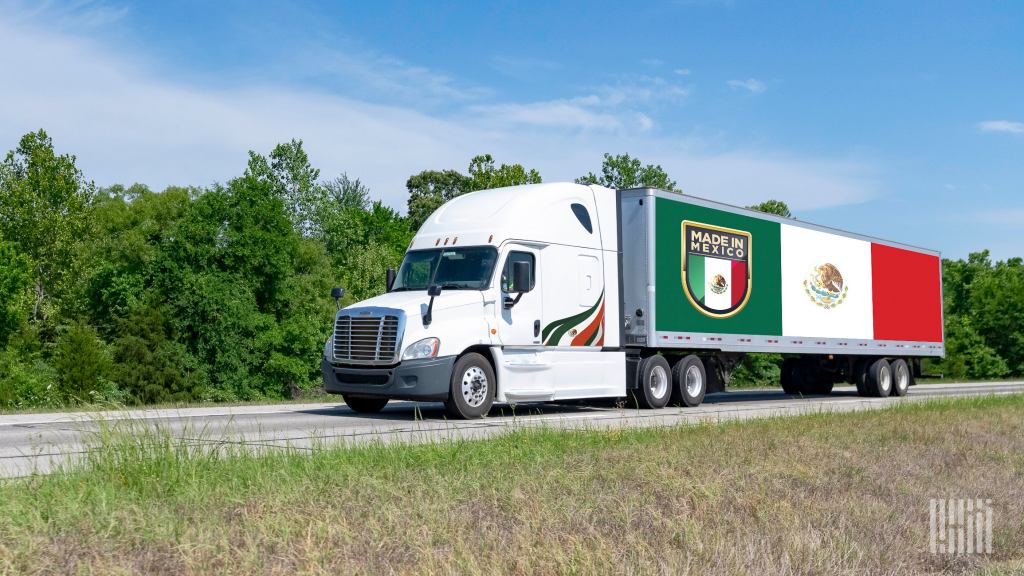
Borderlands: Exports of Mexican-built cargo trucks fell in November
Borderlands is a weekly rundown of developments in the world of United States-Mexico cross-border trucking and trade. This week: Exports of Mexican-built cargo trucks fell in November; Rotor Clip opens global distribution center in Texas; Chinese automotive supplier completes $30M expansion in Mexico; and border officials seize $10M worth of narcotics in jalapeno paste.
Exports of Mexican-built cargo trucks fell in November
Members of ANPACT produced 17,848 units in November, a 2% y/y increase compared to the same month last year.
While exports recorded a slight decline in November, 2023 has been a good year overall for Mexico’s truck production and export industry, according to Miguel Elizalde, ANPACT’s president.
Elizalde said from January through November, ANPACT members produced 204,678 units, a 12.7% y/y expansion compared to the same period in 2022 and 1.3% y/y increase compared to 2019, which was a record year for the association.
“The figures tell us that the difficulties faced during the pandemic have been left behind thanks to the dynamism provided by the entire motor transport value chain,” Elizalde said during a recent video news conference.
During the first 11 months of 2023, ANPACT members exported a total of 163,180 trucks, a 9% y/y increase compared to 2022.
The U.S. received 96.1% of the trucks exported by Mexico. Canada was the second-largest buyer with 2.3%, followed by Colombia with 0.6%.
The 16 members of ANPACT in Mexico include Freightliner, Kenworth, Navistar, Hino, International, DINA, MAN SE, Mercedes-Benz, Isuzu, Scania, Shacman Trucks, Foton, Cummins, Detroit Diesel, Daimler Buses Mexico and Volkswagen Buses.
“If the trend continues in December, then 2023 will be positioned as the best year ever recorded for the heavy vehicle industry, a situation that fills us with pride as an industry and as a country, by producing commercial vehicles for the domestic and foreign markets that generate greater efficiency levels for transport companies, as well as greater road safety and better environmental protection with cleaner technologies,” Elizalde said. “The industry is ready to establish itself as the driving force of nearshoring, which will boost productive capacity and the export volume.”
Freightliner was the top truck producer and exporter in Mexico in November, producing 10,849 trucks and exporting 9,646 units, both 10% y/y increases compared to 2022.
International Trucks Inc. was the No. 2 producer and exporter, manufacturing 4,525 trucks in November, a 13.5% y/y decrease. The truck maker exported 3,947 units during the month, a 17% y/y decline.
Elizalde also recently announced that he will be stepping down from ANPACT at the end of December. He has served as the association’s president since 2012.
Rotor Clip opens global distribution center in Texas
Somerset, New Jersey-based Rotor Clip recently announced the opening of a logistics and distribution center in Fort Worth, Texas.
The 70,000-square-foot warehouse facility boosts the company’s storage capacity and order fulfillment capabilities, officials said.
“We’ll continue to invest in equipment and facilities to ensure the expanding global marketplace has access to the highest quality rings and springs in the world,” Craig Slass, co-president of Rotor Clip, said in a news release.
Founded in 1957, Rotor Clip manufactures retaining rings, wave springs and self-compensating hose clamps. The company serves all various industries, including automotive, aerospace, defense, energy and the medical sector.
Chinese automotive supplier completes $30M expansion in Mexico
China-based Tier 1 supplier Xinquan Automotive Trim recently finished construction of a second production facility in the state of Aguascalientes, generating 700 new direct jobs.
The $30 million investment included the construction of a 115,712-square-foot warehouse and manufacturing facility. Xinquan is a designer and manufacturer of automotive trim system parts and molds.
Xinquan built a 297,084-square-foot facility in Aguascalientes in 2021. The company will produce over 600,000 sets of door panels and center console units annually.
Border officials seize $10M worth of narcotics in jalapeno paste
U.S. Customs and Border Protection officers in Otay Mesa, California recently discovered 349 packages containing narcotics hidden in a shipment of jalapeno paste.
On Dec. 13, CBP officers were inspecting a commercial tractor-trailer arriving from Mexico. The truck was carrying a load of Jalapeno paste.
Officers said they discovered a total of 349 suspicious packages from vats of the paste. The contents were tested and identified as 3,161 pounds of methamphetamine and 522.5 pounds of cocaine.
CBP officers seized the narcotics and commercial tractor-trailer and turned the driver over to Homeland Security Investigations.
The Hot Sulphur Springs, Colorado Post Office serves ZIP Code 80451. Photo by Jimmy Emerson, some rights reserved. Photo shared under the Creative Commons License.
Hot Sulphur Springs Post Office
506 Grand Ave
Hot Sulphur Springs, CO 80451
For all the hand-wringing over the potential for labor disturbances across multiple modes, the year came and went, with the notable exception of the dispute between the United Auto Workers and Mack Trucks, mostly bereft of the images of picket lines.
UPS Inc. (NYSE: UPS) and the Teamsters union reached a five-year contract without 340,000 UPS Teamsters hitting the bricks. U.S. members of the International Longshore and Warehouse Union remained on the job through contract talks that would culminate in a six-year agreement, though Canadian ILWU members did walk off the job twice in July for brief periods.
Workers at less-than-truckload carriers ABF Freight System Inc., a unit of ArcBest Corp., and TForce Freight, the U.S. arm of Canadian transport and logistics company TFI International Inc., ratified their respective five-year contracts with little fanfare. The rail industry, coming off a turbulent 2022 when labor-management disputes came close to shutting down the national system, spent 2023 in relative quiet.
But there is a price to be paid for labor peace. Contracts ratified during 2023 came with employee wage and benefit increases. The gains will either be absorbed by employers, passed on to customers, their customers, consumers or a combination of all of the above. The mainstream media-coined phrase of the “summer of strikes” proved to be overrated. Still, the labor disputes in multiple industries, and the settlements that resulted, were sufficiently high profile to compel workers heading into 2024 to wonder if they too can get more than they have bargained for in the past.
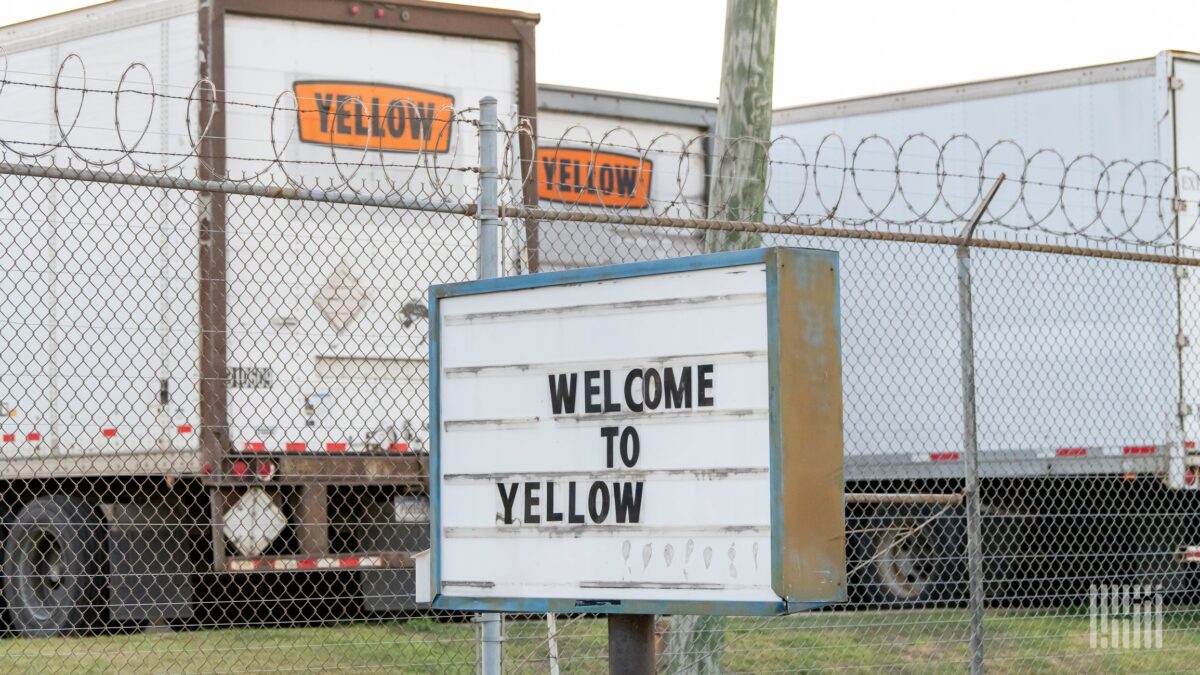
One of the biggest stories of the year, the demise of the near-century-old LTL carrier Yellow Corp., did not involve strikes, but the destruction of 30,000 jobs, 22,000 of them Teamster jobs. It marked a sad ending to a 15-year odyssey that saw Yellow’s rank and file sacrifice mightily to keep the company afloat, only to see the company, and their jobs, disappear.
(Photo: Jim Allen/FreightWaves)
Parcel: Teamsters angling for bigger fish
The Teamsters’ contract with UPS affects more union workers than any compact in North America. Yet it could be just a means to an end.
Teamsters General President Sean O’Brien took a very aggressive posture in contract talks with Big Brown. He did so for three reasons: 1. That’s who he is. 2. He wanted UPS workers to reap the tailwinds of a favorable post-COVID labor environment that they had missed out on having ratified the last contract in 2018. 3. He wanted to send a message to Amazon.com Inc. that it could nail down the same type of deal for its nonunion workers.
On Tuesday, the Teamsters issued a statement accusing Amazon of misclassifying delivery drivers as employees of its Delivery Service Partners (DSP), contractors who work for Amazon, instead of Amazon employees even though the drivers wear Amazon uniforms, drive Amazon-branded vehicles and take direction from the company.
The Teamsters’ efforts will continue to be met with pushback from Amazon. The company refused to negotiate with warehouse workers who have agreed to organize, and it shows no signs of backing off. Regardless, it appears that Amazon will become the Teamsters’ holy grail heading into 2024.
The Teamsters came away with what, by all accounts, was a favorable deal with UPS, though the company maintains that the increases, when spread out over the five-year contract life, were far from enormous. The rank and file won a roughly 10% wage increase in year one and a decent increase — though not as much — in year five. In between, the bumps will be fairly modest. All told, workers will realize compounded annualized gains of 3.3% over the five-year cycle, according to UPS.
The year ends with UPS trying to sort out the status of its volumes in the wake of the contentious Teamster negotiations. In late October, the Atlanta-based company said that about 1.5 million daily parcels had been diverted throughout the year due to customer concerns over a possible strike. That was higher than UPS’ original diversion estimate of 1.1 million parcels. About 600,000 parcels had returned to the network, with roughly half of that coming from chief rival FedEx Corp. (NYSE: FDX), UPS executives said at the time.
The company did not provide an update as of the third week of December.
— Mark Solomon
Teamsters in Houston were among workers who threatened a strike after Yellow Corp. closed this year. (Photo: Jim Allen/FreightWaves)
LTL: Yellow dominated the labor space
Perhaps the biggest story in the transportation and logistics space this year was the closure of Yellow Corp. While the finger-pointing over which party is to blame lingers in some circles, the defunct carrier’s estate continues to be sold off in hopes of fully repaying creditors.
A ray of sunshine came in the spring when it appeared the two parties would pull forward negotiations on their collective bargaining agreement and hash out a proposed change of operations alongside setting rates for wages and benefits. Negotiations quickly fizzled and the heated rhetoric resumed in short order.
The threat of a worker strike over missed health care payments was enough to force Yellow’s customers to seek other capacity options. Court filings showed Yellow had 40,000 shipments in its network the day the strike was announced. Shipments fell by 10,000 per day to “near zero” by the end of that week. On July 30 it ceased operations. It filed for bankruptcy protection a week later.
Some have speculated that O’Brien sacrificed Yellow to show management at UPS (NYSE: UPS), where it was negotiating a labor deal on behalf of nearly 340,000 workers, that it meant business.
The Teamsters claimed throughout the negotiations that its members had given billions in wages, benefits and pension concessions in the past. It blamed Yellow for years of mismanagement and said it wasn’t going to bail it out again.
“It is not left for the Teamsters to save this company; we have given enough,” O’Brien said in June. “What happens next is out of our control.”
In the end, 30,000 employees were on the street, 22,000 of them Teamsters.
There were some LTL labor negotiations conducted in 2023 that didn’t include personal attacks and name-calling. While O’Brien vowed to “fight like hell” heading into talks with TForce Freight (NYSE: TFII) and ABF Freight (NASDAQ: ARCB), no fireworks were publicly visible although Teamsters at both companies voted “yes” to strike if certain demands weren’t met.
In June, ABF and the Teamsters reached a five-year deal that raised wages by $6.50 per hour and benefits contributions by $4.46 per hour over the life of the contract. Employees also received two additional paid sick days and one additional paid holiday, among other provisions. The contract covers approximately 8,600 workers.
In July, TForce reached a deal with the Teamsters covering 7,800 drivers and clerical workers. The package included wage increases totaling $4.50 per hour over the contract period, mileage increases and higher employer contributions to health, welfare and pension plans. Additional paid time off, work rule protections keeping road drivers from working freight on the docks and a requirement for new trucks to have air conditioning, were among other items agreed to.
— Todd Maiden
(Photo: Jim Allen)
Maritime: Different union, same contract concerns
This year began with fears that one of America’s largest dockworker unions would disrupt imports. It ended with the same fears — about a different union.
The ILWU represents dockworkers at the Pacific ports of the U.S. and Canada. The contract covering U.S. West Coast port labor expired on July 1, 2022. Talks dragged on into this year, with salary increases and COVID bonuses the predictable sticking points.
Work slowdowns ensued, but importers were prepared: A portion of Asia-U.S. volumes was redirected to East and Gulf Coast ports to hedge the ILWU risk.
A new contract agreement was finally reached on June 14. ILWU workers got their COVID bonus and a 32% pay raise over a six-year period.
Shipping’s labor saga appeared, briefly, to be over. Then three new plotlines emerged.
The ILWU’s American members reached a deal, but not its Canadian members. ILWU Canada went on strike on July 1, went back to work on July 13, said it was going back on strike on July 18, called the strike off the next day, then finally agreed to a deal on July 30.
Meanwhile, the corporate division of the ILWU was contending with a potentially crippling legal liability.
A jury in Oregon decided in November 2019 that the ILWU owed terminal operator ICTSI $93.6 million in damages for unlawful labor practices starting in 2013 at the ICTSI terminal in Portland, Oregon.
A judge lowered the award to $19 million in March 2020, but only if both sides agreed. ICTSI did not agree, and a second damages trial was put in motion, with ICTSI seeking $48 million to $142 million this time around.
The new damages trial was scheduled for February 2024, but on Sept. 30, the ILWU short-circuited the process by filing for Chapter 11 bankruptcy protection in California.
ICTSI is vigorously contesting the move, claiming the ILWU is forum shopping. A hearing on the final confirmation of the Chapter 11 plan — which calls for the ILWU to pay ICTSI $6.1 million — is scheduled for late March 2024.
Yet another labor plotline features the International Longshoremen’s Association, which represents dockworkers at East and Gulf Coast ports. Its current six-year contract with employers expires on Sept. 30, 2024 — just over a month before the next presidential election.
In its next contract, the ILA is demanding “a landmark compensation package,” prohibitions against terminal automation and tightened language ensuring all work at new terminals goes to ILA members.
ILWU President Harold Daggett warned on Nov. 4: “Members should prepare for the possibility of a coastwide strike in October 2024.”
Thus, the coastal threats have reversed. In early 2023, shippers were shifting cargo away from the risk of West Coast labor disruptions and toward the safety of East and Gulf Coast ports. As this year comes to a close, they are shifting cargo back to the West Coast and away from a potential disruption next year at East and Gulf Coast ports.
Compared with the contentious environment in 2022 and an inability to get a labor agreement passed without congressional intervention, the U.S. operations of the Class I railroads and their craft unions experienced a relatively more subdued 2023. Despite some disagreements over furloughs and crew consists, individual unions reached sick leave agreements with the various Class I railroads throughout the year; some railroads, such as Union Pacific (NYSE: UNP) and Norfolk Southern (NYSE: NSC), even reached agreements on work schedules. Both the sick leave and work scheduling agreements were not part of the labor agreements ratified by the railroads and unions in December 2022.
However, what happens in 2024 in rail labor-railroad relations could serve as an indicator for how the next bargaining round will go. The next bargaining round will officially kick off in January 2025 with preliminary negotiations, but both sides could start gearing up in the second half of 2024.
“The railroads are committed to working with rail labor, delivering on their promises and maintaining railroading’s place among the best jobs in our economy,” Brendan Branon, chairman of the National Railway Labor Conference and the National Carriers’ Conference Committee (NCCC), told FreightWaves in an emailed statement. NCCC represents the freight railroads at the bargaining table.
Branon noted the railroads and the unions in 2023 reached local agreements expanding paid sick leave to more than 90% of all unionized rail employees at NCCC rail carriers.
“We hope to extend that positive momentum throughout 2024 and into the start of the next bargaining round. The most recent national agreements provide that opening proposals can be served starting in November 2024 ahead of the January 1, 2025 amendable date,” Branon said.
— Joanna Marsh
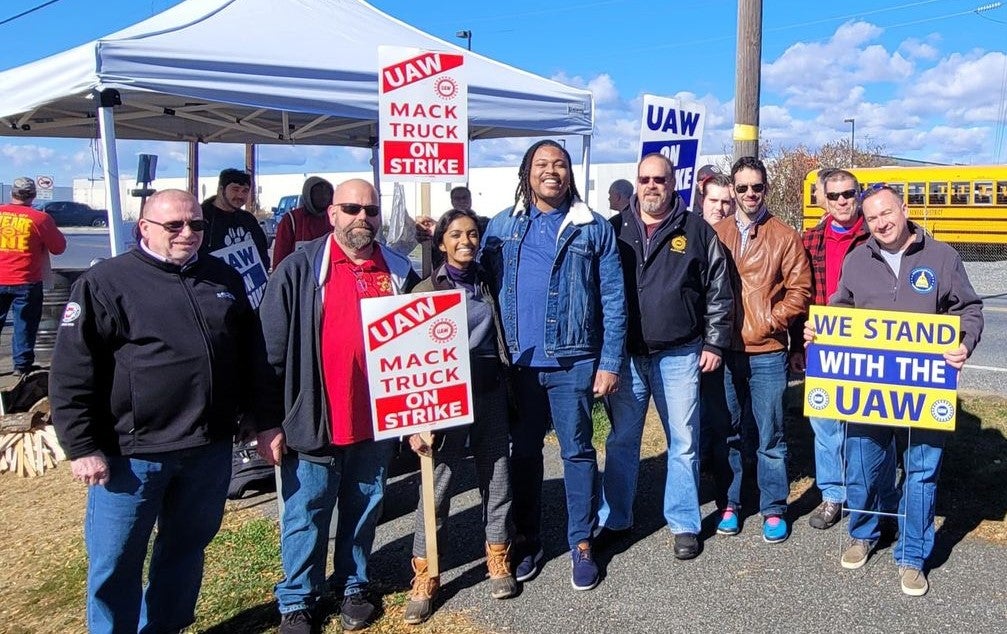
UAW strikers at Mack Trucks. (Photo: UAW)
Trucks: Mack workers walk again
For the second time in four years, Mack Truck workers went on strike against the Volvo Group subsidiary. The Oct. 9 walkout caught the company by surprise because it had reached a tentative agreement Oct. 1 endorsed by both local and international UAW leaders.
Outside influences appeared to prompt the 39-day walkout. An ongoing UAW strike of the Detroit Three automakers caught the attention of Mack workers, who saw the more substantial offers being made by the automakers to the union.
The two sides resumed talks, but Mack made it clear it had nothing more to offer, other than settling some unresolved local agreements. The strike involved 3,900 workers at facilities in Pennsylvania, Florida and Maryland, where a Hagerstown engine plant provides powertrains for Mack and Volvo Truck North America operations.
After the staredown, union leaders took a second vote on the agreement that called for 19% pay hikes across five years, a $3,500 signing bonus and no out-of-pocket increases in benefit costs plus other gains. The company called the Oct. 1 tentative pact its “last, best and final” offer.
The WSWS railed against the “sellout contract” that Mack pushed for ratification as well as agreements with better terms eventually reached by Detroit’s Big Three.
— Alan Adler
Workers load an airplane at Dallas/Forth Worth International Airport. (Photo: Jim Allen/FreightWaves)
Aviation: A busy year
It was a busy year for labor contracts in the airline and air cargo sectors. The threat of disruption loomed over some carriers as unions flexed their muscle to influence negotiations and new deals significantly raised operating costs.
Pilot unions were able to take advantage of favorable economic conditions —a tight labor market, high inflation, crew shortages at mainline carriers as they tried to rebuild after pandemic-driven layoffs and a training backlog for new hires — to get better pay and work schedules.
A number of major passenger airlines reached collective bargaining agreements with cockpit crews. Delta Air Lines pilots finalized a contract that includes a 34% raise over four years. In September, pilots at United Airlines approved a new contract that raised pay up to 40%. American Airlines pilots also received a big raise. And Hawaiian Airlines pilots, including those hired to fly the company’s first freighters for Amazon, reached a deal that raised pay up to 33%.
Southwest Airlines pilots struck a tentative deal this week after earlier giving union leaders leeway to call a strike. Strikes are rare in aviation, in part because of federal law that severely restricts the ability of unions or management to shut down operations for leverage.
Miami-based cargo operator Amerijet agreed last summer to raise pilot pay at least 45% in a three-year deal with the union. The pay hike came against the backdrop of sharply lower revenues because of weak market conditions, with the company laying off some back-office personnel, offshoring accounting functions and parking some aircraft to make ends meet.
Last month, pilots at cargo airline Air Transport International laid the groundwork for union leaders to call a strike when legally allowed. The company is one of the main transportation providers for Amazon Air and DHL Express in the U.S.
Pilots at Western Global Airlines unionized in 2021 and were seeking their first contract when the carrier filed for bankruptcy protection in August. The company exited the bankruptcy process earlier this month after disposing the bulk of its liabilities.
In July, pilots at FedEx Express voted to reject a proposed deal between management and union negotiators. The deal would have raised pay by 30% over five years. Pilots had authorized union leadership to initiate a strike vote before union negotiators reached agreement May 30 on a new deal.
Pilots who voted against the FedEx deal complained about weaker job protections, back pay and alternative pension options and said pay increases were below those achieved by pilots at Delta, United and American. FedEx has too many pilots for fewer needed routes and last month urged some to consider jumping to regional carrier PSA Airlines.
Meanwhile, 1,100 ramp workers at DHL Express’ Cincinnati air hub went on strike on Dec. 7, with the impact spreading as Teamster members at other U.S. locations honored the picket line and refused to report for work. An agreement between the two sides was reached 12 days later.