PS Logistics adds Yordy Transport to its flatbed fleet
PS Logistics said Monday its subsidiary Diamond State Trucking has acquired flatbed operator Yordy Transport.
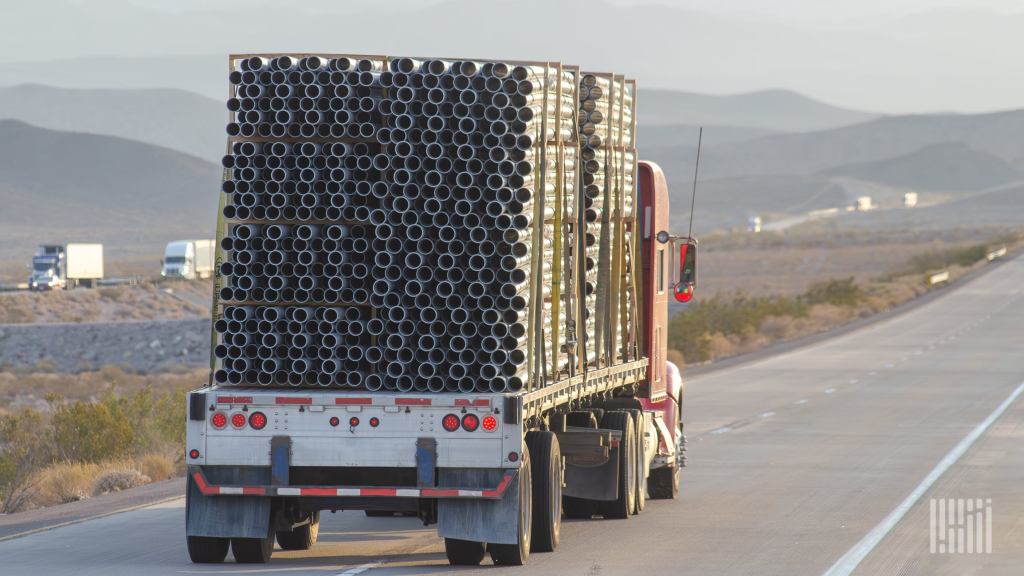
Headquartered in Morton, Illinois, Yordy Transport was founded six years ago and has a fleet of 30 power units, according to Federal Motor Carrier Safety Administration data. It primarily moves railroad and building materials throughout the central and southeast U.S.
“This acquisition aligns nicely with our desire to partner with founder- or family-owned trucking companies that put their drivers first while also providing quality service to their customers, and PS Logistics is looking forward to the growth opportunities that will result from this acquisition,” said Scott Smith, CEO and co-founder at PS Logistics.
The deal is expected to complement Diamond States’ current footprint and provide operational synergies.
Yordy Transport’s drivers and staff will remain on board, operating under the Diamond State banner.
Financial terms of the transaction were not disclosed.
“Throughout the process of working with them, it became evident that they are committed to the drivers’ success, and I’m excited that Yordy Transport will now be a part of a larger organization that will provide greater freight choices to Yordy’s drivers and operational expertise to the business,” said Avery Yordy, founder of Yordy Transport.
Birmingham, Alabama-based PS Logistics provides asset-based transportation and nonasset offerings like brokerage, third-party logistics, managed transportation and warehousing. The company primarily acquires family-owned flatbed trucking and logistics businesses. It has executed 31 acquisitions since 2016.
February brings slight relief to freight cycle’s ‘long bottom,’ Cass says
Freight shipments and expenditures improved from January to February but remained underwater compared to last year, Monday data from the Cass Freight Index showed.
Shipments increased 7.3% from January, up 2% when adjusted for normal seasonal trends, and were just 4.5% lower year over year (y/y). The y/y decline was the smallest in 10 months and 3.1 percentage points lower than January’s decline.
Severe winter weather in January as well as an extra day in February favorably impacted the comparisons.
“While seasonality remains soft in the near term and there are no more extra days on the calendar, underlying volumes have shown improvement,” the report said. “It’s been over two years since the first y/y decline of this freight recession, and with destocking playing out and goods consumption rising, we see this improvement as an encouraging sign that a recovery is beginning.”
The shipments index is forecast to increase 3% seasonally adjusted from the fourth to the first quarter. The data set is expected to turn positive on a y/y basis in May.
February 2024
y/y
2-year
m/m
m/m (SA)
Shipments
-4.5%
-4.8%
7.3%
2.0%
Expenditures
-19.8%
-27.6%
4.0%
1.8%
TL Linehaul Index
-5.4%
-11.1%
0.1%
NM
Table: Cass Information Systems (SA – seasonally adjusted)
Cass’ expenditures subindex, which measures all dollars spent on freight (including fuel surcharges and accessorial charges), was up 4% sequentially in February (1.8% higher seasonally adjusted). The index was off nearly 20% y/y, the smallest y/y decline since May.
The y/y change rates in the shipments and expenditures subindexes imply actual freight rates were down 3.1% from January to February and roughly flat when adjusting for seasonality. The subindex for implied rates hit a new cycle low during the month — the lowest reading since May 2021.
After declining 19% y/y last year, the expenditures subindex is expected to be down 14% in the first half of this year. The revised outlook is 200 basis points better than the forecast one month ago.
Cass’ truckload linehaul index, which excludes changes in fuel and accessorial charges, was up slightly from January but 5.4% lower y/y. The y/y decline was the smallest in more than a year as the index has moved sideways for the past eight months. Compared to two years ago, the index was off 11.1%.
The TL linehaul index captures changes in both spot and contract rates.
“While the freight cycle is certainly stabilizing with rates below sustainable levels in many cases and little room for further savings, we’re also seeing surprisingly strong new equipment orders for this point in the cycle,” the report said. However, the report noted “planning for upcoming emissions regulations is likely a key factor.”
“These capacity additions suggest the long bottom in the freight cycle may lengthen even further.”
Class 8 truck orders were up by low-double-digit percentages in both January and February.
Data used in the Cass indexes is derived from freight bills paid by Cass (NASDAQ: CASS), a provider of payment management solutions. Cass processes $44 billion in freight payables annually on behalf of customers.
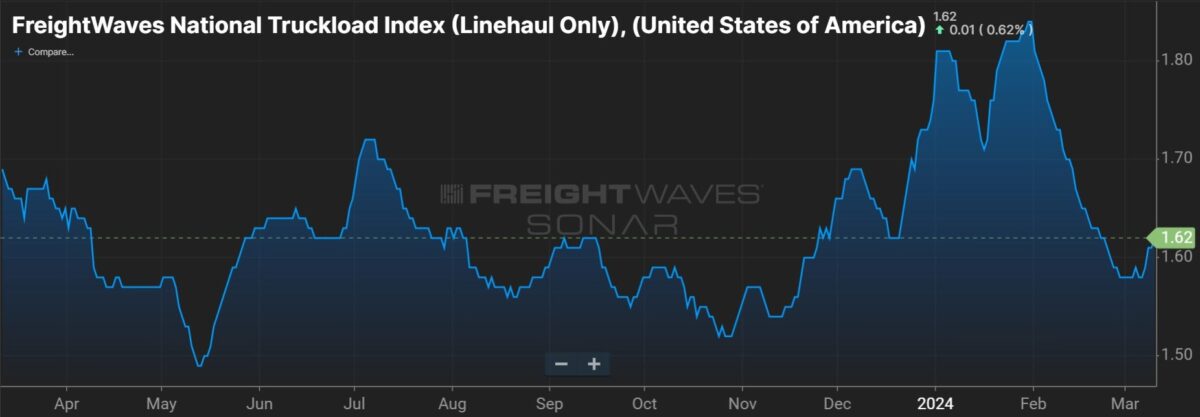
Chart: (SONAR: NTIL.USA). The National Truckload Index (linehaul only – NTIL) is based on an average of booked spot dry van loads from 250,000 lanes. The NTIL is a seven-day moving average of linehaul spot rates excluding fuel. To learn more about FreightWaves SONAR, click here.
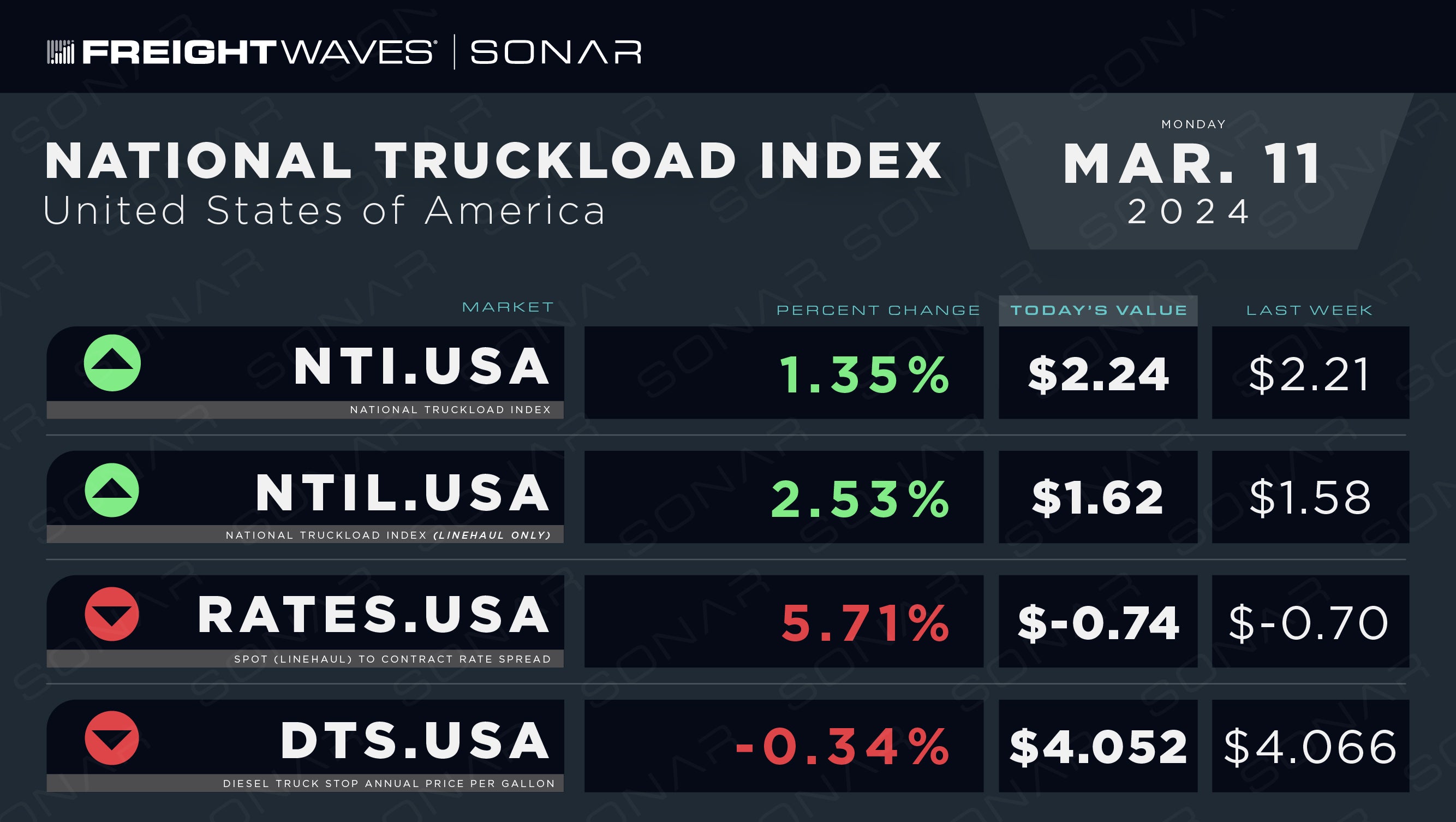
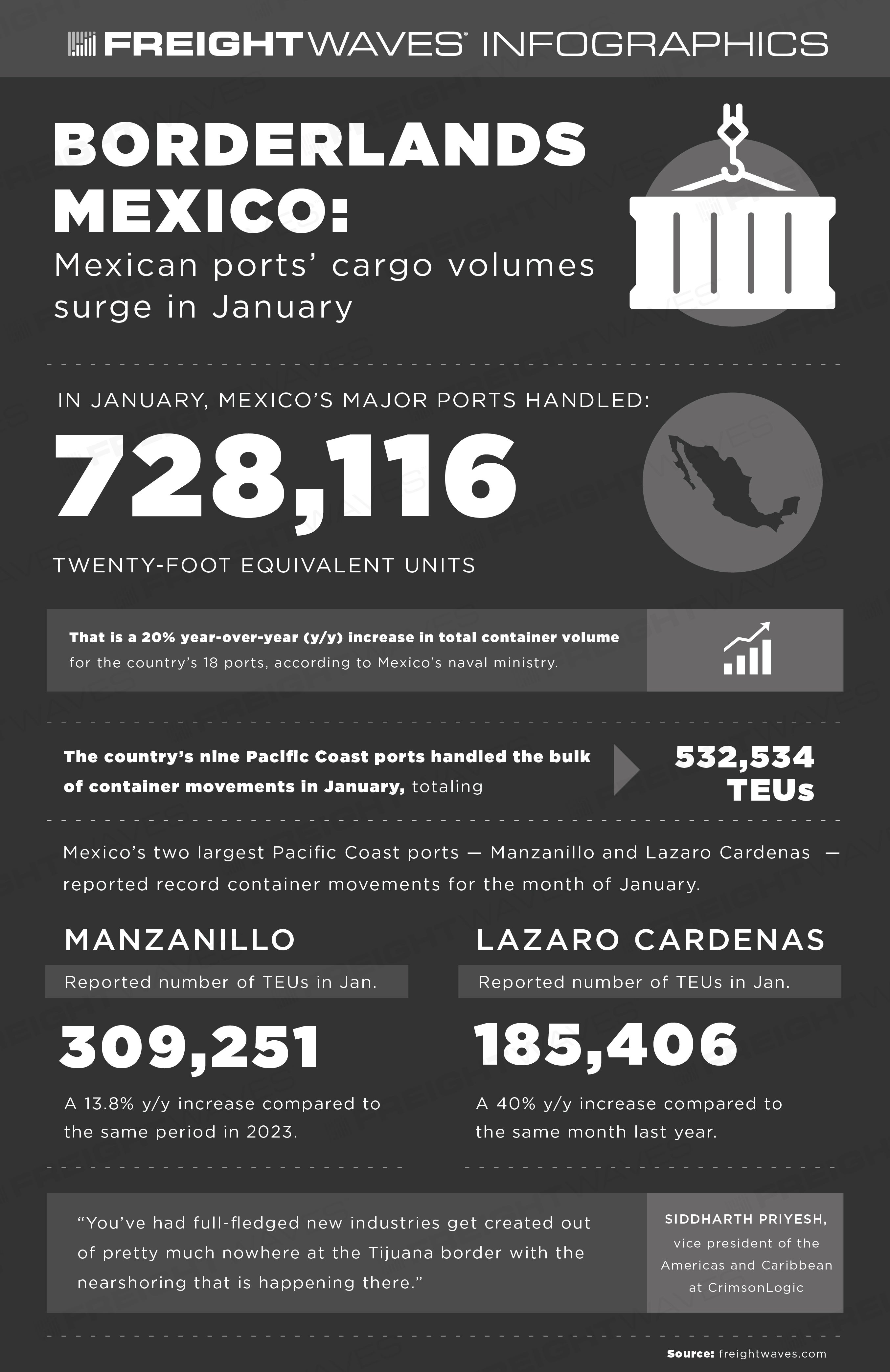
Daily Infographic: Borderlands Mexico: Mexican ports’ cargo volumes surge in January
To view more FreightWaves infographics, click here
Borderlands Mexico: US-Mexico trade in January totaled $64.5B
Mexico cross-border trade is off to a good start in 2024. The country was the United States’ top trading partner in January, with two-way commerce totaling $64.5 billion, according to the most recent data from the Census Bureau.
Mexico’s trade with the U.S. rose 1.1% year over year (y/y) compared to January 2023. Canada ranked No. 2 with $59.7 billion in trade with the U.S. in January, a 3% y/y decrease. China was the third-ranked U.S. trading partner in the month with $47.9 billion in trade, a 6.6% y/y decrease.
Port Laredo, Texas, was the No. 2-ranked U.S. trade gateway during January. Trade at the Laredo port of entry totaled $25.1 billion in January.
The Port of Los Angeles was the No. 1 international U.S. trade gateway last month, totaling $26.5 billion. Chicago O’Hare International Airport was the third-ranked U.S. gateway for international trade at $22.3 billion.
Port Laredo handled over $2 billion worth of auto parts imports during January. Other top imports included commercial vehicles at $816 million and passenger vehicles at $816 million. Top exports through Port Laredo in January included auto parts ($1.25 billion), gasoline ($279 million) and diesel engines ($260 million).
Trade experts at Kuehne+Nagel are bullish on the continued growth of cross-border commerce among the United States, Canada and Mexico.
“North America is a very important region for us,” Joachim Goller, Kuehne+Nagel’s senior vice president of road logistics for North America, told FreightWaves. “A large percentage of our revenue is generated out of North America, and it’s one of the focus regions in our Roadmap 2026.”
In February, Switzerland-based Kuehne+Nagel completed the acquisition of Ontario, Canada-based customs broker Farrow, which has 830 employees in 41 locations across Canada and the U.S. In 2022, Farrow managed over 1.5 million customs entries.
The acquisition of Farrow helps expand Kuehne+Nagel’s customs capabilities, especially at the Canadian and Mexican borders. Goller said Kuehne+Nagel is focused on cross-border trade “because we see a lot of activity in northern Mexico.”
“We see that many customers are changing their supply chains,” Goller said. “We’re seeing Asia-based supply chains that are adding Mexico-based supply chains, as well.”
Kuehne+Nagel has always had a significant footprint at the border, including Laredo and El Paso, Texas, and in the San Diego-Tijuana, Mexico, area, Goller said.
“What we’re doing now is doubling down on those locations’ investments that we already made there in the past,” Goller said. “We are opening up a new warehouse in El Paso soon, and we are going to move into a new warehouse in Laredo next year.”
The El Paso warehouse will be 363,000 square feet and is scheduled to open by the end of the year.
“The new facilities are going to be more mobile. They are going to be more modern and state-of-the-art facilities,” Goller said. “We are seeing [nearshoring] across a couple of industries. Mexico is very important for the automotive industry, and there’s a couple of things that contribute to it. Mexico has a really skilled labor force, as well as low labor costs. Mexico is geographically really well located. Its neighbor is the largest economy in the world. Mexico also has a large amount of free trade agreements with companies all over the world. This is why Mexico is not just important for the U.S., it’s important overall.”
Airbus’ distinctive new airline ready to haul whale-size loads
Airbus Beluga Transport, a new cargo airline established by the European aircraft manufacturer to carry oversize shipments, is open for business and prospecting for customers.
An ultralarge BelugaST freighter will arrive Monday afternoon at Orlando Sanford International Airport in Florida with an Airbus-built Eutelsat E36D satellite, which will be trucked to the Kennedy Space Center for launch into orbit aboard a SpaceX Falcon 9 rocket later this month.
The delivery marks the inaugural North American flight of Airbus Beluga Transport following the U.S. Department of Transportation’s grant in January of a foreign carrier permit allowing the airline to conduct commercial charter service to, from or within the United States.
But this is no ordinary freighter aircraft. It resembles a beluga whale, a species with a distinctive white color and a prominent forehead found in Arctic coastal waters. The design is based on an A300 widebody jet that Airbus (CXE: AIR) adapted by lowering the cockpit and adding a bulbous fuselage shell to accommodate large aircraft sections so they could be moved from factories to assembly plants in Europe by its in-house airline.
Airbus two years ago decided to replace the BelugaST with a larger XL version and establish a stand-alone airline with its own operating certificate and pilots who could offer dedicated transport services to external shippers with unique loads that don’t easily fit in traditional cargo jets. After occasionally renting out the supersize freighter on a trial basis, Airbus is now entering an airfreight niche that management says is underserved.
With the largest cross section of any transport aircraft in the world — 50% higher and 10% wider than market alternatives such as the Antonov An-124 or Boeing 747-8 — the Beluga is well suited for nonstandard shipments.
“We strongly believe there is a big need in the market. There is not enough capacity,” Benoît Lemonnier, managing director of Airbus Beluga Transport (AiBT), said Friday in a phone interview from the company’s headquarters in Toulouse, France. “Even if we cannot address the whole market due to the weight limitations, we are totally convinced that there is an opportunity to fill the capacity of these four aircraft over time.”
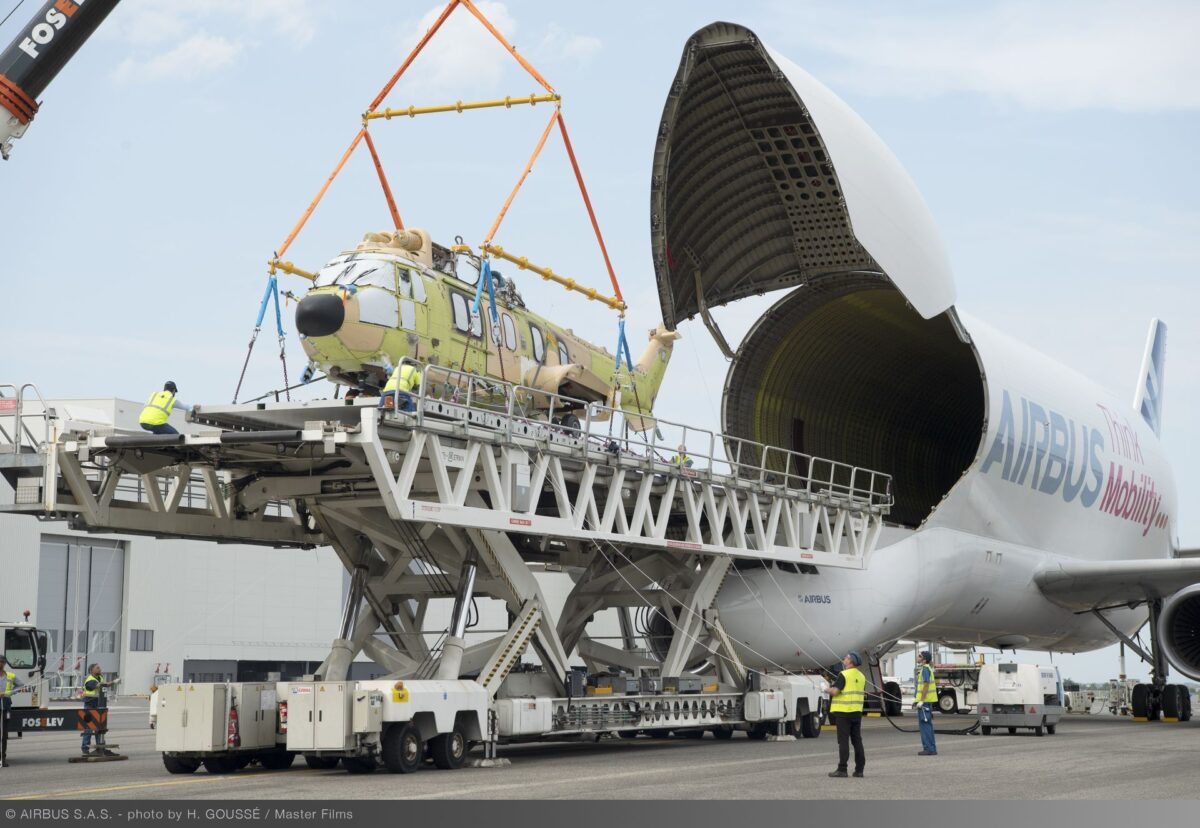
Airbus test loads a helicopter on a BelugaST transporter. (Photo: Airbus)
The Airbus subsidiary is currently allowed to fly in Europe, the U.S. and certain countries that don’t require their own certifications.
AiBT has four Beluga STs. Three are in service and a fourth is held as a spare. The fifth aircraft, phased out of Airbus’ in-house airline, has been grounded since the beginning of COVID and won’t be reactivated unless there is enough business.
A key factor in AiBT’s favor is the drop in heavy-lift capacity resulting from Western sanctions on Russia for its invasion of Ukraine, which cut off Russian carrier Volga-Dnepr and its fleet of Antonov An-124 and Ilyushin-76 mega freighters from a large portion of the global market.
Other aircraft competitors to the Beluga include military cargo jets such as the U.S.-built C-5 Galaxy and C-17 Globemaster, which in some circumstances are used for commercial missions.
AiBT still has a long way to go building up a client base because Airbus and other parties must qualify each type of unique load for carriage by the Beluga ST.
So far, the catalog of products eligible for transport includes certain types of satellites housed in special containers and some Airbus helicopters. Lemonnier told FreightWaves that AiBT is working with Boeing and Sikorsky Aircraft for certification to carry their large helicopters, such as the Chinook. The airline expects to gain approval soon to carry aircraft engines, which require the development of jigs to safely hold them in place. Other potential business opportunities could come from the oil and gas industry, unmanned aerial vehicles and small electric aircraft, and humanitarian aid organizations.
In addition to meeting customers’ requirements for safe carriage of sensitive equipment, Airbus’ aircraft design office must approve different types of payloads to make sure lashing systems and other systems will hold large shipments in place.
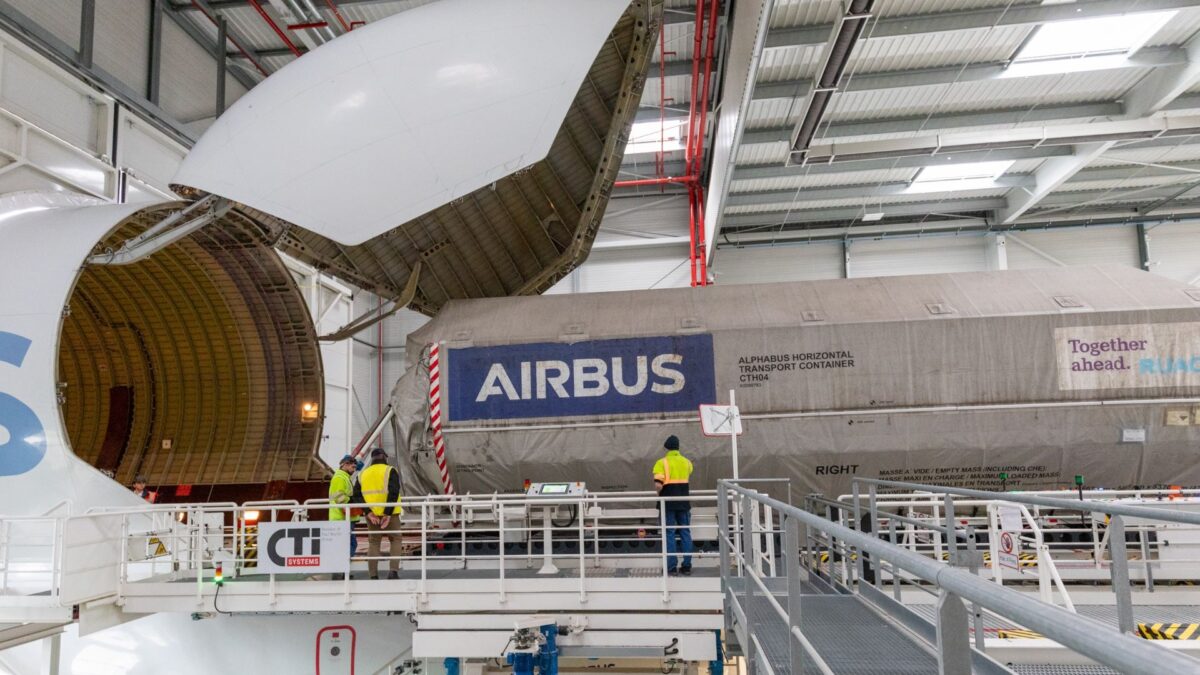
Technicians load a container holding a Eutelstat satellite onto an Airbus Beluga Transport freighter for delivery to Florida. (Photo: Airbus)
The Beluga’s massive girth is an advantage for helicopter shippers because the tail rotor, and sometimes the main rotor, don’t need to be dismantled and reassembled on arrival, which can save many days of work, said Lemonnier.
While the Beluga ST can accommodate oversize loads, it’s not as versatile as the Antonov or 747 because it can’t carry as much weight and needs special loading equipment. With a maximum payload of 44 tons, it isn’t able, for example, to transport tanks, generators or other heavy industrial machinery, which can easily be rolled onto other freighters with ramps.
Loading and unloading is a complex process. The loader is basically scaffolding with a built-in rail system that allows the plane to be filled from a high point, above the cockpit. The platform can be assembled and taken apart in one day, put in containers, and transported to another point. It takes several hours to position the platform in front of the aircraft, connect it with the aircraft handling system and load/unload shipments, with the assistance of a crane.
Shipments up to 22 tons allow the Beluga to carry an onboard loader, which speeds up loading and off loading. The trade-off is that the superfreighter can carry one helicopter instead of two if an onboard loader is part of the payload. AiBT hopes to get the portable system certified this summer.
Meanwhile, Lemonnier said Airbus is testing an alternative solution with lifting capability in the platform.
“We need to have a portfolio of solutions adapted to the need,” the airline chief said. “If it’s an urgent mission, we will use an onboard cargo loader. If we need to densify and fill the Beluga, we will use a fixed platform. And if it’s someplace we go to regularly, we could leave the platform permanently assembled.”
AiBT opted to use Orlando Sanford airport instead of flying directly to Cape Canaveral because of the convenient parking and lack of time constraints so that the unloading won’t be rushed, said Lemonnier. Orlando Sanford is a former U.S. naval air station and has a long runway.
Preparation and pilot training
Ramping up operations has been a major undertaking that has taken longer than expected. Before European and U.S. authorities signed off on operating certificates, AiBT had to write and submit voluminous operating manuals demonstrating the procedures in place for flight safety, flight operations, ground operations, technical controls and crew training. And the fleet registration also had to be transferred from the Airbus transport organization to AiBT.
To date, AiBT has hired about 60 people for various roles and operates from a base at Francazal airport near Toulouse, according to the company. It started with short-haul flights within Europe late last year under contract with Airbus to test internal procedures and train everyone, especially since planning and executing several flights per week takes more capability than operating random flights.
AiBT last May hired Olivier Schneider, a former captain and instructor with Air France Group who headed flight operations at one of the group’s regional airline subsidiaries, to head its flight operations.
AiBT also has extra challenges building up its pool of pilots because flying the BelugaST is different from many other freighter aircraft. The independent airline is borrowing a dozen crew members from Airbus’ internal fleet for up to three years while it strives to hire about 36 permanent aviators and gets them type-rated. Lemonnier said AiBT is recruiting pilots experienced in steering conventional aircraft versus modern aircraft with fly-by-wire controls in which electronic signals are sent by computer from the flight control system to the elevators, rudders and ailerons instead of being controlled by mechanical means.
Airbus Belgua Transport stops for fuel Newfoundland, Canada, on its way to Orlando.
“We are looking for pilots of 747 or A300 or even sometimes 737 who like to feel the wheel,” said Lemmonier. The A300/A310 family shares the same cockpit as the Beluga, but the training path to become a first officer and then be promoted to captain is extensive.
One notable difference, according to an Airbus blog post, is that crews will have to fly several legs to reach long-haul destinations. The Beluga fleet was built for Airbus’ European network, where flight sectors are about four hours maximum. Meanwhile, freighter pilots are used to flying between continents in eight to 13 hours without interruption. But a Beluga trip from Europe to Singapore, for example, will require four stops and take two days. The freighter arriving on Monday in Orlando made stops at Terceira Island in the Atlantic, stopped at St. Johns International Airport in Newfoundland, Canada.
Pilots will also need to fly some missions at 20,000 feet and Mach 0.7 speed, versus the typical cruising altitude of 35,000 feet and Mach 0.8 of traditional freighters. That’s because certain payloads, especially helicopters, aren’t usually certified for exposure to altitudes of more than 20,000 feet and the Beluga’s cargo hold isn’t pressurized. The AiBT fleet can cruise at higher altitudes when carrying a space satellite since spacecraft are built to operate in the vacuum of space. At lower altitudes, pilots will experience different weather conditions than they would encounter higher up.
As a startup airline with limited business, AiBT pays pilots a differential to make up for reduced flight hours.
Planned upgrades for the BelugaST fleet include a new flight management system with a global navigation database, an onboard heater to protect sensitive cargo from rapid temperature changes and related condensation during ascent and descent, and a Class-E fire suppression system for the cargo hold that will increase the ability to carry items such as lithium ion batteries. Installation of the fire suppression system will be done by the end of the year, Airbus spokesperson Katharina Wambach said.
(Correction: Managing Director Benoit Lemonnier’s name was misspelled in a previous version of this story.)
Borderlands Mexico: Nearshoring boom brings more production closer to US
Borderlands is a weekly rundown of developments in the world of United States-Mexico cross-border trucking and trade. This week: Nearshoring boom bringing more production closer to US; Mexican and US officials sign agreement to expand international bridge; Old Dominion Freight Line receives approval for new terminal near Phoenix; and construction begins for 785,000-square-foot logistics park in Houston.
Nearshoring boom bringing more production closer to US
Mexico registered a record $36 billion in foreign direct investment last year, a 2% year-over-year increase compared to 2022, according to data from the country’s Economy Ministry.
Nearshoring — the relocation of production and manufacturing operations from one country to another to be closer to end consumers — has been fueling manufacturing growth across Mexico as shippers look for supply chains that are closer, cheaper and more favorable to doing business with the U.S.
Mike Burkhart, C.H. Robinson’s vice president of North America surface transportation, said he is already seeing the results of the nearshoring of supply chains to Mexico.
“We’re transitioning to a new era now, where we can say the nearshoring boom has officially arrived,” Burkhart said. “The beauty of this is that more is on the way, we still expect this trend to play out more fully over the next five years.”
In September, brokerage giant C.H. Robinson opened a 400,000-square-foot cross-border facility in Laredo, Texas. The complex includes 154 dock doors and room for 700 trailers, while expanding the company’s footprint along the U.S.-Mexico border to 1.5 million square feet of logistics space.
“Last year, Mexico set a record with foreign direct investment, it was about 24% over 2020 and it marked the first time in two decades that the U.S. bought more goods from Mexico than China,” Burkhart said. “U.S. imports from Mexico are up, while imports from China actually dropped 20%.”
Georg Roesch, vice president of direct procurement strategy at JAGGAER, said shippers are always looking for stable, reliable and cost effective supply chains.
JAGGAER is a cloud-based procurement technology company. The firm is headquartered in Morrisville, North Carolina, and has offices around the world.
“I would say right now, there is a good and bad in the global supply chain at the same time,” Roesch told FreightWaves. “What we’re seeing is companies learning from situations that we had, such as when COVID totally hit us, companies were like, ‘Oh my God, nothing is working anymore.’ So companies learn from that, and they build up resilience.”
Roesch said while shippers were recovering and learning from their experiences during the pandemic, other global incidents and conflicts began to disrupt supply chains over the last two years.
“There’s a lot going on and the longer these situations last, the harder it will get to circumvent them, the [Houthi attacks on merchant ships] in the Red Sea is one of these examples,” Roesch said. “The longer it drags on, the more problematic it gets for various different reasons, because freight takes longer, it has higher carbon emissions associated with it. So there’s a lot of different things that are impacted by this. Generally, I would say I’m still positive that we’ve learned from our mistakes that we made pre-COVID.”
Another sign that nearshoring is growing in Mexico is that the country’s industrial parks expect to receive 453 new companies by mid-2025, 20% of which are from firms based in China, according to a study from BBVA Research and the Mexican Association of Private Industrial Parks.
Roesch said JAGGAER is seeing shippers looking for supply chains outside of China and other Asian countries, but are not completely abandoning China.
“I see a spike in companies trying to find new sources, companies are actively trying to find different suppliers,” Roesch said. “It’s not that companies don’t look into China anymore, they still do, they are still trying to find suppliers in China, but the number is stagnant. We are seeing an uptick in other regions and other areas as supply chains shift. This is the nearshoring and friendshoring and all of these types of efforts. Resilience doesn’t mean risk avoidance, it means to be able to cope with the risks that are out there.”
C.H. Robinson has helped manufacturers physically move entire production lines from Asia and Europe to Mexico, Burkhart said.
Burkhart also said that 2024 may be the first year ocean container volumes also shift due to nearshoring, as more companies bring in machinery, equipment, parts and raw materials to get operations running in Mexico.
“It’s not just Asian or overseas companies that we’re seeing, we’re still seeing huge expansion with U.S. companies that are expanding in Mexico because of the United-States-Mexico-Canada-Agreement providing stability and cost savings through 2046,” Burkhart said. “We have customers, especially in the automotive sector, that treat the whole continent as one integrated supply chain. We move a lot between Canada and Mexico, and that seems to be growing as well. So whether it’s intermodal, whether it’s truckload, whether it’s consolidation, whether it’s less-than-truckload, we’re seeing much more intercontinental movements.”
US, Mexican officials sign agreement to expand international bridge
The mayor of Laredo, Texas, and the governor of the Mexican state of Nuevo Leon recently signed an agreement to expand the Colombia Solidarity International Bridge in Laredo.
The agreement between Laredo Mayor Victor Trevino and Nuevo Leon Gov. Samuel aims to increase the bridge from eight lanes to 16 lanes. The bridge is a key border truck crossing that connects the state of Nuevo Leon with Laredo. The agreement was signed March 1.
However, the plan to expand the Colombia Solidarity International Bridge must still receive a U.S. presidential permit.
Old Dominion receives approval for new terminal near Phoenix
Old Dominion Freight Line Inc. has received final approval for its plans to develop a new freight terminal in Buckeye, Arizona, a suburb of Phoenix.
The facility will be located on 72-acres and include 200 truck dock doors with parking for tractor-trailers and employees. The new terminal will be its fifth in Arizona.
The North Carolina-based less-than-truckload carrier anticipates that the terminal will create up to 350 jobs in Buckeye with an average median annual salary of $80,000. Construction on the terminal is scheduled to begin by the end of the year.
Construction begins for 785,000-square-foot logistics park in Houston
Houston-based Lovett Industrial and PCCP LLC announced the construction of Stafford Logistics Park, which will encompass two class A industrial buildings, totaling 785,000-square-feet, according to a news release.
Stafford Logistics Park will be located on 38-acres and feature a 520,000-square-foot cross-dock warehouse and a 265,000-square-foot front-load warehouse. The buildings will also feature 36-foot and 32-foot clearance heights for tractor-trailers, and will be able to accommodate 190 trailer parking spaces.
Lovett Industrial is a real estate investment firm. PCCP LLC is a national commercial real estate investment firm. The companies did not provide a timeline for the project’s completion.
FedEx pilots seek release from federally mediated contract talks
The union representing some 5,800 pilots at FedEx Express has asked the National Mediation Board to be officially released from mediation for the purpose of being able to go on strike against the company to achieve a new contract.
The Air Line Pilots Association (ALPA) announced Friday that it asked the federal agency to declare an impasse in contract negotiations and move the process to binding arbitration. The request is designed to clear the way for a potential strike against the company in a heavily regulated bargaining process. Talks, which have been underway for nearly three years, have broken down over retirement, pay and quality of life.
The sides reached a tentative agreement that was endorsed by the FedEx ALPA Master Executive Council, but narrowly rejected by membership in July. It would have raised pilot pay 30% over four years. Mediated negotiations resumed in November.
“While ALPA has been generous in our movement on positions, FedEx’s incremental movement on some items and refusal to accept many of ALPA’s items indicate an unwillingness to ever reach an agreement,” Captain Christopher Comer and First Officer Jose Gomez, local FedEx union leaders, said Wednesday in a letter to fellow pilots obtained by FreightWaves.
FedEx (NYSE: FDX) said internal divisions within the pilots’ union are the main reason for the lack of a deal.
“We strongly disagree that a release from mediation is appropriate. This is a common union tactic that does not impact our outstanding service to customers around the world,” the company said in a statement.
“We have already reached one tentative agreement with our pilots that ALPA leadership supported and hailed as ‘the highest value achieved among major carriers in the last twenty years.’ Despite active support by its leadership, FedEx pilots narrowly voted it down last summer, and since that time we have seen continuous changes in union direction and leadership that have hindered progress toward a new deal. FedEx remains steadfastly committed to bargaining in good faith and reaching an agreement that is fair to all stakeholders. We believe the mediation process under the supervision of the National Mediation Board – which ALPA requested – remains the best way to achieve that goal.”
The pilots said FedEx apparently doesn’t intend to offer more money to a new contract proposal that it did last year. The comment indirectly referenced a FreightWaves article from January in which Pat DiMento, FedEx’s vice president of flight operations and training, was reported saying the company plans to offer the same amount of total money to the pilots as it did in the tentative agreement, but reallocate it differently between retirement, higher pay scales, signing bonuses or other areas.
“The intransigence of the company should not be a surprise to us, nor should it be used as an excuse for lowering our expectations. Rather, it should be the motivation for our deliberate, intentional demonstration of our unwavering will and unflinching determination to achieve the recognition that we have earned and that we deserve,” the letter said.
Pilots are also concerned about how pilots are paid when removed from trips for student training and language regarding medical mandates, such as vaccines, according to a Jan. 26 message from the FedEx negotiating committee to the pilot group.
ALPA notes that FedEx Express accounted for nearly half of the corporation’s $90 billion in revenue last year, is also in the midst of a $5 billion stock buyback and that 18 days of flying would pay for the entire increase pilots seek in a four-year contract.
But the union ask comes at a fraught time for FedEx, which is under shareholder pressure to increase profitability after a prolonged stretch of weaker parcel demand. The slowdown in demand previously spurred management to undertake an ambitious restructuring strategy designed to improve network efficiency and save $6 billion in structural costs.
At the same time, the future of FedEx’s contract with the U.S. Postal Service is an open question with the Postal Service motivated to shift more volume to cheaper ground transportation and FedEx considering whether to walk away from the business if it can’t get higher rates needed to make its daytime flying profitable.
FedEx pilots are making much less money than they did two years ago because there are fewer flight hours. Management has indicated a desire to offer early retirement packages to hundreds of pilots once a new contract is finalized, FreightWaves reported in January.
“In this business environment, as a pilot you can’t go in there asking for the world. It’s just not going to happen,” DiMento privately told a group of FedEx evaluators late last year.
Next steps
The Master Executive Council plans to organize an informational picket on Wall Street on March 21 to coincide with the release of FedEx’s quarterly earnings, according to the letter.
Collective bargaining for airlines is governed under the Railway Labor Act, which is much more restrictive than general labor law.
Under federal rules designed to prevent work interruptions in critical interstate commerce, workers are prohibited from striking and companies from locking out workers until a lengthy series of bargaining steps, including federal mediation, are completed. The federal mediator has the power to hold the parties in mediation indefinitely.
Before a strike can take place, the National Mediation Board (NMB) must first decide that additional mediation efforts would not be productive and offer the parties an opportunity to arbitrate the dispute before a special panel.
If either side declines the arbitration, both parties enter a 30-day “cooling off” period, after which the parties can engage in self-help — a strike by the union or a lockout by management.
Arbitration in the airline industry is rare because both sides must agree to it. And, the NMB historically has been very reluctant to open the door to potential strikes, which airlines often use to their advantage in negotiations.
And getting to the point of a legal strike doesn’t end there. The law allows the president to create an emergency board to investigate a labor dispute and issue a report within 30 days if the parties reject binding arbitration. That is followed by another 30-day period to consider the board’s recommendations and reach an agreement. If no agreement is reached at the end of the second cooling-off period, the parties may take action.
The pilot union at Air Transport International, a cargo subsidiary of Air Transport Services Group, in late January also asked the National Mediation Board to end contract talks and allow the process to move to arbitration. The NMB rejected the request and directed the ATI pilots to return to mediated negotiations, said Michael Sterling, chairman of the ATI Master Executive Council.
Culture and innovation success – Taking the Hire Road
On this week’s episode of Taking the Hire Road, Ben Schill, CEO of Wisconsin-based Paper Transport, and Jeremy Reymer discussed the importance of creating a top-notch workplace by leveraging innovative and progressive approaches to achieve success.
“Our purpose is to build a great place to work,” Schill said. “This truly is a people business, and it is about relationships; specifically it is about relationships with your employees and your professional drivers.”
For Schill, building a great place to work starts with hiring great drivers — then taking good care of them. This requires a deep respect for drivers as hard-working individuals.
“The grit and the grind and what [truck drivers] go through to deliver America every day is pretty awesome,” Schill said.
Paper Transport utilizes a driver screening platform to ensure it hires the right drivers from the very beginning. This means that drivers are assessed before they even interview for the job, streamlining the hiring process for everyone involved.
From there, the company prioritizes training and driver health at every turn. This is how Schill works to combat the growing driver health crisis plaguing the nation.
“Do something. Sitting back and accepting that the average lifespan of a driver is 61 is ludicrous,” he said. “You can start with simple things.”
For companies looking to better support their drivers, Schill recommends implementing an employee assistance program (EAP) as a first step. This gives drivers a way to access critical resources — including counseling and financial guidance — during times of crisis, improving their overall well-being.
Paper Transport has looked beyond the EAP, hiring a professional nurse to help the company’s drivers prioritize their day-to-day health. This support includes diet and exercise coaching, mental health resources, and financial well-being tips.
Schill and the team at Paper Transport have received multiple awards centered around growth and innovation over the past several years. Schill believes the meanings of those common buzzwords should be expanded.
“When you think about innovation, people jump to tech right away. That is a narrow view of innovation. We have had tremendous success through technology but also through things like sustainability,” Schill said. “There are times when growth takes a different avenue than you traditionally think.”
At the end of the day, all of these initiatives — from improving driver health to redefining innovation — directly support Schill’s mission to build a great place to work.
Other highlights from this episode of Taking the Hire Road