Synop aims to reshape supply chains starting with EV drayage trucks

Synop co-founder Gagan Dhillon considers drayage trucks, which move freight from ports to distribution warehouses, as a good entry point for more commercial electric vehicles to make their way into the logistics sector.

New York-based Synop is a charging and energy management software platform for commercial EVs. Dhillon founded the company with Andrew Blejde in 2021. Synop’s customers include OEMs, fleet operators and real estate firms, such as Prologis and The Lion Electric Co. 

“Drayage was something that I had in mind when we started [Synop] because I saw a lot of the efforts that the ports were making to decarbonize just their own vehicles,” Dhillon told FreightWaves. “You think about these loaders that they have, the little autonomous trucks that drive around the ports, some ports were starting to electrify them.”

Dhillon said improvements in battery technology and EV commercial trucks make battery-electric trucks ideal for operators that want to decarbonize parts of their supply chains.

“If you think about where battery technology is, a typical Volvo VNR electric truck has about 130 to 140 miles of range. You can do multiple trips with that from places like California’s Inland Empire to the Port of Long Beach and back,” Dhillon said. “The use case for drayage is really perfect. The charging technology can have you charged within 90 minutes and be back up on the road, so the driver gets to meet their downtime requirements as well.”

Medium- and heavy-duty trucks are one of the largest transportation-related sources of greenhouse gas emissions every year, according to the Environmental Protection Agency. Commercial trucks accounted for about 23% of emissions from the transportation sector in 2021.

A recent study found that 483 premature deaths and 15,468 asthma attacks could be attributed to heavy-duty drayage trucks in 2012 in Southern California alone. 

California pushes for zero-emissions drayage vehicles by 2035

Widespread adoption of medium- and heavy-duty electric trucks has been slowly increasing since 2016, when fewer than 17,000 were sold across the globe, according to the International Energy Agency. About 60,000 medium- and heavy-duty trucks were sold worldwide in 2022, with the majority of sales in China. 

“We’re seeing EVs spreading. It’s the same fleets that are investing in electrification on the West Coast that are looking to take that to the East Coast because the total cost of ownership (TCO) of electrifying these assets is going to quickly catch up to the TCO of a diesel vehicle,” Dhillon said.

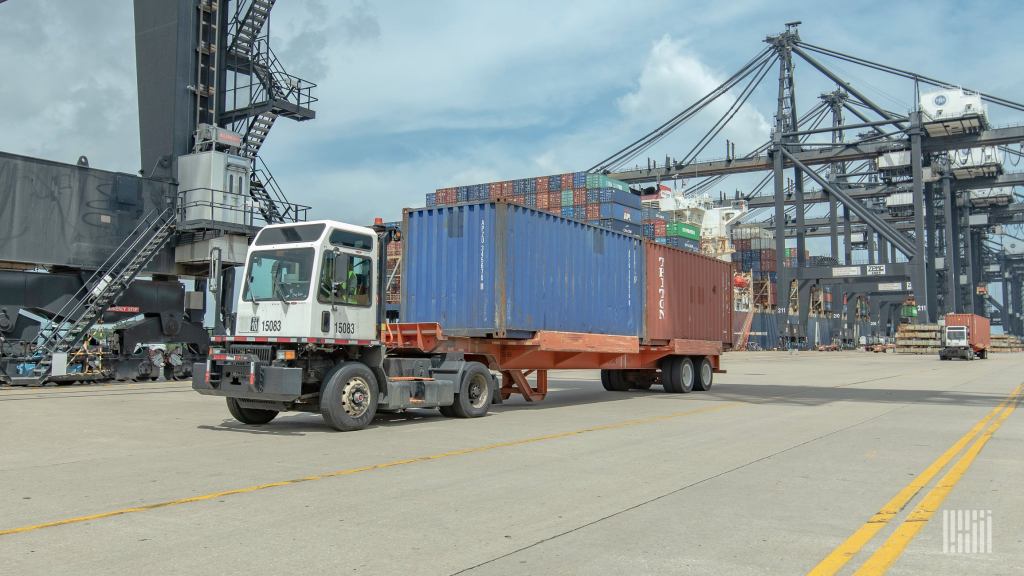
Last year, Port Houston acquired its first EV drayage truck, which is being used to transport freight at its Bayport Container Terminal. The truck, manufactured by Nikola Corp., has a range of up to 350 miles, and it can charge up to 80% in under two hours. 

Port Houston has also transitioned its crane fleet to where 40% of its yard cranes are hybrid-electric, along with all of its ship-to-shore cranes powered by electric batteries.   

“The yard tractor was purchased as part of a Texas Commission on Environmental Quality grant focused on reducing emissions at ports,” Lisa Ashley, director of media relations at the port, told FreightWaves. “This was an early step in a long-range plan for fleet upgrades to zero emissions cargo handling equipment and will be a part of the port’s carbon neutral roadmap.    

Port Houston has announced a goal to be carbon neutral by 2050. The port is working toward eventually eliminating dockside emissions and helping implement green shipping corridors as well as green marine and road fuels.

“To do that we are engaging communities, fleet operators, manufacturers, and electricity/fuel providers on the best ways to move ahead, while also facing the reality that markets are just beginning to develop,” Ashley said. “Ultimately zero-emissions equipment will be a key part of supply chains , and the port’s role is to help accelerate and de-risk the business decisions needed to make that happen, in part by seeking additional grants to help, as well as promoting collaboration.
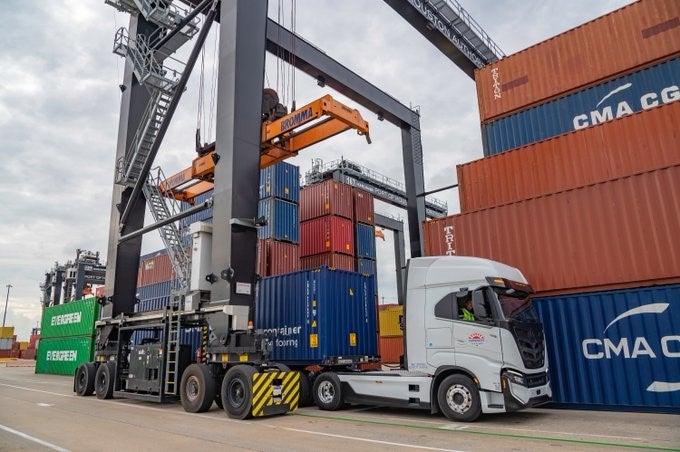
 Last year, Port Houston began using an electric drayage vehicle manufactured by Nikola Corp. (Photo: Nikola Corp.)

California has the largest number of electric trucks operating at port facilities in the U.S., driven by regulation, incentives and the Advanced Clean Fleets regulation enacted in April. The law requires all new drayage trucks registered in the state (over 140,500 trucks) to be zero emission starting in 2024, with full implementation by 2035.

“California has a lot of regulation around EVs. … They started to put in place not only regulations around their ports but around warehousing as well for a certain percentage of trucks that interact with warehouses to be electric,” Dhillon said. “We found that the larger fleets that we work with, their drivers really enjoy using electric vehicles. It’s less harsh on their bodies when they’re driving.”

Freight operators at the Port of Savannah in Georgia have also shown interest in using EV drayage trucks as a gateway into more EV adoption across its logistics chain, Dhillon said.

“That adoption at the [Port of Savannah] is probably a little bit slower. The operation there is just starting to get kicked off,” Dhillon said. “But there is interest from significant fleet operators in the Port of Savannah to follow what’s happening in California, follow what’s happening with the Port of Long Beach to the Port of Oakland to be able to have electrification also take hold at the Port of Savannah.”

EV fleet adoption requires more infrastructure, interoperability

Some of the barriers for adopting EV for widespread commercial use at ports include finding available locations for charging stations. Electric charging depots need to be located at ports or nearby for fleets to power their vehicles.

Some of the most recent investments include carrier Schneider National opening a 4.8-megawatt charging facility in El Monte, east of Los Angeles, and NFI Industries, a supply chain services provider, which is scheduled to complete construction of a charging station for its Class 8 battery-electric trucks in by the end of the year in Ontario, California. 

“What I’ve seen is creativity, companies installing chargers at warehouses they already own,” Dhillon said. “Now we are seeing companies like TeraWatt Infrastructure that are buying up premium land and to install very specific depots.”

Other challenges to more EV use in the commercial space include hardware/software interoperability and ease of use for trucks, drivers and charging stations.

“Our charging platform is super easy to use for drivers, because the ease of use matters with interoperability,” Dhillon said. “It doesn’t matter how great your software is, if you can’t simply plug that truck in and start charging because the charger and vehicle don’t speak to one another, then it’s not going to matter. That’s the No. 1 problem that we have to solve and we are solving.”

Click for more FreightWaves articles by Noi Mahoney.

More articles by Noi Mahoney

Logistics boom drives $1.2B e-commerce firm’s relocation in Texas
Canadian freight forwarder Farrow acquired by Kuehne+Nagel

Renewed migrant surge forces closure of Texas border bridge

First wave of Yellow terminals will go for $1.9B; sale process ongoing

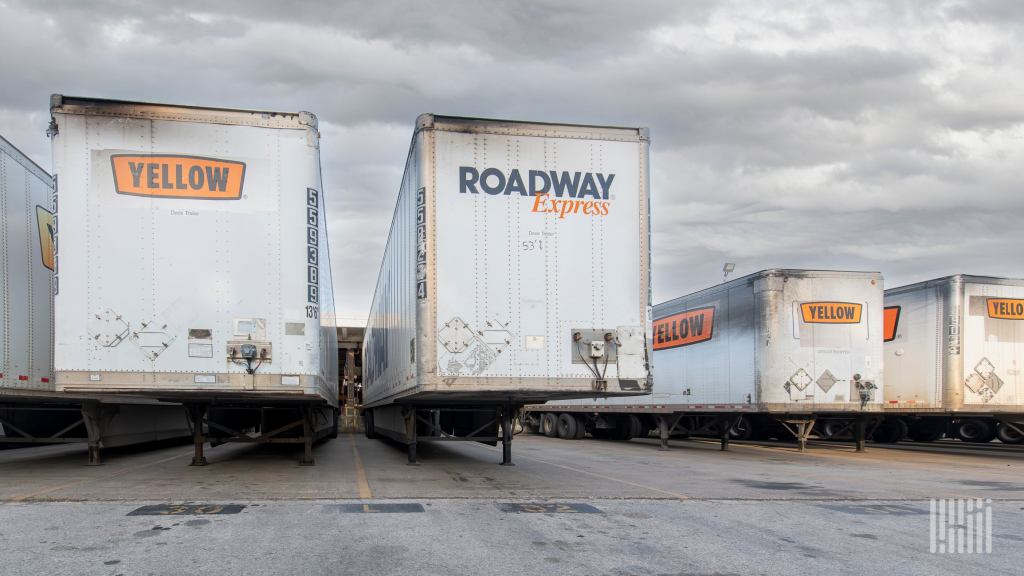
Trailers parked at a Yellow terminal

Several large less-than-truckload carriers as well as some real estate investors were named as winning bidders of defunct Yellow’s portfolio of terminals. In total, an auction that started last Tuesday netted nearly $1.9 billion in commitments for 130 of Yellow’s owned properties, according to a Monday evening filing in a Delaware court.

XPO’s (NYSE: XPO) $870 million bid for 28 properties — two of which are leased — was the largest winning bid.

Estes, which started the process with a $1.525 billion stalking horse bid that set the price floor for the auction, will walk with 24 terminals at a total purchase price of nearly $250 million.

Saia’s (NASDAQ: SAIA) bid includes 17 properties for a purchase price of $236 million.

Knight-Swift Transportation (NYSE: KNX), which amassed a $1 billion LTL network through acquisition in 2021, has a winning bid for 13 terminals at a $51 million purchase price.

Private carriers R+L Carriers and Pitt Ohio were active as well through their real estate arms.

The Moroun family, which has majority interests in Central Transport, PAM Transportation (NASDAQ: PTSI) and Universal Logistics (NASDAQ: ULH), holds a winning bid for eight properties valued at $38 million through its real estate arm, Crown Enterprises. 

Not mentioned in the filing was Old Dominion Freight Line (NASDAQ: ODFL), which briefly held a top stalking horse bid of $1.5 billion. However, the carrier may still be active in the process or it could potentially acquire terminals from the winning bidders. 

BidderTerminal countPurchase price
XPO28$870M
Estes24$248.7M
Saia17$235.7M
RAMAR Land Corp. (R+L Carriers)8$211.5M
Terminal Properties, LLC (Pitt Ohio)7$83.8M
Knight-Swift Transportation13$51.3M
ArcBest 3$30.2M
A. Duie Pyle4$29.4M
TForce2$16M
Southeast Consolidators1$8.5M
Skylark Logistics2$8M
Z Brothers Trucking1$4.2M
Unis2$2.4M
Table: Court filings

The court filing showed there were still 46 owned terminals that remain to be sold. A separate filing showed the auction of Yellow’s 140-plus leased terminals is set to reconvene on Dec. 18

Objections to the sale order are due by the end of business Friday. The court is expected to hold a hearing to approve the sales on Dec. 12.

The court recently approved the sale of Yellow’s 12,000 tractors and 35,000 trailers through auction houses. That liquidation remains ongoing.

The unwinding of Yellow’s estate is expected to generate proceeds greater than the $1.2 billion in debt held by secured lenders and the more than $200 million in bankruptcy financing provided by hedge funds.

The estate will still need to settle claims from unsecured creditors, including pension funds, which have claimed they are due billions. However, bankruptcy experts have told FreightWaves that pension withdrawal liabilities owed are likely to be negotiated to just a small fraction of a recent $6.5 billion estimate.

More FreightWaves articles by Todd Maiden

TuSimple lays off 150 more employees as it winds down US operations

TuSimple Holdings, once a leader in U.S. autonomous trucking development, is winding down its operations after a five-month review apparently found no takers for its business that was the first to conduct a driverless pilot two years ago.

TuSimple went through a brutal internal leadership struggle in late 2022 that was at least partly responsible for chasing away Navistar International, its development partner on a purpose-built autonomous truck. The two sides broke up a year ago this week after a 2-and-a half-year partnership. 

Unable to align with another OEM partner, TuSimple had to rely on Tier 1 suppliers for redundant steering, braking and other components needed when a truck has no human driver.

TuSimple joins Embark Trucks and Waymo Via in leaving autonomous trucking development this year. Waymo, part of Google parent Alphabet Inc., continues to work with Daimler Truck North America on development of a redundant chassis while pursuing robotaxis. It left open the possibility of resuming autonomous trucking at some point.

TuSimple still pursuing U.S. business in March

As recently as March, San Diego-based TuSimple indicated it would seek another partner and pursue plans for autonomous trucking in the U.S. After a second wave of 300 layoffs in May, the company announced a strategic review in late June. Exiting the U.S. was one possible outcome.

In an 8-K filing with the U.S. Securities and Exchange Commission on Monday, TuSimple said it was laying off 150 of its remaining U.S. employees. Those left will focus on winding down operations. Most of the company’s remaining 700 full-time employees will be in China and Asia, where TuSimple has focused its efforts after suggesting it would try to sell those operations.

TuSimple laid off more than 300 employees in December 2022 — about a quarter of its U.S. workforce. At the time of the layoffs in May, the company shuttered an autonomous freight-hauling operation that used safety drivers. TuSimple celebrated 10 million autonomous miles in March between the layoff rounds.

Despite assertively promoting its patent portfolio, TuSimple apparently attracted no meaningful offers.

Latest layoffs take out 75% of remaining U.S. workforce

The latest layoffs amount to 75% of the remaining U.S. workforce and 19% of its global employment, the 8-K said.

“The company anticipates that the remaining U.S. workforce will focus on winding down the company’s U.S. operations, including through sales of U.S. assets, and assisting with the strategic shift to the Asia-Pacific region,” the SEC filing said. 

The company’s board of directors approved the window last Thursday. TuSimple expects one-time charges of approximately $7 million to $8 million in connection with the restructuring. That includes cash expenses for employee transition and severance,  employee benefits, and related costs.

Is TuSimple’s patent promo intended to find a buyer?

TuSimple prepares to exit US autonomous trucking market

TuSimple cuts 300 more US jobs, will keep China operations

Click for more FreightWaves articles by Alan Adler. 

Down over 50 cents in 2.5 months, retail diesel not yet impacted by futures slide

The key benchmark price used for most fuel surcharges is now down to levels not seen since July 24.

The latest weekly average retail diesel price posted by the Department of Energy/Energy Information Administration price, however, only had a few days to react to the plunging futures market that accompanied an OPEC+ meeting where the final agreement left most oil traders skeptical of the group’s efforts to combat a growing imbalance in global markets.

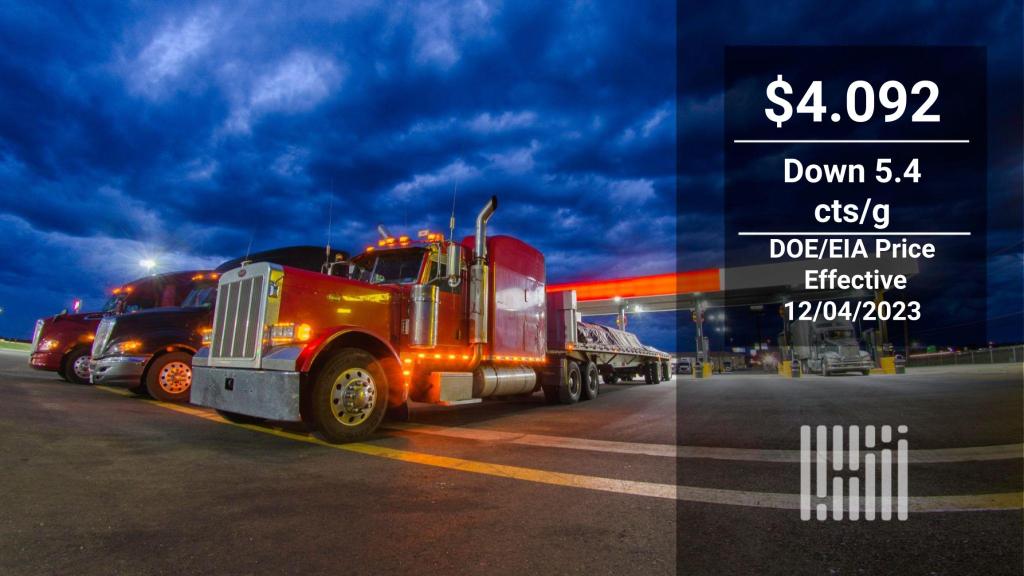
The DOE/EIA price declined 5.4 cents per gallon to $4.092, a drop of 5.4 cents per gallon. It has now declined nine of the last 11 weeks. It’s down 54.1 cents since a recent high on Sept. 18, and the price is down 87.5 cents per gallon from where it was a year ago.

The all-time high of $5.81 per gallon recorded on June 20 of last year is now $1.718 per gallon in the rearview mirror. 

With the normal lag in retail changes in place, it means that the retail price of diesel is not able yet to reflect the steep fall in global petroleum prices and in particular the price of ultra low sulfur diesel (ULSD) on the CME commodity exchange, both in the days leading up to last Thursday’s OPEC+ meeting and the days since.

From a settlement of $2.907 per gallon Tuesday on the CME, ULSD dropped four consecutive trading days to settle Monday at $2.6597 per gallon, a drop of 24.73 cents per gallon. During that time, Brent crude, the world benchmark, dropped more than $5 a barrel, to $78.03 per barrel from $83.10 per barrel.

The declines came in response to the OPEC+ meeting’s decision to produce a headline reduction in supply of 2.2 million barrels per day in the first quarter. But that number includes a 1 million b/d reduction by Saudi Arabia that is already in place as well as a 500,000 b/d cut in exports from Russia that is not necessarily a cut in output. Instead, the consensus calculations are that the new reductions from quotas will be 700,000 b/d. 

But some of those member countries of OPEC+ already are struggling to produce their quotas, so the reductions may not amount to much. That could be a problem for oil exporting nations that are facing a 2024 in which virtually every model shows supply growth outstripping demand growth.  

“[The] decisions technically would tighten the first quarter balance, but the market was expecting more,” Clay Seigle, director of global oil service at Rapidan Energy Group, was quoted by S&P Global Commodity Insights as saying following the meeting. 

Two other energy-related developments Monday:

  • The Department of Energy is planning an aggressive push to refill the Strategic Petroleum Reserve. Bloomberg quoted Deputy Energy Secretary David Turk as saying that with some maintenance work on the SPR infrastructure now completed, the DOE can buy 3 million barrels per month. The news had no apparent impact on prices Monday.
  • The price of U.S. natural gas has now fallen back to the price of late September. Henry Hub natural gas settled Monday at 2.694, just above the $2.656/thousand cubic feet (Mcf) settlement of Sept. 24. In the interim, it settled as high as  $3.515/Mcf on Nov. 3. But a slow start to winter in much of the U.S., combined with hefty inventories, have pushed down prices, all but eliminating much chance for some natural gas applications to switch to diesel because of more attractive oil prices. 

More articles by John Kingston

Court won’t hear Berkshire claims over Haslam’s Pilot payments next month

Jacobs leading takeover of software company as he readies next move

BMO’s transportation sector data suggesting trucking credit markets worsening

Landstar CEO Jim Gattoni to retire

A blue tractor pulling a Landstar trailer

Freight broker Landstar System announced Monday a succession plan for the dual role of president and CEO as Jim Gattoni, who holds the positions currently, is retiring after nearly three decades with the company.

Landstar’s (NASDAQ: LSTR) board of directors has chosen Frank Lonegro, current CFO at Beacon (NASDAQ: BECN), the largest publicly traded roofing and building supply company in the U.S. and Canada, as its new chief effective Feb. 2.

Gattoni will continue to lead the company through the fourth-quarter earnings call, which is scheduled for Feb. 1. He will then step down from his current duties and as a board director to assume the role of special adviser to the CEO. He is expected to retire from the advisory position in July.

The company’s new chief has been working outside of the industry most recently but has ties to the transportation sector.

In addition to working for the construction supply company, Lonegro spent nearly 20 years at CSX (NASDAQ: CSX), which like Landstar is headquartered in Jacksonville, Florida. Lonegro was the CFO at CSX from 2015 to 2019. He also held leadership roles in service design and maintenance and repair for the railroad.

“Frank’s broad financial, operational and technology leadership at large, publicly traded organizations make for an outstanding fit at Landstar,” said Diana Murphy, Landstar’s chairman. “The board is delighted to welcome Frank and his impressive record of achievement to Landstar.”

Gattoni joined Landstar in 1995 as corporate controller. He was promoted to CFO in 2007 and added the title of president in 2014. Later that year, he took over as CEO when former company head Henry Gerkens retired. Since Gattoni took the the helm, Landstar’s revenue has more than doubled to $7.5 billion and its net income has tripled ($431 million in 2022).

“On behalf of the independent members of the board, I also want to express tremendous appreciation to Jim for his leadership of Landstar and partnership with all of us,” Murphy said.

“Landstar has greatly benefited from Jim’s many contributions over an almost 30-year career with the company,” stated David Bannister, Landstar board member and head of the compensation committee. “His passion for the independent business owners who make up the Landstar network has played an integral part in driving Landstar forward as a technology-driven industry leader. We wish Jim all the best in his retirement.”

Lonegro will also have a spot on Landstar’s board.

Nearly 8% of Landstar’s annual revenue comes from the shipment of building products.

“Frank is an experienced, solutions-oriented leader. He understands the fast-paced freight transportation industry, the critical importance of a safety-first culture and our commitment to the long-term success of Landstar agents, BCOs [business capacity owners] and other third-party capacity providers to continue to drive our growth,” Gattoni said.

“I am honored to follow in Jim’s footsteps and to further build on the company’s tremendous legacy of success,” Lonegro said. “It is my privilege to guide Landstar into the future as we write the next chapters in Landstar’s impressive story.”

More FreightWaves articles by Todd Maiden

Florida seeks help for truckers failing pre-trip inspections

Truck driver inspecting tires.

WASHINGTON — CDL applicants in Florida may have a faster road to getting a license if testers in the state get an exemption from federal regulators.

Specifically, the Florida Department of Highway Safety and Motor Vehicles (FLHSMV) is petitioning the Federal Motor Carrier Safety Administration to allow skills testers — at their discretion — to continue testing a person applying for a CDL who fails the pre-trip inspection or basic vehicle controls segments of the CDL skills test to come back later to retake only the failed segment.

Currently, federal regulations require the three-part CDL skills test — pre-trip inspection, basic vehicle control skills and on-road skills — to be administered and completed in that order. If an applicant fails one part of the test, he or she is not allowed to start the next part of the test but instead must return on a different day to retake all three parts.

In Florida, nearly all CDL skills tests are conducted by third-party testers, FMCSA noted.

“[FLHSMV] cites that the most failed segment of the test is the pre-trip inspection, and if the exemption is granted, the tester could continue to test basic vehicle control skills and on-road skills,” if the tester failed the pre-trip inspection portion, FMCSA stated in an exemption notice posted on Monday. “If the CDL applicant passed these other portions of the test, they could return at a later date and retake just the pre-trip inspection portion of the test.”

In addition to easing testing procedures for entry-level truck drivers, an exemption, if granted, “would allow their compliance staff to better utilize their time and resources in completing the required monitoring of third-party testers,” FLHSMV asserted. “FLHSMV believes the exemption would not compromise safety, because the decision to continue with the test would reside with certified, experienced testers.”

FLHSMV also pointed out that, with implementation of the Federal Entry-Level Driver Training (ELDT) regulations in 2022, most applicants being tested “have been certified as proficient in operating commercial motor vehicles, having completed behind-the-wheel training that prepares them to safely operate a commercial motor vehicle during the on-road portion of the CDL skills test.”

The ELDT regulations set minimum training requirements that new prospective truck drivers must complete before being allowed to take certain CDL skills or knowledge tests.

Asked to comment on the exemption request, Andrew Poliakoff, executive director of the Commercial Vehicle Training Association, said his association “is encouraged to see Florida pursuing this opportunity to make skills testing more efficient, and we support other states in seeking similar authority.”

Comments on FLHSMV’s application must be received by Jan. 4. 

Click for more FreightWaves articles by John Gallagher.

DHL Express rotates Americas CEO to Europe

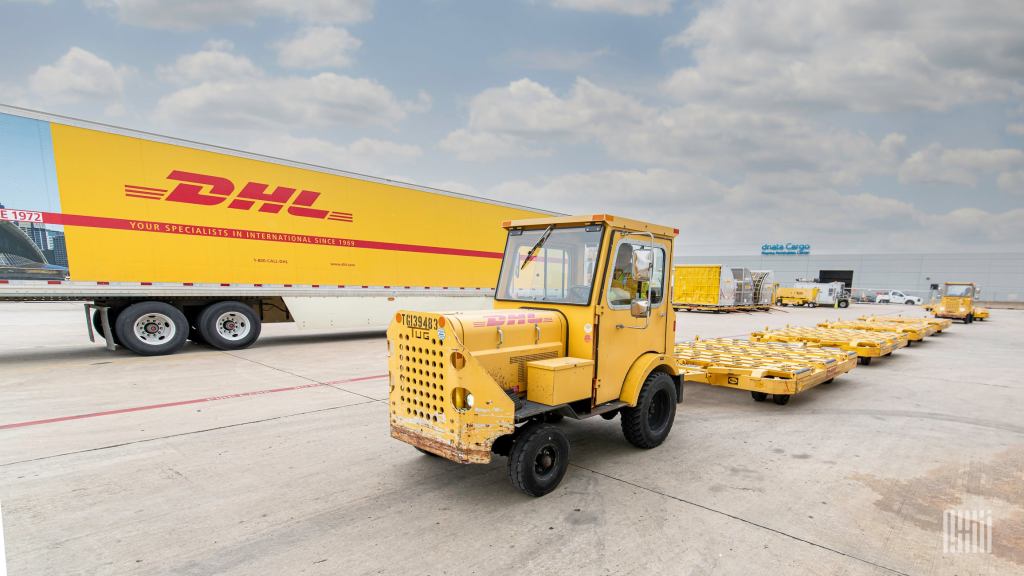
A yellow DHL tractor trailer and airport tug on a paved lot.

DHL Express announced Monday it has shuffled its regional leadership, highlighted by Mike Parra, CEO of the Americas, taking over the organization in Europe and being replaced by Andrew Williams, the current CEO of DHL Express Canada, effective Jan. 1.

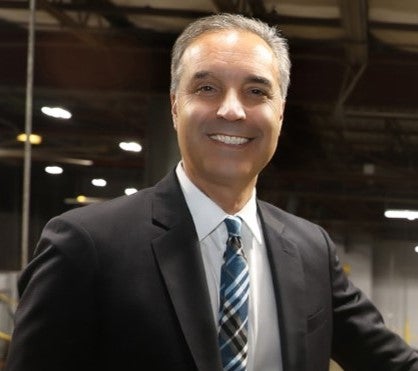
Americas CEO Mike Parra (Photo: DHL)

Parra has been the Americas CEO since 2016, during which time Express has doubled revenue, added more than 12,000 jobs and expanded its operational footprint, most recently with new regional hubs in the U.S., Mexico and Canada, and new direct in-network flights to Argentina, Chile and Brazil. He also oversaw the introduction of a new air hub in Atlanta and the expansion of the Miami hub. Parra started his career in logistics at DHL Express in 1997.

In Europe, Parra will manage DHL Express operations across more than 60 countries and territories, as well as more than 46,000 employees. He will be based in Madrid.

The musical chairs began last summer when Alberto Nobis left as CEO of DHL Express Europe to pursue other opportunities, according to the company. In August, Nobis became CEO of VTG Gmbh, a rail car leasing company based in Hamburg, Germany.

Williams started in sales at Loomis Express, which was acquired by DHL Group in 2002. He has served as CEO of DHL Express Canada since 2015, helping to make Canada a top-five country for inbound parcel volume. During his tenure, revenue has grown by nearly four times and DHL has grown market share in Canada.

The Americas region covers 55 countries and territories and has more than 29,000 employees. It is headquartered near Miami in Plantation, Florida.

DHL has not yet named a successor for Williams in Canada.

Click here for more FreightWaves/American Shipper stories by Eric Kulisch.

RECOMMENDED READING: 

DHL Express upsizes Hong Kong facility

DHL Express opens new freighter route to Argentina

‘Astronomical’ gains for dry bulk shipping but rally looks fleeting

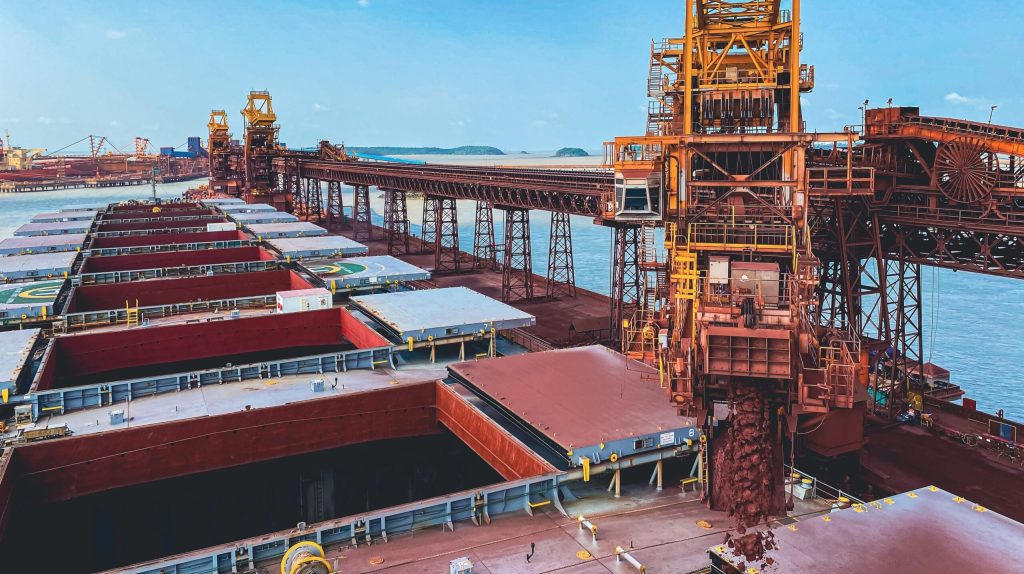
a photo of a dry bulk carrier

Dry bulk shipping is the world’s largest ocean shipping market by volume and boasts the world’s largest freight futures market. After spending most of this year on the sidelines, dry bulk shipping is suddenly back in the spotlight again.

Spot rates for larger bulkers have skyrocketed over the past four weeks. Freight futures trading has been frenetic. Dry bulk stocks are up double digits.

The caveat is that this market spike is expected to be short-lived. Rates may have already peaked.

A week that shipowners ‘dream of’

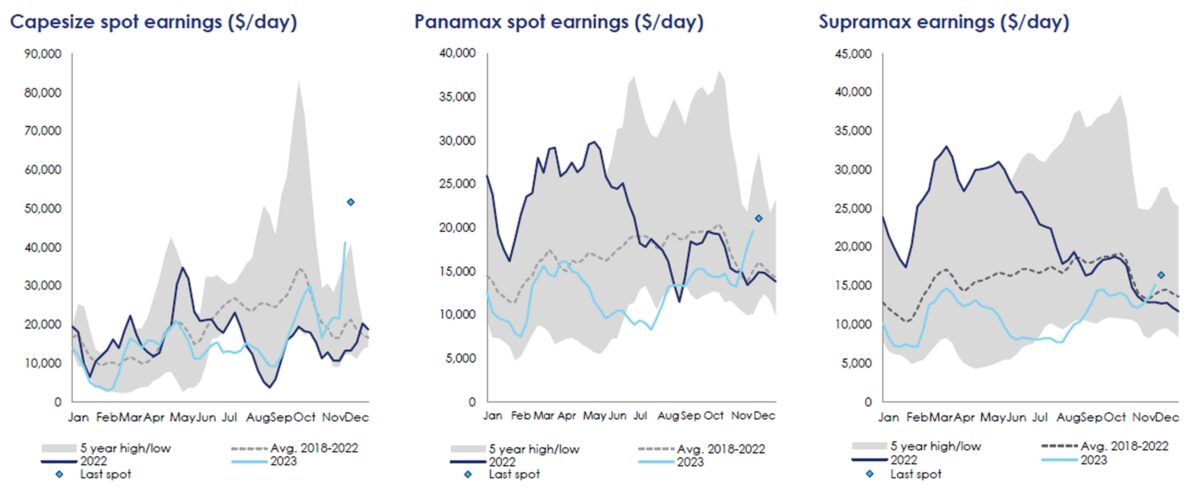
Rates for Capesizes — larger dry bulk vessels with capacity of around 180,000 deadweight tons (DWT) that carry iron ore, coal and bauxite — averaged $54,600 per day on Monday, according to Clarksons Securities, more than triple rates on Nov. 1 of $15,800 per day.

 “This is a week that [shipowners] dream of,” said ship brokerage Braemar on Thursday. “There were astronomical gains made in all markets related to Capes.”

Deutsche Bank analyst Chris Robertson noted that last week’s 71% surge in Capesize rates was “one of the biggest jumps in the spot market in the last decade.”

John Kartsonas, managing partner of the Breakwave Dry Bulk Shipping ETF (NYSE: BDRY), said in an interview with FreightWaves on Monday: “It is not only Capes. It’s across the board. This has been a synchronized rally across every asset class over the last three or four weeks.”

Panamaxes (65,000-90,000 DWT) and Supramaxes (45,000-60,000 DWT) transport grains, coal and so-called “minor bulks” (minerals, steel, etc.). Panamax spot rates reached $21,100 per day on Monday, according to Clarksons Securities, up 53% since Nov. 1. Supramax rates hit $16,400 per day, up 31% over the same period.

(Charts: Clarksons Securities)

“Clearly the Atlantic market is lacking ships, not only Capes but also Panamaxes and Supramaxes,” said Kartsonas.

Why dry bulk rates spiked in November

One driver of the dry bulk rally — particularly for Panamaxes and Supramaxes carrying U.S. grain exports to Asia — is restrictions at the Panama Canal.

“Everyone has been talking about this since the summer. Now it is finally having an effect,” said Kartsonas. Ships carrying U.S. grain are taking the longer route via the Suez Canal, and bulkers face long delays returning to the Atlantic from Asia via the Panama Canal.

Panama Canal restrictions are compounding fleet inefficiencies caused by months of heavy congestion at Brazilian grain ports. Braemar reported that there are still 113 Panamaxes and geared bulkers waiting to load off Brazilian ports, down from a peak of 168 but more than double levels a year ago.

Another rate driver is winter weather, said Kartsonas. “The weather has finally gotten worse in both Europe and China, so there are a lot of delays in unloading there.”

In the all-important iron ore trade, 400,000-DWT Valemax-class bulkers controlled by Brazilian iron ore miner Vale (NYSE: VALE) are being bogged down by weather issues at unloading ports, prompting Vale to secure more Capesize tonnage in the spot market, said Kartsonas.

Yet another driver of Capesize rates: West African exports of iron ore and bauxite. Braemar said Monday that last week was “the most active week on record for bauxite and iron ore Capesize shipments from West Africa.”

According to Kartsonas, “We always think about Brazil for the Capesize trade, but it’s increasingly about West Africa. There are times when West Africa accounts for more spot charter demand than Brazil. This is a very important change to the whole equation and it’s something the market is just starting to figure out.”

Is the end of rate spike nigh?

The BDRY exchange-traded fund, which buys near-dated forward freight agreements (FFAs), was down 7% on Monday in almost quintuple average volume.

“The consensus, when you look at the futures market, is that rates are going to collapse,” Kartsonas told FreightWaves.

Dry bulk rates typically hit annual lows in the first quarter. Compared to current rates of over $50,000 per day, the January Capesize FFA contract was trading at just $17,250 per day on Monday, down 17% versus Friday. The February contract was at $10,125 per day, down 8% versus Friday.

Brokerage Thurlestone Shipping said on Monday: “There were some signs of nervousness on the FFA market towards the close of play, with the market taking a bit of a battering. Time will tell whether this is a fundamental shift in sentiment or just profit-taking, but undeniably, things feel a little more nervous here, although the physical fundamentals are still relatively unchanged with tonnage tight everywhere.”

According to Kartsonas, “The belief is clearly that this [rally] is very temporary. And I think that makes a lot of sense. If this was positional tightness that happened because all of these circumstances came together at the same time, it is very easy to see how this is going to unwind. The question is how deep the correction will be.”

Ship brokerage BRS issued a bearish outlook on dry bulk’s 2024 prospects on Thursday. “There has been a general improvement in dry cargo volumes this year, [but] it lacks the robustness that industry participants have grown accustomed to.” Fleet supply growth is outpacing demand growth and there are concerns over China, it said.

 “Without tailwinds afforded by one-off disruptive events, we are now confronting ‘darker storms ahead,’” warned BRS.

Capturing rate upside while it lasts

Dry bulk stocks are moved by expectations on future cash flows, company-specific issues unrelated to rates and broader stock market issues unrelated to dry bulk. The BDRY exchange-trade fund, due to its purchase of FFAs, is more correlated with spot rates.

FFA trading volumes exploded as dry bulk rates spiked in November. “On one day last week, hundreds of millions of dollars of freight were traded, multiples of what the average has been over time,” said Kartsonas. “The liquidity is incredible. You can get in and out of major positions on a daily basis without affecting the price. What this tells you is that there is a lot of institutional money in the [FFA] space.”

Buying FFAs is not a practical option for the typical retail trader seeking to profit off dry bulk rates, so they either buy dry bulk stocks or the BDRY ETF.

BDRY more than doubled — up 109% — between Nov. 1 and Friday, according to data from Koyfin. In contrast, Himalaya Shipping (NYSE: HSHP) rose only 34% over the same period, Eurodry (NASDAQ: EDRY) 33%, Golden Ocean (NASDAQ: GOGL) 28%, Safe Bulkers (NYSE: SB) 27%, Genco Shipping & Trading (NYSE: GNK) 24%, Star Bulk (NASDAQ: SBLK) 19% and Eagle Bulk (NYSE: EGLE) 17%.

chart of dry bulk shipping stocks vs. BDRY ETF
Share price adjusted for dividends. (Chart: Koyfin)

“For traders looking to capture these kinds of short-term spikes, BDRY is clearly the better product,” argued Kartsonas. “BDRY follows the futures market and the futures market will follow spot rates, whereas stocks are priced over longer-term cash flows — and I think that’s a different animal.”

Click for more articles by Greg Miller 

Colonial Terminals acquires Cape Fear bulk liquid facility

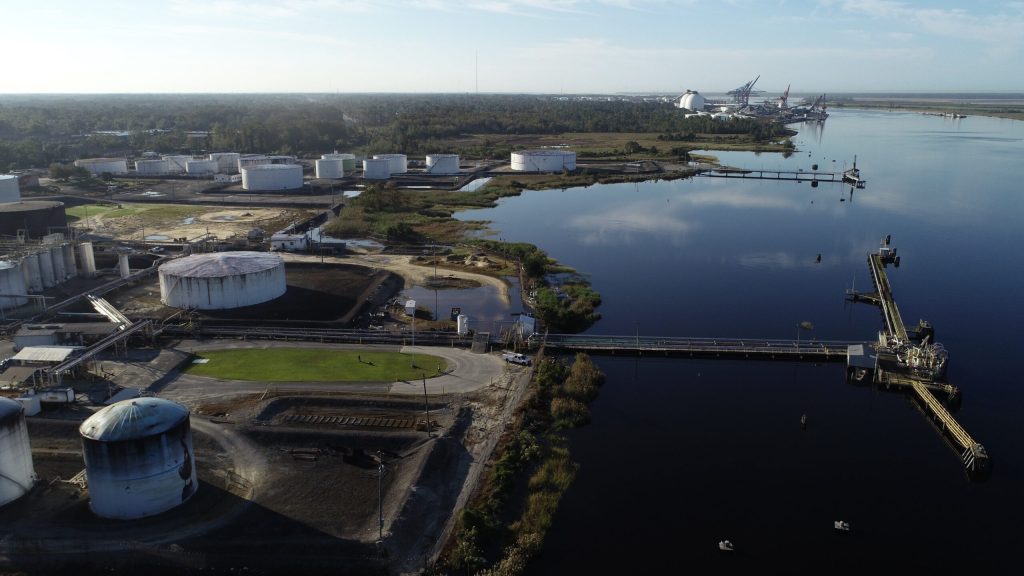
A photo of CTI's new Cape Fear terminal

Colonial Terminals Inc. (CTI) announced it acquired a bulk liquid terminal in Wilmington, North Carolina, from Buckeye Terminals.

The facility provides roughly 550,000 barrels of storage capacity along the Cape Fear River and sits near another site that is already owned and operated by CTI. The two sites together have more than 1 million barrels of capacity and are accessible by rail and truck in addition to water. The properties primarily store industrial chemicals, specialty chemicals and petroleum.

CTI said it plans to retain all employees working at the Buckeye location.

Financial terms of the transaction were not disclosed.

“This adjacent facility adds a new berth and substantial river frontage to our already large footprint on the Cape Fear River, and we’re eager to offer new capabilities for existing customers as well as attract new customers and products to the market,” said CTI President Ryan Chandler.

The nearly 100-year-old company now has the largest independent liquid and dry bulk storage network with breakbulk capabilities in the Southeast. The acquisition brings CTI’s liquid capacity to 8 million barrels across seven terminals, five of which are in Georgia. The network also provides dry capacity of 200,000 tons of vertical storage and 400,000 square feet of covered flat storage.

“Wilmington is a gateway to the growing Southeastern US market, and we believe this acquisition strongly positions our team to support current and new customer growth far into the future,” said Chandler.

In June, the company announced a more than $100 million project to develop 17 acres along the Savannah River in Georgia. That breakbulk operation will be served by Norfolk Southern (NYSE: NSC).

More FreightWaves articles by Todd Maiden

Court won’t hear Berkshire claims over Haslam’s Pilot payments next month

The Haslam family and Berkshire Hathaway will square off in a Delaware court next month in their battle over accounting at Pilot Travel Centers, but a trial on charges Jimmy Haslam III secretly paid Pilot executives to give a short-term boost to the company’s earnings this year will need to wait.

Although Vice Chancellor Morgan Zurn of the Delaware Court of Chancery gave Berkshire Hathaway (NYSE: BRK.B) the opportunity to have its case over the Haslam payments heard at the same time as the proceedings over the accounting issues, attorneys for Berkshire Hathaway subsidiary NICO declined. 

Zurn had spelled out restrictions on what NICO attorneys could do if the case was expedited and heard alongside the accounting case. 

“NICO is not entitled to any additional discovery to investigate its counterclaims — it would be permitted to rely solely on the discovery it obtains in further of its defenses. The Court would not consider the existence of NICO’s affirmative defenses when ruling on any discovery, evidentiary, or similar motions. NICO would not be permitted to call any fact witnesses or experts to testify in support of its counterclaims unless the testimony also properly supports its other defenses,” Zurn wrote in a letter dated Friday and posted to the court’s website Monday.

In its response, NICO’s attorneys said that “given the uncertainty in the amount and type of evidence that will be allowed to be adduced and presented,” they chose not to proceed under those conditions.

The Haslams filed their original suit regarding Berkshire Hathaway’s accounting under the name of Pilot Corp. Pilot Travel Centers (PTC) along with several Berkshire Hathaway executives are defendants.

At the heart of that case are accounting changes Berkshire Hathaway implemented, moving to a basis known as “pushdown,” when it took control of PTC at the start of 2023. After the steps to take control, Berkshire Hathaway owned 80% of the country’s largest truck stop chain.

The two sides do not dispute the changes were implemented. They also do not seem to dispute that in the short term, it has an impact on the way Pilot’s earnings were measured. 

But what is at issue is whether the accounting will be used to determine PTC’s earnings before interest and taxes this year, and if it does, whether it will affect the value of PTC should the Haslams pull the trigger on a put option that will require Berkshire Hathaway to buy the 20% of the company it does not own. EBIT will be the basis for determining how much that 20% stake is worth.

In its original lawsuit, the Haslams said Berkshire Hathaway founder Warren Buffett had told family representatives the accounting used to determine EBIT would be the same as the two sides agreed upon back in 2017 when the staggered acquisition of PTC by Berkshire Hathaway was decided. That agreed-upon accounting is not the pushdown accounting that was implemented after Berkshire Hathaway took control.

If the Haslams were to exercise the option in 2024, they must do so in a window during the first quarter. The next opportunity after that would be in 2025.

The trial over the accounting issue is set in the Delaware Chancery Court for Jan. 8.

Zurn, in his opinion, challenged the NICO argument that it would suffer irreparable harm if its claims regarding the Haslam payments weren’t heard by the time the family could exercise its put option in the first quarter. If NICO’s arguments were heard after the put was exercised and it went through with the question of whether the Haslam payments impacted PTC’s bottom line in 2023, that could be dealt with later, Zurn wrote. “It is the rare case in which it is so difficult to quantify purely and proximate monetary harm that the harm is irreparable.” 

No date was set for the NICO claim over the payments to be heard.

The payments made by Haslam III were to a group of longtime Pilot employees still at the company, ostensibly to replace the end of another bonus system. But the payments were made privately out of Haslam’s pockets and Berkshire Hathaway management was not informed of them, calling them “illicit” in its lawsuit. Berkshire Hathaway charges that they led the Pilot executives to take steps mostly focused on boosting 2023 earnings — and thereby inflating the value of 2023 EBIT — rather than being concerned with the company’s long-term welfare.

More articles by John Kingston

Debt ratings review: Pilot remains strong operator

1st peek at Pilot’s finances after Berkshire Hathaway ownership grows

Berkshire Hathaway will pump out more Pilot data with bigger stake