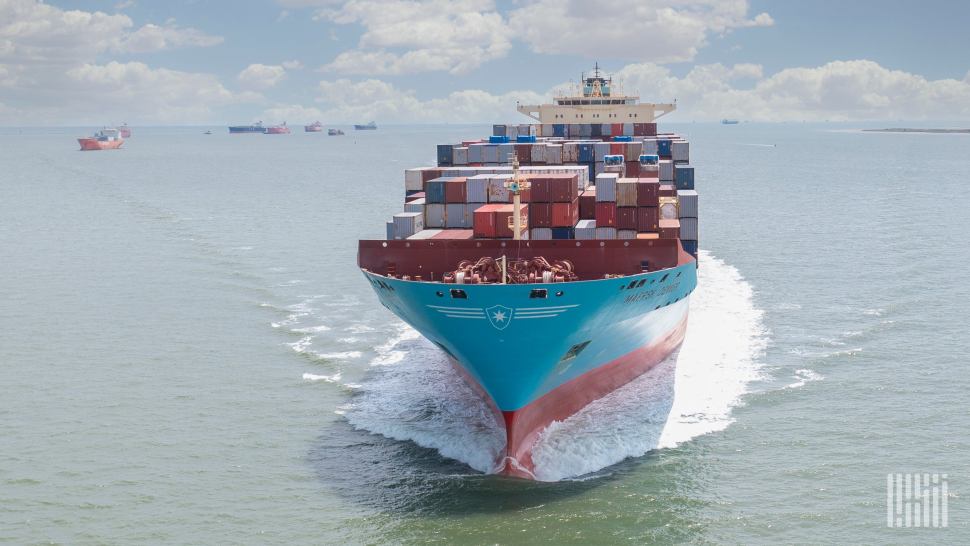
Port Houston announced the completion of its share of the $1 billion Houston Ship Channel Expansion (Project 11) during Monday’s commission meeting, marking a major milestone toward widening one of the nation’s busiest waterways; even as residents and environmental groups pressed for stronger safeguards over dredging practices.
Port officials said the widened channel through Galveston Bay — expanded from 530 feet to 700 feet — will improve safety, reduce vessel emissions, and strengthen Houston’s competitiveness.
“This is really big for our port and our channel and our region,” Charlie Jenkins, CEO of Port Houston, said during the meeting. “It has already had measurable efficiency gains and safety gains for all users of the Houston Ship Channel.”
Jenkins said daylight-restricted vessels now have an additional two-and-a-half hours each day to sail.
“That’s a huge improvement in emissions because ships aren’t sitting out there waiting — and it helps balance the workload of the channel, making it safer for everyone,” Jenkins said.
Jenkins also reported that September tonnage rose 6% year-over-year, with total throughput up 5% year-to-date, even as some commodity imports softened.
Port Houston handled 337,659 twenty-foot equivalent units in September, a 2% year-over-year increase compared to the same month in 2024.
“Compared to most ports, we’re faring very well given the economic uncertainties,” he said.
Public concerns over dredge spoil placement
The meeting’s public comment period was dominated by concerns about dredge spoil disposal sites linked to Project 11.
Representatives from the Environmental Defense Fund, Public Citizen, and local neighborhood coalitions urged the port to support a U.S. Army Corps of Engineers (USACE) proposal to barge dredged material to offshore bay sites instead of reusing legacy placement areas near Pleasantville and Clinton Park.
Paige Varner, a toxicologist scientist for the Environmental Defense Fund, said the dredge spoils could pose contamination risks.
“Testing from USACE and communities show that the material from both Project 11 dredging and ongoing maintenance dredging contains potentially hazardous concentrations of chemicals, including dioxins, furans, PCBs, arsenic, and PAHs,” Varner said. “These chemicals are linked to multiple cancers, developmental and reproductive harm, liver damage, and immune system suppression.”
Varner said “samples exceeded EPA risk levels by up to 25 times” and nearby “neighborhoods already face some of the highest cancer and non-cancer health risks in the country from air pollution.”
Varner urged the port to halt any new on-land placement of dredge spoils until comprehensive, transparent risk assessments are completed.
“It is imperative that the port take immediate steps to protect affected communities,” she said.
Retired Army Corps engineer Bill Empson echoed those concerns, saying the proposed onshore sites should undergo full dam-safety reviews, while Adrian Shelley, director of Public Citizen’s Texas office, asked the commission to “make a decision in favor of public health and safety.”
Major capital approvals
Commissioners also advanced a slate of infrastructure and maintenance contracts, including:
- $20 million for construction of Container Yard 7 North at Barbours Cut Terminal.
- $4.65 million for design of Wharf 8 at Bayport Terminal.
- $1.7 million for two truckable push boats and a maintenance barge.
- Renewals and new pipeline and barge-fleeting leases with Kirby Inland Marine and others
Brokerage Compliance Symposium
The day before F3. Every compliance issue you face - fraud exposure, carrier liability, FMCSA rules, cargo theft, insurance gaps - navigated by attorneys and operators defining best practices in a changing industry.
F3 Awards Dinner
The night before F3. FreightTech100 companies honored. FreightTech 25 and Shipper of Choice winners revealed live. Cocktail reception into dinner and live music - 300 industry leaders in one purpose-built room.
F3: Future of Freight Festival
Industry-defining keynotes, rapid-fire technology demos, and industry leaders networking in experiences across Chattanooga - plus the inaugural F3 Awards Dinner featuring the FreightTech and Shipper of Choice reveals.
The day before F3. Every compliance issue you face - fraud exposure, carrier liability, FMCSA rules, cargo theft, insurance gaps - navigated by attorneys and operators defining best practices in a changing industry.
The Signal at Chattanooga Choo Choo • Chattanooga, TN Register NowThe night before F3. FreightTech100 companies honored. FreightTech 25 and Shipper of Choice winners revealed live. Cocktail reception into dinner and live music - 300 industry leaders in one purpose-built room.
The Signal at Chattanooga Choo Choo • Chattanooga, TN Register NowIndustry-defining keynotes, rapid-fire technology demos, and industry leaders networking in experiences across Chattanooga - plus the inaugural F3 Awards Dinner featuring the FreightTech and Shipper of Choice reveals.
The Signal at Chattanooga Choo Choo • Chattanooga, TN Register Now