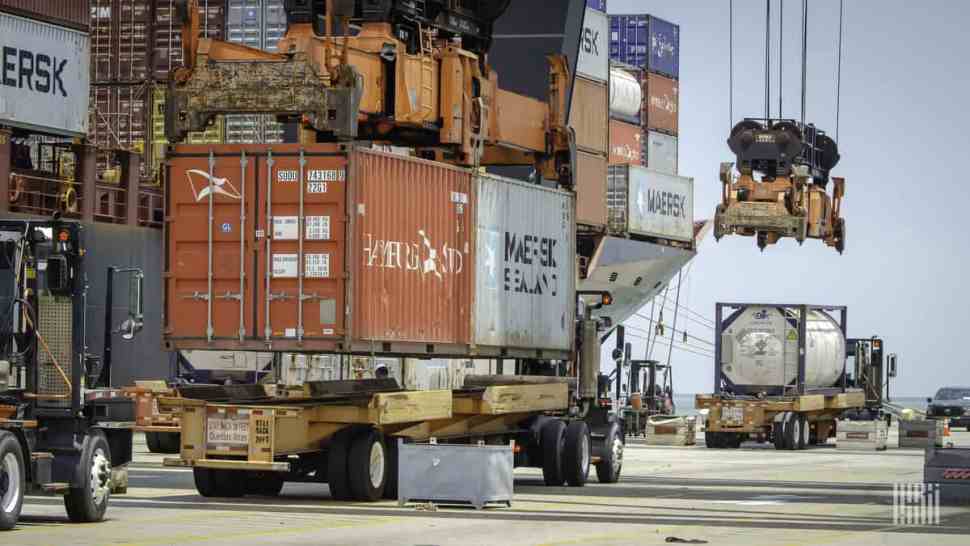
Port Houston saw steady cargo volumes in February, while commissioners on Monday approved a new tariff rule that shortens free time for refrigerated imports — a move that could tighten terminal capacity for shippers moving temperature-controlled freight through the Gulf.
Cargo tonnage rises in February, TEUs flat
Cargo tonnage at Port Houston increased 4% year over year in February, totaling 4.38 million short tons across the port’s eight public terminals. Year-to-date tonnage reached 8.9 million short tons, up 5% compared with the same period in 2025.
Container volumes were essentially flat for the month at 326,799 twenty-foot equivalent units, but year-to-date container volumes reached 696,833 TEUs, up 2% year over year.
Loaded exports increased 5% and loaded imports rose 3% in the first two months of the year, reflecting continued demand moving through the Houston Ship Channel.
At Port Houston’s multipurpose facilities, February volumes for dry bulk and liquid bulk increased 28% and 31%, respectively, while steel volumes declined 27% year to date due to cyclical demand and global market conditions.
During the port’s commission meeting Monday, CEO Charlie Jenkins said the port maintained efficient operations in February despite fog and other delays.
“We had lots of weather challenges with fog this last month, and to see us still being able to grow with a lot of downtime in the system is a good sign of things to come,” Jenkins said.
Port Houston’s revenue was up 1% year over year in February, according to Christopher Edwards, the port’s deputy chief financial officer.
“Through February, operating revenues totaled $110 million, up 1% from the prior year, down 6% to plan,” Edwards said. “Cash generation remains consistent with historical trends between 40% and 45%. Despite some weather in February, container volumes are running steady against the 2026 plan, and early indicators are that March’s throughput will be stronger.”
Reduction in free time at Barbours Cut and Bayport terminals
One of the key operational items approved during the meeting was an amendment to Tariff Nos. 14 and 15 governing Barbours Cut and Bayport container terminals, effective May 1.
The tariff amendments include two primary changes:
- Clarification of placard requirements for certain battery-powered vehicles transported through the container terminals.
- Reduction in free time for loaded import refrigerated containers requiring power, which affects storage charges and terminal dwell time for reefer containers.
“This aligns our rules with other major markets and supports the shippers’ needs to expedite the handling of these commodity types,” Chief Port Operations Officer Ryan Mariacher said. “We want to be a transit facility, not a storage facility, and more throughput creates more economic activity and jobs.”
The reefer free-time change could be particularly significant for shippers and logistics providers handling temperature-controlled cargo, as reduced free time can increase storage costs and encourage faster cargo pickup from terminals.
The battery-powered vehicle placard requirement reflects growing volumes of electric vehicles and lithium battery shipments moving through container terminals, which require specific safety labeling and handling procedures.
Port Houston’s economic impact expanding
Jenkins also highlighted the broader scale of the Houston Ship Channel complex and the economic impact of port operations.
“As a port and side note, we are one port, and it’s got public and private facilities, by far the largest in the nation,” Jenkins said, noting the public port alone would rank among the top U.S. ports by volume.
Mariacher said operational and infrastructure improvements, along with the impact of the Houston Ship Channel expansion project, will benefit the region.
“Project 11 represents that forward-looking investment,” Mariacher said, noting the expansion improves safety, efficiency and long-term economic growth tied to freight movement.
Mariacher also emphasized how infrastructure improvements translate into operational benefits for terminals and vessel movements.
“Projects like this, they do more than move ships. They sustain American jobs, they increase the economy, they increase national security, and they support domestic manufacturing,” Mariacher said.
He added that expanded navigation and improved channel access are already improving vessel movements and terminal utilization.
“The impact is already seen, and I think we’ll continue to see it for years to come,” Mariacher said.
Brokerage Compliance Symposium
The day before F3. Every compliance issue you face - fraud exposure, carrier liability, FMCSA rules, cargo theft, insurance gaps - navigated by attorneys and operators defining best practices in a changing industry.
F3 Awards Dinner
The night before F3. FreightTech100 companies honored. FreightTech 25 and Shipper of Choice winners revealed live. Cocktail reception into dinner and live music - 300 industry leaders in one purpose-built room.
F3: Future of Freight Festival
Industry-defining keynotes, rapid-fire technology demos, and industry leaders networking in experiences across Chattanooga - plus the inaugural F3 Awards Dinner featuring the FreightTech and Shipper of Choice reveals.
The day before F3. Every compliance issue you face - fraud exposure, carrier liability, FMCSA rules, cargo theft, insurance gaps - navigated by attorneys and operators defining best practices in a changing industry.
The Signal at Chattanooga Choo Choo • Chattanooga, TN Register NowThe night before F3. FreightTech100 companies honored. FreightTech 25 and Shipper of Choice winners revealed live. Cocktail reception into dinner and live music - 300 industry leaders in one purpose-built room.
The Signal at Chattanooga Choo Choo • Chattanooga, TN Register NowIndustry-defining keynotes, rapid-fire technology demos, and industry leaders networking in experiences across Chattanooga - plus the inaugural F3 Awards Dinner featuring the FreightTech and Shipper of Choice reveals.
The Signal at Chattanooga Choo Choo • Chattanooga, TN Register Now