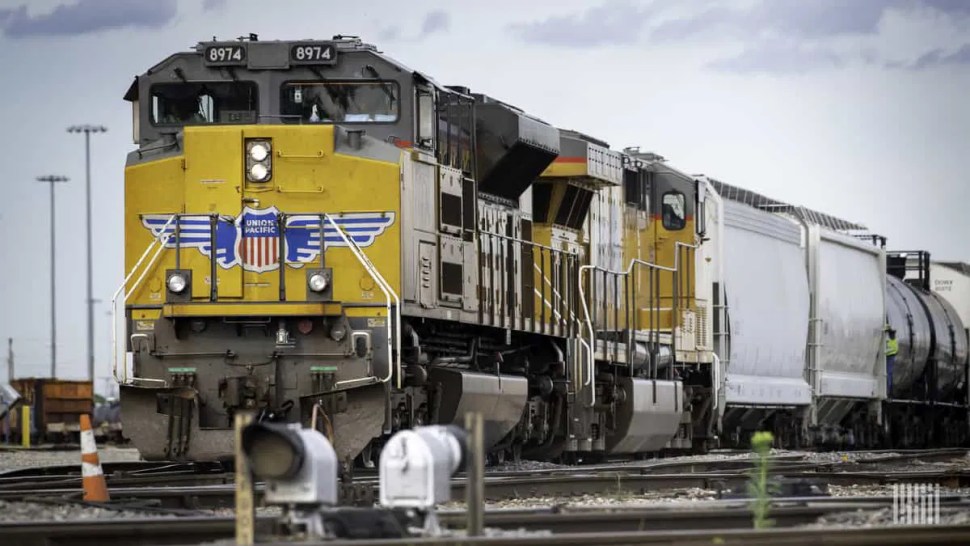
A trade group representing 3,500 chemical, manufacturing, agriculture, and energy companies warned that past history shows that a proposed merger of Union Pacific and Norfolk Southern will push up shipping costs without improving service.
“The Freight Rail Customer Alliance (FRCA) has long been opposed to continued consolidation in the rail industry based on past experiences resulting in increased rates, higher fees and unreliable service,” said FRCA President Emily Regis, in a release.
UP (NYSE: UNP) and NS (NYSE: NSC) on July 29 announced the $85 billion stock-and-cash deal to create a transcontinental system with more than 50,000 route-miles of track in 43 states. The carriers said the acquisition would improve service by cutting up to 48 hours from a loaded railcar’s total travel time from departure to arrival, know as dwell, while simplifying paperwork and creating a seamless journey for trains moving from coast to coast.
The FRCA pointed out that since the Staggers Rail Act of 1980 deregulated freight railroads, the industry has shrunk from 40 Class I carriers to six, with four handling 90% of U.S. rail freight.
“This demonstrated market power is a continuing concern as the railroads have lost market share to trucks over the past 20-plus years due to their dismal service and high rates, but the railroads keep increasing their profits and reducing their operating ratios,” said FRCA spokesperson Ann Warner, in the release. “This growth in and exploitation of railroad market power has also included forcing shippers into contracts that not only fall outside the Surface Transportation Board’s (STB) regulatory jurisdiction but also lack protection from poor service and increased fees. Any efficiencies achieved under so-called Precision Scheduled Railroading (PSR) have NOT been passed through to shippers – only retained by the railroads and their shareholders to Wall Street’s applause.”
The adjudicatory authority of the STB, which will either accept or reject the UP-NS deal, covers published tariff rates and not confidential contracts between railroads and shippers.
As far as service is concerned, unlike shippers who move goods by the carload, the FRCA observed that it is unclear how the STB’s tougher merger rules would benefit its larger shippers who move bulk freight such as coal or grain in trains dedicated to a single commodity, known as unit trains.
Regis stated that “particularly important to FRCA members is that a transcontinental merger provides enhanced competition for those who ship via unit train, typically point-to-point, and can utilize only a single rail carrier.”
About half of the 1.5 billion tons of freight shipped annually on U.S. rail are bulk commodities.
“In the end, shippers, particularly captive shippers, need guaranteed competitive solutions that are workable, effective, and enforced by the STB. Even if this imperative can be achieved in a transcontinental merger, there are concerns about how long it would take for the improvements to be successfully implemented and whether the integration problems and service meltdowns of past mergers can be avoided,” Regis said.
Werner said that the “FRCA looks forward to participating in the review and comment period once a formal merger application(s) has been filed.”
Subscribe to FreightWaves’ Rail e-newsletter and get the latest insights on rail freight right in your inbox.
Related coverage:
UP-NS merger puts intermodal giants on the wrong side of the map
Hub Group is fully behind a potential UP-NS transcontinental railroad creation
Brokerage Compliance Symposium
The day before F3. Every compliance issue you face - fraud exposure, carrier liability, FMCSA rules, cargo theft, insurance gaps - navigated by attorneys and operators defining best practices in a changing industry.
F3 Awards Dinner
The night before F3. FreightTech100 companies honored. FreightTech 25 and Shipper of Choice winners revealed live. Cocktail reception into dinner and live music - 300 industry leaders in one purpose-built room.
F3: Future of Freight Festival
Industry-defining keynotes, rapid-fire technology demos, and industry leaders networking in experiences across Chattanooga - plus the inaugural F3 Awards Dinner featuring the FreightTech and Shipper of Choice reveals.
The day before F3. Every compliance issue you face - fraud exposure, carrier liability, FMCSA rules, cargo theft, insurance gaps - navigated by attorneys and operators defining best practices in a changing industry.
The Signal at Chattanooga Choo Choo • Chattanooga, TN Register NowThe night before F3. FreightTech100 companies honored. FreightTech 25 and Shipper of Choice winners revealed live. Cocktail reception into dinner and live music - 300 industry leaders in one purpose-built room.
The Signal at Chattanooga Choo Choo • Chattanooga, TN Register NowIndustry-defining keynotes, rapid-fire technology demos, and industry leaders networking in experiences across Chattanooga - plus the inaugural F3 Awards Dinner featuring the FreightTech and Shipper of Choice reveals.
The Signal at Chattanooga Choo Choo • Chattanooga, TN Register Now