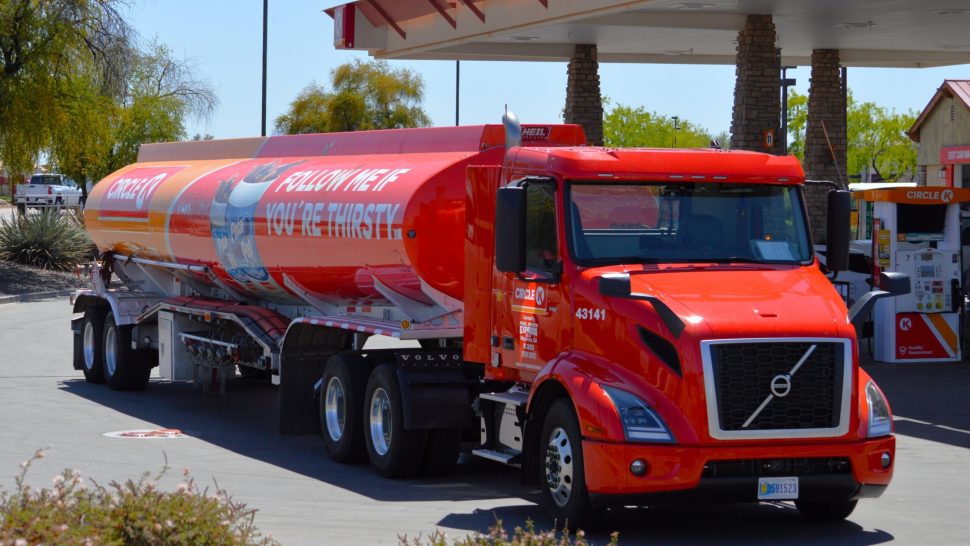
Relay Payments has signed up its third-largest customer with a deal for convenience store giant Circle K to accept its payment system at what it refers to as its “truck-accessible locations.”
The significance of the deal can be seen in the numbers: Relay Payments says its payment service is accepted at more than 3,000 locations. Circle K is bringing about 500 new outlets to the universe of outlets that accept Relay Payments.
Meghann Erhart, an executive vice president at Relay, said in an interview with FreightWaves that Circle K is the third-largest company accepting their services behind Pilot Flying J (NYSE: BRK-A) and Love’s Travel Centers. Notably, Travel Centers of America, which with Pilot Flying J and Love’s make up the triumvirate of the three biggest travel centers, does not yet accept Relay Payments.
High-flow diesel sites
Erhart said the Circle K (TO: ATD.TO) access is for the outlets that are what it called “high flow diesel sites.” The approximately 500 sites that will be accepting Relay Payments do not include the many more Circle K outlets that are built to service cars and customers in the convenience store part of the outlet, as opposed to those that specifically are set up so they can service trucks.
When a new merchant decides to use Relay Payments, Erhart said the time to get the system up and running can vary widely. The fastest duration for a larger customer, she said, from signature to being turned on at the merchant was about four and a half weeks. A smaller merchant, Erhart said, “we could get live under a month.”
For some other merchants, Erhart said, a period of several months might be needed to get them online with Relay Payments “because it requires a little bit more testing, or it requires additional resources.”
Erhart declined to reveal the number of users of the Relay Payments app. But the prepared statement announcing the launch of Relay Payments at Circle K said the system “supports more than 500,000 drivers and carriers nationwide.”
As Erhart explained, payments are different from fuel cards in that first, the access to the Relay Payments network is through a phone app, rather than a plastic card. Where accepted, payment systems like at Relay are replacing not only fuel cards at the pump, but check-based payments for such services as lumpers, scales and maintenance.
Payments vs. cards on fraud
Another key selling point: in a market where fraud is an increasing problem and fighting it a priority for so many companies, a fraud against a fleet’s fuel card that requires a full replacement of all the cards in circulation is not an issue with a payments system.
But Erhart added that payments systems have a built-in protection against the type of fraud that can befall a fuel card. “We don’t have fraud on our platform,” she said. “You can’t skim a phone.”
Relay Payments has been in business for about seven years. It’s a crowded field, and any company in a freight tech field always has the challenge of differentiating themselves from the pack.
Asked about where Erhart sees Relay’s “value prop,” among other features she cited was the relative newness of the company and its impact on technology.
“We don’t have technical debt of 40 or 50 years,” she said. “We’re not running our system on a mainframe where there’s only two people within 1,200 miles that know what to do if it goes down. We have built a system that is agile.”
More articles by John Kingston
Werner faces social media storm over Kenyan driver rumors
Raucous Teamsters demonstration at Amazon in New York belies tough road for unionization efforts
Brokerage Compliance Symposium
The day before F3. Every compliance issue you face - fraud exposure, carrier liability, FMCSA rules, cargo theft, insurance gaps - navigated by attorneys and operators defining best practices in a changing industry.
F3 Awards Dinner
The night before F3. FreightTech100 companies honored. FreightTech 25 and Shipper of Choice winners revealed live. Cocktail reception into dinner and live music - 300 industry leaders in one purpose-built room.
F3: Future of Freight Festival
Industry-defining keynotes, rapid-fire technology demos, and industry leaders networking in experiences across Chattanooga - plus the inaugural F3 Awards Dinner featuring the FreightTech and Shipper of Choice reveals.
The day before F3. Every compliance issue you face - fraud exposure, carrier liability, FMCSA rules, cargo theft, insurance gaps - navigated by attorneys and operators defining best practices in a changing industry.
The Signal at Chattanooga Choo Choo • Chattanooga, TN Register NowThe night before F3. FreightTech100 companies honored. FreightTech 25 and Shipper of Choice winners revealed live. Cocktail reception into dinner and live music - 300 industry leaders in one purpose-built room.
The Signal at Chattanooga Choo Choo • Chattanooga, TN Register NowIndustry-defining keynotes, rapid-fire technology demos, and industry leaders networking in experiences across Chattanooga - plus the inaugural F3 Awards Dinner featuring the FreightTech and Shipper of Choice reveals.
The Signal at Chattanooga Choo Choo • Chattanooga, TN Register Now