




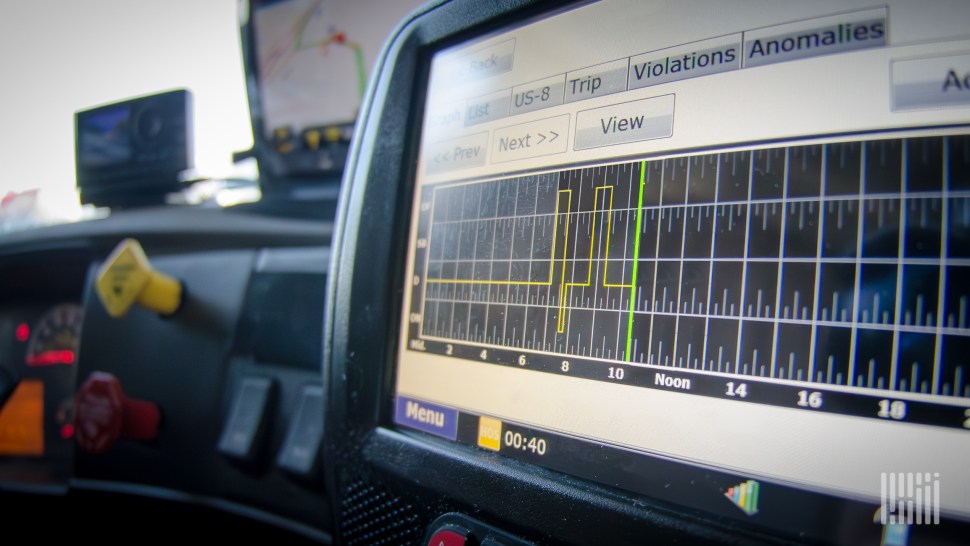
WASHINGTON — If the Federal Motor Carrier Safety Administration wants to tackle the problem of unreasonable detention times, there’s no proof that can happen by extending truck drivers’ work day from 14 to 17 hours, according to truck safety advocates.
“The agency should be examining problems with detention time instead of proposing this dangerous and misguided initiative,” wrote Advocates for Highway and Auto Safety, in comments filed in response to FMCSA’s proposed pilot program that will allow drivers to pause their 14-hour on-duty period – known as their “driving window” – for up to three hours.
FMCSA contends such a pause, in addition to providing flexibility to take extra rest, would improve working conditions for truck drivers by mitigating excessive detention times.
“The fact that the proposed pilot program encourages use of the pause, at least in part, to address detention time, does not place any limit on non-sleeper berth trucks, and does not require that time to be off-duty contradicts conclusions already reached by the agency” in a prior rulemaking, the safety group asserted.
“The agency does not need the proposed pilot program to quantify the detention time problem but rather should be studying detention time and coercion of drivers as it relates to schedules and driver fatigue.”
The group points also to FMCSA’s claims that allowing motor carriers to pause the on-duty clock could reduce pressure on truck drivers to speed in order to ensure freight is delivered on time – but that the agency provides no data showing that current regulations have led to increased speeding.
The group notes, for example, that the percentage of truck drivers in single-vehicle fatal crashes where speeding was a factor actually decreased from 18.4% in 2002 – before the 14-hour driving window was established – to 11.2% in 2022.
“While this comparison is not definitive, it raises questions as to the validity of the conclusion drawn by the agency without any supporting evidence,” according to the group.
“To address the deadly consequences of speeding trucks, the agency should require the use of speed limiters … instead of withdrawing the speed limiter rulemaking earlier this year despite the widespread use of the technology within the industry and well documented safety benefits of these safety systems.”
Truckload carrier Werner Enterprises (NASDAQ: WERN), which supports the 14-hour driving window pause, told FMCSA that it’s important the agency assess hours of service (HOS) and flexible driver rest times “rather than adhering to rigid schedules that may not reflect real-world conditions,” the company stated in comments filed on the pilot.
“In Werner’s experience, limited flexibility in HOS has not compromised safety or performance. In fact, allowing drivers to take breaks when needed and avoid unnecessarily burning their HOS clock leads to better safety outcomes, especially by reducing pressure during inclement weather, peak traffic times, or when drivers are not feeling well.”
Related articles:
Brokerage Compliance Symposium
The day before F3. Every compliance issue you face - fraud exposure, carrier liability, FMCSA rules, cargo theft, insurance gaps - navigated by attorneys and operators defining best practices in a changing industry.
F3 Awards Dinner
The night before F3. FreightTech100 companies honored. FreightTech 25 and Shipper of Choice winners revealed live. Cocktail reception into dinner and live music - 300 industry leaders in one purpose-built room.
F3: Future of Freight Festival
Industry-defining keynotes, rapid-fire technology demos, and industry leaders networking in experiences across Chattanooga - plus the inaugural F3 Awards Dinner featuring the FreightTech and Shipper of Choice reveals.
The day before F3. Every compliance issue you face - fraud exposure, carrier liability, FMCSA rules, cargo theft, insurance gaps - navigated by attorneys and operators defining best practices in a changing industry.
The Signal at Chattanooga Choo Choo • Chattanooga, TN Register NowThe night before F3. FreightTech100 companies honored. FreightTech 25 and Shipper of Choice winners revealed live. Cocktail reception into dinner and live music - 300 industry leaders in one purpose-built room.
The Signal at Chattanooga Choo Choo • Chattanooga, TN Register NowIndustry-defining keynotes, rapid-fire technology demos, and industry leaders networking in experiences across Chattanooga - plus the inaugural F3 Awards Dinner featuring the FreightTech and Shipper of Choice reveals.
The Signal at Chattanooga Choo Choo • Chattanooga, TN Register Now