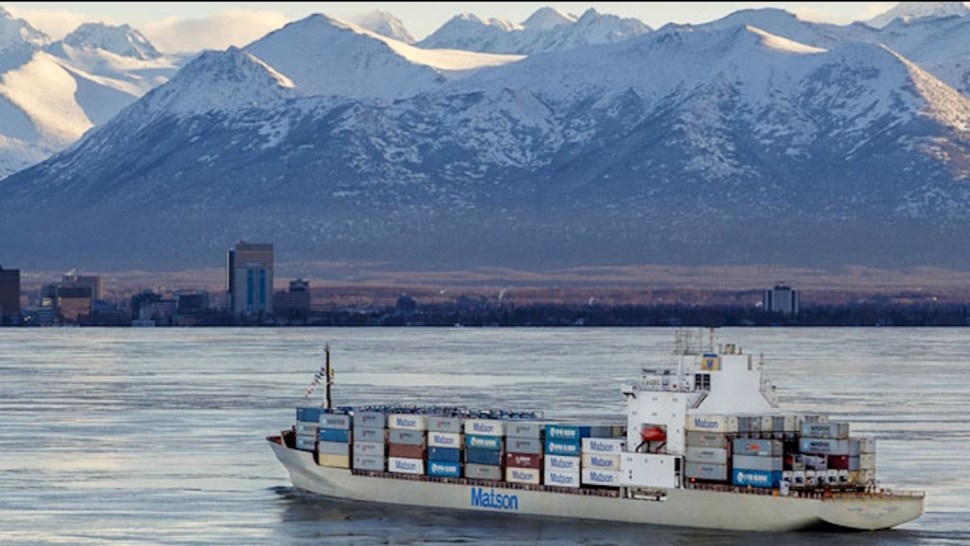
Matson, the largest U.S. ocean container carrier, saw its stock improve Wednesday as improved prospects for China shipping outweighed lower earnings in the fourth quarter.
The Honolulu-based company (NYSE: MATX) said net income of $134.7 million, or $4.24 per diluted share, for the quarter ended Sept. 30, from $199.1 million, or $5.89 per diluted share, a year ago.
Consolidated revenue was $880.1 million compared with $962 million for the third quarter of 2024.
Matson’s shares were up more than 9% in intraday trading.
The Jones Act carrier saw quarterly domestic volumes for Hawaii increase 0.3% and 4.1% for Alaska y/y, while Guam volume declined 4.2%. Tariffs and trade issues hit China business, which fell 12.1%.
Operating income was $147.4 million against $226.9 million a year ago as margins fell from 28.4% to 20.5%. Logistics operating income was lower year-over-year primarily due to lower contributions from freight forwarding, transportation brokerage, and supply chain management.
“In the fourth quarter 2025, we expect many of our China service customers to be cautious on inventory levels and work through previously purchased inventory,” said Matson Chairman and Chief Executive Matt Cox, in a release. “[H]owever, we expect a more stable trading environment for our customers in the fourth quarter as a result of a reduction in uncertainty regarding tariffs, port entry fees, global trade, and other geopolitical factors due to the trade and economic deal between the U.S. and China announced on Oct. 30.”
Find more articles by Stuart Chirls here.
Related coverage:
Japan’s ocean lines face profit decline amid tariff impact
Panama Canal fights drought with $8.5B plan to secure future trade
U.S.-China port fees to be suspended amid trade talks
Port Houston completes ship channel dredging amid environmental scrutiny
Brokerage Compliance Symposium
The day before F3. Every compliance issue you face - fraud exposure, carrier liability, FMCSA rules, cargo theft, insurance gaps - navigated by attorneys and operators defining best practices in a changing industry.
F3 Awards Dinner
The night before F3. FreightTech100 companies honored. FreightTech 25 and Shipper of Choice winners revealed live. Cocktail reception into dinner and live music - 300 industry leaders in one purpose-built room.
F3: Future of Freight Festival
Industry-defining keynotes, rapid-fire technology demos, and industry leaders networking in experiences across Chattanooga - plus the inaugural F3 Awards Dinner featuring the FreightTech and Shipper of Choice reveals.
The day before F3. Every compliance issue you face - fraud exposure, carrier liability, FMCSA rules, cargo theft, insurance gaps - navigated by attorneys and operators defining best practices in a changing industry.
The Signal at Chattanooga Choo Choo • Chattanooga, TN Register NowThe night before F3. FreightTech100 companies honored. FreightTech 25 and Shipper of Choice winners revealed live. Cocktail reception into dinner and live music - 300 industry leaders in one purpose-built room.
The Signal at Chattanooga Choo Choo • Chattanooga, TN Register NowIndustry-defining keynotes, rapid-fire technology demos, and industry leaders networking in experiences across Chattanooga - plus the inaugural F3 Awards Dinner featuring the FreightTech and Shipper of Choice reveals.
The Signal at Chattanooga Choo Choo • Chattanooga, TN Register Now