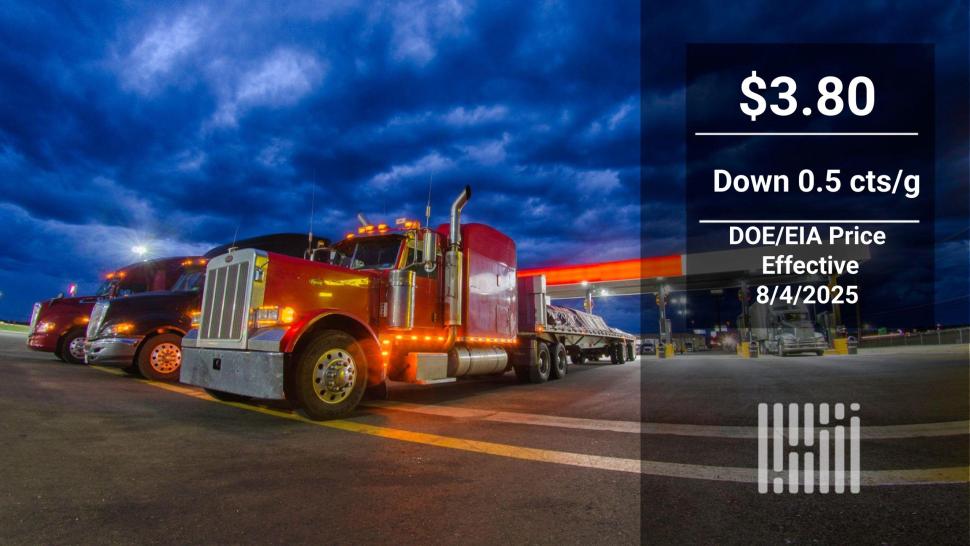
The Department of Energy/Energy Information Administration average weekly retail diesel price declined 0.5 cents/gallon to $3.80/g, effective Monday and announced Tuesday. It follows a decline the week before of 0.7 cts/g.
Relative calm in the benchmark price comes as a new round of volatility–this one pointing down–is rearing its head in the market for ultra low sulfur diesel (ULSD) on the CME commodity exchange.
In the four trading days leading up to the ULSD settlement Monday, the price of ULSD fell to $2.3176/g, down almost 15 cts/g from the July 29 settle of $2.4638/g. On July 21, ULSD settled at more than $2.50/g.
But market news has been largely bearish since then. Oil, including crude and diesel, both fell hard Friday in sympathy with the large asset selloff that accompanied the news of the weakest monthly employment report in several months. Prices bounced back only slightly Monday with the rise in equity markets, and resumed their decline Tuesday. At approximately 11:05 a.m. EDT, ULSD was down just over 6 cts/g, a drop of 2.6%.
Over the weekend, eight members of the OPEC+ group announced an increase in their output of 547,000 barrels/day. That increase would bring the group, which consists of OPEC and several non-OPEC oil exporters nominally led by Russia, close to fully reversing the more than 2-million b/d in output cuts the group has had in effect since spring 2023.
Diamondback CEO warns of imbalance
The bearish view of the market was laid out Monday in a letter from Kaes Van’t Hof, CEO of Diamondback Energy, one of the largest operators in Texas’ Permian Basin.
In the letter to investors, Van’t Hof said the market could have been worse for an upstream company like Diamondback. “The likelihood of a massive oil supply glut combined with an oil demand shock seems to have dissipated (on the demand side),” he wrote.
But there is no basis for a recovery, he added. “The projected increase in global oil supply in the second half of this year is hard to ignore,” Van’t Hof wrote. “Although projections are often incorrect in this sector, particularly when consensus is uniformly bullish or bearish (in this case bearish), we still believe we are approaching a yellow light to pull from last quarter’s ‘stop light’ analogy.”
Diesel coming back to earth against crude
One small piece of good news for diesel consumers is that the raging strength of diesel relative to crude has slowed.
A straight comparison of the front-month price of ULSD to the price of Brent crude, the world’s benchmark, peaked July 21 at more than 86 cts/g. But that spread dropped to almost 64 cts/g by Friday. The average for the year is about 61 cts/g.
Another piece of positive news for diesel buyers is that the spread between the first month and second month ULSD price on CME has narrowed sharply.
That spread is a function of several factors, but inventories are the largest.
When inventories are tight, the market will move into a structure known as backwardation, with the front month price higher than the next month, the next month higher than the next one after that, and so on. It is a reversal of the structure of a market in perfect balance, known as contango, when prices rise as they go out the calendar.
That spread got as high as 6-7 cts/g at the end of June, with the front month that much higher than the second month. But by the settlement Monday, it was just 7/10 of one cent, still in backwardation but getting closer to flipping into contango.
One reason: growing inventories. The EIA reported last week that U.S. stocks of all non-jet fuel distillates had risen to 113.5 million barrels. That is an increase of almost 11 million barrels in just three weeks and was the highest number since the end of March.
More articles by John Kingston
Averitt pay increase could be a sign of some acceleration in driver wages
Sequential numbers at diversified trucking operator TFI International may mark a turnaround
At C.H. Robinson, improved profitability, productivity and a lot fewer workers
Brokerage Compliance Symposium
The day before F3. Every compliance issue you face - fraud exposure, carrier liability, FMCSA rules, cargo theft, insurance gaps - navigated by attorneys and operators defining best practices in a changing industry.
F3 Awards Dinner
The night before F3. FreightTech100 companies honored. FreightTech 25 and Shipper of Choice winners revealed live. Cocktail reception into dinner and live music - 300 industry leaders in one purpose-built room.
F3: Future of Freight Festival
Industry-defining keynotes, rapid-fire technology demos, and industry leaders networking in experiences across Chattanooga - plus the inaugural F3 Awards Dinner featuring the FreightTech and Shipper of Choice reveals.
The day before F3. Every compliance issue you face - fraud exposure, carrier liability, FMCSA rules, cargo theft, insurance gaps - navigated by attorneys and operators defining best practices in a changing industry.
The Signal at Chattanooga Choo Choo • Chattanooga, TN Register NowThe night before F3. FreightTech100 companies honored. FreightTech 25 and Shipper of Choice winners revealed live. Cocktail reception into dinner and live music - 300 industry leaders in one purpose-built room.
The Signal at Chattanooga Choo Choo • Chattanooga, TN Register NowIndustry-defining keynotes, rapid-fire technology demos, and industry leaders networking in experiences across Chattanooga - plus the inaugural F3 Awards Dinner featuring the FreightTech and Shipper of Choice reveals.
The Signal at Chattanooga Choo Choo • Chattanooga, TN Register Now