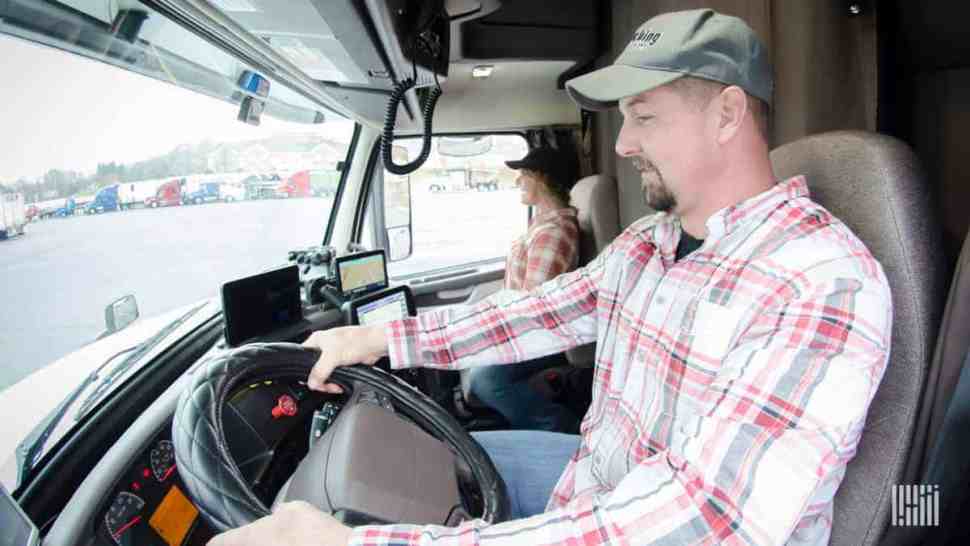
As trucking fleets lean more heavily on cameras, telematics and onboard technology to monitor driver behavior, many still struggle with a fundamental challenge: turning training into a consistent, measurable program rather than a one-time event.
Smith System, a longtime provider of driver safety training, is aiming to address that gap with the launch of Trainer Center, a new digital platform designed to modernize how fleets operate and scale the Smith System Certified Trainer Program.
“Fleets don’t struggle with commitment to safety — they struggle with running safety programs at scale with consistent execution and real visibility,” Dunaway said in an interview with FreightWaves. “Trainer Center is really about supporting customers in running training as a program, not just an event.”
Trainer Center digitizes behind-the-wheel assessments, standardizes trainer workflows and generates Smith5Keys-based driver scorecards, giving safety leaders clearer visibility into driver performance and training effectiveness across large, distributed fleets.
Founded in 1952, Smith System is provider of driver safety training and risk management. The company has trained millions of drivers worldwide using its Smith5Keys methodology.
Moving training beyond paperwork and checklists
For many large carriers, trainer-led programs still rely heavily on paper evaluations, spreadsheets or local processes that vary by terminal. According to Dunaway, that makes it difficult to answer basic questions such as which trainers are most effective, which drivers need additional coaching, or whether training is translating into safer on-road behavior.
Trainer Center centralizes those processes. Trainers record assessments digitally, and those observations automatically feed into a driver’s Smith5Keys scorecard. The system tracks who was trained, when training occurred and how drivers performed, creating a consistent record that can be reviewed across locations and regions.
“That consistency piece is huge,” Dunaway said. “When you’ve got dozens or even hundreds of trainers, it’s very hard to know if training is being delivered and scored the same way. Capturing it in one system forces a common framework and makes it much easier to see what’s working and what’s not.”
Linking training, coaching and driver risk
Trainer Center is also designed to connect training data with broader driver risk management efforts. While Smith System emphasizes that cameras and telematics are an important part of fleet safety, Dunaway cautioned against viewing technology as a substitute for foundational training.
“There’s a danger in thinking that having cameras means you don’t need to train,” he said. “Training builds the fundamental skills that help drivers avoid risky situations in the first place.”
The platform can ingest data from telematics and camera systems — including integrations with providers such as Geotab — and align that data with Smith5Keys principles. Rather than focusing purely on individual incidents like speeding or harsh braking, the system maps patterns of behavior back to the underlying driving skills being taught.
That approach allows fleets to target coaching and microlearning more precisely, Dunaway said, helping trainers address behavior change rather than reacting only after incidents occur
Designed with trainers — and fleets — in mind
Smith System developed Trainer Center collaboratively, beta testing the platform internally and with a group of fleet customers before its broader release. The company also uses the platform to manage its own trainer-led programs, which Dunaway said helped stress-test usability and workflow.
“Our internal trainers are some of the toughest critics — many of them have been doing this for 10 years or more,” he said. “That pushed us to focus heavily on ease of use, speed and flexibility.”
Early customer feedback has focused on the time savings and visibility the platform provides, particularly for safety teams that previously tracked training data across multiple systems or formats.
“Training departments are always under-resourced,” Dunaway said. “If we can give them time back and better insight into who needs coaching — and who’s doing great — that’s a big win.”
A step toward programmatic safety management
Smith System positions Trainer Center as part of a broader shift toward programmatic driver risk management, tying training, reinforcement and data-driven coaching into a single operating layer anchored by the Smith5Keys methodology.
With driver turnover, insurance pressures and safety performance under increasing scrutiny, Dunaway said fleets need tools that provide both consistency and proof of impact.
“This should improve the efficacy of training programs simply because there’s more clarity,” he said. “You know who’s been trained, how they were trained and where strengths and weaknesses are. That creates better coaching, better reinforcement — and ultimately, safer drivers.”
Brokerage Compliance Symposium
The day before F3. Every compliance issue you face - fraud exposure, carrier liability, FMCSA rules, cargo theft, insurance gaps - navigated by attorneys and operators defining best practices in a changing industry.
F3 Awards Dinner
The night before F3. FreightTech100 companies honored. FreightTech 25 and Shipper of Choice winners revealed live. Cocktail reception into dinner and live music - 300 industry leaders in one purpose-built room.
F3: Future of Freight Festival
Industry-defining keynotes, rapid-fire technology demos, and industry leaders networking in experiences across Chattanooga - plus the inaugural F3 Awards Dinner featuring the FreightTech and Shipper of Choice reveals.
The day before F3. Every compliance issue you face - fraud exposure, carrier liability, FMCSA rules, cargo theft, insurance gaps - navigated by attorneys and operators defining best practices in a changing industry.
The Signal at Chattanooga Choo Choo • Chattanooga, TN Register NowThe night before F3. FreightTech100 companies honored. FreightTech 25 and Shipper of Choice winners revealed live. Cocktail reception into dinner and live music - 300 industry leaders in one purpose-built room.
The Signal at Chattanooga Choo Choo • Chattanooga, TN Register NowIndustry-defining keynotes, rapid-fire technology demos, and industry leaders networking in experiences across Chattanooga - plus the inaugural F3 Awards Dinner featuring the FreightTech and Shipper of Choice reveals.
The Signal at Chattanooga Choo Choo • Chattanooga, TN Register Now