The U.S. trucking industry continues to face a harsh economic reality: spot rates have failed to keep pace with inflation, squeezing carrier margins and contributing to significant financial pressure on truckers nationwide.
Here’s a clear visual of the disconnect — spot trucking rates (via the SONAR National Truckload Index) overlaid against the Consumer Price Index (CPI):
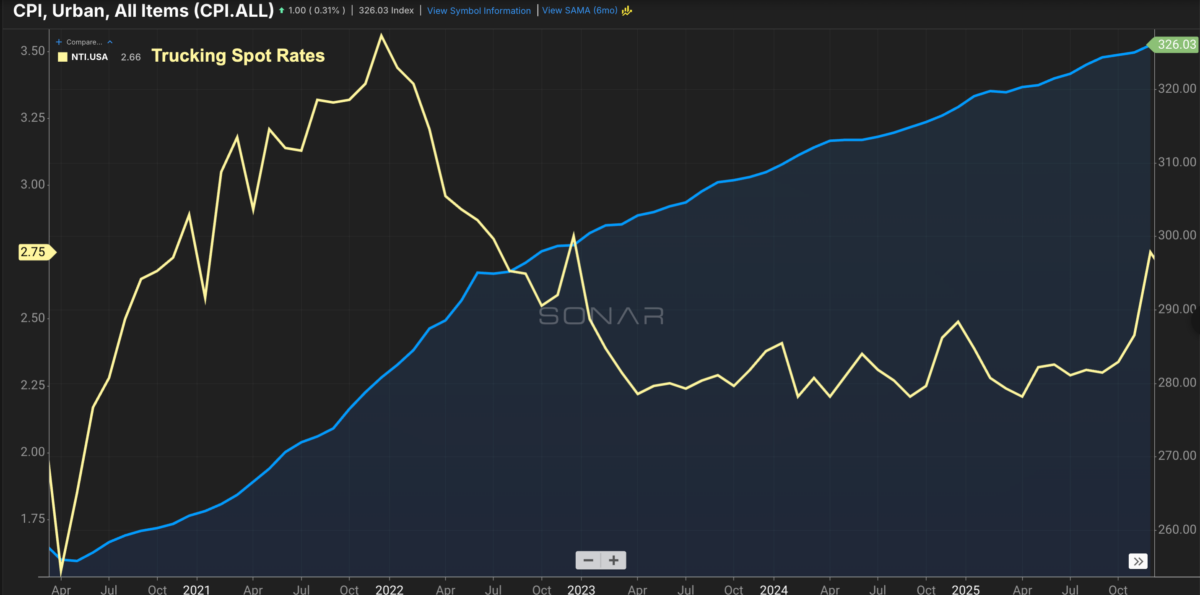
Truckload spot rates (SONAR: NTI.USA) vs. CPI (SONAR: CPI.USA). Source: GoSONAR.com
As of mid-January 2026, national trucking spot rates are showing signs of strength following a late-2025 rally, with recent levels approaching multi-year highs (the National Truckload Index is at $2.75 per mile according to SONAR, inclusive of fuel).
However, if spot rates had simply matched the cumulative growth in CPI since March 2020 — before freight markets initially surged early in the pandemic — they would be significantly higher, closer to the equivalent of $3.50 per mile or more. That’s a substantial gap of roughly 27%.
This disparity isn’t abstract. It translates directly into real-world pain for owner-operators and small to mid-sized carriers, who bear the brunt of escalating operational costs. Fuel prices, truck maintenance, insurance, tires, driver wages, and regulatory compliance have all risen sharply since 2020, yet revenue per mile has not kept up. Many truckers are operating at breakeven or worse, with some exiting the industry entirely — a trend that has contributed to gradual capacity tightening observed in late 2025 and into early 2026.
The chart highlights the dramatic post-pandemic trajectory:
- Spot rates peaked sharply in 2021–2022 amid supply chain chaos and booming demand.
- They then collapsed through 2023 and much of 2024, bottoming out well below pre-pandemic adjusted levels.
- Recent months have shown upward movement, with spot rates climbing through the 2025 holiday season and into early 2026, reaching multi-year highs driven by seasonal demand, winter weather disruptions, and tighter capacity.
Despite this late-2025 rally, the long-term picture remains clear: trucking has absorbed inflationary hits without corresponding rate increases. This has been exacerbated by a massive capacity glut in prior years, fueled by an influx of new entrants — including many drivers who may not meet the compliance standards expected of veteran American truckers from a decade ago.
Truckers are the backbone of American freight, yet too many are struggling because rates have not kept up with inflation. They deserve better — fair compensation that reflects the true cost of moving the nation’s goods.
As the industry enters 2026, several factors could influence whether this gap begins to close:
- Ongoing FMCSA compliance enforcement, including crackdowns on training providers, non-compliant CDLs (e.g., language proficiency issues), and illegal practices, which could remove thousands of drivers and authorities from the market.
- Years of difficult operating conditions, with carrier costs far outpacing trucking rates — obliterating balance sheets for many.
- Continued capacity discipline among carriers.
- Potential demand recovery in industrial and housing sectors.
- Persistent regulatory pressures and rising equipment costs.
For now, the data speaks volumes. Shippers have benefited from years of suppressed rates, but that era appears to be ending as compliance actions and natural attrition put pressure on capacity.
With spot rates showing signs of life and a continued compliance crackdown, 2026 should offer a window for carriers to claw back years of lost profits. Shippers are advised to prepare budgets for a very different environment this year.
Brokerage Compliance Symposium
The day before F3. Every compliance issue you face - fraud exposure, carrier liability, FMCSA rules, cargo theft, insurance gaps - navigated by attorneys and operators defining best practices in a changing industry.
F3 Awards Dinner
The night before F3. FreightTech100 companies honored. FreightTech 25 and Shipper of Choice winners revealed live. Cocktail reception into dinner and live music - 300 industry leaders in one purpose-built room.
F3: Future of Freight Festival
Industry-defining keynotes, rapid-fire technology demos, and industry leaders networking in experiences across Chattanooga - plus the inaugural F3 Awards Dinner featuring the FreightTech and Shipper of Choice reveals.
The day before F3. Every compliance issue you face - fraud exposure, carrier liability, FMCSA rules, cargo theft, insurance gaps - navigated by attorneys and operators defining best practices in a changing industry.
The Signal at Chattanooga Choo Choo • Chattanooga, TN Register NowThe night before F3. FreightTech100 companies honored. FreightTech 25 and Shipper of Choice winners revealed live. Cocktail reception into dinner and live music - 300 industry leaders in one purpose-built room.
The Signal at Chattanooga Choo Choo • Chattanooga, TN Register NowIndustry-defining keynotes, rapid-fire technology demos, and industry leaders networking in experiences across Chattanooga - plus the inaugural F3 Awards Dinner featuring the FreightTech and Shipper of Choice reveals.
The Signal at Chattanooga Choo Choo • Chattanooga, TN Register Now