




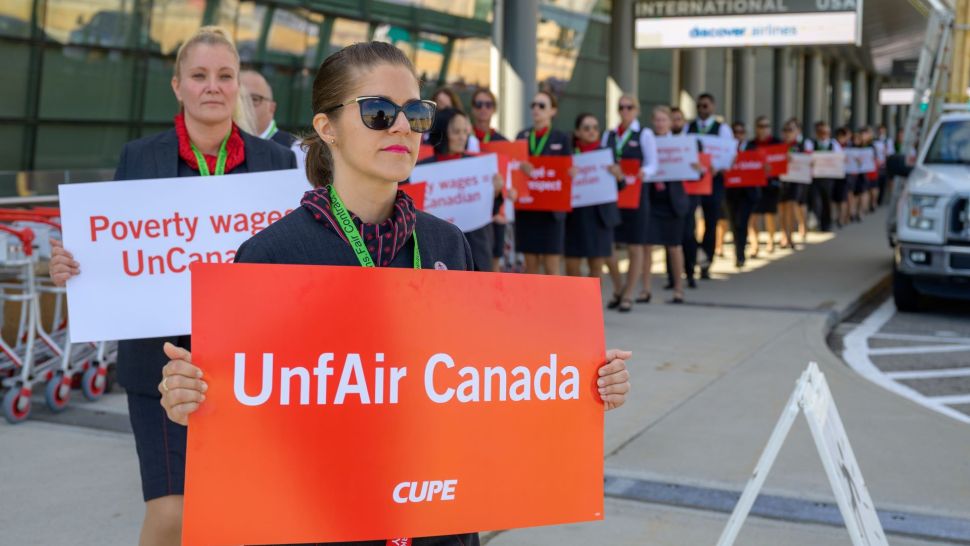
Air Canada has begun canceling long-haul international flights, which carry most of the airline’s cargo, in preparation for a planned work stoppage by flight attendants on Saturday, executives said Thursday.
The news conference in Toronto was cut short after union members walked in front of the stage with signs, such as “Unpaid work won’t fly,” critical of Air Canada’s negotiating position in stalled contract talks.
Air Canada (TSX: AC) will gradually suspend flights until all flights are grounded by Saturday morning. Dozens of flights will be canceled Thursday and by the end of Friday about 500 flights will be canceled, impacting more than 100,000 travelers.
“This will also impact our cargo operations and have consequences on the supply chain,” said Arielle Meloul-Wechsler, chief human resources and public affairs officer. Air Canada’s fleet of six Boeing 767-300 freighter aircraft will operate with modified schedules, which will protect about 20% to 25% of usual volumes, a spokesman informed FreightWaves by email.
The Canadian Chamber of Commerce on Tuesday urged the federal government to intervene to prevent a prolonged disruption to travel and commerce, if the sides can’t resolve their differences. Nearly half of all Canadian pharmaceuticals shipped by air are carried by Air Canada. Shipments of agriculture, perishable food products, parts and machinery for manufacturing will all be delayed if Air Canada is forced to shut down, the business group said.
“At a time when Canada is facing unprecedented economic challenges and trade uncertainty, a service disruption would interrupt air cargo connectivity, directly impacting Canadian businesses that are working to diversify their customers in provinces across the country. The impact on business will be felt internationally too, and would lead to losses for Canadian exporters, further compounding the impacts on industries throughout our economy,” the Chamber said in a statement.
The Canadian Federation of Independent Businesses expressed similar concerns and interest in government intervention.
Once the strike is over it will take a full week for Air Canada to fully restore operations, said Chief Operating Officer Marc Nasr.
Air Canada has characterized the flight attendants as not serious about reaching an agreement on a new collective bargaining agreement.
The Canadian Union of Public Employees, which represents 10,000 flight attendants, started negotiations demanding a compensation increase of more than 100%, according to the airline, which countered with a 38% increase in total compensation, including benefits and pensions, over four years. The offer also includes an increase in ground pay, which is calculated separately for work carried out when planes are not in flight.
CUPE blames Air Canada for the breakdown in talks, saying the airline’s offer is below industry standard and fails to make up ground on inflation since the previous contract was signed in 2015. It says the employer’s offer would only raise wages by 17.2% and has refused to participate in binding arbitration as a way to resolve the labor dispute. Air Canada has requested the Canadian government impose arbitration on the parties if there is no resolution by Saturday.
The union claims flight attendants aren’t paid for much of the time worked while the plane is at the gate.
“Flight attendants should be paid for every minute they spend on the job. It’s as simple as that,” said CUPE National President Mark Hancock. “But instead of negotiating in good faith, Air Canada is asking the federal government to help get them off the hook.”
CUPE said it tabled a proposal at 9 p.m. on Tuesday, but Air Canada has not responded.
Air Canada operates more than 250 aircraft to 200 destinations in more than 65 countries.
Click here for more FreightWaves/American Shipper stories by Eric Kulisch.
Write to Eric Kulisch at ekulisch@freightwaves.com.
RELATED STORIES:
Air Canada flight attendants announce strike date, cargo shipments at risk
Air Canada agrees to new contract with pilots, avoids strike
Brokerage Compliance Symposium
The day before F3. Every compliance issue you face - fraud exposure, carrier liability, FMCSA rules, cargo theft, insurance gaps - navigated by attorneys and operators defining best practices in a changing industry.
F3 Awards Dinner
The night before F3. FreightTech100 companies honored. FreightTech 25 and Shipper of Choice winners revealed live. Cocktail reception into dinner and live music - 300 industry leaders in one purpose-built room.
F3: Future of Freight Festival
Industry-defining keynotes, rapid-fire technology demos, and industry leaders networking in experiences across Chattanooga - plus the inaugural F3 Awards Dinner featuring the FreightTech and Shipper of Choice reveals.
The day before F3. Every compliance issue you face - fraud exposure, carrier liability, FMCSA rules, cargo theft, insurance gaps - navigated by attorneys and operators defining best practices in a changing industry.
The Signal at Chattanooga Choo Choo • Chattanooga, TN Register NowThe night before F3. FreightTech100 companies honored. FreightTech 25 and Shipper of Choice winners revealed live. Cocktail reception into dinner and live music - 300 industry leaders in one purpose-built room.
The Signal at Chattanooga Choo Choo • Chattanooga, TN Register NowIndustry-defining keynotes, rapid-fire technology demos, and industry leaders networking in experiences across Chattanooga - plus the inaugural F3 Awards Dinner featuring the FreightTech and Shipper of Choice reveals.
The Signal at Chattanooga Choo Choo • Chattanooga, TN Register Now