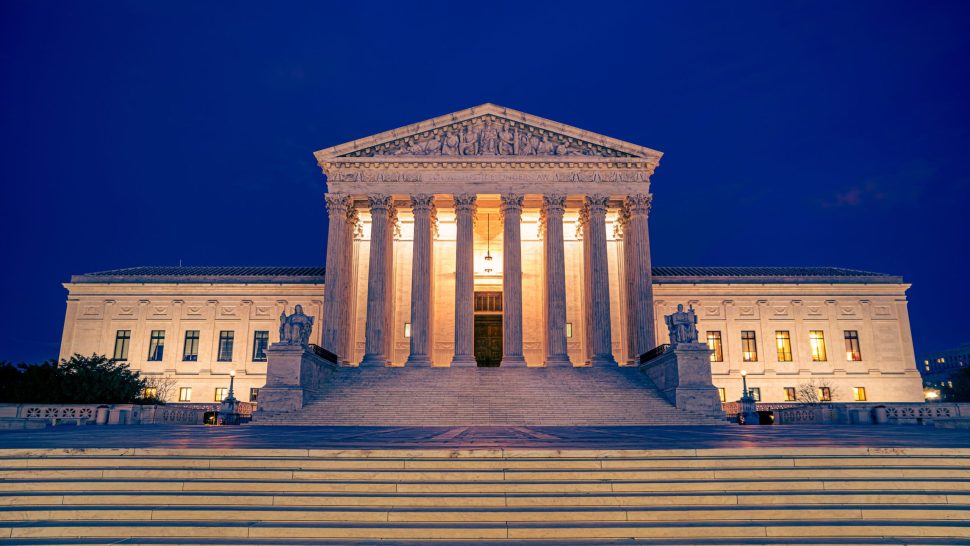
A schedule for how the process will proceed in the broker liability case before the Supreme Court has begun to take shape.
The court Thursday agreed to a request from the attorney for original plaintiff Shawn Montgomery, referred to before the court as the petitioner as it was Montgomery that sought and was granted Supreme Court review, to set a December 1 deadline for Montgomery’s brief to be filed.
The request came from attorney Paul Clement of Clement & Murphy representing Montgomery.. The role of Clement on the case shows its significance, as he presumably does not come cheap; he was the Solicitor General for three years under George W. Bush, arguing cases before the Supreme Court for the administration.
High-profile lawyer
Clement & Murphy has been described as a “boutique” law firm with a specialty in arguing before the high court. It was established in 2022 after Clement left the firm of Lane & Kirkland in a high-profile departure.
The firm recently made news in legal circles by hiring Danielle Sassoon, the former Acting U.S. Attorney for the Southern District of New York. She resigned after being instructed to drop corruption charges against outgoing New York mayor Eric Adams.
The next relevant date in Montgomery vs. Caribe after December 1 is January 14, which is the deadline for the respondents to file.
After that, the deadline for Montgomery to respond to the Caribe brief and presumably friends of the court briefs filed by other parties, such as the Transportation Intermediaries Association, was set for February 13.
Sometime after that, there will be oral arguments in the case.
The role of C.H. Robinson
C.H. Robinson (NASDAQ: CHRW) was removed as a defendant in the case by a lower court so it is no longer listed as a party. But it was the giant 3PL that hired Caribe Transport to move freight, and it was Caribe that was involved in the December 7, 2017 collision in Illinois that seriously injured Montgomery, including a leg amputation.
The removal of C.H. Robinson in November 2023 was ordered under the provisions of the Federal Aviation Administration Authorization Act and its restriction on state action that could impact a transportation “price, route or service.”
But that law also has a safety exception, which allows state action against a transportation provider if it can be found the provider acted in a negligent manner. Precisely what constitutes actionable behavior under the safety exception is very much up for debate, which is why Montgomery is before the Supreme Court. Specifically: does the safety exception include finding liable a broker that hired a carrier involved in a wreck, particularly if the carrier had a poor safety record?
There are conflicting rulings among the circuit courts on that question. The brokerage industry prevailed on that question in Montgomery, Ye vs. GlobalTranz, Gauthier vs. TQL and Aspen vs. Landstar. The first two cases saw their losing plaintiffs request certiorari from the Supreme Court, but those appeals were denied.
The court in 2022 had rejected review in Miller vs. C.H. Robinson. That Ninth Circuit decision was a loss for the 3PL sector while contributing to the split decisions among the circuits on the question of the safety exception.
With conflicting circuit court decisions on the issue piling up, the justices accepted the Montgomery request, setting the stage for a precedent-setting decision that could impact the brokerage sector.
There’s another case sitting before the justices: Cox vs. TQL. That Sixth Circuit case, like Miller vs. Robinson, was a loss for the brokerage industry.
TQL requested certiorari. The court has not granted review, nor has it declined it. The general assumption in the legal sector is that the justices are likely to let that one sit until there’s a resolution coming out of Montgomery vs. Caribe, since the issues in the two cases are essentially the same.
More articles by John Kingston
RXO faces a rate squeeze: what it means for the 3PL
Beautiful women, open doors and drivers: trucking cybersecurity risks proliferate
Aifleet’s bold move: cutting its fleet size to survive in freight recession
Brokerage Compliance Symposium
The day before F3. Every compliance issue you face - fraud exposure, carrier liability, FMCSA rules, cargo theft, insurance gaps - navigated by attorneys and operators defining best practices in a changing industry.
F3 Awards Dinner
The night before F3. FreightTech100 companies honored. FreightTech 25 and Shipper of Choice winners revealed live. Cocktail reception into dinner and live music - 300 industry leaders in one purpose-built room.
F3: Future of Freight Festival
Industry-defining keynotes, rapid-fire technology demos, and industry leaders networking in experiences across Chattanooga - plus the inaugural F3 Awards Dinner featuring the FreightTech and Shipper of Choice reveals.
The day before F3. Every compliance issue you face - fraud exposure, carrier liability, FMCSA rules, cargo theft, insurance gaps - navigated by attorneys and operators defining best practices in a changing industry.
The Signal at Chattanooga Choo Choo • Chattanooga, TN Register NowThe night before F3. FreightTech100 companies honored. FreightTech 25 and Shipper of Choice winners revealed live. Cocktail reception into dinner and live music - 300 industry leaders in one purpose-built room.
The Signal at Chattanooga Choo Choo • Chattanooga, TN Register NowIndustry-defining keynotes, rapid-fire technology demos, and industry leaders networking in experiences across Chattanooga - plus the inaugural F3 Awards Dinner featuring the FreightTech and Shipper of Choice reveals.
The Signal at Chattanooga Choo Choo • Chattanooga, TN Register Now