It took China a generation to ascend to the top of the global maritime sector; it won’t take nearly that long for that country to brush off expensive U.S. port fees on its ships.
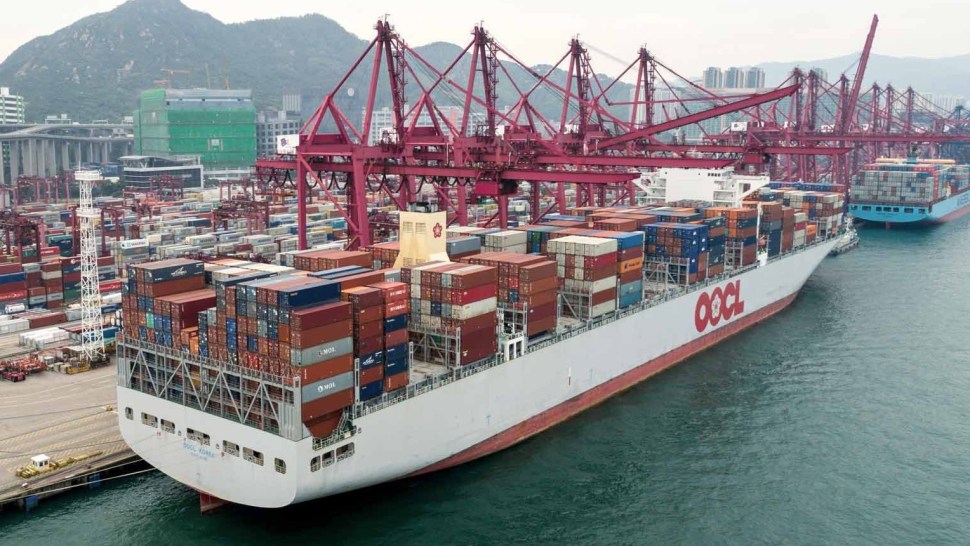
Cosco, China’s flag carrier and the world’s fifth-largest container line, and subsidiary Orient Overseas Container Line (OOCL) of Hong Kong said that they won’t levy surcharges to offset the fees on Chinese-built and operated ships calling U.S. ports to be implemented Oct. 14.
While other liner operators scramble to drop calls and shift some of their China tonnage, Cosco advised customers in the U.S. that it plans no changes to services ahead of the punitive fees formulated under the authority of the United States Trade Representative.
“It seems unlikely shippers will experience much of an impact once the new law takes effect,” said Judah Levine of analyst Freightos, in a note to clients.
The fees, which escalate in the coming years, could cost Cosco and OOCL as much as $2.1 billion in 2026, analysts say, but could be absorbed by subsidies from Beijing.
The ship tax, which aims to blunt China’s maritime dominance and boost American shipping and shipbuilding, charges China-owned or operated ships $80 per net tonnage for each voyage to the U.S. Non-Chinese operators will be charged the greater of $23 per net ton or $154 per twenty-foot equivalent unit (TEU) capacity. The fees apply up to five times annually per vessel; roll-on/roll-off (ro-ro) vehicle carriers will pay a rate of $14 per net ton. The fees increase by $5 per ton annually until April 2028.
The fees must be paid in advance of arrival via the Treasury Department’s Pay.gov platform, and vessels must show proof of payment or risk denial of entry or cargo operations at U.S. ports.
Beijing for its part in late September passed new maritime laws that allow it to levy its own retaliatory port fees, and bar access to ports and data for vessels from countries that discriminate against China.
“American lines such as Matson, and U.S.-flagged vessels make up a modest share of trans-Pacific volumes,” said Levine, “so this kind of response may not have an outsized impact, but does represent an escalation as the deadline approaches.”
Trans-Pacific spot container rates continued to fall following the Chinese Golden Week holiday. The Freightos Baltic Index saw Asia-U.S. West Coast rates drop 16% to what Levine termed “a possibly loss-making” $1,554 per forty foot equivalent unit (FEU). Prices to the East Coast fared worse, off 18% to $3,260 per FEU.
Asia-Europe settled at $2,000 per FEU, down 9%, and Asia- Mediterranean prices fell 6% to $2,217 per FEU, “with all these lanes at least 60% lower than this time last year and at or near their lowest levels since just before the start of the Red Sea crisis almost two years ago,” Levine said.
“That rates are falling to this degree while Red Sea diversions are still in place suggests that capacity growth is a big factor in lower rates across the industry,” said Levine, “with the eventual end of the war in Gaza primed to release even more capacity back into the market.”
Ocean container lines introduced approximately 1.18 million TEUs of new container shipping capacity in the first half of 2025, according to analyst Xeneta, up 3.8% from a year ago.
Whether general rate increases planned by carriers for mid-October hold could depend on capacity adjustments through blankings and service suspensions. October shows 67 sailings cancelled from China to the U.S. and 71 on the westbound trade, according to project44, higher than early-Covid levels.
Find more articles by Stuart Chirls here.
Related coverage:
Gaza plan to boost Suez shipping recovery in 2025
Red Sea carriers wait and watch Gaza peace talks
Busiest U.S. port plans new container terminal for biggest ships
Brokerage Compliance Symposium
The day before F3. Every compliance issue you face - fraud exposure, carrier liability, FMCSA rules, cargo theft, insurance gaps - navigated by attorneys and operators defining best practices in a changing industry.
F3 Awards Dinner
The night before F3. FreightTech100 companies honored. FreightTech 25 and Shipper of Choice winners revealed live. Cocktail reception into dinner and live music - 300 industry leaders in one purpose-built room.
F3: Future of Freight Festival
Industry-defining keynotes, rapid-fire technology demos, and industry leaders networking in experiences across Chattanooga - plus the inaugural F3 Awards Dinner featuring the FreightTech and Shipper of Choice reveals.
The day before F3. Every compliance issue you face - fraud exposure, carrier liability, FMCSA rules, cargo theft, insurance gaps - navigated by attorneys and operators defining best practices in a changing industry.
The Signal at Chattanooga Choo Choo • Chattanooga, TN Register NowThe night before F3. FreightTech100 companies honored. FreightTech 25 and Shipper of Choice winners revealed live. Cocktail reception into dinner and live music - 300 industry leaders in one purpose-built room.
The Signal at Chattanooga Choo Choo • Chattanooga, TN Register NowIndustry-defining keynotes, rapid-fire technology demos, and industry leaders networking in experiences across Chattanooga - plus the inaugural F3 Awards Dinner featuring the FreightTech and Shipper of Choice reveals.
The Signal at Chattanooga Choo Choo • Chattanooga, TN Register Now