Bernie Sanders’ green deal – $216 billion for electric trucks
Fund would be used to transition from diesel by 2030.
The concept of customer experience has been around for decades but it is getting new emphasis in trucking as electric and autonomous technology arrives.
Combined with previously authorized programs, the investment is the largest by electric utilities in the U.S. to help replace heavy-duty vehicles with zero-emission technology.
Cowen analyst Jeffrey Osborne has raised his estimate for Workhorse Group Inc. shares from $2.00 to $4.00 based on the company beginning production in the fourth quarter of more than 1,100 lightweight electric-powered NGEN vans.
For the first time, Workhorse Group is tying the possibility of a huge contract with the U.S. Postal Service to the acquisition of General Motors Lordstown, Ohio assembly complex.
Brian Aoaeh writes about how machine learning and artificial intelligence can be used to improve transportation and decrease emissions.
Volvo Group and Samsung SDI will work together to advance Volvo’s electric truck plans with direct supply of battery cells and packs to Volvo manufacturing plants.
Volvo Trucks North America is leading a partnership to get heavy-duty electric trucks and the infrastructure they’ll need underway in California.
The country becomes the first to join international Drive to Zero initiative for trucks, cargo vans and buses.
GM closed its Lordstown Complex on March 5, 2019, but it could see new life as the company is negotiating with Workhorse, which would build electric pickups in the facility.
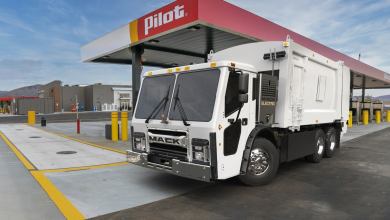
The New York City Department of Sanitation (DSNY) will put into operation a battery-electric vehicle (BEV) built by Mack Trucks in 2020. The vehicle is an LR model refuse truck. The announcement was made on May 8, 2019, at Waste Expo in Las Vegas. The Mack LR BEV is powered by Mack’s integrated electric powertrain […]
Bosch is working with Powercell to develop a hydrogen fuel stack for vehicles. Plus, housing index has positives for home buyers, JFK starts new phase of air cargo expansion, and trucking company in Denver crash had history of violations.
Three states and several utilities will study the needs of electric trucks along the I-5 corridor to make long-haul electric trucks a reality. Plus, the future of Cummins, flex fuels, and are the Chinese taking our railway jobs?
Marc Bédard, founder and president of Lion Electric, discusses the Canadian-made Class 8 and its promises of winter performance.
Thor Trucks announced it is changing its name to XOS on April 18 after settling a trademark infringement lawsuit with the maker of recreational vehicles with a similar name, Thor Industries Inc., in January.
Nikola Motor Company formally introduced its hydrogen-electric tractors, the Nikola Two and Nikola Tre (for Europe) at Nikola World 2019. Here are some photos from the event.
If you can get your hands on a Nikola Two hydrogen-electric truck in the near future, it could save you money compared to a diesel model, the company said. Getting one, though, will be hard due to early demand.
Nikola Motor envisions a world that is better off tomorrow than it is today, and it starts with a zero-emission future, the company said, as it introduced five emissions-free vehicles, including two semi trucks.
Navistar’s Steve Gilligan discussed several technological opportunities for truck makers, including autonomous and electric trucks, during this week’s ACT Research conference.
Nikola Motors is setting up its hydrogen truck manufacturing plant in Arizona, which is expected to roughly bring about 2,000 jobs by 2024.
Canadian-made Class 8 truck posts a 250-mile range and 25,000-pound maximum payload.
Electric trucks dominated the vehicle conversations at this week’s Work Truck Show in Indianapolis, plus the cost of charging vehicles, overtime pay changes and another trucker protest planned.
Truck electrification is ramping up quickly, but a number of challenges remain that must be solved before they see widespread adoption.
UPS’ Carlton Rose, president of global fleet maintenance and engineering, said he expects electric power to be the long-term solution in medium-duty, but it isn’t there just yet.
Electric vehicle charging infrastructure is still in its infancy, but is making progress.
Funding announced as investment heats up for low-carbon fuel technology.
The Nikola Motor Company announced that Mark Russell has joined its executive management team as president. According to Nikola’s press release, Russell will manage the company’s production of new zero-emission vehicles.
Wireless charging could be key to making electric trucks viable for the long-haul sector.
Tesla’s acquisition Maxwell Technologies could have an impact on Maxwell’s fleet business, which counts more than 7,000 trucks using its products.
Electric vehicle makers can learn from some of the lessons that natural gas developers faced when introducing that fuel source to trucking.
There are numerous reasons why electric trucks may continue to take a backseat when private transportation fleets and for-hire carriers are developing their truck procurement strategies.
The SureFly is just one of the products that Workhorse is working on. Additional projects include electric delivery vans and electric pickups.
The udelv autonomous delivery vehicle, with an electric range of about 60 miles, will enter a pilot program with XL Parts in Houston.
Volvo will put an electric powertain in its popular VNR regional tractor. Test vehicles will begin operating next year and commercial units will be available in 2020.
German OEM major MAN Truck & Bus is investing heavily in clean mobility, and is now collaborating with the CNL consortium for testing 26-tonne electric trucks.
Fleets are increasingly focused on reducing theirs and cutting fuel usage. Electric vehicles, particularly medium-duty trucks and those vehicles used in e-commerce and last-mile delivery, represent prime opportunities to achieve both goals.
With the ongoing, high-profile negative news surrounding Tesla, there is still interest in the company’s electric semi. Albertsons Companies, which operates well-known food and drug retailers across the country, has purchased 10 Tesla Semi all-electric trucks.
Net-zero carbon emissions from the transportation sector is possible by 2050 if industry starts to make changes now, says a new report.
West Coast ports post strongest volumes ever; Norfolk Southern is moving to Atlanta; flatbed tender rejections stay down; expect electric trucks in 2020; pregnant XPO Logistics warehouse workers suffer miscarriages; E2open buys Inttra; Iraq produces more oil but can’t rebuild.
Volvo Trucks will introduce an all-electric truck in California next year before making them commercial available in North America in 2020, the company said.
Hyundai is working on mass producing hydrogen fuel cell powered heavy-duty electric trucks, which would make an entry into the Swiss commercial market between 2019 and 2023.
Ford Trucks unveiled its new F-MAX tractor, boasting a high-performance engine with 500 PS, 2500 Nm and 400 kW of braking power. The tractor also has 6% higher fuel optimization over previous models, and delivers lower cost of ownership with 7% reduced maintenance costs.
Volvo Trucks enters the electromobility age with FE and FL Electric truck variants and Vera, a fully autonomous electric truck concept that could redefine transportation within logistics hubs.
Volvo Trucks has unveiled its concept autonomous electric vehicle that it believes could help create a more efficient and cleaner transportation network, while acting as a complement to existing solutions.
Drones may someday soon become a primary delivery method of last-mile, but they likely won’t be the only solution, as flexibility in methods will be key to successful delivery.
Toyota has unveiled its second-generation hydrogen-electric truck, which builds upon the success of the first model that has been hauling live loads in the Ports of Los Angeles and Long Beach.
Realizing the need for its customers to have easy access to and use of electric vehicle charging infrastructure in the future, Penske Truck Leasing has joined the global Charging Interface Initiative e.V. association.
Third-party supply chain provider NFI along with Penske Truck Leasing will take delivery of and test Daimler Trucks North America’s (DTNA) electric vehicles.
Sweden has unveiled the world’s first road that can charge electric trucks while they move over it, by letting the vehicle connect with charging tracks embedded inside the road.
The technology and product offerings for LNG/CNG Class 8 trucks are well ahead of battery-electric vehicles. Rising diesel prices may spur another wave of natural gas-powered truck adoption.
Tesla was a conspicuous absence at a massive exhibition showing off electric cars, trucks, commercial vehicles, and energy technology, but the industry is moving forward with or without Elon Musk.
Volvo Trucks has now formally entered the all-electric push with the announcement that its FL Electric vehicle has been introduced in Europe.
Motiv is producing an all-electric chassis that offers the same performance and functionality as a diesel or gasoline equipped equivalent.
It’s estimated that Tesla produces battery packs at a cost of $157/kwh, and the company has stopped claiming that it can dramatically reduce their cost. This puts the 1 mw Tesla Semi battery at $157k.
The American auto industry’s shift to electric vehicles over the next five years may represent an opportunity for Chinese EV makers to capture market share. Several companies have announced plans to expand into the U.S., which might represent a threat to Tesla.
FreightWaves had a chance to speak with Jason Schenker about what’s ahead for the freight and automotive industries, and what that means for our lives.
Tesla is taking pre orders for its Semi, asking for $20,000 each. Participating in such an exercise is likely to end in disappointment
Electric car manufacturers need cobalt for their batteries, a metal that’s scarce, subject to geopolitical threats, and mined by children.
Tesla is now accepting orders for its Tesla Semi in three European countries. The different dynamics of the European freight market represent some different challenges for the company.
The Canadian province of Ontario has announced an electric truck rebate of 60% of the incremental purchase cost compared to an equivalent conventional fuel vehicle, up to a cap of CA$75,000 per vehicle, under the new Green Commercial Vehicle Program.
In a strange twist, Tesla’s stock took a hit yesterday in spite of the apparent good news of e-trucks. Why?
Meritor has made a strategic investment in TransPower, hoping to tap into the company’s full electric trucking solutions and integrated drive systems along with energy-storage subsystems.
L.A. is a hotbed for EV talent, and electric truck startup, Thor, is ready to take advantage. Last week they announced plans to bring a heavy-duty electric vehicle to market before the Tesla Semi hits in 2019.
The Budweiser brewer says this is part of its strategy to reduce the company’s carbon emissions by 30% by 2025.
One of the questions many ask as the electric and autonomous vehicles are introduced to market is: What happens with the “last mile” delivery? It can be the most expensive leg of deliveries, especially in rural areas.
Anheuser-Busch’s private fleet is among the leaders in the country when it comes to efforts to cut carbon emissions through alternative fuel use. The company is taking another step, announcing it has reserved 40 Tesla Semi electric tractors.
A Memorandum of Understanding has been signed between Alkane Truck Company, based in Myrtle Beach, SC, and evLaboratory Inc., to have the latter’s powertrain and battery management technology integrated into Alkane’s OEM chassis products.
German automobile manufacturer Volkswagen has decided to throw its hat into the electric vehicle market, planning to develop 40 models for Chinese automobile market by 2025.
Electric vehicles have a hidden carbon footprint: their intensive use of aluminum and copper, and the dirty electric grids that charge their batteries, make them much less environmentally friendly than their boosters admit.
Nikola Motors, a leading startup that is building the next generation of truck tweeted out that Elon Musk was full of it and his claims on performance and range were invalid
On Thursday night, Elon Musk announced Tesla’s new Semi tractors. Although the promised range of 500 miles impressed industry observers, the event left analysts and investors with even more questions about the truck’s specifications and Tesla’s production capacity.
The recent Freight in the City event in London served as the perfect time for UK-based Hiab, a subsidiary of Finland-based Cargotec Corporation which manufactures on-road load handling equipment, to launch its skip loader truck powered by electricity.
The Tesla Semi is purely battery-electric, carrying enough storage capacity for 500 miles, according to the company. With plenty of fanfare, the truck made its long-awaited debut, and the range was not the only surprise.
The price of diesel fuel jumped last week, rising 6.3 cents per gallon to $2.882. The increase follows a rise in oil prices and a 20-cent jump in fuel taxes in California, that went into effect on Nov. 1.
This is what being “deep in production hell” looks like. Yesterday Tesla reported wider-than-expected losses of $671M for the third quarter, the largest quarterly loss in the company’s history, which comes right on the heels of a $336M loss in Q2.
Former Tesla shareholder Daimler seems intent on upstaging the upstart with its own electric truck program, reports Bloomberg. Weeks before Tesla is set to unveil its own electric vehicle, Daimler introduced its own model, the E-Fuso Vision One.
The trailer portion of EPA’s Phase 2 greenhouse gas regulations will be on hold following a federal appeals court hearing on Friday. The court, with the support of EPA which did not challenge the ruling, stopped implementation of the rule that affects trailers.
The provincial government of Sichuan in China is pulling out all the stops to promote development of alternative energy vehicles even as sales of heavy trucks in the country climb to record highs.
General Motors has advanced its next-generation fuel cell system, which is part of its concept SURUS (Silent Utility Rover Universal Superstructure) platform that was shown last week at the fall meeting of the Association of the United States Army. Whether commercial transportation is willing to adopt fuel cell technology, though, remains a question.
The California Air Resources Board (CARB), through chairperson Mary Nichols, has revealed the state’s interest in banning vehicles that produce carbon emissions, Bloomberg News reports. Governor Jerry Brown has called Nichols to ask why the CARB has not moved forward on this idea, Nichols told Bloomberg.
The world is going electric, and according to a McKinsey Energy Insights report, it is leaving the U.S. behind. According to the report authored by Chrsiter Tryggestand, Namit Sharma, Jasper van de Staaij and Arjan Keizer, because of market dynamics, the U.S. and China are lagging in the development and cost parity needed to make electric trucks viable.
GM announced yesterday that it will stop developing new gas-powered vehicles and instead will invest in electric and fuel-cell vehicles, including a truck platform that could potentially serve as a package delivery vehicle in last-mile operations.
Bosch may be well known for its automotive technology, but it is less known for its commercial vehicle technologies here in the United States. That is starting to change as Bosch is investing in technologies that will be part of the electric and autonomous future many are predicting for the industry.
Customer experience and uptime are two of the focus areas that Volvo Trucks North America (VTNA) addressed when designing its new lineup of VNL and VNR tractor models – both launched earlier this year at separate events.
Electric vehicles have come a long way, yet there is an important question that never seems to get addressed when discussing electric cars and trucks: what happens if the power goes out? Will your trucks still make their deliveries?
The never-ending mystery over what kind of truck Tesla is building may have moved one giant step closer to being solved on Thursday when it was revealed the electric truck will likely have an operating range of 200 to 300 miles.
An impending terminal crisis in net energy is looming over the global economy, according to Jonathan Rutherford of Insurgent Intelligence. The kind of growth that some multinational companies have been conducting is “green growth,” he notes with no signs of “degrowth.”
The National Motor Freight Traffic Association (NMFTA) has made changes to the National Motor Freight Classification (NMFC). The changes, which took effect on Aug. 5, will impact how some items are packaged and costs to shippers, particularly those shipping via less than truckload.
Since everyone’s favorite game these days is guessing what is behind every move companies like Uber and Tesla are up to, it was likely only a matter of time before someone came up with the idea that Tesla could be building its own freight network.
Last week, Volvo Trucks announced that it would soon be adding Apply CarPlay to its lineup as an optional package. More connected trucks will soon become commonplace, and maybe in the commercial transportation space, technologies such as this, Android Auto and WiFi will be welcomed additions.
In Pakistan, drivers care so much for their trucks that they turn them into works of art. Also, NATSO opposes rest stop privatization plan, working with robots and the path to better trade deals.