Slowing freight to hold down rate increases in 2019, but fleet profitability remains positive
Rate increases are slowing and could even turn negative later this year, although fleet profits should remain strong for much of the year.


Data on producer prices shows that overall inflation pressure eased further in February, as a gain in goods prices was restrained by the service sector. Industry detail showed that overall trucking rates declined in February, led by the largest decline in long-distance truckload rates in four years.
Down, down, down – freight rates are down, nearly across the board, on export and import routes to and from China, according to indices published by the Shanghai Shipping Exchange.
Wiehoff says demand should stay firm while supply comes on-stream. Firm posts strong Q3 results.
CH Robinson’s CEO sees a more balanced supply-demand scale next year.
Indonesian coal suppliers have increased their domestic coal production target by 4.5 percent from a previous 485 million tonnes to a massive 507 million tonnes in the current year. All the additional tonnage will be exported.
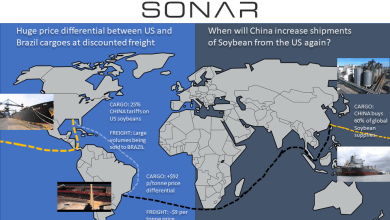
China imposed a 25% import duty on US soybean imports in July and a domestic shortage of beans is now resulting in Chinese traders paying a higher price for Brazilian beans than what domestic crushers are paying, leading to speculation that China could again increase shipments from the US.
A surge in hydro-power, cleaner air in the Capital and a need to further stimulate the economy will see increased demand for seaborne coal supplies to China this winter. That is good news for freight.
Volume falls this week in the freight markets but rejections are flattening indicating there are still some spots where capacity is an issue.
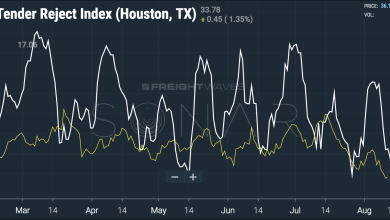
Tender rejection rates for reefer trucks outbound from Houston have oscillated wildly all year. Even compared to other regional markets, shippers and carriers are having a difficult time matching capacity to volume.
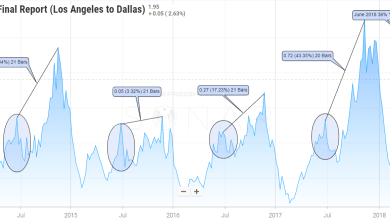
The recent slide in spot rates is typical for this time of year, according to FreightWaves’ CEO, and data indicates another peak before Thanksgiving is possible.
In today’s pickup, CEOs on analysts calls don’t see a peak and see better driver retention for their companies. Also: OPEC output and a change in Chinese scrap policy.
The Chainalytics-Cowen Indices are indicating a slowing freight market in April, but how does that help us in mid-June?
Wages continue to rise for America’s truckers as the trucking industry contends with driver shortages coupled with an increased demand for shipping services.
National van rate slips 1 cent.
While producer price inflation for the overall service sector has remained fairly benign, hovering between 2-2.5%, freight trucking inflation has been accelerating rapidly. After a dismal 2-year period of declining rates within the trucking industry, prices have picked up, with inflation reaching a 6-year high in January.
The spot market, which has been trending up for much of this year and is near record highs, is showing no signs of slowing down, according to DAT.