A second federal court ruling against President Donald Trump’s tariff strategy is creating fresh uncertainty for importers, manufacturers and freight markets, while the administration simultaneously escalates trade pressure on Europe and faces growing calls from automakers to preserve the U.S.-Mexico-Canada Agreement.
On Thursday, the U.S. Court of International Trade struck down a second round of 10% global tariffs imposed by the Trump administration after the U.S. Supreme Court ruled in February that the president lacked authority under the International Emergency Economic Powers Act to enact sweeping worldwide duties.
The split 2-1 ruling found Trump exceeded the tariff authority delegated by Congress under Section 122 of the Trade Act of 1974, which the administration used to replace the broader tariffs invalidated earlier this year. The court described the tariffs as “invalid” and “unauthorized by law,” according to
The latest tariffs were temporary 10% duties applied globally and scheduled to expire July 24. The administration imposed them after the Supreme Court struck down broader double-digit tariffs Trump had placed on nearly every country in 2025.
The ruling directly blocks tariff collection from the plaintiffs in the case — the state of Washington, toy company Basic Fun! and spice importer Burlap & Barrel — although legal experts said additional importers are likely to seek refunds and broader relief.
“This ruling will open the door for more companies to request that the tariffs be thrown out and that any payments they’ve made be refunded,” trade attorney Dave Townsend told the Associated Press.
The legal setback adds another layer of uncertainty for transportation providers and importers already navigating volatile freight demand, shifting sourcing patterns and rising customs compliance costs tied to Trump’s evolving tariff policies.
According to NPR, the administration argued the replacement tariffs were justified under a law permitting tariffs in response to balance-of-payments deficits, but the trade court ruled those conditions did not exist.
The government is already preparing to refund more than $166 billion tied to earlier tariff collections invalidated by the Supreme Court, with initial payments expected to begin next week, NPR reported.
Related: Tariff turmoil: Refunds, lawsuits and new duties ahead
Trump pressures EU for trade deal
At the same time, Trump is intensifying trade pressure on the European Union.
In a Truth Social post late Thursday, Trump said he would give the EU until July 4 to ratify its trade agreement with the United States, warning tariffs would “immediately jump to much higher levels” if the bloc failed to comply.
The comments came shortly after Trump threatened to raise tariffs on cars and trucks imported from Europe to 25%, accusing the EU of failing to uphold terms of a trade agreement negotiated in Scotland last year.
European Commission President Ursula von der Leyen said the EU remained “fully committed” to implementing the deal and that “good progress” was being made toward tariff reductions ahead of the July deadline.
Automakers urge Trump to extend trade deal with Mexico, Canada
Also on Thursday, seven major automotive trade groups, first reported by Reuters, urged the Trump administration to extend the USMCA trade pact with Mexico and Canada, arguing the agreement remains critical to North American manufacturing competitiveness.
The groups, representing automakers, dealers and suppliers including General Motors, Toyota, Volkswagen, Tesla and Hyundai, warned against fragmenting the regional trade framework into separate bilateral agreements.
“Dividing USMCA into distinct trade deals would introduce unnecessary complexity, increase administrative burden, create divergent regulatory regimes, and undermine the very supply chains the agreement was designed to strengthen,” the organizations wrote in a letter to U.S. Trade Representative Jamieson Greer.
The push comes ahead of a July 1 review deadline for the six-year-old trade pact. Mexico and the U.S. are expected to begin formal bilateral negotiations later this month in Mexico City.
Automakers have increasingly warned that Trump’s 25% Section 232 tariffs on imported vehicles and parts are disrupting the highly integrated North American automotive supply chain built over decades under NAFTA and later USMCA.
Trucking market is tightening ahead of peak season
For freight markets, the latest legal and geopolitical trade developments are likely to sustain volatility in cross-border trucking volumes, customs brokerage activity and sourcing decisions across manufacturing sectors ranging from automotive to consumer goods.
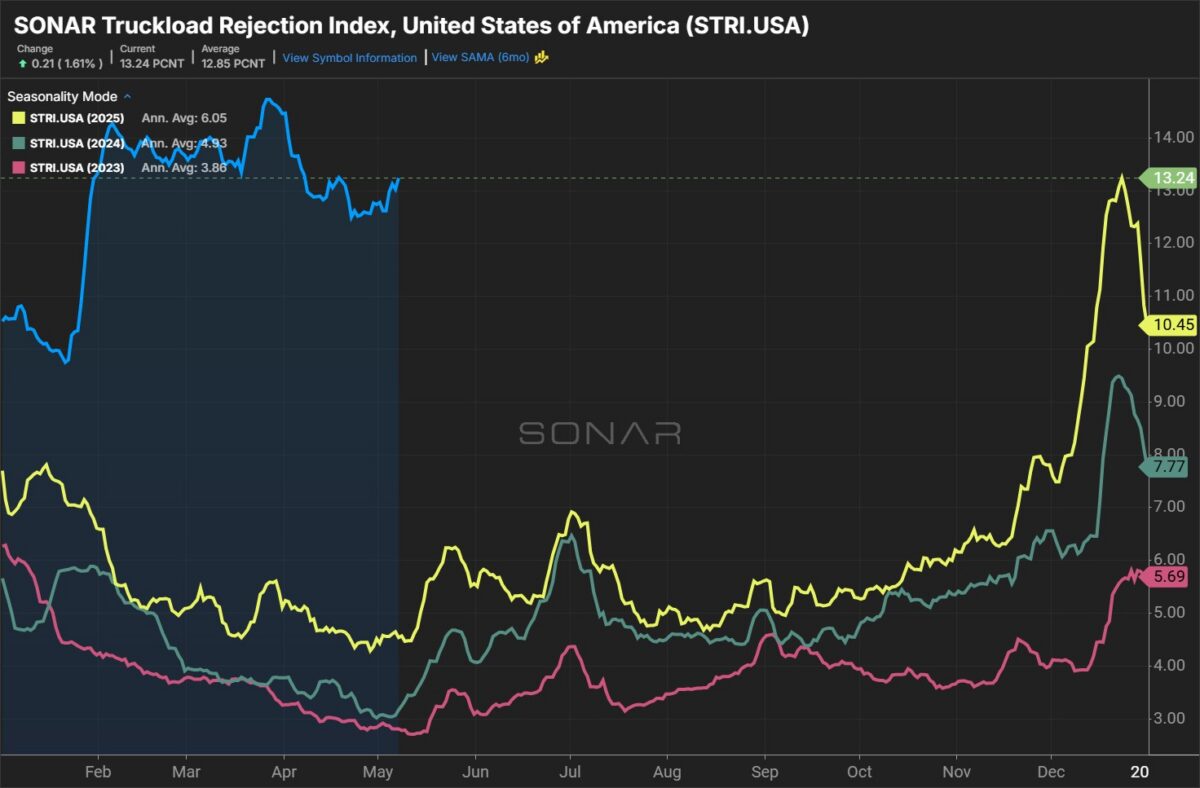
As of Thursday, SONAR’s Truckload Tender Volume Index (STVI.USA), a real-time indicator measuring the percentage of loads carriers turn down from shippers, was at 13.24% and about 13% higher year over year. The data shows significant capacity tightening ahead of the peak season for imports, which typically runs from July through August.
Brokerage Compliance Symposium
The day before F3. Every compliance issue you face - fraud exposure, carrier liability, FMCSA rules, cargo theft, insurance gaps - navigated by attorneys and operators defining best practices in a changing industry.
F3 Awards Dinner
The night before F3. FreightTech100 companies honored. FreightTech 25 and Shipper of Choice winners revealed live. Cocktail reception into dinner and live music - 300 industry leaders in one purpose-built room.
F3: Future of Freight Festival
Industry-defining keynotes, rapid-fire technology demos, and industry leaders networking in experiences across Chattanooga - plus the inaugural F3 Awards Dinner featuring the FreightTech and Shipper of Choice reveals.
The day before F3. Every compliance issue you face - fraud exposure, carrier liability, FMCSA rules, cargo theft, insurance gaps - navigated by attorneys and operators defining best practices in a changing industry.
The Signal at Chattanooga Choo Choo • Chattanooga, TN Register NowThe night before F3. FreightTech100 companies honored. FreightTech 25 and Shipper of Choice winners revealed live. Cocktail reception into dinner and live music - 300 industry leaders in one purpose-built room.
The Signal at Chattanooga Choo Choo • Chattanooga, TN Register NowIndustry-defining keynotes, rapid-fire technology demos, and industry leaders networking in experiences across Chattanooga - plus the inaugural F3 Awards Dinner featuring the FreightTech and Shipper of Choice reveals.
The Signal at Chattanooga Choo Choo • Chattanooga, TN Register Now