




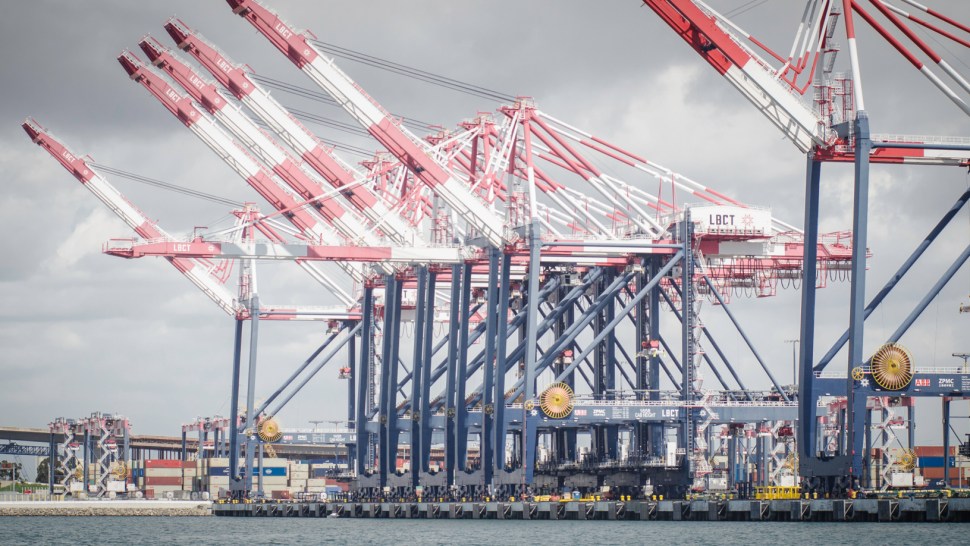
WASHINGTON — New tax incentives proposed by Republican lawmakers aimed at protecting US supply chains from Chinese market power could also boost competition among Gulf Coast ports.
The Port Crane Tax Credit of 2025, introduced recently by U.S. Reps. Mike Ezell, R-Miss., Jen Kiggans, R-Va., and Nicole Malliotakis, R-N.Y., would establish tax credits to incentivize the domestic production of port cranes, “a critical step toward strengthening U.S. supply chain security and revitalizing American manufacturing,” according to the bill’s sponsors.
“I’m deeply concerned that so many of our ports are forced to use cranes manufactured by Shanghai Zhenhua Heavy Industries [ZPMC], a Chinese state-owned company,” Kiggans said in a press statement.
“It makes no sense to let our top adversary build and maintain the very equipment that powers our supply chains. The work our ports do is imperative – we cannot afford to leave that in the hands of the Chinese Communist Party.”
The American Association of Port Authorities (AAPA) sees the incentive as a counter to levying tariffs on Chinese-built cranes to achieve economic and national security policy goals. Last year the Biden administration imposed a 25% tariff on Chinese cranes, and the Trump administration has proposed raising it to 100%.
“Instead of levying unfair taxes on port development, the Port Cranes Tax Credit Act is a tangible first step on the supply side towards incentivizing the reshoring of key [container handling equipment] in the coming years since there are currently no domestic STS [ship-to-shore] crane manufacturers,” said AAPA President and CEO Cary Davis.
Gulf Coast ports have been particularly vocal about the cost increases they face due to existing and potential new tariffs on Chinese-made container cranes.
The Port of Houston, Port Freeport in Texas, and the Port of New Orleans all have invested in the past several years in container cranes built in China, which dominates the U.S. and international container gantry crane markets.
Their rivals in the Eastern part of the Gulf – the ports of Gulfport and Pascagoula in Mississippi, and Port Tampa – see the tax credit as a way to help compete for business as well as incentivizing domestic manufacturing.
The proposed tax credit “is exactly the kind of forward-thinking support Gulf Coast ports like ours need to stay competitive and meet the demands of a modern, American-made supply chain,” said Port Pascagoula Port Director Bo Ethridge.
“As manufacturing continues to return to U.S. shores, our port is experiencing increased demand and new growth opportunities. Yet we remain the only major Gulf Coast port without cargo cranes, which is an infrastructure gap that limits our ability to diversify commodities. This legislation is a vital step toward closing that gap.”
Jon Nass, executive director at the Port of Gulfport, said the legislation “creates a path to bring new skilled jobs to Mississippi and reinforces our ability to compete globally while supporting our maritime and port industries.”
Port Tampa Bay, which installed Chinese-made cranes at its container terminal in 2016 to help compete for larger container ships, supports the tax credit because it “addresses urgent national security concerns,” said Paul Anderson, the port’s president, by incentivizing U.S-made port equipment.
Related articles:
Brokerage Compliance Symposium
The day before F3. Every compliance issue you face - fraud exposure, carrier liability, FMCSA rules, cargo theft, insurance gaps - navigated by attorneys and operators defining best practices in a changing industry.
F3 Awards Dinner
The night before F3. FreightTech100 companies honored. FreightTech 25 and Shipper of Choice winners revealed live. Cocktail reception into dinner and live music - 300 industry leaders in one purpose-built room.
F3: Future of Freight Festival
Industry-defining keynotes, rapid-fire technology demos, and industry leaders networking in experiences across Chattanooga - plus the inaugural F3 Awards Dinner featuring the FreightTech and Shipper of Choice reveals.
The day before F3. Every compliance issue you face - fraud exposure, carrier liability, FMCSA rules, cargo theft, insurance gaps - navigated by attorneys and operators defining best practices in a changing industry.
The Signal at Chattanooga Choo Choo • Chattanooga, TN Register NowThe night before F3. FreightTech100 companies honored. FreightTech 25 and Shipper of Choice winners revealed live. Cocktail reception into dinner and live music - 300 industry leaders in one purpose-built room.
The Signal at Chattanooga Choo Choo • Chattanooga, TN Register NowIndustry-defining keynotes, rapid-fire technology demos, and industry leaders networking in experiences across Chattanooga - plus the inaugural F3 Awards Dinner featuring the FreightTech and Shipper of Choice reveals.
The Signal at Chattanooga Choo Choo • Chattanooga, TN Register Now