




Freight volumes remained under pressure in February but rates continued to step higher, according to monthly data from Cass Information Systems.
Cass’ (NASDAQ: CASS) multimodal shipments index declined 7.2% year over year during the month, but increased 10.4% from January. The index was up 4.3% sequentially on a seasonally adjusted basis. The Monday report said the February increase occurred as the freight market was catching up from prior weather disruptions.
If typical seasonal patterns hold, the index is expected to be down approximately 5% y/y in March. However, the Middle East conflict has driven up energy prices, creating a headwind for domestic freight volumes by potentially reducing consumer spending.
Truckload carriers have signaled an expectation for more pronounced rate increases this year. English-language proficiency requirements, non-domiciled CDL restrictions, a crackdown on ELD providers and forced closures of driver schools are tightening the screws on capacity, providing material catalysts for rate hikes. However, the high-single-digit increases that some carriers were hoping for will be tougher to push through in an inflationary fuel environment.
| February 2026 | y/y | 2-year | m/m | m/m (SA) |
| Shipments | -7.2% | -12.3% | 10.4% | 4.3% |
| Expenditures | 2.1% | -2.5% | 5.1% | 0.3% |
| TL Linehaul Index | 2.2% | 4.1% | 0.2% | NM |
Cass’ expenditures index, which measures total freight spend including fuel, increased 2.1% y/y and was up 5.1% from January (up just 0.3% seasonally adjusted). A two-year-stacked decline of 2.5% was the smallest since July 2023.
Netting the change in volumes from the change in expenditures implies freight rates were likely up by a high-single-digit percentage y/y in February. However, changes in freight mix can alter the data.
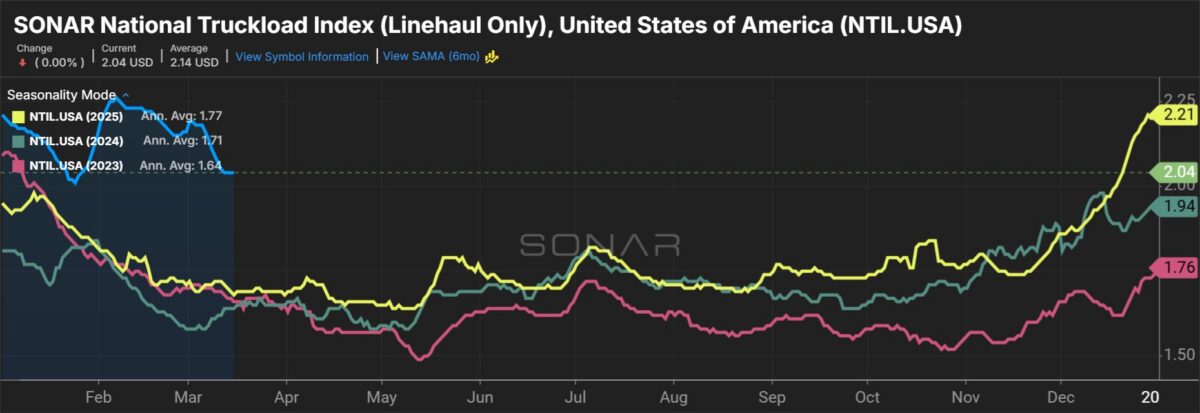
The TL linehaul index, which tracks rates excluding fuel and accessorial surcharges, increased 2.2% y/y and was up 0.2% from January. The latest reading was the highest since April 2023. The dataset, which includes for-hire spot and contract rates, has increased sequentially in each of the past six months.
The report said TL rates are poised to keep climbing as “spot capacity remains tight in early March. … With volumes still soft around the industry, supply constraints are supporting higher rates. These constraints are not just weather, but equipment and increasingly drivers.”
On a two-year-stacked comparison, TL linehaul rates were 4.1% higher, the largest increase since early 2023.
“After 3.5 years of capacity contraction in the for-hire market, rates have begun a supply-driven recovery, even amid soft freight demand.”
The report said company drivers thinking about venturing out on their own given a tightened spot market are now likely to “stay put” as diesel fuel prices are up $1.05 per gallon (28%) in two weeks. Most owner-operators work in the spot market and struggle to recoup fuel price fluctuations through surcharges.
Data used in the indexes comes from freight bills paid by Cass, a provider of payment management solutions. Cass processes $37 billion in freight payables annually on behalf of customers.
Brokerage Compliance Symposium
The day before F3. Every compliance issue you face - fraud exposure, carrier liability, FMCSA rules, cargo theft, insurance gaps - navigated by attorneys and operators defining best practices in a changing industry.
F3 Awards Dinner
The night before F3. FreightTech100 companies honored. FreightTech 25 and Shipper of Choice winners revealed live. Cocktail reception into dinner and live music - 300 industry leaders in one purpose-built room.
F3: Future of Freight Festival
Industry-defining keynotes, rapid-fire technology demos, and industry leaders networking in experiences across Chattanooga - plus the inaugural F3 Awards Dinner featuring the FreightTech and Shipper of Choice reveals.
The day before F3. Every compliance issue you face - fraud exposure, carrier liability, FMCSA rules, cargo theft, insurance gaps - navigated by attorneys and operators defining best practices in a changing industry.
The Signal at Chattanooga Choo Choo • Chattanooga, TN Register NowThe night before F3. FreightTech100 companies honored. FreightTech 25 and Shipper of Choice winners revealed live. Cocktail reception into dinner and live music - 300 industry leaders in one purpose-built room.
The Signal at Chattanooga Choo Choo • Chattanooga, TN Register NowIndustry-defining keynotes, rapid-fire technology demos, and industry leaders networking in experiences across Chattanooga - plus the inaugural F3 Awards Dinner featuring the FreightTech and Shipper of Choice reveals.
The Signal at Chattanooga Choo Choo • Chattanooga, TN Register Now