




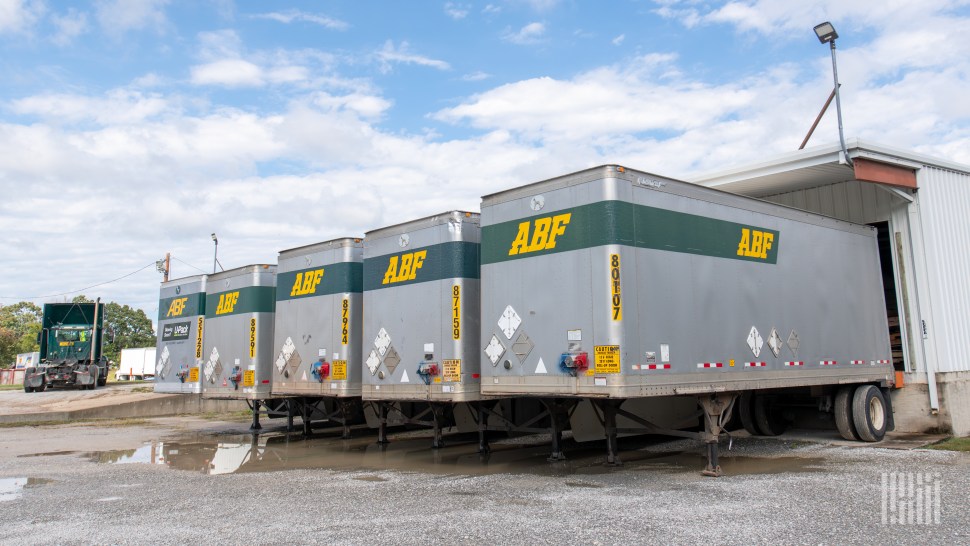
ArcBest reported flattish metrics for February as it awaits a more meaningful turn in less-than-truckload demand. Results at its asset-based segment appeared to decelerate from January, but the prior-year comparison was skewed by a particularly weak January 2025.
The company’s asset-based unit, which includes LTL subsidiary ABF Freight, recorded no year-over-year change to revenue per day for February, according to a filing with the Securities and Exchange Commission. A 2% y/y increase in tonnage (entirely driven by higher weight per shipment) was offset by a 2% decline in revenue per hundredweight, or yield. (Higher shipment weights and lower fuel surcharges were headwinds to the yield calculation.)
ArcBest’s (NASDAQ: ARCB) final results for January came in a little better than previously disclosed. Tonnage was 9.9% higher y/y versus its initial expectation for an 8% increase, which was provided on a quarterly call at the end of January. The notable y/y deceleration in volume growth during February was due to January’s easy prior-year comp (negative-9.2%). On a two-year-stacked comparison, tonnage was up 0.7% in January and flat in February. (Its daily revenue and yield metrics were close to flat on a two-year look as well.)

The company said on the January call it had taken on more dynamically priced truckload shipments—pushing shipment weights higher but dragging yields lower—due to weakness across the manufacturing and housing sectors.
ArcBest previously forecast first-quarter tonnage per day to increase by 4% to 5% y/y, which would be flat to up 1% on a two-year-stacked comparison. Quarter-to-date, tonnage is up 6% y/y.
Manufacturing activity was modestly in expansion territory for a second straight month in February. The Purchasing Managers’ Index registered a 52.4 reading during the recent month, which was 20 basis points lower than January. (A reading above 50 signals expansion while one below 50 indicates contraction.) The dataset has largely been in negative territory for over three years.
The new orders subindex—an indicator of future activity—came in at 55.8. (Inflections in PMI data usually lead LTL volumes by a few months.)
The asset-based unit reported a 3% sequential yield increase in February (revenue per shipment was 2% higher) “due to pricing gains” and a step up in fuel surcharge revenue. Contract pricing renewals averaged 5% in the fourth quarter, the highest increase in six quarters and up 9.5% on a two-year-stacked comparison.
ArcBest reiterated its prior asset-based operating margin guidance for the first quarter. The unit normally sees 260 bps of sequential deterioration, but the company expects to curb the degradation to just 100 to 200 bps this year given cost actions and the lower starting point (“softer-than-normal fourth quarter”). The guide implies a 97.7% adjusted OR at the midpoint, 180 bps worse y/y.
Cost headwinds from expanding the network (800 incremental doors) and adding labor to support higher volumes will abate as throughput ramps. The company is also using training and better technology to improve efficiency and lower expenses.
The asset-light segment, which includes truck brokerage, is now expected to see adjusted operating income “of up to $2 million” in the first quarter versus the prior outlook calling for a loss of up to $1 million. The unit operated at breakeven in the fourth quarter, as AI-enabled automation is helping to remove structural costs.
Asset-light per-day revenue increased 10% sequentially in February as shipments grew 7% and revenue per shipment increased 3%.
“We remain committed to maintaining yield discipline, managing costs, and positioning the segment for sustainable, long-term profitability,” the filing said.
Shares of ARCB were off 2.5% at 11:24 a.m. EDT compared to the S&P 500, which was down 0.5%.
Brokerage Compliance Symposium
The day before F3. Every compliance issue you face - fraud exposure, carrier liability, FMCSA rules, cargo theft, insurance gaps - navigated by attorneys and operators defining best practices in a changing industry.
F3 Awards Dinner
The night before F3. FreightTech100 companies honored. FreightTech 25 and Shipper of Choice winners revealed live. Cocktail reception into dinner and live music - 300 industry leaders in one purpose-built room.
F3: Future of Freight Festival
Industry-defining keynotes, rapid-fire technology demos, and industry leaders networking in experiences across Chattanooga - plus the inaugural F3 Awards Dinner featuring the FreightTech and Shipper of Choice reveals.
The day before F3. Every compliance issue you face - fraud exposure, carrier liability, FMCSA rules, cargo theft, insurance gaps - navigated by attorneys and operators defining best practices in a changing industry.
The Signal at Chattanooga Choo Choo • Chattanooga, TN Register NowThe night before F3. FreightTech100 companies honored. FreightTech 25 and Shipper of Choice winners revealed live. Cocktail reception into dinner and live music - 300 industry leaders in one purpose-built room.
The Signal at Chattanooga Choo Choo • Chattanooga, TN Register NowIndustry-defining keynotes, rapid-fire technology demos, and industry leaders networking in experiences across Chattanooga - plus the inaugural F3 Awards Dinner featuring the FreightTech and Shipper of Choice reveals.
The Signal at Chattanooga Choo Choo • Chattanooga, TN Register Now