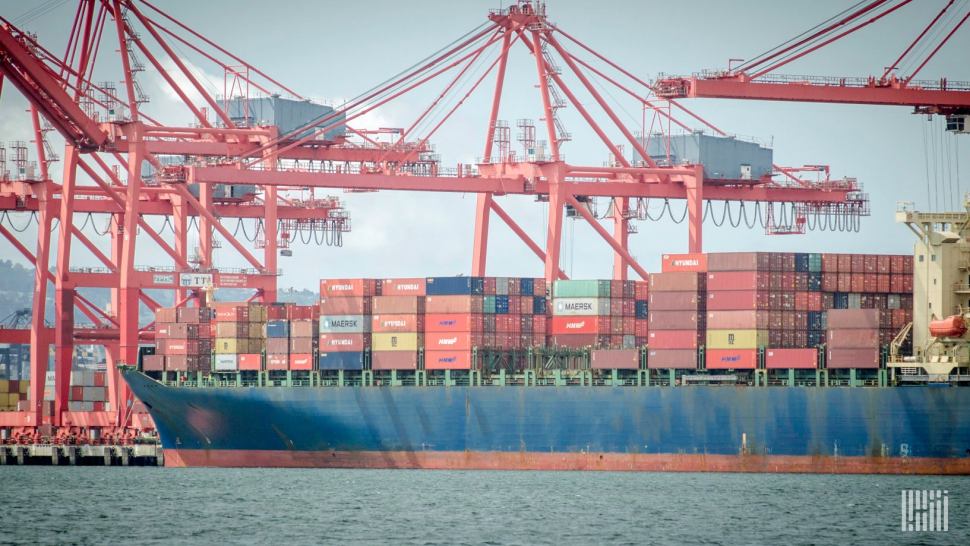
Imports are forecast to remain elevated at major U.S. container ports as shippers try to stay a step ahead of levies on China and other producer countries, according to the Global Port Tracker report released Monday by the National Retail Federation and Hackett Associates.
There’s no end in sight for monthslong frontloading, which has carried through from late last year into 2025.
United States ports covered by Global Port Tracker handled 2.14 million twenty-foot equivalent units in December, absent the Port of New York and New Jersey and the Port of Miami, which have yet to report. Volume was off 0.9% from November but up 14.4% y/y — the busiest December on record.
Container flows for all of 2024 totaled 25.5 million TEUs, up 14.8% y/y and near the record 25.8 million TEUs during the pandemic in 2021.
Frontloading is just one way retailers are trying to cope with the effects of tariffs in the near term, said NRF Vice President for Supply Chain and Customs Policy Jonathan Gold, in a release.
“While we support the need to address the fentanyl crisis at our borders, new tariffs on China and other countries will mean higher prices for American families,” Gold said. “Retailers have engaged in mitigation strategies to minimize the potential impact of tariffs, including frontloading of some products, but that can lead to increased challenges because of added warehousing and related costs. We hope to resolve our outstanding border security issues as quickly as possible because there will be a significant impact on the economy if increased tariffs are maintained and expanded.”
There is also a concern on the part of importers, who continue to bring shipments forward, that China tariffs could increase further.
“There isn’t just one set of tariffs,” Gold told FreightWaves in an interview. “President Trump has also spoken about universal baseline tariffs, more tariffs on China and other countries, as well as reciprocal tariffs. So, there’s a wide variety of tariff discussions, and uncertainty over tariffs, that figure into retailers’ approach to the supply chain.”
Tariffs and the threat of a strike by union longshore workers for months spurred frontloading through December.
The White House on Feb. 1 announced tariffs of 25% on most imports from Canada and Mexico, and 10% on goods from China. The Canadian and Mexican tariffs were suspended on Feb. 3 for 30 days; the China tariffs took effect on Feb. 4.
Since retail merchandise from Mexico and Canada primarily moves by truck or train, the near-term effect on port traffic was seen as minimal.
“At this stage, the situation is fluid, and it’s too early to know if the tariffs will be implemented, removed or further delayed,” said Hackett Associates founder Ben Hackett. “As such, our view of North American imports has not changed significantly for the next six months.”
The International Longshoremen’s Association and port employers represented by the United States Maritime Alliance agreed on a tentative contract days before an extension of the current pact was due to expire Jan. 15. The union expects to send the new contract to a ratification vote by members later this month.
January data has yet to be released, but the Global Port Tracker projected volume of 2.11 million TEUs, a gain of 7.8% y/y. Usually the slowest month of the year, February is forecast at 1.96 million TEUs, up 0.2% y/y despite the shutdown of factories for Lunar New Year.
March is forecast at 2.14 million TEUs, up 11.1%, April at 2.18 million TEUs, up 8.2%, and May at 2.19 million TEUs, up 5.4%. A decline of 0.6% on volume of 2.13 million TEUs is forecast for June.
This article was update Feb. 10 with comments from Jonathan Gold of the NRF, in an interview with FreightWaves.
Find more articles by Stuart Chirls here.
Related coverage:
Hydrogen trucks to get fuel station near busy East Coast container port
ILA sends longshore contract to rank-and-file for approval
Brokerage Compliance Symposium
The day before F3. Every compliance issue you face - fraud exposure, carrier liability, FMCSA rules, cargo theft, insurance gaps - navigated by attorneys and operators defining best practices in a changing industry.
F3 Awards Dinner
The night before F3. FreightTech100 companies honored. FreightTech 25 and Shipper of Choice winners revealed live. Cocktail reception into dinner and live music - 300 industry leaders in one purpose-built room.
F3: Future of Freight Festival
Industry-defining keynotes, rapid-fire technology demos, and industry leaders networking in experiences across Chattanooga - plus the inaugural F3 Awards Dinner featuring the FreightTech and Shipper of Choice reveals.
The day before F3. Every compliance issue you face - fraud exposure, carrier liability, FMCSA rules, cargo theft, insurance gaps - navigated by attorneys and operators defining best practices in a changing industry.
The Signal at Chattanooga Choo Choo • Chattanooga, TN Register NowThe night before F3. FreightTech100 companies honored. FreightTech 25 and Shipper of Choice winners revealed live. Cocktail reception into dinner and live music - 300 industry leaders in one purpose-built room.
The Signal at Chattanooga Choo Choo • Chattanooga, TN Register NowIndustry-defining keynotes, rapid-fire technology demos, and industry leaders networking in experiences across Chattanooga - plus the inaugural F3 Awards Dinner featuring the FreightTech and Shipper of Choice reveals.
The Signal at Chattanooga Choo Choo • Chattanooga, TN Register Now